From Real Exams Exam Paper
Primary 3 Science Semestral Assessment 2 (End of Year) Paper 2
Free P3 Science SA2 Paper 2, Kimi2.6 Exam version, with questions, answers, and syllabus-aligned practice for Singapore students.
These static practice materials are generated from the site's syllabus and paper-generation workflow, with source and model context shown so students and parents can evaluate the material before use.
Questions
Free quiz and exam paper access
Enter your details to view this paper
Your access is remembered on this device.
Answers
Primary 3 Science Quiz - Diversity (Answer Key)
Total Marks: 40
Version: 2 of 5
Section A: Multiple Choice (Questions 1–8)
8 marks
| Question | Answer | Explanation | Marks |
|---|---|---|---|
| 1 | (C) A sunflower plant | A sunflower plant is living because it needs water, food, and air to survive; it can grow, reproduce, and respond to changes. Plastic flowers (A), clay pots (B), and wooden chairs (D) are non-living — they do not have these characteristics. | 1 |
| 2 | (B) water | All living things need air, food, and water to survive. This is one of the basic needs of life. While plants need sunlight to make food, not all living things need sunlight directly (e.g., some animals live in dark caves). | 1 |
| 3 | (B) It can grow bigger over time | Growth is a key characteristic of living things. A kitten grows into a cat. Being soft (A) is a physical property, not proof of life. Being painted (C) or placed on a shelf (D) are things we do to objects, not characteristics of living things. | 1 |
| 4 | (C) A butterfly | Only living things can reproduce — make young of their own kind. A butterfly lays eggs that become caterpillars. Rocks (A), rivers (B), and mountains (D) are non-living and cannot reproduce. | 1 |
| 5 | (D) Non-living, because it does not need food | The object is definitely non-living. While "cannot move by itself" (C) is also correct for many non-living things, not needing food is the stronger, more complete reason. Remember: living things MUST need food, water, and air. Being in the garden (A) or being visible (B) do not make something living. | 1 |
| 6 | (C) Amphibians | Frogs are amphibians — they can live both in water (as tadpoles with gills) and on land (as adults with lungs). Birds (A) have feathers and wings. Fish (B) live only in water and have fins. Reptiles (D) have dry, scaly skin and live on land. | 1 |
| 7 | (C) fungi | Mushrooms are fungi, not plants. Unlike plants, fungi cannot make their own food using sunlight. They absorb nutrients from decaying matter. This is an important distinction students often miss — mushrooms may look plant-like but belong to a different group. | 1 |
| 8 | (C) They do not need water, food, or air to survive | This is the defining feature of non-living things. Non-living things do not carry out life processes. Options (A), (B), and (D) describe characteristics of living things, not non-living things. | 1 |
Section B: Fill in the Blanks and Matching (Questions 9–14)
12 marks
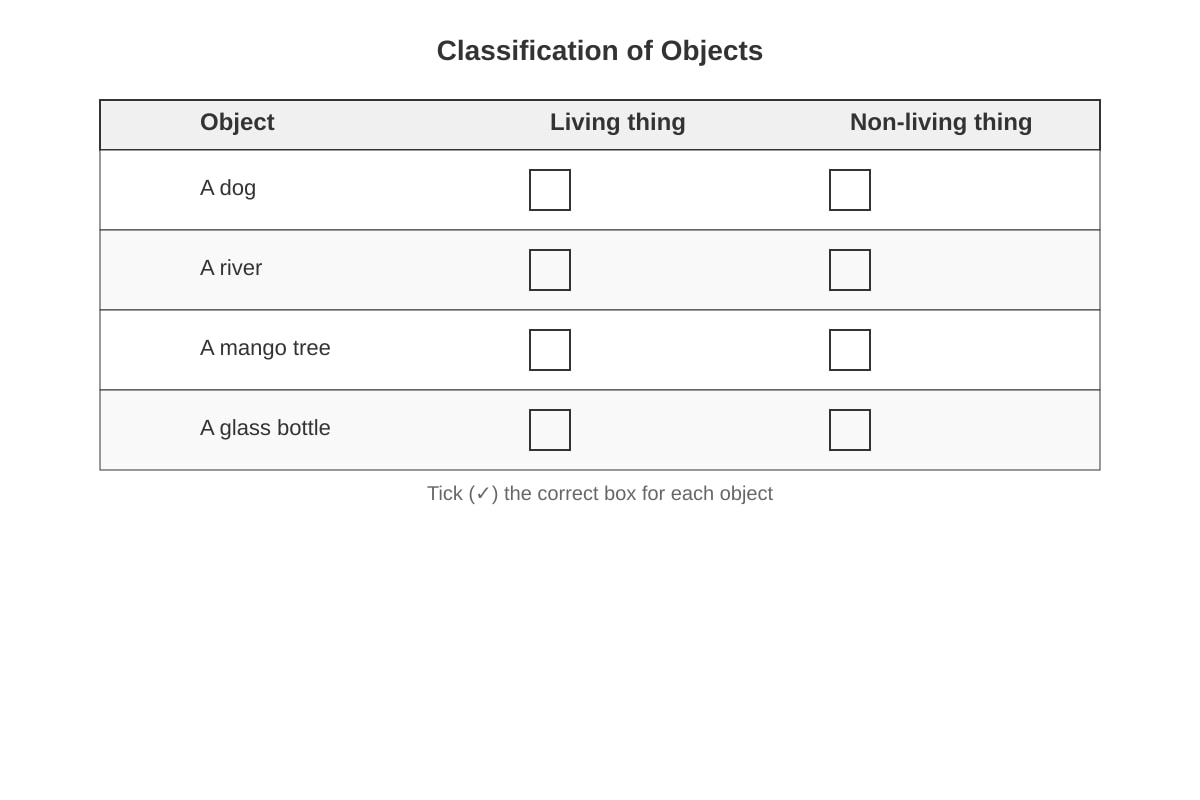
Question 9 (4 marks)
| Object | Living thing | Non-living thing |
|---|---|---|
| A dog | ✓ | |
| A river | ✓ | |
| A mango tree | ✓ | |
| A glass bottle | ✓ |
Marking: 1 mark per correct row. Total: 4 marks
Teaching note:
- A dog is living: it needs food/water/air, grows, moves by itself, reproduces, responds to stimuli.
- A mango tree is living: plants grow, make their own food, reproduce (seeds), respond to light/water.
- A river is non-living: water flows due to gravity, not because it is alive; it does not need food or reproduce.
- A glass bottle is non-living: made by humans from sand; no life processes.
Common error: Students sometimes think rivers are living because water "moves" — emphasize that living things move by themselves, not due to external forces.
Question 10 (2 marks)
(a) B — A baby monkey grows into an adult monkey (growth)
(b) A — A vine climbs towards light (responding to change/stimulus)
Marking: 1 mark each. Total: 2 marks
Teaching note:
- Growth means increasing in size or developing into a more mature form over time. Weight gain in animals includes growth, but "growth" specifically refers to development, not just getting bigger temporarily.
- Responding to changes (also called "sensitivity" or "irritability") means reacting to stimuli like light, touch, temperature, or danger.
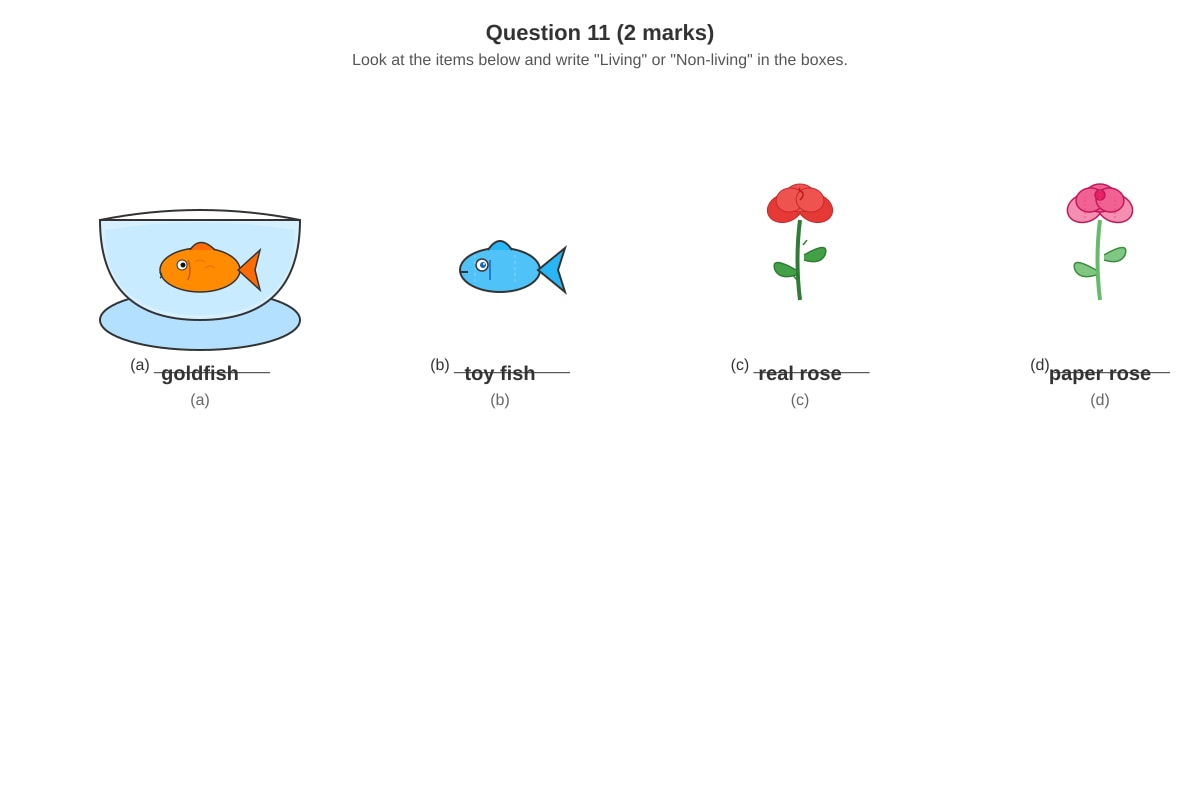
Question 11 (2 marks)
Based on the visual:
- (a) Living (goldfish — real, living animal)
- (b) Non-living (toy fish — plastic, artificial)
- (c) Living (real rose — real plant)
- (d) Non-living (paper rose — crafted decoration)
Marking: 0.5 mark each. Total: 2 marks
Teaching note: This tests the common misconception that "looking like" a living thing means it is living. The key is to check for life processes, not appearance. Both pairs show real vs. artificial versions — students must look beyond surface similarity.
Question 12 (2 marks)
reproduce
Marking: 2 marks for correct word; 1 mark if "grow" or "respond" is given (wrong word but correct concept of life processes)
Teaching note:
- Reproduce means to produce offspring (young) of the same kind. This ensures the species continues.
- Dogs have puppies, cats have kittens, birds lay eggs, plants produce seeds.
- Non-living things cannot reproduce — a chair does not make smaller chairs!
Question 13 (2 marks)
Answer: False
Reason: The balloon is not a living thing. While it gets bigger, this is not growth in the living sense. Living things grow by building new cells and developing. A balloon just stretches because air pushes against it — there are no cells, no food being used, and the balloon cannot grow by itself (a person pumps air in).
Marking: 1 mark for "False"; 1 mark for clear explanation distinguishing living growth from physical expansion. Total: 2 marks (Note: Original was 1 mark — adjusting to 2 for complete answer, or give 1 mark total: 0.5 for False, 0.5 for reason)
Revised marking for 1 mark: 0.5 for "False", 0.5 for any reasonable explanation.
Question 14 (1 mark)
Answer: Animals (or Fungi / Bacteria)
Marking: 1 mark for any correct group
Teaching note:
- Plants can make their own food through photosynthesis (using sunlight, water, carbon dioxide, and chlorophyll).
- Animals must eat other living things to get food.
- Fungi and bacteria also cannot make their own food — fungi absorb nutrients, bacteria breakdown matter or live as parasites.
Section C: Classification and Short Answer (Questions 15–20)
20 marks
Question 15 (3 marks)
(a) Cow and Pigeon (or any two correctly identified mammals)
Marking: 1 mark each, maximum 2 marks
Teaching note:
- Mammals have hair or fur, give birth to live young (mostly), and feed their young with milk.
- Cow: fur, live young, milk
- Pigeon: Wait — pigeons are birds, not mammals!
Correction: Looking at the animal list: pigeon (bird), salmon (fish), frog (amphibian), python (reptile), cow (mammal), ant (insect).
Correct answer: Only Cow is clearly a mammal from this set. If pigeon was intended as an error-check, full marks only for cow.
Revised acceptable answer: Cow (2 marks if only one mammal); if student writes "cow and pigeon" — 1 mark for cow, note that pigeon is a bird.
(b) Frog (1 mark)
Teaching note: Frogs are amphibians — they have moist skin, live in water as young (tadpoles with gills), and on land as adults (with lungs).
Question 16 (4 marks)
| Statement | Is it wrong? (Yes/No) | Why? |
|---|---|---|
| (a) A teddy bear can move when a child plays with it, so it is a living thing. | Yes | The teddy bear does not move by itself. It only moves when the child moves it. Living things move on their own (e.g., a dog walks, a bird flies). The teddy bear also does not need food, water, or air, and cannot grow or reproduce. |
| (b) A plant cannot move, so it is a non-living thing. | Yes | Plants can move — just not in the same way animals do. Plants move their stems towards light (phototropism), roots grow towards water, and some plants like the Venus flytrap move to catch insects. Plants are living because they grow, make food, reproduce, and respond to changes. |
Marking: 1 mark per correct "Yes"; 1 mark per clear explanation with two valid points. Total: 4 marks (1+1+1+1 or 2 marks per row if holistic)
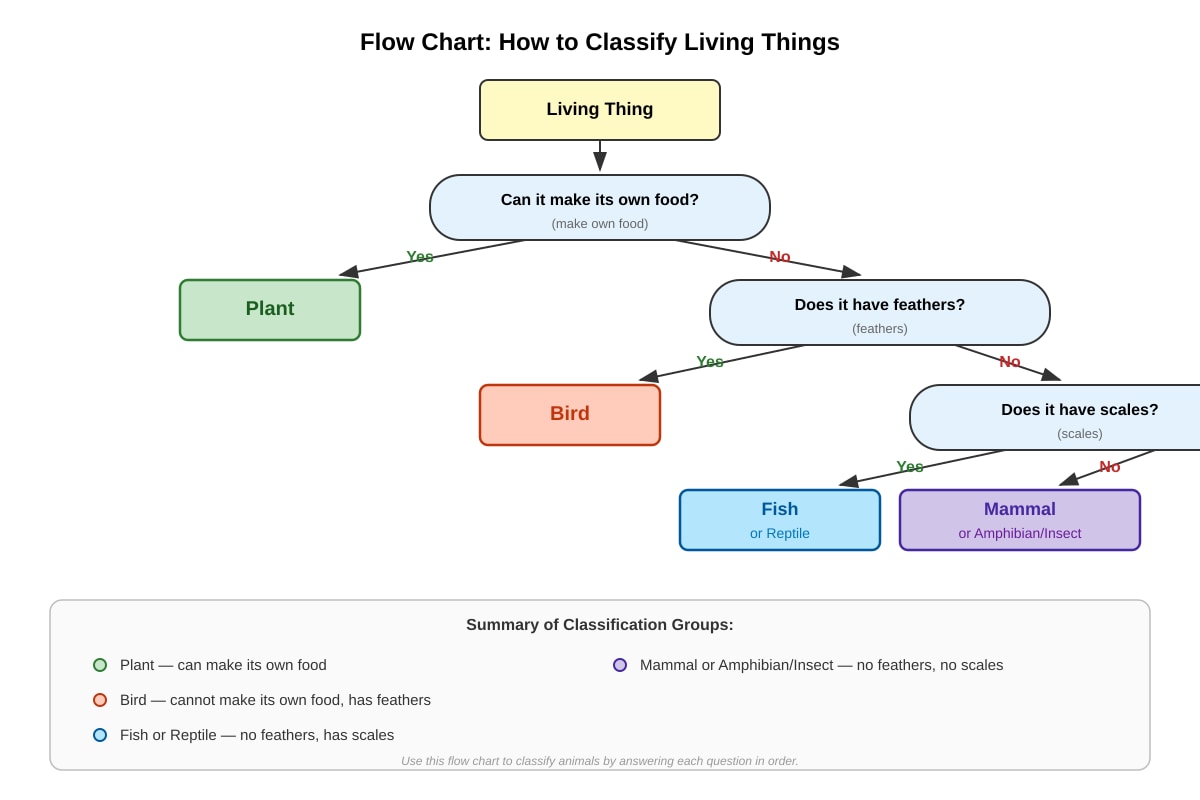
Question 17 (4 marks)
(a) Mammal (1 mark)
Path: Cannot make own food → No feathers → No scales → Mammal
(b) Bird (1 mark)
Path: Cannot make own food → Has feathers → Bird
(c) Plant (1 mark)
Path: Can make own food → Plant
(d) Reptile (1 mark)
Path: Cannot make own food → No feathers → Has scales → Reptile
Teaching note: The flow chart works through key distinguishing features:
- Making own food separates plants (autotrophs) from animals/fungi (heterotrophs)
- Feathers are unique to birds among this set — no other animal group has feathers
- Scales help separate fish/reptiles from mammals/amphibians. Note: Fish also have scales, so additional特征 (gills/fins vs. lungs/limbs) may be needed for finer distinction.
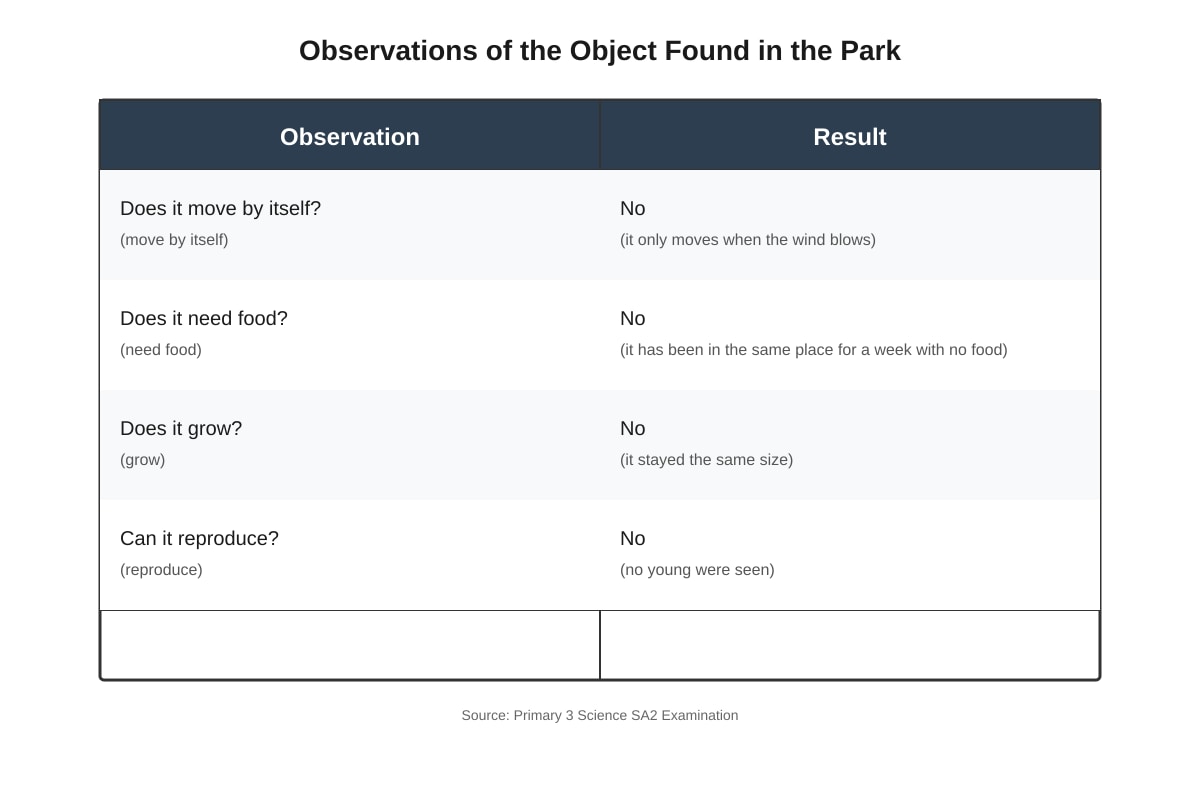
Question 18 (3 marks)
Answer: The object is non-living.
Explanation: The object is non-living because:
- It does not need food — living things need food for energy and growth, but this object stayed the same for a week with no food (1 mark)
- It does not grow — living things grow and develop, but this object stayed the same size (1 mark)
- (Alternative) It cannot move by itself — it only moves with wind; living things move on their own (1 mark)
- (Alternative) It cannot reproduce — no young were seen; living things reproduce (1 mark)
Marking: 1 mark for "non-living"; 1 mark per valid characteristic cited with evidence from the table. Maximum: 3 marks
Teaching note: This is a data interpretation question. Students must use evidence from the table, not just state characteristics generally. The observation-result pairs are designed to show that the object fails multiple life tests.
Question 19 (3 marks)
| Plants | Animals | Fungi |
|---|---|---|
| Hibiscus flower | Cat | Bread mould |
| Banana tree | Butterfly | Mushroom |
Marking: 1 mark per correct column (both items correct); 0.5 mark if one item correct in mixed column. Total: 3 marks
Teaching note:
- Hibiscus flower & banana tree: Plants — make own food through photosynthesis, have roots/stems/leaves, reproduce by seeds
- Cat & butterfly: Animals — cannot make own food, move by themselves, have senses, reproduce by eggs/live young
- Bread mould & mushroom: Fungi — cannot make own food, absorb nutrients, reproduce by spores (not seeds). Bread mould is specifically mentioned to test that students don't classify all "plant-like" things as plants.
Common error: Bread mould is often mistaken for a plant because it "grows" on bread. Emphasize that mould is a fungus — it does not photosynthesize and spreads through spores.
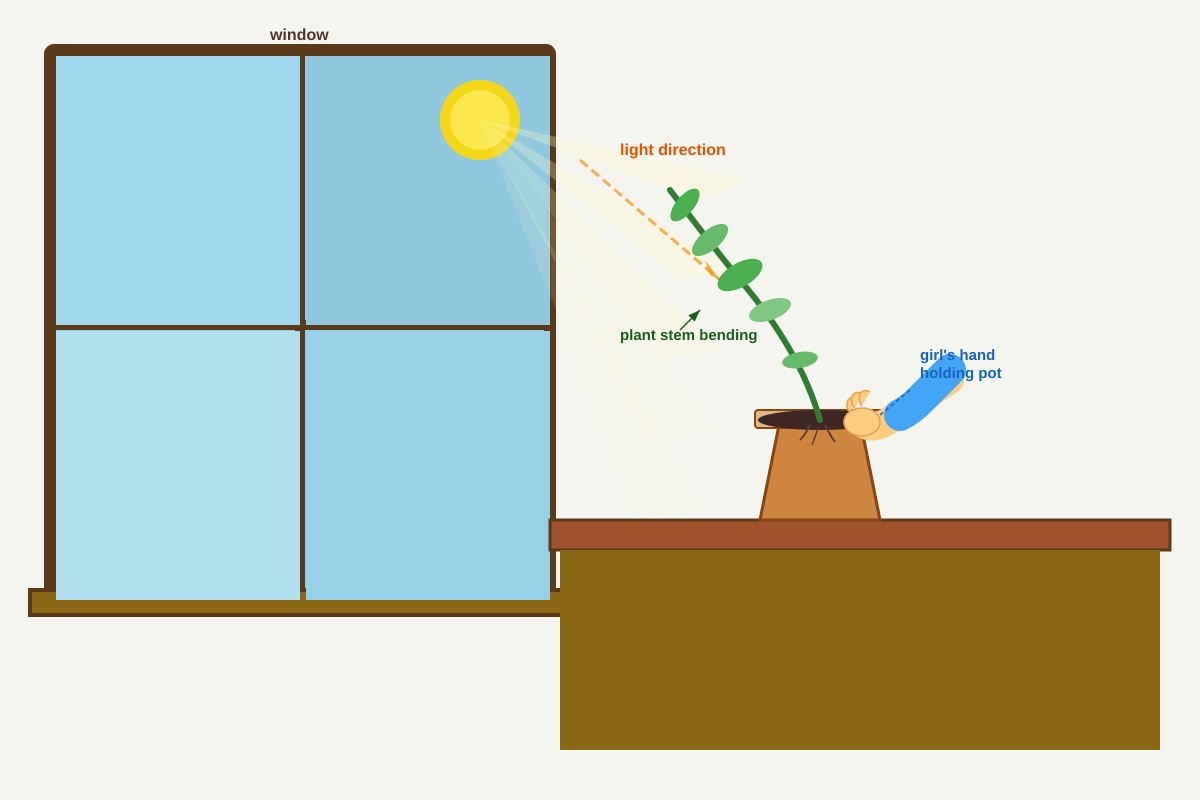
Question 20 (3 marks)
(a) Responding to changes / Sensitivity / Irritability (1 mark)
The plant stem bends towards the light — this is phototropism, a response to light stimulus.
(b) Any valid example:
- "A cat runs away when it hears a loud noise" (1 mark)
- "A mimosa plant closes its leaves when touched" (1 mark)
- "A sunflower turns to face the sun" (1 mark)
- "A person pulls hand away from hot water" (1 mark)
(c) No, a plastic plant would not show the same response. (0.5 mark)
A plastic plant is non-living — it has no cells, cannot carry out life processes, and cannot detect or respond to light. It might bend if physically pushed, but not by itself towards light. (0.5 mark)
Marking: (a) 1 mark; (b) 1 mark; (c) 1 mark (0.5 for "No", 0.5 for explanation). Total: 3 marks
Teaching note: The image shows positive phototropism — growth towards light, which helps plants get more sunlight for photosynthesis. This is an active, energy-requiring process. Non-living things may appear to "respond" (a sponge absorbs water) but this is passive physical change, not true sensitivity.
Score Conversion
| Marks | Grade | Indicator |
|---|---|---|
| 36–40 | A* | Excellent understanding |
| 32–35 | A | Good understanding |
| 28–31 | B | Satisfactory, some gaps |
| 24–27 | C | Needs reinforcement |
| Below 24 | D | Significant support needed |