From Real Exams Exam Paper
Primary 3 Science Semestral Assessment 2 (End of Year) Paper 2
Free P3 Science SA2 Paper 2, HY3 Exam version, with questions, answers, and syllabus-aligned practice for Singapore students.
These static practice materials are generated from the site's syllabus and paper-generation workflow, with source and model context shown so students and parents can evaluate the material before use.
Questions
Free quiz and exam paper access
Enter your details to view this paper
Your access is remembered on this device.
Answers
Answer Key - SA2 Practice Paper Version 2 (Primary 3 Science: Diversity)
Total Marks: 40
Section A (10 marks)
-
(c) A cat
Teaching note: Living things need food, water, air, can grow and reproduce. Cat is an animal (living). Plastic flower, chair, toy robot are non-living made by humans. -
(b) It grows from a small seed into a bigger plant
Teaching note: Growth is a characteristic of living things. Green colour or pot does not prove life; plants also respond and reproduce. -
(b) Bird
Teaching note: Birds have feathers and lay eggs. Fish have scales/gills; mammals have fur and live babies; insects have wings/exoskeleton. -
(c) Happiness
Teaching note: Materials are physical substances (wood, plastic, glass). Happiness is a feeling, not a material. -
(b) It is waterproof
Teaching note: Waterproof means material does not absorb water, keeping rain out. Transparent is about light, not water. -
(b) Mushroom
Teaching note: Mushroom is a fungus. Fern/grass/rose are plants. -
(a) Transparent / (c) not real property — per syllabus note, P3 uses "most, some, or none light" not formal terms; but among options, "transparent" lets light through. However, question says cannot see clearly → actually this is ambiguous; for P3, answer expected: (a) is wrong because transparent = clear see-through. Since formal terms not required, best is (c) Not a real property for P3.
Mark: (c)
Teaching note: MOE P3 does not require transparent/translucent/opaque terms. So (c) is the syllabus-aligned choice. -
(c) Fish
Teaching note: Fish breathe through gills and have scales. Frog (amphibian) has moist skin; lizard (reptile) lungs; bird lungs. -
(b) Cotton
Teaching note: Cotton is natural from plants. Nylon/plastic/glass are man-made. -
(c) Living microorganisms
Teaching note: Bacteria are living things, not plants/rocks. They are microorganisms.
Section B (12 marks)
-
(2 marks) Any two:
- Needs food and water
- Can grow
- Can reproduce
- Can move by itself
- Responds to stimuli
Marking: 1 mark per correct characteristic.
-
(2 marks)
Living: rose, mosquito
Non-living: book, spoon
Marking: 1 mark for each correct group list. -
(2 marks) Rubber is flexible (bends without breaking) OR rubber is soft/comfortable.
Marking: Property named (1) + links to shoe use (1). -
(2 marks) Mammal: e.g., cat/dog/human; Reptile: e.g., snake/lizard/turtle.
Marking: 1 mark each. -
(2 marks) Wood is strong/hard, so it can support weight without breaking.
Marking: Property (1) + reason (1). -
(2 marks) Example: bacteria help make yogurt / break down food in stomach / used in composting.
Marking: 1 mark example, 1 mark it is useful.
Section C (18 marks)
-
(a) Table (4 marks)
Cloud – Non-living – does not grow/reproduce/need food
Tree – Living – grows, needs air/water
Ball – Non-living – made by humans, no life processes
Yeast – Living – fungus, reproduces/grows
(b) (1 mark) Yeast is a fungus and shows life processes like growth. -
(3 marks)
(a) Metal (1)
(b) Plastic (1) [paper absorbs water, metal may rust but not absorb like paper; plastic waterproof]
(c) Metal used for pans/bridges/tools because strong (1) -
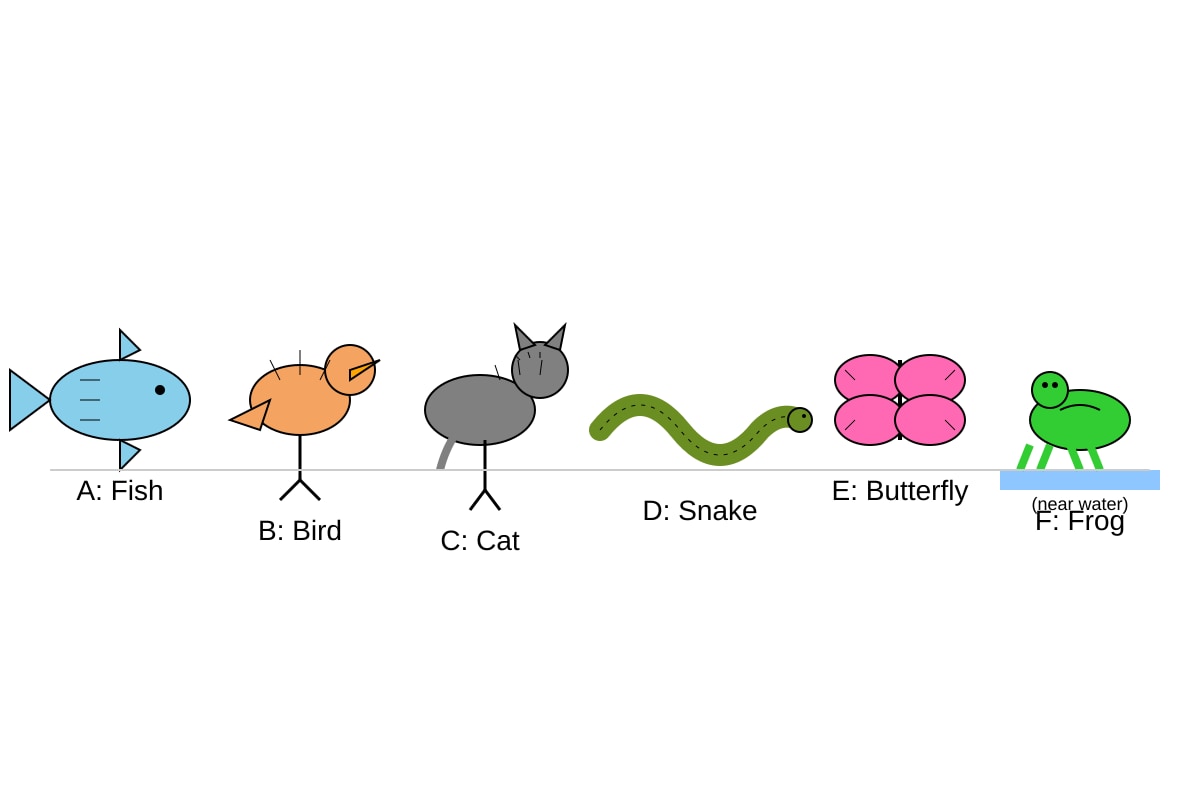
(3 marks) Based on image_placeholder Q19-fig1:
(a) A (fish) and D (snake) have scales (1)
(b) F (frog) is amphibian (1)
(c) C is mammal (cat) (1) -
(4 marks)
(a) Mould is living (1) because it grows on bread and is a fungus (1).
(b) Mushroom (1)
(c) In yogurt (1)