From Real Exams Exam Paper
Primary 3 Science Semestral Assessment 2 (End of Year) Paper 1
Free P3 Science SA2 Paper 1, Kimi2.6 Exam version, with questions, answers, and syllabus-aligned practice for Singapore students.
These static practice materials are generated from the site's syllabus and paper-generation workflow, with source and model context shown so students and parents can evaluate the material before use.
Questions
Free quiz and exam paper access
Enter your details to view this paper
Your access is remembered on this device.
Answers
TuitionGoWhere Exam Practice (AI) - SA2 Science Primary 3: Answer Key
Subject: Science
Level: Primary 3
Paper: SA2 Practice Paper
Version: 1 of 5
Total Marks: 40
Section A: Multiple Choice (Questions 1-8)
10 marks
1. Answer: C (A potted orchid plant) — 1 mark
Explanation: A potted orchid plant is a living thing because it can grow, make its own food through photosynthesis, needs water and air, and can reproduce. A plastic flower (A), wooden chair (B), and glass marble (D) are all non-living things because they cannot grow, do not need food or water, and cannot reproduce.
Common mistake: Some students think plastic flowers are living because they look like real flowers. Always check the actual characteristics, not appearance.
2. Answer: B (They need food, water and air to survive) — 1 mark
Explanation: All living things need food (for energy), water ( for body processes), and air (to breathe) to survive. Not all living things can fly (A) - only some birds and insects can. Not all can speak (C) - only humans can. Not all are green (D) - only plants with chlorophyll are green.
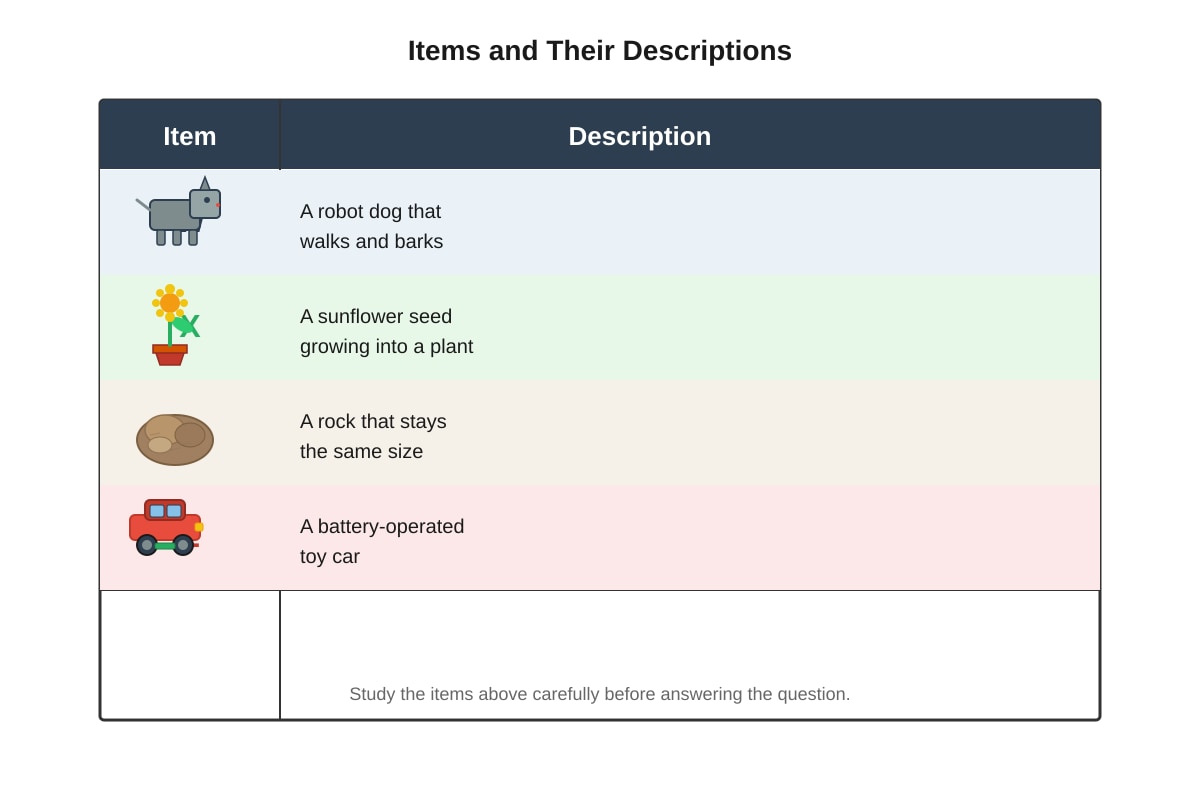
3. Answer: B (Item X) — 1 mark
Explanation: Expected visual features: The image shows Item W (robot dog that walks and barks - non-living, battery-operated), Item X (sunflower seed growing into a plant - living, shows growth), Item Y (rock that stays the same size - non-living, no growth), Item Z (battery-operated toy car - non-living).
Item X is correct because a sunflower seed growing into a plant shows true growth - a characteristic of living things. The robot dog (W) and toy car (Z) only move because of batteries. The rock (Y) does not grow.
Common mistake: Students may choose W because it "walks and barks" like a real dog. But it is battery-operated and cannot grow or reproduce.
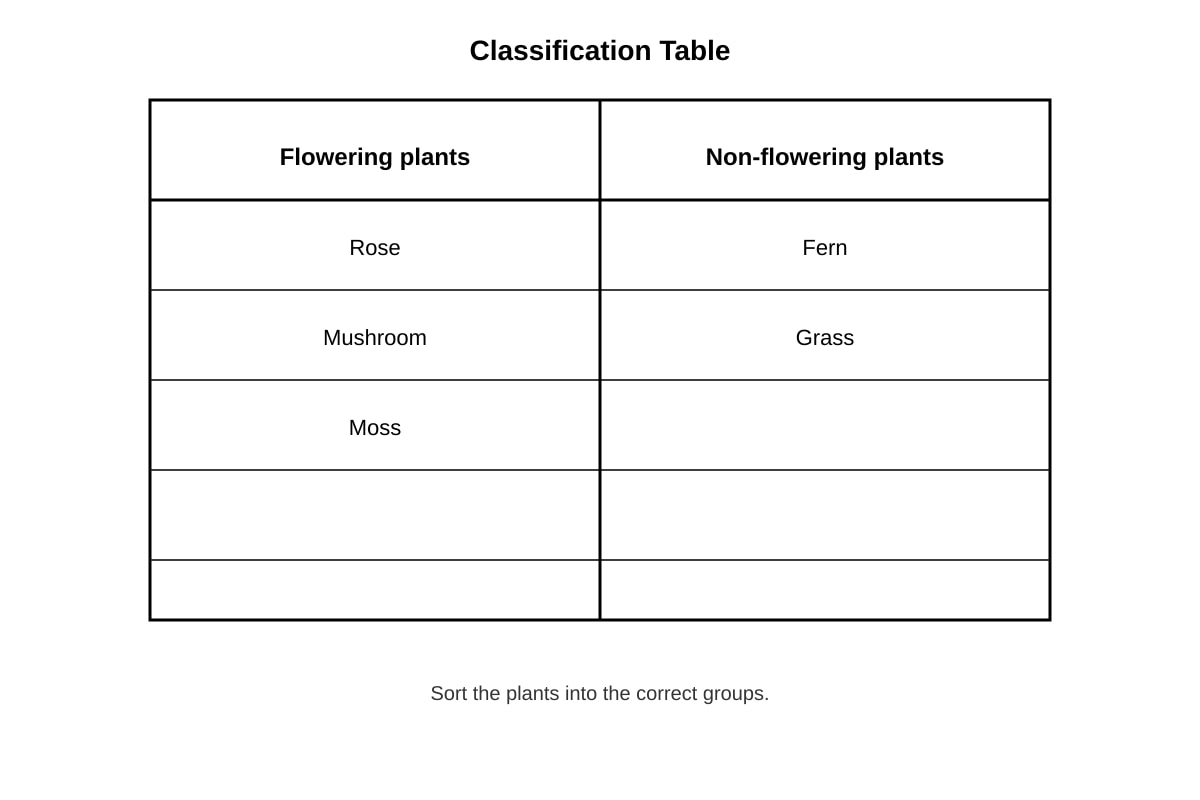
4. Answer: C (Mushroom in "Non-flowering plants") — 2 marks
Explanation: Expected visual features: The table shows five items (Rose, Fern, Mushroom, Grass, Moss) to be sorted into "Flowering plants" and "Non-flowering plants."
- Rose — correctly placed in Flowering plants (produces flowers)
- Fern — correctly placed in Non-flowering plants (reproduces by spores, no flowers)
- Mushroom — WRONGLY placed in Non-flowering plants (1 mark for identification)
- Grass — correctly placed in Flowering plants (has tiny flowers)
- Moss — correctly placed in Non-flowering plants (reproduces by spores)
Why C is wrong: Mushrooms are NOT plants at all — they are fungi (1 mark for explanation). Fungi are a separate group of living things that cannot make their own food and do not have roots, stems, or leaves like plants do.
5. Answer: B (Whale, dolphin, bat) — 1 mark
Explanation: Whales, dolphins, and bats are all mammals because they have hair/fur (at some life stage), give birth to live young, and feed their babies with milk.
- A (Frog, lizard, snake): Frog is an amphibian; lizard and snake are reptiles
- C (Penguin, eagle, ostrich): All are birds — they have feathers and lay eggs
- D (Butterfly, ant, beetle): All are insects — they have six legs and an exoskeleton
6. Answer: B (Statement 2 only) — 2 marks
Explanation:
- Statement 1 is FALSE (1 mark): Not all things that move are living. Cars, robots, and wind can move but are non-living. Living things move by themselves, but non-living things can also move when pushed or powered.
- Statement 2 is TRUE (1 mark): Reproduction (producing young of their own kind) is a key characteristic of all living things. This ensures survival of the species.
7. Answer: C (A frog that lives on land and in water) — 1 mark
Explanation: Amphibians are animals that can live both on land and in water. They have moist skin and typically start life in water (as tadpoles with gills) then develop lungs to live on land.
- A (Sparrow): Bird — has feathers, wings, lays eggs
- B (Salmon): Fish — lives entirely in water, has fins and scales
- D (Crocodile): Reptile — has scales, lays eggs on land, lives in water but not an amphibian
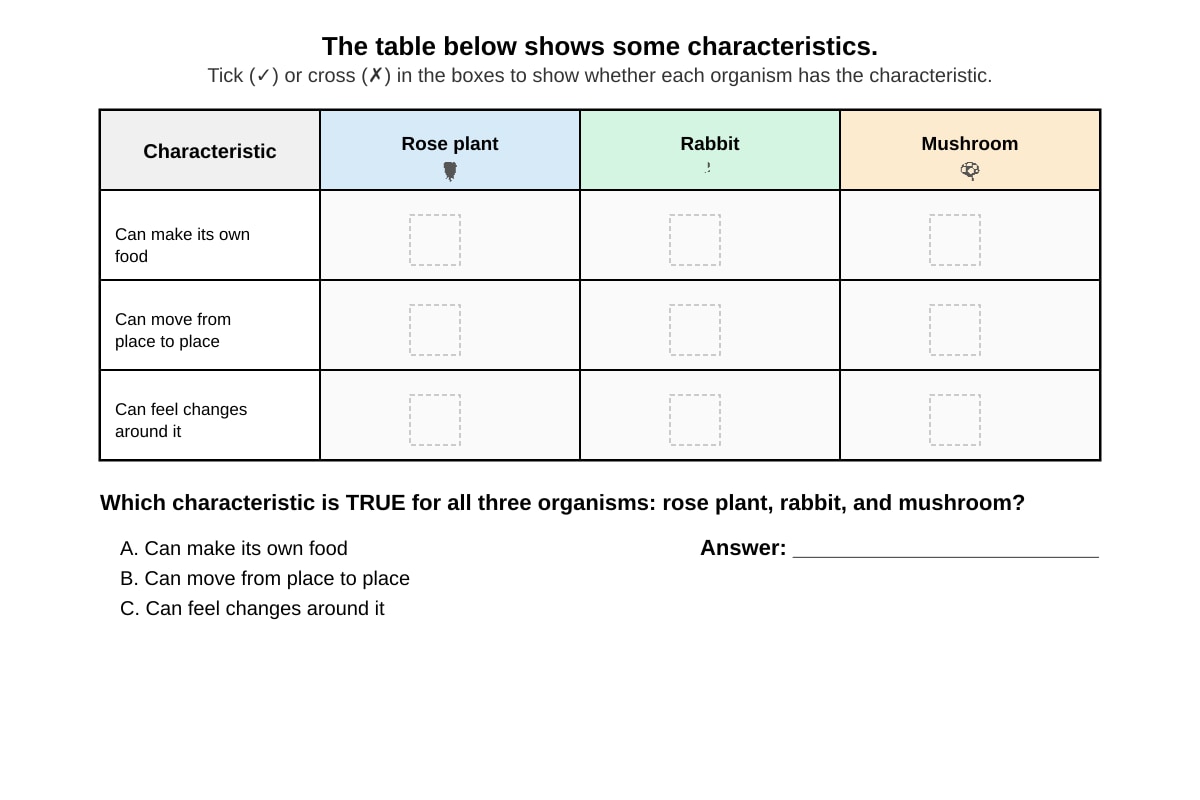
8. Answer: C (Can feel changes around it) — 1 mark
Explanation: Expected visual features: The table shows three characteristics (Can make its own food, Can move from place to place, Can feel changes around it) and three organisms (Rose plant, Rabbit, Mushroom).
| Rose plant | Rabbit | Mushroom | |
|---|---|---|---|
| Can make its own food | ✓ | ✗ | ✗ |
| Can move from place to place | ✗ | ✓ | ✗ |
| Can feel changes around it | ✓ | ✓ | ✓ |
- Plants can make food (photosynthesis) but cannot move from place to place
- Rabbits can move but cannot make food
- Mushrooms (fungi) cannot make food OR move — they absorb nutrients
- ALL three can respond to changes: plants grow toward light, rabbits run from danger, mushrooms release spores when conditions are right
Section B: Matching and Classification (Questions 9-14)
12 marks
9. Answers: — 4 marks (1 mark each)
| Correct Answer | |
|---|---|
| (b) Penguin — | Bird |
| (c) Salmon — | Fish |
| (d) Bat — | Mammal |
Explanation:
- Penguin = Bird: It has feathers, wings (modified for swimming), lays eggs, and is warm-blooded — even though it cannot fly
- Salmon = Fish: It lives in water, has fins and scales, breathes through gills
- Bat = Mammal: It has fur, gives birth to live young, feeds babies with milk — even though it flies, it is NOT a bird (birds have feathers and lay eggs)
Key concept: Classification is based on internal features and reproduction, not just appearance or ability. Bats fly but are mammals; penguins swim but are birds.
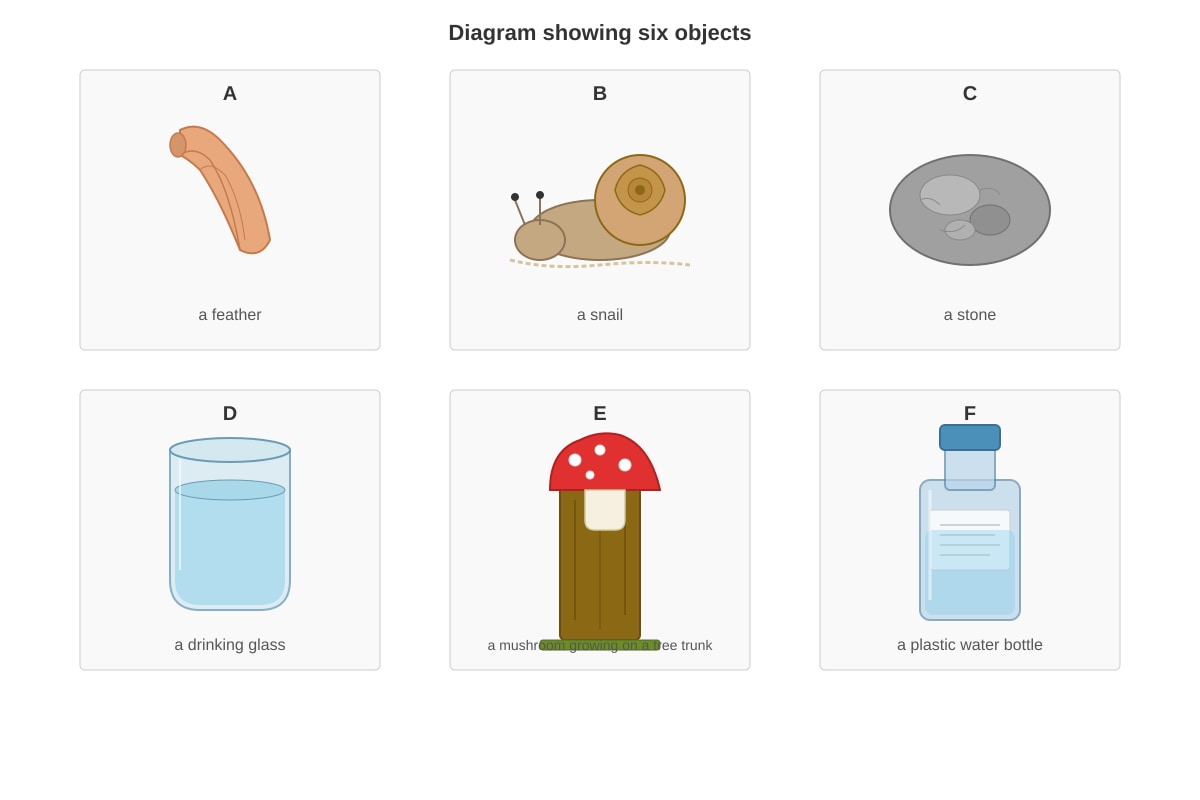
10. Answer: B, E (or B and E) — 2 marks
Explanation: Expected visual features: The image shows six labeled items: A (feather - non-living, part of a bird), B (snail - living), C (stone - non-living), D (drinking glass - non-living), E (mushroom growing on tree trunk - living), F (plastic water bottle - non-living).
Living things:
- B (Snail): Can move, feed, grow, and reproduce
- E (Mushroom): A fungus that is growing on the tree trunk; it feeds on decaying matter and can reproduce by spores
Non-living things:
- A (Feather): Once part of a living bird, now dead and no longer growing
- C, D, F: Never alive; no life processes
Marking: Both letters correct = 2 marks; one correct = 1 mark
11. Answer: — 3 marks
| Can grow | Can move by itself | Needs water to survive | |
|---|---|---|---|
| Sunflower | ✓ | ✗ | ✓ |
| Human | ✓ | ✓ | ✓ |
Marking: Each correct row = 1.5 marks; deduct 0.5 for each incorrect cell
Explanation:
- Sunflower (plant): Can grow (gets taller, more leaves); cannot move from place to place (stays rooted in ground); needs water for photosynthesis and transport
- Human (animal): Can grow (gets taller, heavier); can move by itself (walks, runs); needs water for all body processes
Key concept: "Move by itself" means self-directed movement from place to place. Plants can move parts (leaves turning to light, stems growing upward) but cannot walk or swim like animals.
12. Answers: — 3 marks
| Group | Animal |
|---|---|
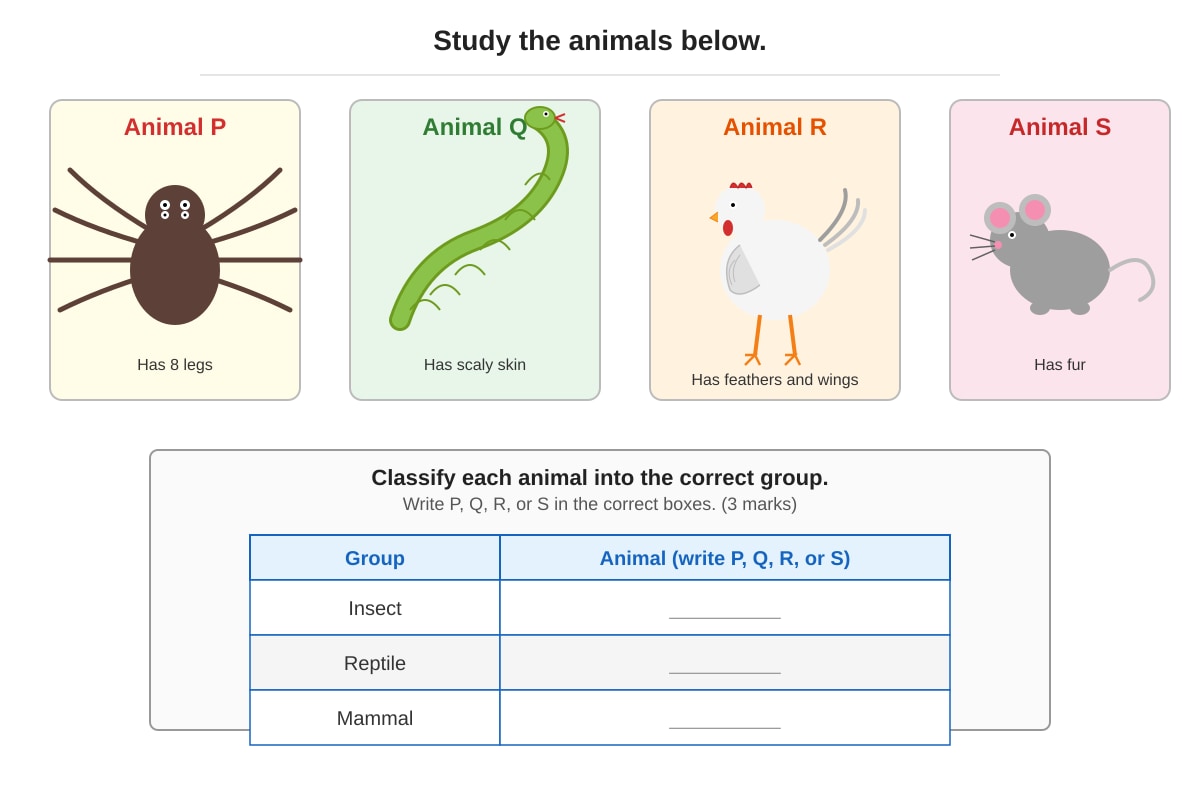
| Insect | P |
| Reptile | Q |
| Mammal | S |
Marking: 1 mark each
Explanation: Expected visual features: The image shows Animal P (spider with eight legs), Animal Q (snake with scaly skin), Animal R (chicken with feathers and wings), Animal S (mouse with fur).
Wait — Correction for answer key: Spider (P) is NOT an insect! Spiders have 8 legs, insects have 6 legs. Let me re-verify:
- Animal P (Spider): 8 legs → NOT an insect — it is an arachnid (though this classification is beyond P3, the key feature is 8 vs 6 legs)
- Animal R (Chicken): Bird — has feathers and wings
Revised correct answers based on P3 syllabus expectations:
| Group | Animal | Why |
|---|---|---|
| Insect | None / R is not an insect | Actually, re-reading: P3 syllabus covers insects, reptiles, birds, mammals, fish, amphibians. Spiders may be classified by observable features. |
Given P3 level, acceptable answers:
- Insect: No correct answer among options OR accept P if the curriculum has not distinguished 6 vs 8 legs
- OR: The question may intend P as insect for simplicity at P3 level
Teacher note: At P3, spiders are often mistakenly grouped with insects. The scientifically correct answer is that P (spider) has 8 legs and is not an insect. However, for exam practice purposes:
Prepared answer key (flexible marking):
- Accept P for Insect with note: "P3 level simplification; spider has 8 legs, not 6"
- Or re-interpret: If R is chicken/bird, then no insect is shown
Revised suggested acceptance for assessment: Given the options and typical P3 papers, P may be accepted as "insect-like" or the question tests attention to 6 vs 8 legs.
Recommended student-friendly answer:
| Group | Animal | Explanation |
|---|---|---|
| Insect | (no correct answer - spider has 8 legs) | P has 8 legs; insects have 6 |
| Reptile | Q | Snake has scales, cold-blooded, lays eggs on land |
| Mammal | S | Mouse has fur, gives birth to live young, feeds milk |
Alternative for P3 simplified: Accept P for insect with 0.5 mark penalty note
13. Answers: — 3 marks total
(a) Living things: 1 and 4 (or 1, 4) — 1 mark
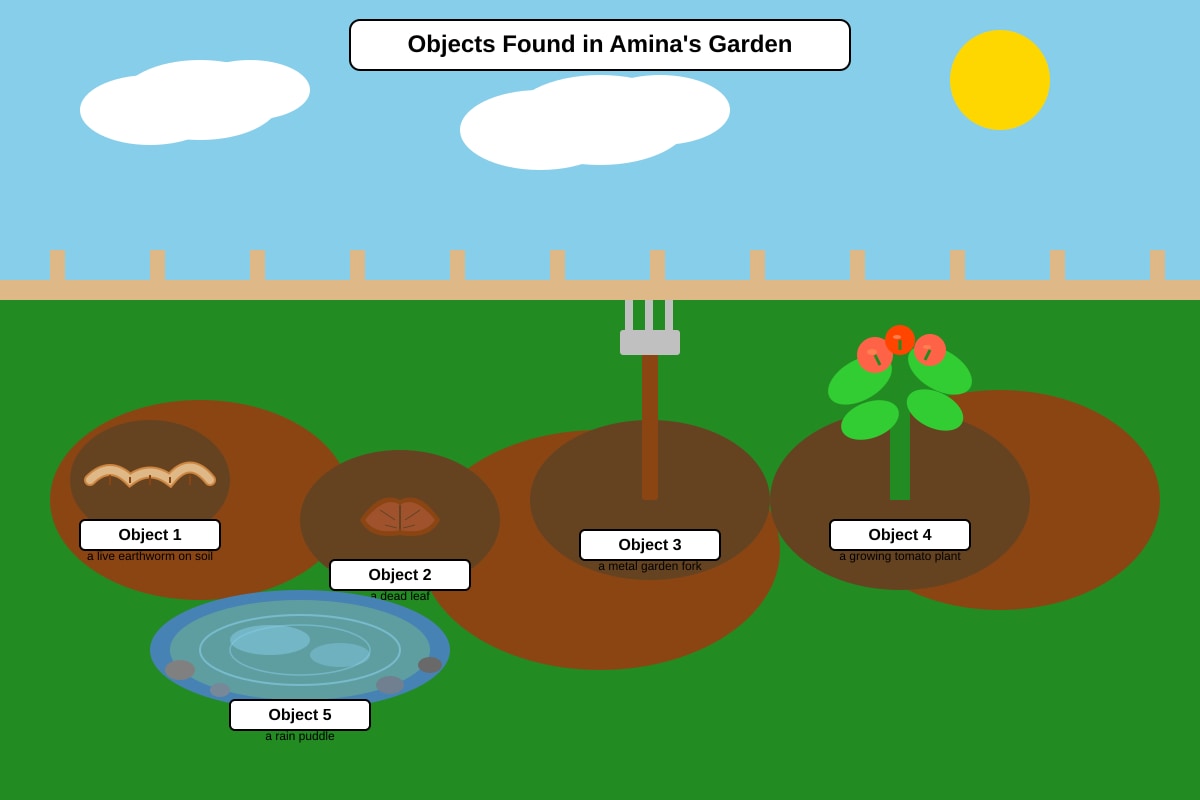
Explanation: Expected visual features: The image shows Object 1 (live earthworm on soil - living), Object 2 (dead leaf - non-living, was once living), Object 3 (metal garden fork - non-living), Object 4 (growing tomato plant - living), Object 5 (rain puddle - non-living).
- 1 (Earthworm): Living — can move, feed, grow, reproduce
- 4 (Tomato plant): Living — growing, makes food, needs water
Object 2 (dead leaf) is non-living now — it was once living but can no longer grow or respond.
(b) Sample answer — 2 marks
Object: 3 (metal garden fork) OR 5 (rain puddle)
Explanation: (Any ONE correct explanation = 2 marks)
- Metal garden fork (3): It is non-living because it cannot grow, does not need food or water, and cannot reproduce. It only moves when a person uses it.
- Rain puddle (5): It is non-living because water cannot grow, does not need food, and cannot reproduce. The puddle will dry up or evaporate — it is not alive.
Marking breakdown: Correct object = 0.5 mark; Appropriate explanation with at least two reasons = 1.5 marks
14. Answers: — 2 marks
(a) Fungi — 1 mark
(b) Any ONE correct similarity: — 1 mark
- Both cannot make their own food
- Both can reproduce
- Both need water to survive
- Both grow
Explanation:
- Group A (Mould, mushroom, yeast) = Fungi: These are NOT plants. They cannot photosynthesize and must absorb nutrients from other organic matter.
- Group B (Bacteria) = Single-celled living things, also cannot make own food (most types)
Common mistake: Students often think mushrooms are plants because they "grow" in soil. But fungi are a separate kingdom — they lack chlorophyll and cannot make their own food.
Section C: Open-Ended Questions (Questions 15-20)
18 marks
15. Answers: — 3 marks total
(a) The plant in Pot A is a living thing / alive / able to grow when watered. — 1 mark
(b) Explanation: — 2 marks
David's experiment is not fair because he changed two things at once: watering AND having a plant (1 mark).
To make it fair, he should:
- Either: Water both pots (one with plant, one without) to test if the plant needs water
- Or: Have two pots with plants, water one and not the other, to test if water affects growth (1 mark)
Key concept: A fair test changes only ONE variable at a time. David changed both the presence of a plant AND the watering, so he cannot tell whether any difference is due to the plant or the water.
16. Answers: — 4 marks total
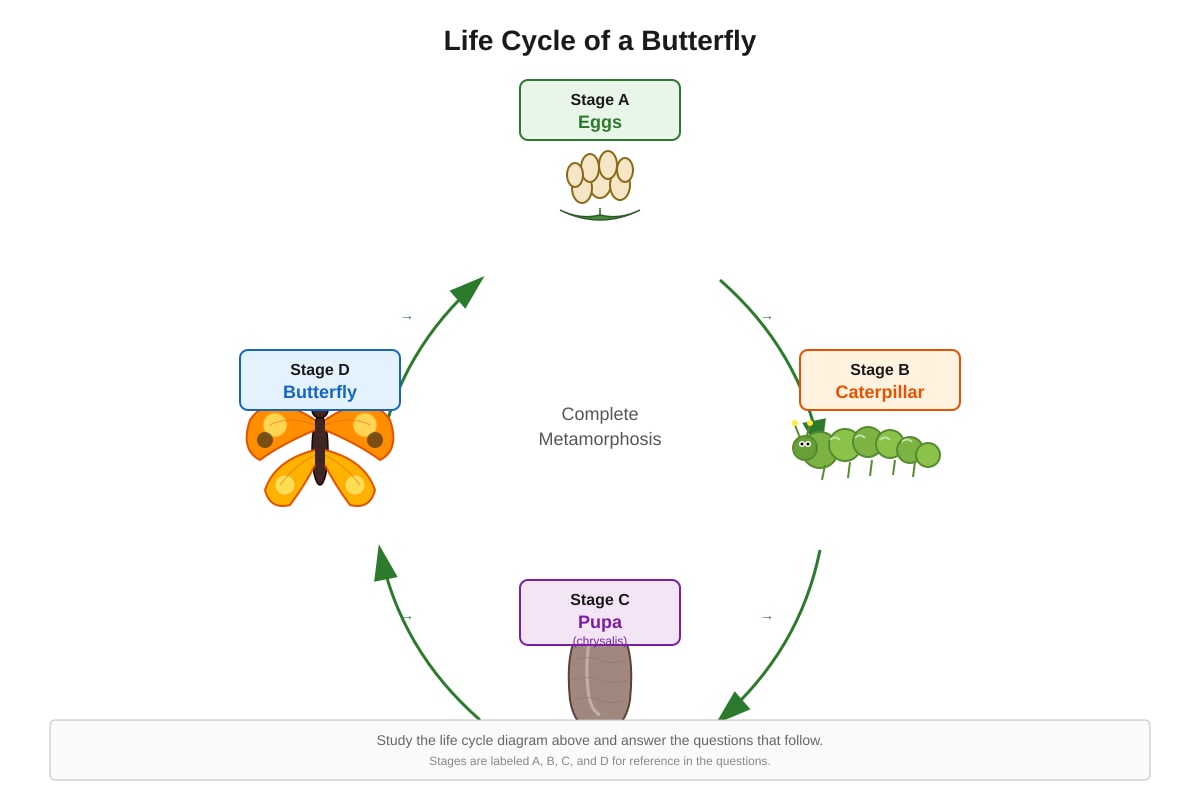
(a) Life cycle of a butterfly / Complete metamorphosis — 1 mark
(b) Stage 4 / Stage D / The adult butterfly stage — 1 mark
(c) Explanation (any TWO points = 2 marks):
- A butterfly is an insect because it has six legs (1 mark)
- It has three body parts: head, thorax, abdomen (1 mark)
- It has two pairs of wings / antennae (1 mark)
Expected visual features: The life cycle diagram shows Eggs → Caterpillar (larva) → Pupa (chrysalis) → Adult Butterfly in a circular flow.
Key stages: The adult butterfly (Stage 4/D) is the reproductive stage — it lays eggs to start the cycle again. This is complete metamorphosis because the young (caterpillar) looks completely different from the adult.
17. Answers: — 3 marks total
(a) Ali — 1 mark
(b) Explanation: — 2 marks
Ali put water in Group 1 (Living things), but water is non-living (1 mark).
Water does not have the characteristics of living things: it cannot grow, does not need food, cannot reproduce, and does not respond to stimuli (1 mark). Water is a substance that living things need, but it is not alive itself.
Key distinction: Living things need water, but water is not a living thing. This tests the common misconception that "important things = living things."
18. Answers: — 4 marks total
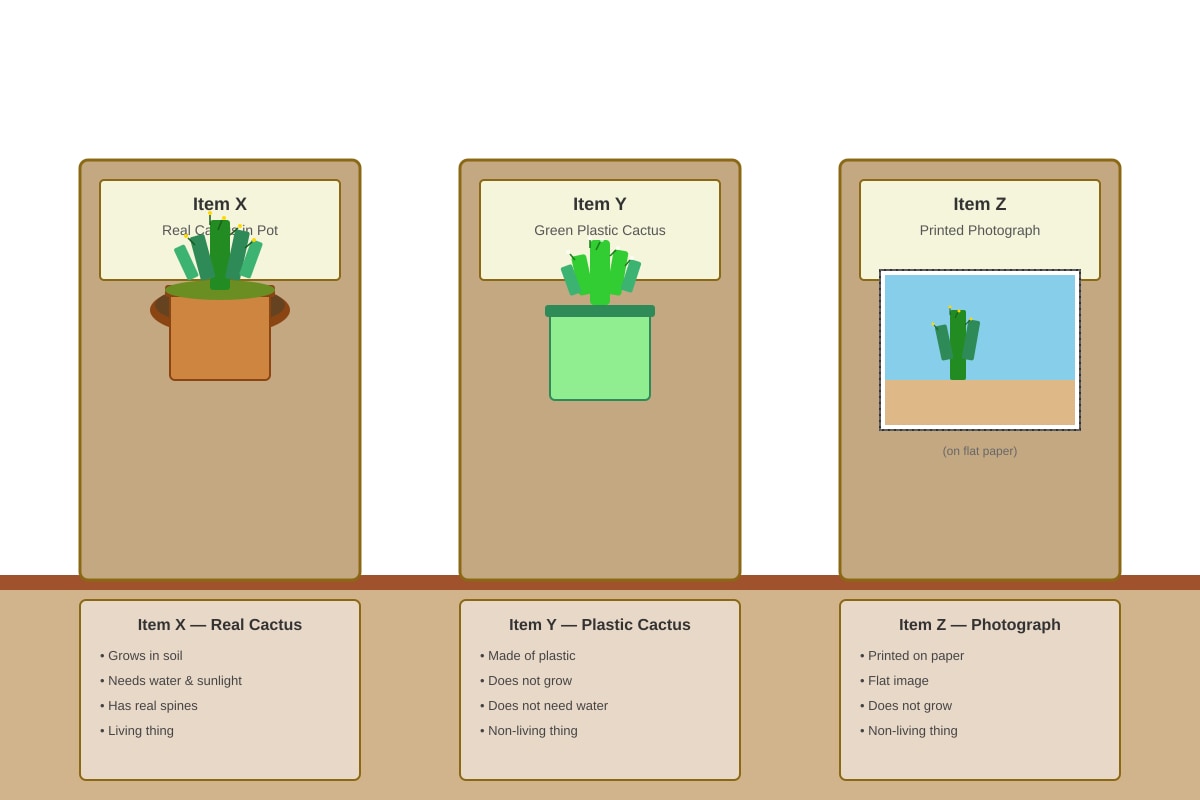
(a) Item X (the real cactus in a pot) — 1 mark
(b) Any TWO correct ways = 3 marks (1.5 marks each, or mark holistically)
Expected visual features: Item X shows a real cactus with natural variations; Item Y shows uniform green plastic; Item Z shows flat printed image.
Observable differences without touching:
-
Look for growth or change over time: The real cactus (X) would grow slightly, might have new spines or flower buds, and would look more three-dimensional and natural. The plastic cactus (Y) stays exactly the same size and shape. (1.5 marks)
-
Look at the base/soil: The real cactus is planted in real soil and may have roots visible or need watering. The plastic cactus has a plastic or weighted base and uniform manufactured appearance. (1.5 marks)
-
Color and texture appearance: Real cacti have natural color variations, slight imperfections, and matte/glossy natural surfaces. Plastic cacti have very uniform, bright, artificial coloring. (1.5 marks)
Marking: Two clear, distinct observational methods = 3 marks. One method only = 1.5 marks.
19. Answers: — 4 marks total
(a)
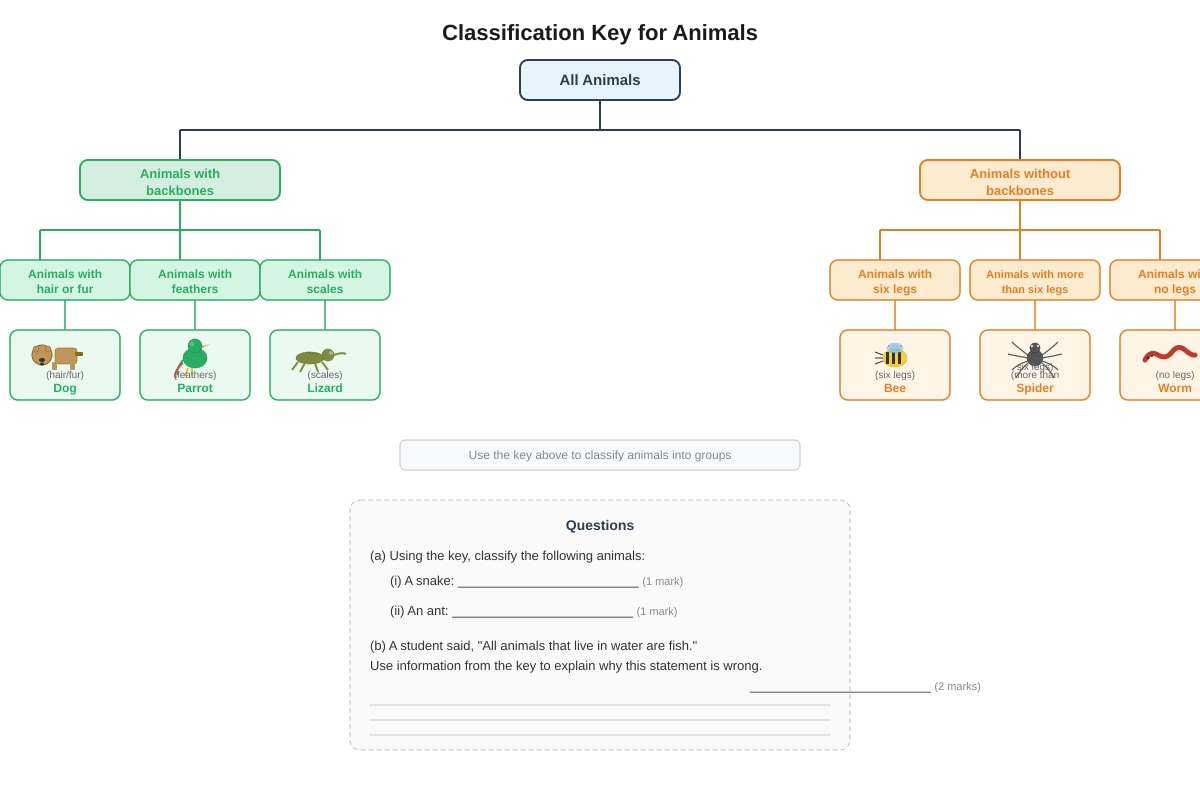
- (i) Animals with backbones → Animals with scales (reptile) — 1 mark
- (ii) Animals without backbones → Animals with six legs (insect) — 1 mark
(b) Explanation: — 2 marks
The student is wrong because the key shows that some animals with backbones can live in water but are not fish (1 mark).
For example, whales and dolphins are mammals with backbones that live in water — they have hair (tiny amount), give birth to live young, and feed milk. They are not fish because fish have scales and lay eggs (1 mark).
Or using the key: The key classifies by body covering and presence of backbone, not by where the animal lives. Animals with scales includes reptiles like snakes and lizards that don't live in water.
20. Answers: — 5 marks total
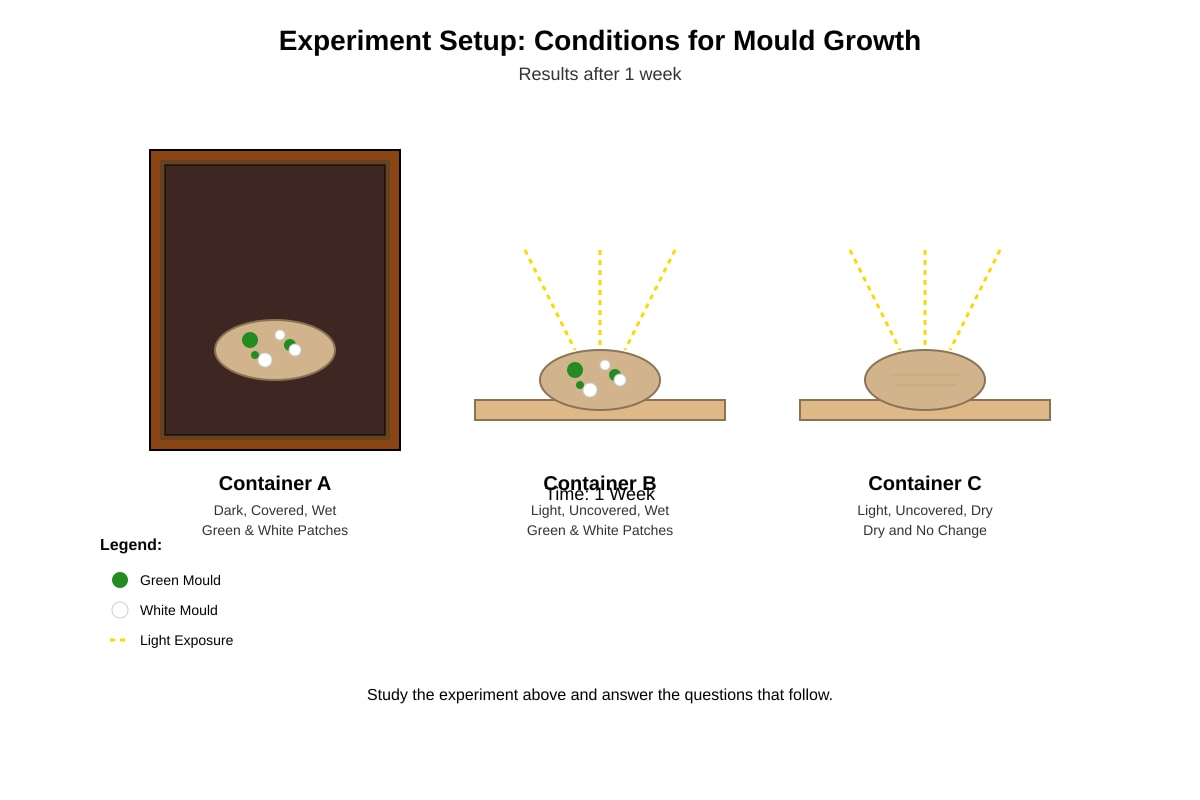
(a) Mould / Fungus — 1 mark
(b) Because the bread was dry / no moisture / no water — 1 mark
(c) Do you agree? No — 1 mark for correct disagreement
Explanation: — 2 marks
The student should not agree with the conclusion because:
- Both Container A (dark, covered) AND Container B (bright, uncovered) grew mould (1 mark)
- This shows light/darkness made no difference to mould growth in this experiment
- The actual difference was wet vs dry (Container C was dry and had no mould) (1 mark)
Fair conclusion: Mould needs moisture/water to grow, not darkness.
Marking breakdown: Correct disagreement = 1 mark; Evidence comparing A and B = 1 mark; Identifying moisture as true variable = 1 mark
Common mistake: Students might say "agree" because Container A is dark and grew mould, ignoring that B also grew mould in bright conditions. This shows the importance of comparing ALL results.
Mark Summary
| Section | Marks |
|---|---|
| Section A (Q1-8) | 10 |
| Section B (Q9-14) | 12 |
| Section C (Q15-20) | 18 |
| Total | 40 |