AI Generated Quiz
Primary 3 Mathematics Multiplication Division Quiz
Free P3 Maths Multiplication Division quiz, Kimi2.6 AI version, with questions, answers, and syllabus-aligned practice for Singapore students.
These static practice materials are generated from the site's syllabus and paper-generation workflow, with source and model context shown so students and parents can evaluate the material before use.
Questions
Free quiz and exam paper access
Enter your details to view this paper
Your access is remembered on this device.
Answers
Primary 3 Mathematics Quiz - Multiplication Division: Answer Key
Total Marks: 40
Section A: Multiple Choice (5 marks)
1. B) 56
- Working: 7 × 8 = 56. Recall multiplication table: 7, 14, 21, 28, 35, 42, 49, 56.
- Common mistake: Confusing with 6 × 9 = 54 (Option A) or 7 × 9 = 63 (Option C).
- Teaching note: The product is the result of multiplication. "7 times 8" means 7 groups of 8, or 8 + 8 + 8 + 8 + 8 + 8 + 8 = 56.
Marks: 1 mark for correct answer.
2. D) Both B and C
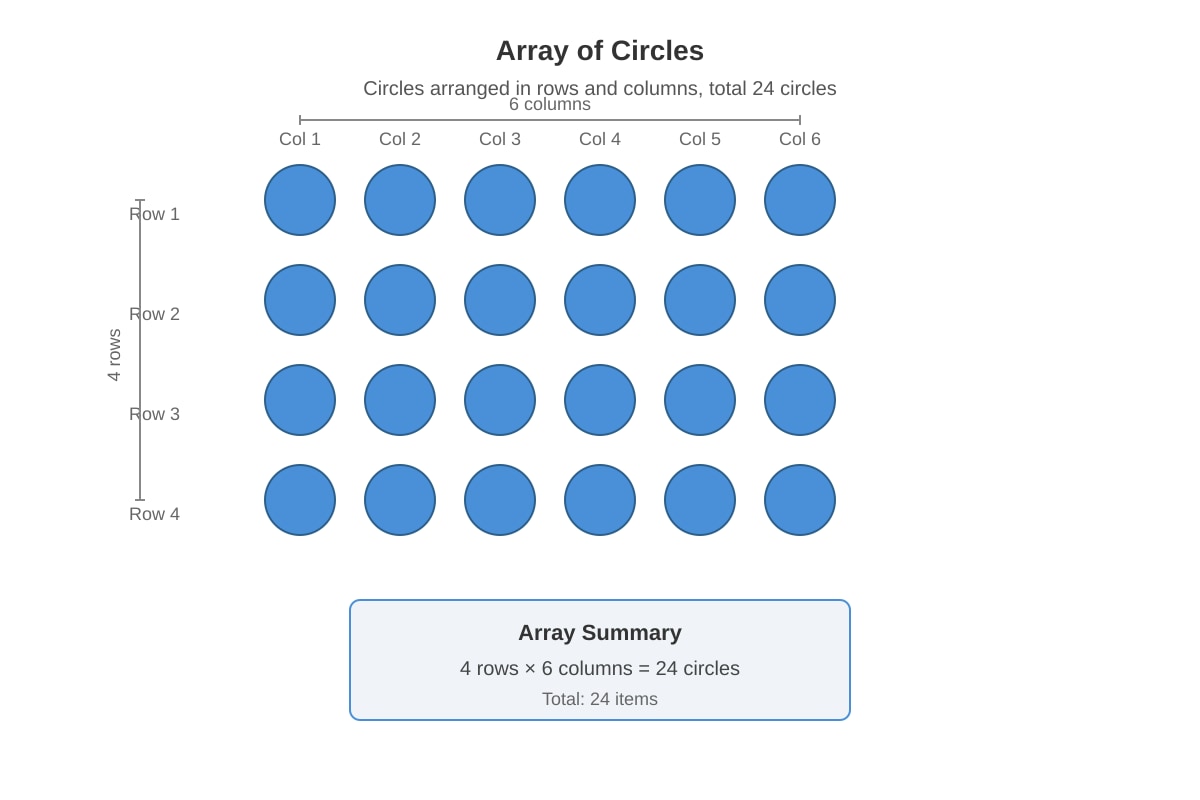
- Working: The array shows 24 items arranged in 4 rows of 6 (so 24 ÷ 4 = 6) OR 6 rows of 4 (so 24 ÷ 6 = 4).
- Teaching note: Division and multiplication are inverse operations. An array with equal rows shows both the multiplication fact (4 × 6 = 24) and related division facts. Since the diagram shows a rectangle that can be read as 4 × 6 or 6 × 4, both division sentences are correct.
- Common mistake: Choosing only B or only C without recognising that both describe the same array from different perspectives.
Marks: 1 mark for correct answer.
3. B) 9
- Working: 45 ÷ 5 = 9. Recall: 5, 10, 15, 20, 25, 30, 35, 40, 45 — nine fives make 45.
- Teaching note: "How many boxes" means we divide the total by the amount in each box. Total ÷ group size = number of groups.
- Common mistake: Choosing D (40) by subtracting instead of dividing, or A (8) by guessing.
Marks: 1 mark for correct answer.
4. A) 3 × 18
- Working: 9 × 6 = 54. Check each option:
- A) 3 × 18 = 54 ✓
- B) 6 × 8 = 48 ✗
- C) 12 × 4 = 48 ✗
- D) 9 × 5 + 1 = 45 + 1 = 46 ✗
- Teaching note: We can use the associative property: 9 × 6 = (3 × 3) × 6 = 3 × (3 × 6) = 3 × 18. This shows how breaking down factors helps verify equivalence.
Marks: 1 mark for correct answer.
5. C) 8
- Working: 48 ÷ 6 = 8. Recall multiplication table: 6 × 8 = 48, so 48 ÷ 6 = 8.
- Teaching note: Division "undoes" multiplication. If 6 × 8 = 48, then 48 shared into 6 equal groups gives 8 in each group.
Marks: 1 mark for correct answer.
Section B: Short Answer (20 marks)
6. 56
- Working: 8 × 7 = 8 + 8 + 8 + 8 + 8 + 8 + 8 = 56
- Or use multiplication table: 8 × 7 = 56 (known fact)
- Teaching note: "8 times 7" means 7 groups of 8. Memorising tables allows quick recall, but understanding as repeated addition builds foundation.
Marks: 2 marks (1 mark for method, 1 mark for correct answer). Deduct 1 mark if no working shown.
7. 6
- Working: 54 ÷ 9 = 6 because 9 × 6 = 54
- Method: Think "what times 9 equals 54?"
- Teaching note: Division is the inverse of multiplication. To find 54 ÷ 9, ask "9 × ? = 54" or "how many 9s make 54?"
Marks: 2 marks (1 mark for method, 1 mark for correct answer).
8. 72 stickers
- Working: 6 packets × 12 stickers per packet = 6 × 12 = 72
- Step 1: 6 × 10 = 60
- Step 2: 6 × 2 = 12
- Step 3: 60 + 12 = 72
- Teaching note: "Altogether" signals multiplication. We have 6 groups of 12. Use distributive property: 6 × 12 = 6 × (10 + 2) = 60 + 12 = 72.
Marks: 2 marks (1 mark for correct multiplication set-up, 1 mark for correct answer). Deduct 1 mark if units omitted.
9. 9 pupils
- Working: 72 ÷ 8 = 9
- Check: 8 × 9 = 72 ✓
- Teaching note: "Divided equally" means fair sharing. Total ÷ number of groups = amount per group. 72 pupils shared into 8 groups gives 9 in each.
Marks: 2 marks (1 mark for correct division set-up, 1 mark for correct answer with unit).
10. 7
- Working: 9 × ? = 63, so ? = 63 ÷ 9 = 7
- Check: 9 × 7 = 63 ✓
- Teaching note: The missing factor is found by dividing the product by the known factor. This uses the inverse relationship between multiplication and division.
Marks: 2 marks (1 mark for method showing inverse operation, 1 mark for correct answer).
11. 336 stickers
- Working: 48 pages × 7 stickers per page = 48 × 7
- Step 1: 40 × 7 = 280
- Step 2: 8 × 7 = 56
- Step 3: 280 + 56 = 336
- Teaching note: "In all" signals multiplication. Use place value decomposition: 48 = 40 + 8, then multiply each part by 7.
Marks: 2 marks (1 mark for correct method with decomposition, 1 mark for correct answer with unit).
12. 8 marbles each, 2 left over
- Working: 50 ÷ 6 = 8 remainder 2
- Step 1: 6 × 8 = 48
- Step 2: 50 − 48 = 2 (remainder)
- Teaching note: This introduces division with remainder. After sharing equally, what remains is too small for another complete group. 6 × 8 = 48, but we have 50, so 2 are left over. The remainder must be smaller than the divisor (6).
- Common mistake: Answer "8 remainder 4" — remainder must be less than 6. Or forgetting to state both parts of the answer.
Marks: 2 marks (1 mark for correct quotient, 1 mark for correct remainder). Both parts required for full marks.
13. 0
- Working: 7 × 8 × 0 = 56 × 0 = 0
- Teaching note: Any number multiplied by 0 equals 0. This is the zero property of multiplication. No matter how large the other factors, once × 0 appears, the product is 0.
- Common mistake: Calculating 7 × 8 = 56 and stopping, or writing 56.
Marks: 2 marks (1 mark for recognising zero property, 1 mark for correct answer 0). Award full marks even without working if answer is correct.
14. 9 complete boxes, 4 pencils left over
- Working: 85 ÷ 9 = 9 remainder 4
- Step 1: 9 × 9 = 81
- Step 2: 85 − 81 = 4
- Check: 9 × 9 + 4 = 81 + 4 = 85 ✓
- Teaching note: "Complete boxes" means we need full groups of 9. 9 × 9 = 81, leaving 4 pencils not enough for another box. Remainder (4) < divisor (9).
Marks: 2 marks (1 mark for correct quotient with unit "boxes", 1 mark for correct remainder with unit "pencils"). Deduct ½ mark if units missing.
15. 48
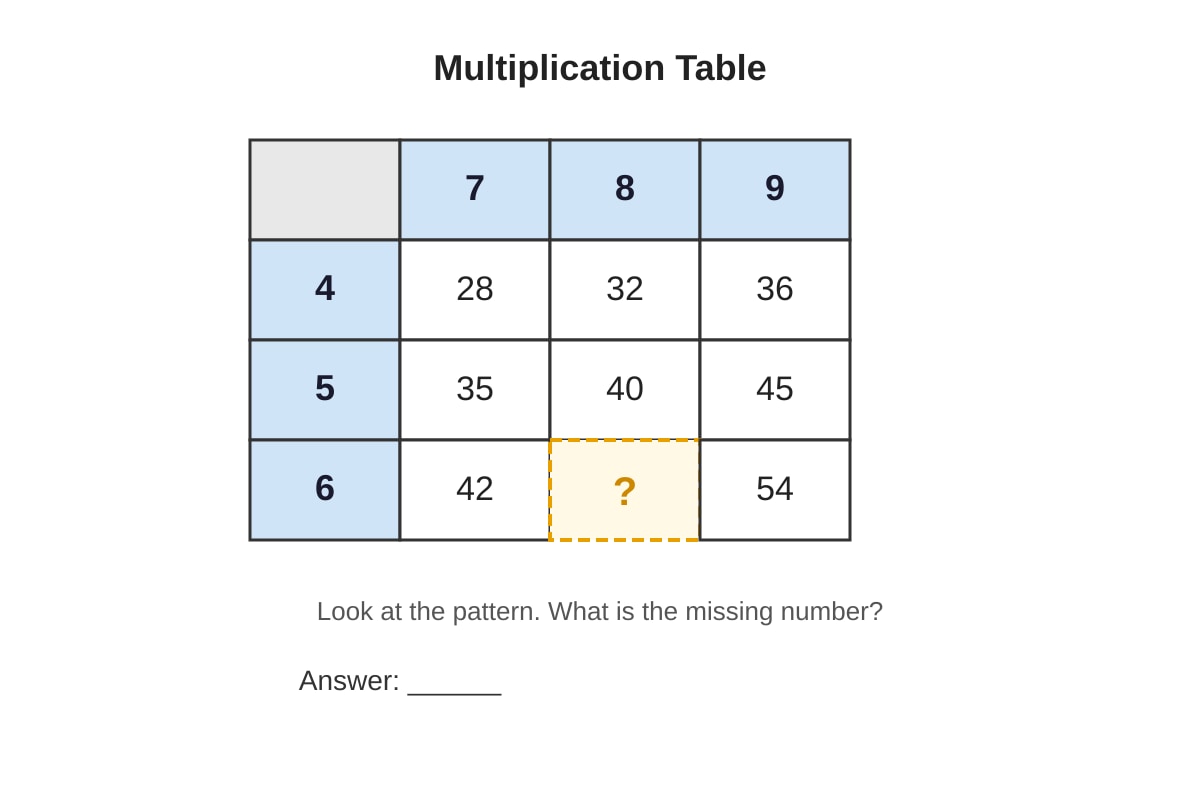
- Working: From the table, the missing cell is at row 6, column 8.
- Calculation: 6 × 8 = 48
- Alternative reasoning from table pattern:
- Row 4: 4 × 8 = 32, 4 × 9 = 36
- Row 5: 5 × 8 = 40, 5 × 9 = 45
- Row 6: 6 × 7 = 42, 6 × 8 = ?, 6 × 9 = 54
- Check pattern down column 8: 32, 40, ? — increases by 8 each time, so 40 + 8 = 48
- Teaching note: Multiplication tables show patterns. Moving down a column adds that column's number; moving across a row adds that row's number.
Marks: 2 marks (1 mark for identifying correct row and column, 1 mark for correct answer 48). Deduct 1 mark if no working shown.
Section C: Word Problems and Application (15 marks)
16. 7 bags
- Working:
- Total apples needed: 56
- Apples per bag: 8
- Number of bags: 56 ÷ 8 = 7
- Check: 7 × 8 = 56 ✓
- Teaching note: "How many bags" asks for number of groups. Total ÷ group size = number of groups. The word "must" implies we need exactly enough—no rounding up needed since 56 is exactly divisible by 8.
Mark breakdown:
- 1 mark: Correct division statement 56 ÷ 8 or equivalent
- 1 mark: Correct answer 7
- 1 mark: Correct unit "bags" and complete working
17. 82 chairs
- Working:
- Step 1: Total chairs = 7 rows × 15 chairs = 7 × 15 = 105
- 7 × 10 = 70
- 7 × 5 = 35
- 70 + 35 = 105
- Step 2: Usable chairs = 105 − 23 = 82
- Step 1: Total chairs = 7 rows × 15 chairs = 7 × 15 = 105
- Teaching note: This is a two-step problem. First find total (multiplication), then subtract broken chairs. "Can be used" means we remove the broken ones.
Mark breakdown:
- 1 mark: Correct total chairs (105)
- 1 mark: Correct subtraction 105 − 23 = 82
- 1 mark: Correct final answer with unit "chairs"
18. 9 weeks, $4 left
- Working:
- Step 1: Weeks needed = 50 ÷ 6 = 8 remainder 2
- Since 8 weeks gives only 8 × 6 = $48 (not enough), John needs 9 weeks
- Step 2: Total saved in 9 weeks = 9 × 6 = $54
- Step 3: Money left = 50 = $4
- Teaching note: "Least number of weeks" requires rounding up—John cannot buy the toy with partial savings. Even though 50 ÷ 6 ≈ 8.33, he needs 9 full weeks. This is a real-world interpretation of division with remainder.
- Common mistake: Answering "8 weeks remainder 48 is enough.
Mark breakdown:
- 1 mark: Correct identification that 9 weeks needed (rounding up from 8 remainder 2)
- 1 mark: Correct calculation 9 × 6 = 54, then 54 − 50 = 4
- 1 mark: Both answers correct with units "weeks" and "$"
19. (a) 12 boxes; (b) $60
Part (a):
- Working: 75 ÷ 6 = 12 remainder 3
- Answer: 12 complete boxes
- Teaching note: "Complete" means full boxes only. 12 × 6 = 72, leaving 3 oranges unpacked.
Part (b):
- Working: 12 boxes × 60
- Teaching note: Use the answer from part (a). Only complete boxes are sold. Part (b) depends on part (a)—if students used wrong number of boxes, follow through with correct method for their number.
Mark breakdown for (a):
- 1 mark: Correct answer 12 boxes with remainder 3 (or just 12 complete boxes)
Mark breakdown for (b):
- 1 mark: Correct multiplication using answer from (a): 12 × 5
- 1 mark: Correct final answer $60 with dollar sign
20. (a) 24; (b) 16; (c) 3/2 times or 1.5 times
Part (a):
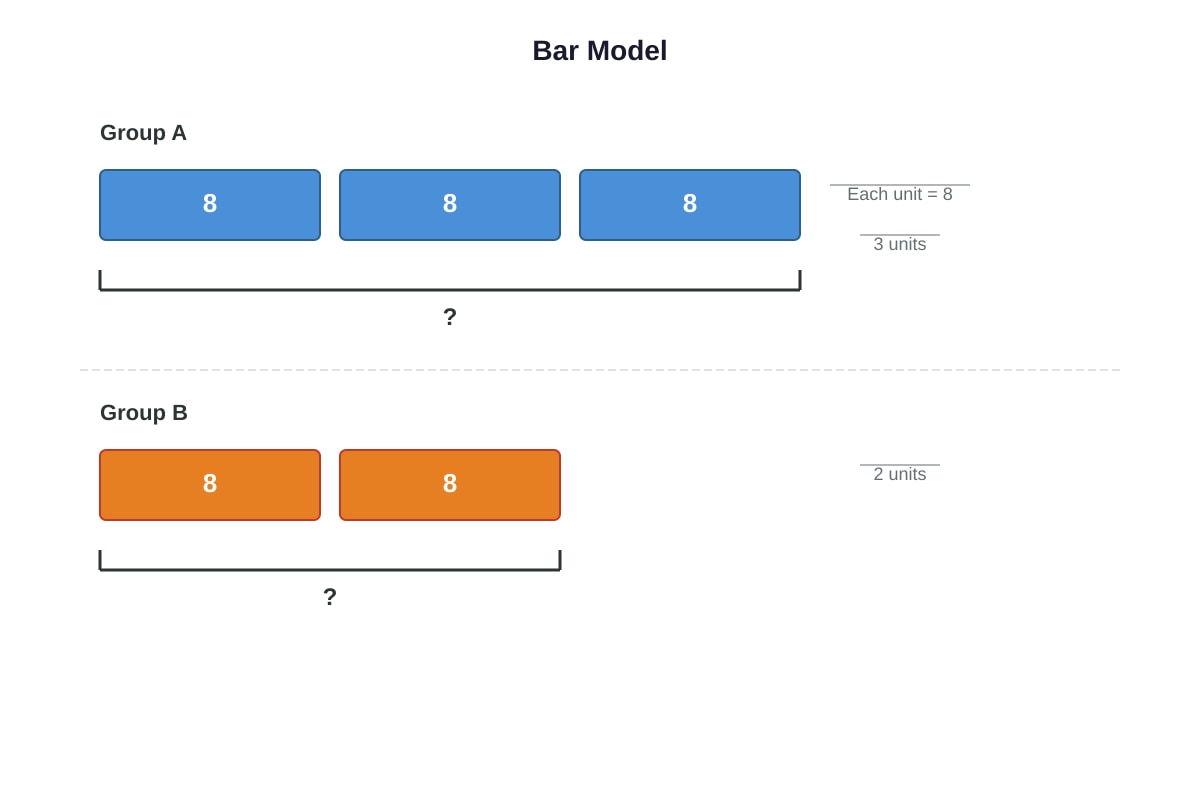
- Working: Group A = 3 units × 8 = 3 × 8 = 24
- Teaching note: Bar models represent quantities as equal units. Multiply number of units by value per unit.
Part (b):
- Working: Group B = 2 units × 8 = 2 × 8 = 16
Part (c):
- Working: 24 ÷ 16 = 24/16 = 3/2 = 1.5 or "1½ times"
- Or: Compare units directly: 3 units ÷ 2 units = 3/2 times
- Teaching note: "How many times as much" means division: larger ÷ smaller. This can also be seen from the bar model—3 units compared to 2 units gives ratio 3:2.
- Common mistakes: Answering "3 times" (comparing units to 1), or "8 times" (using unit value). Must compare totals or number of units.
Mark breakdown:
- 1 mark (a): Correct total for Group A: 24
- 1 mark (b): Correct total for Group B: 16
- 1 mark (c): Correct comparison 24 ÷ 16 = 1.5 or 3/2 or 1½ times
- END OF ANSWER KEY -
Summary of Marks Distribution:
- Section A: 5 × 1 = 5 marks
- Section B: 10 × 2 = 20 marks
- Section C: 5 × 3 = 15 marks
- Total: 40 marks