AI Generated Quiz

Primary 3 Mathematics Geometry Quiz

Free AI-Generated Kimi K2 6 Free Primary 3 Mathematics Geometry quiz with questions and answers for Singapore students. This page is rendered as a direct URL so the questions and answers can be discovered without pressing in-page buttons.

These static practice materials are generated from the site's syllabus and paper-generation workflow, with source and model context shown so students and parents can evaluate the material before use.

Primary 3 Mathematics AI Generated Generated by Kimi K2 6 Free Updated 2026-06-07

Questions

<!-- TuitionGoWhere generation metadata: stage=5-1; model=moonshotai/kimi-k2.6:free; model_label=Kimi K2.6 Free; generated=2026-06-06; Sources: Stage 4-0 LLM templates, syllabus context, and Stage 2 evidence where available. -->

Primary 3 Mathematics Quiz - Geometry

Name: _________________________
Class: _________________________
Date: _________________________
Score: ______ / 40

Duration: 40 minutes
Total Marks: 40
Instructions: Answer all questions. Show your working clearly. Marks are shown in brackets [ ].


Section A: Multiple Choice (Questions 1-8)

Choose the correct answer for each question. Each question carries 2 marks.

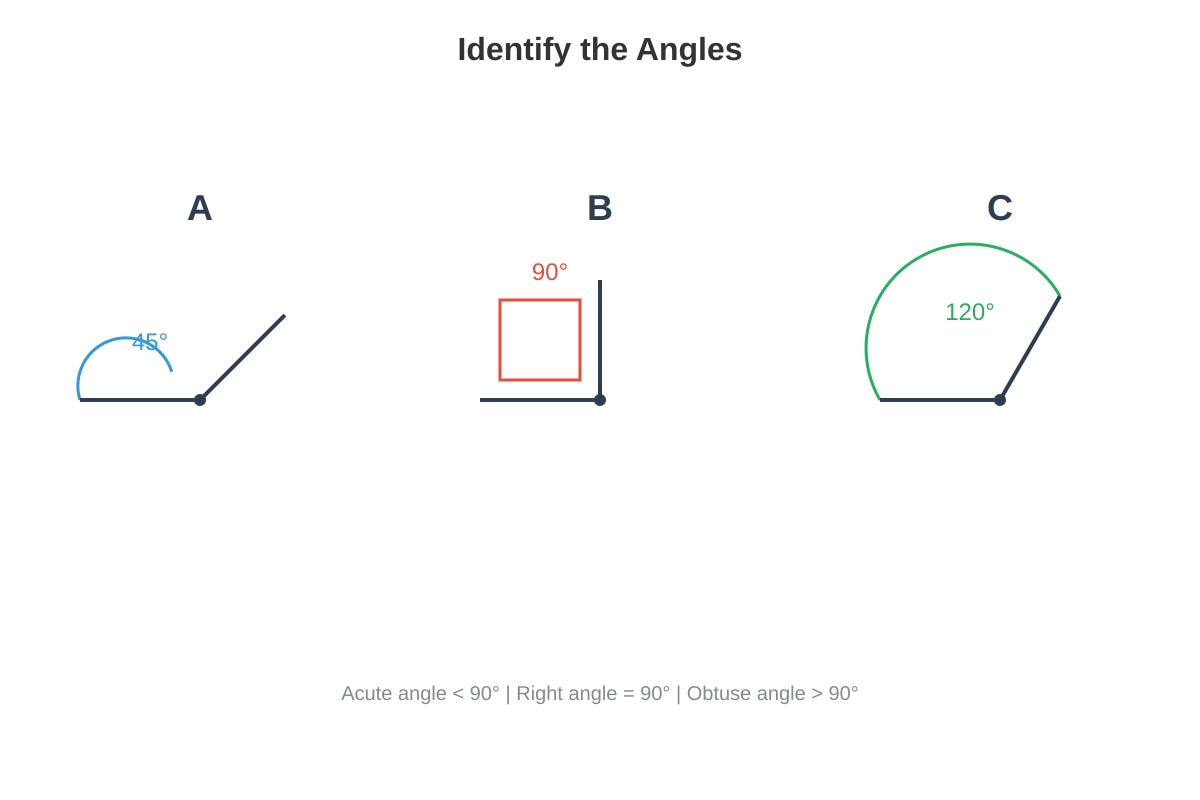
1. Which of the following figures shows a right angle?

<image_placeholder> id: Q1-fig1 type: diagram linked_question: Q1 description: Three diagrams labeled A, B, and C, each showing an angle. Diagram A shows an acute angle (approximately 45°). Diagram B shows a right angle (exactly 90° with a square corner box symbol). Diagram C shows an obtuse angle (approximately 120°). labels: A, B, C; square corner symbol on B values: approximate angle measures: A=45°, B=90°, C=120° must_show: The square corner box on angle B to indicate a right angle; clear distinction between acute, right, and obtuse angles </image_placeholder>

Your answer: _________________ [2]

2. How many right angles are there in a rectangle?

Your answer: _________________ [2]

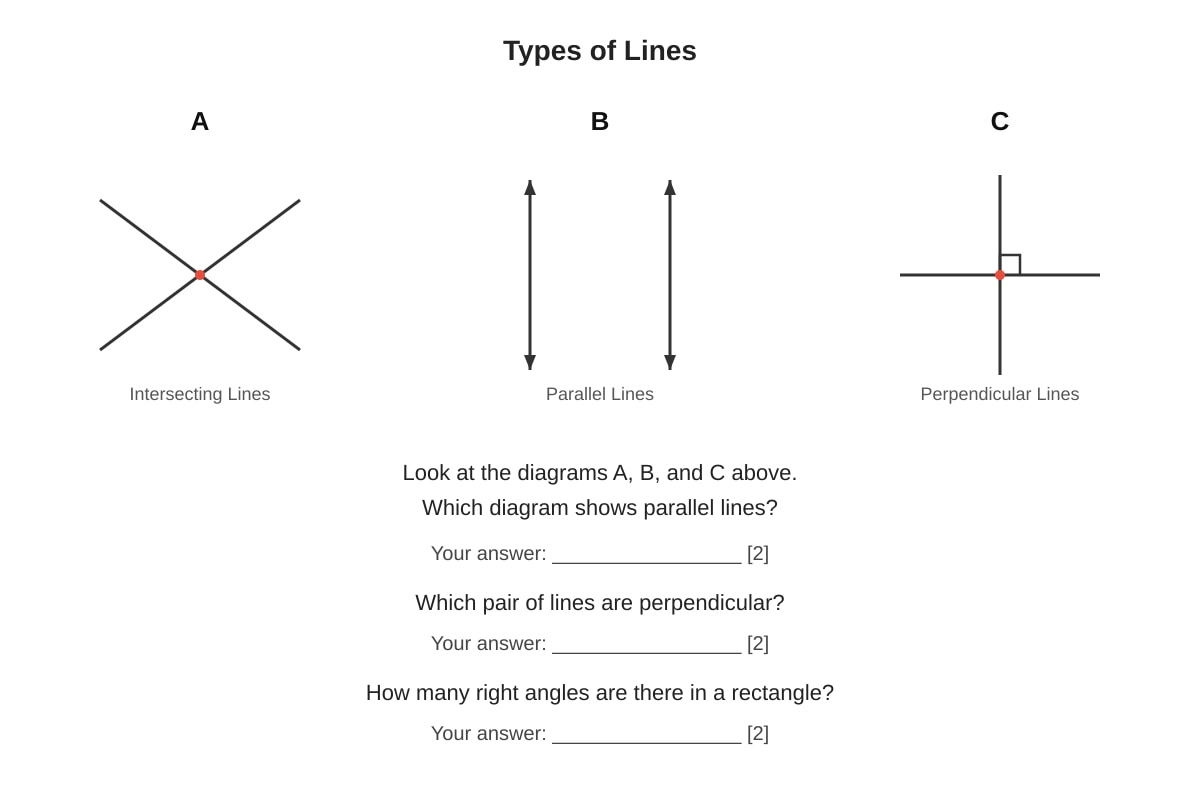
3. Which pair of lines are parallel?

<image_placeholder> id: Q3-fig1 type: diagram linked_question: Q3 description: Three diagrams labeled A, B, and C. Diagram A shows two lines that intersect at a point (crossing lines). Diagram B shows two vertical lines the same distance apart with arrowheads indicating they never meet. Diagram C shows two lines that meet at a point with a right angle symbol (perpendicular lines). labels: A, B, C; arrowheads on B; right angle symbol on C values: none must_show: Clear distinction between intersecting, parallel (with arrowheads), and perpendicular lines </image_placeholder>

Your answer: _________________ [2]

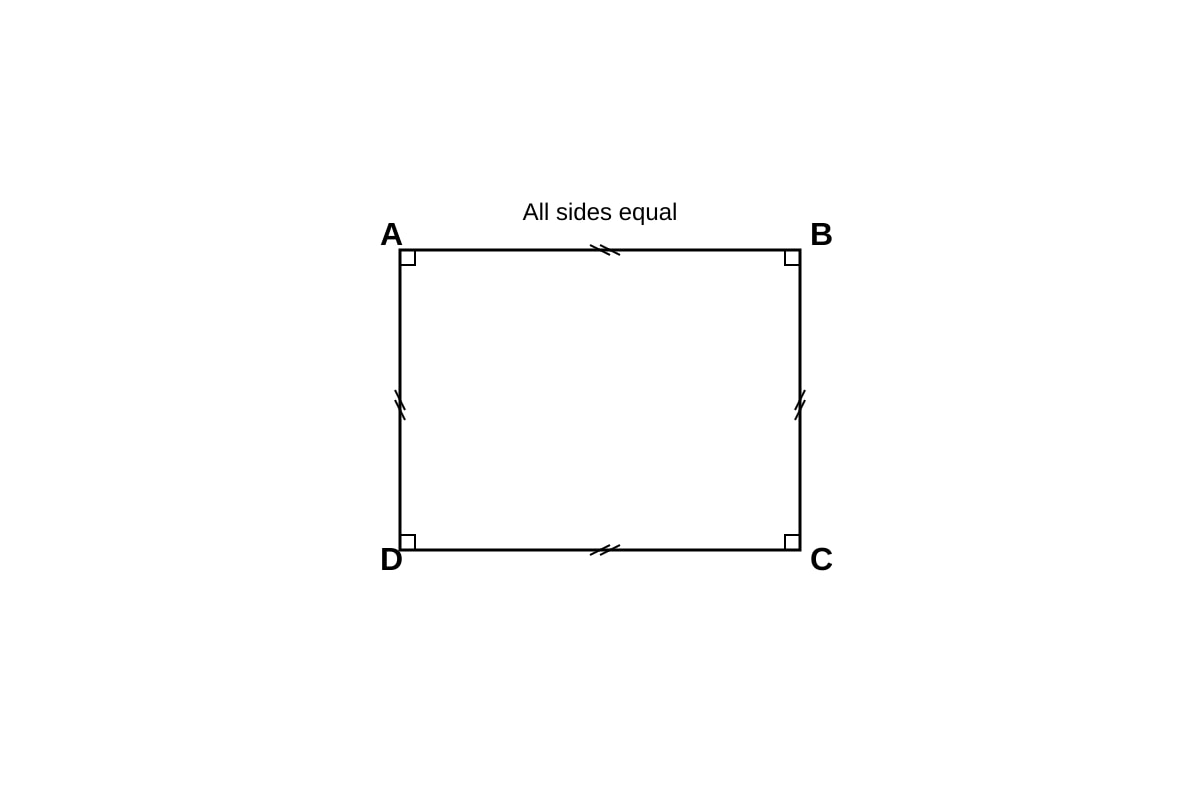
4. What is the name of this shape?

<image_placeholder> id: Q4-fig1 type: diagram linked_question: Q4 description: A quadrilateral with four equal sides and four right angles. All sides are labeled with the same tick mark to indicate equality. labels: tick marks on all four sides values: side length can be shown as equal must_show: Four equal sides, four right angles, square corner symbols at each vertex </image_placeholder>

Your answer: _________________ [2]

5. The time on the clock is 3 o'clock. What type of angle do the hour hand and minute hand make?

Your answer: _________________ [2]

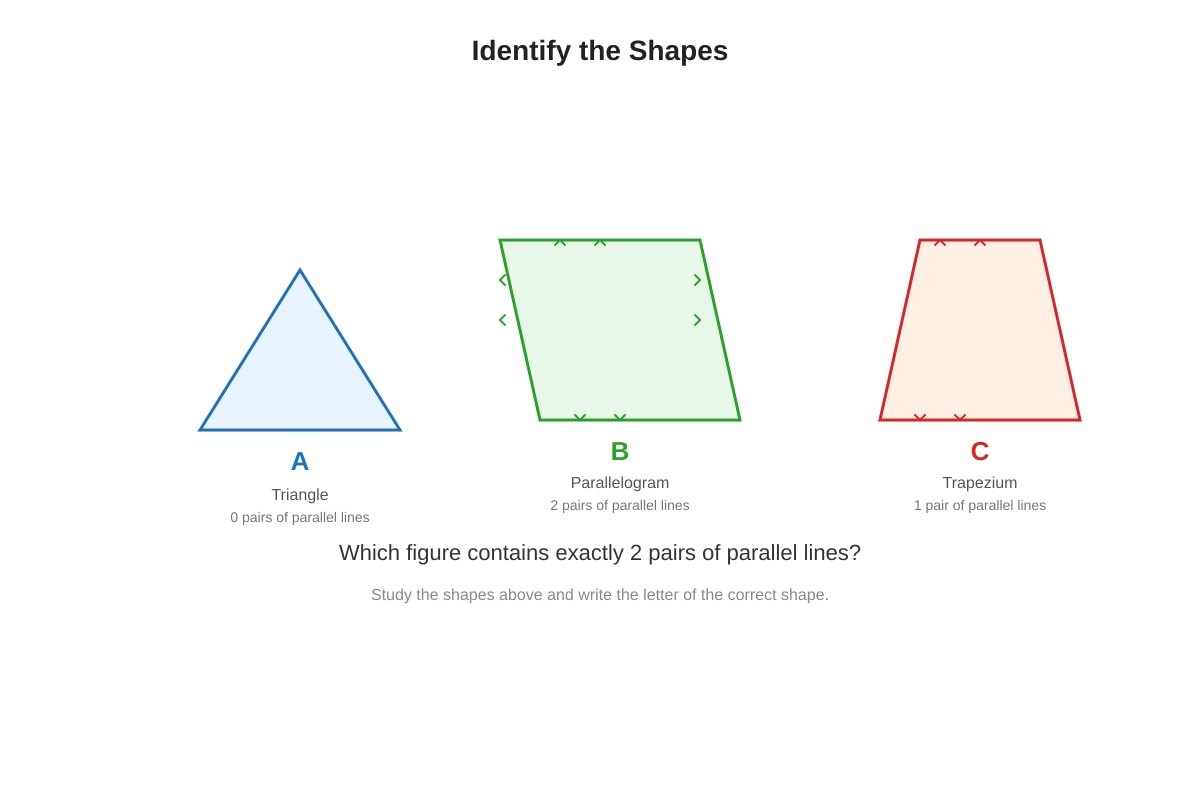
6. Which figure contains exactly 2 pairs of parallel lines?

<image_placeholder> id: Q6-fig1 type: diagram linked_question: Q6 description: Three labeled shapes. Shape A is a triangle (3 sides, 0 pairs of parallel lines). Shape B is a parallelogram (4 sides, 2 pairs of parallel lines with arrowhead pairs on opposite sides). Shape C is a trapezium (4 sides, 1 pair of parallel lines with one arrowhead pair). labels: A, B, C; arrowheads indicating parallel sides values: none must_show: Clear arrowhead notation for parallel sides; different shapes with distinct numbers of parallel line pairs </image_placeholder>

Your answer: _________________ [2]

7. A square has sides of 5 cm. What is its perimeter?

Your answer: _________________ [2]

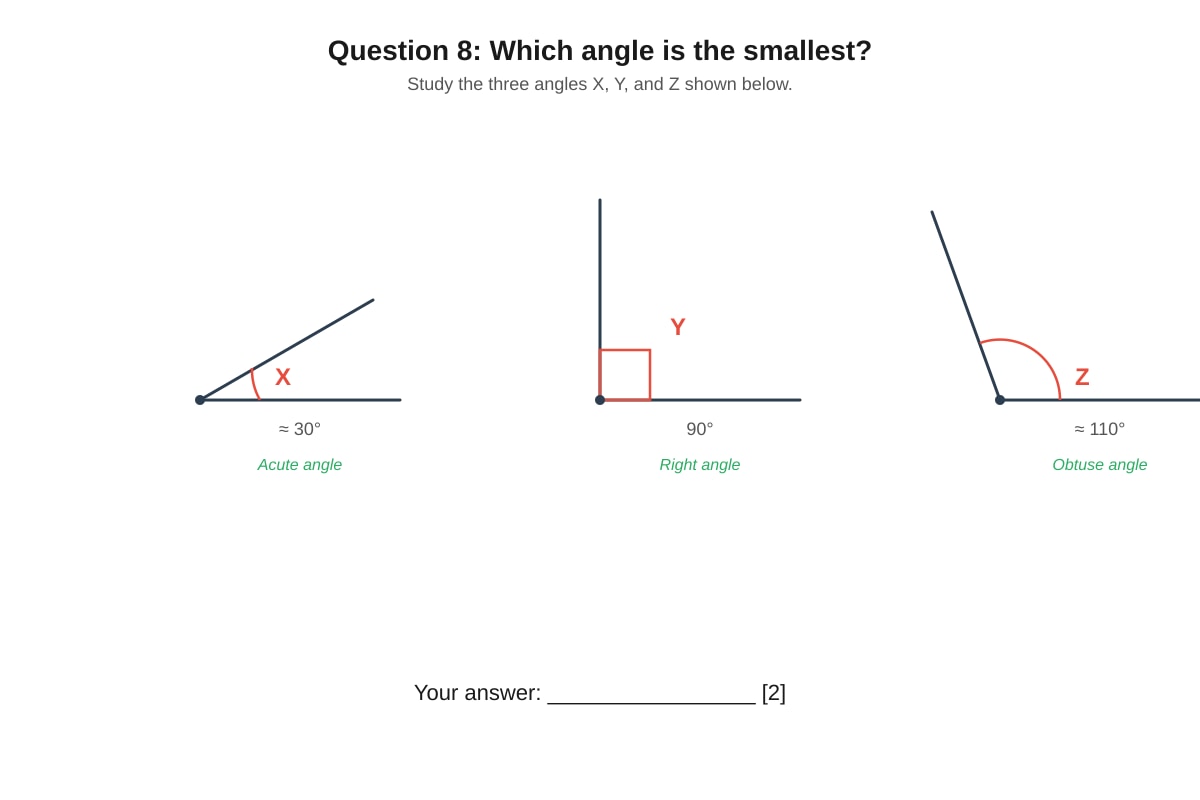
8. Which angle is the smallest?

<image_placeholder> id: Q8-fig1 type: diagram linked_question: Q8 description: Three angles labeled X, Y, and Z. Angle X is an acute angle (approximately 30°). Angle Y is a right angle (90° with square corner symbol). Angle Z is an obtuse angle (approximately 110°). labels: X, Y, Z; square corner symbol on Y values: approximate measures: X=30°, Y=90°, Z=110° must_show: Clear visual size difference between acute, right, and obtuse angles </image_placeholder>

Your answer: _________________ [2]


Section B: Short Answer (Questions 9-16)

Show your working clearly. Marks are shown in brackets.

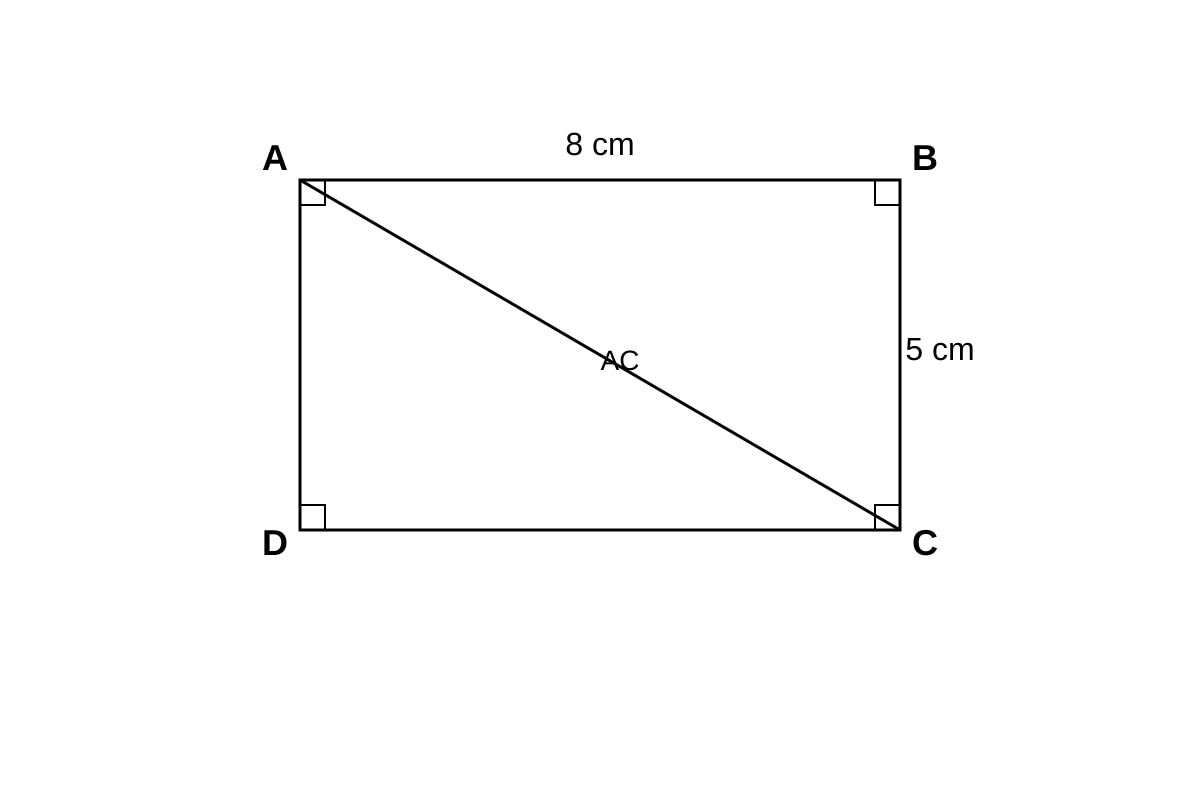
9. Look at the figure below.

<image_placeholder> id: Q9-fig1 type: diagram linked_question: Q9 description: A rectangle ABCD with vertices labeled A (top left), B (top right), C (bottom right), D (bottom left). Diagonal line AC drawn from top left to bottom right. Right angle symbols at all four corners. labels: A, B, C, D at corners; diagonal AC; right angle symbols at all vertices values: side AB = 8 cm, side BC = 5 cm (labeled on diagram) must_show: Rectangle with labeled vertices, diagonal line, side lengths, right angle symbols </image_placeholder>

(a) Name one pair of perpendicular lines. [1]


(b) Name one pair of parallel lines. [1]


(c) How many right angles are there in rectangle ABCD? [1]

_________________________________________________ [3]

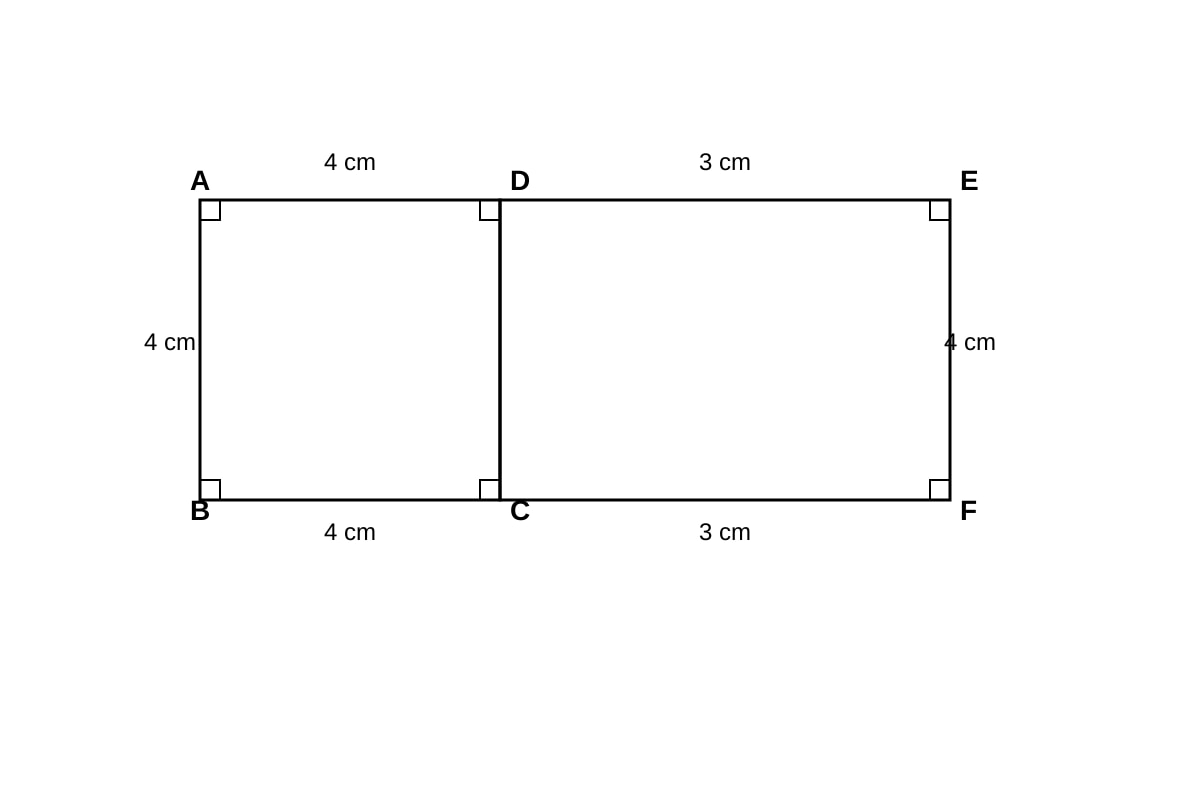
10. The figure below is made up of a rectangle and a square.

<image_placeholder> id: Q10-fig1 type: diagram linked_question: Q10 description: A composite figure consisting of a square on the left and a rectangle on the right, sharing a common vertical side. The square has sides labeled 4 cm. The rectangle has width 3 cm and height 4 cm (same as square side), with the shared side not labeled externally. labels: square side 4 cm; rectangle width 3 cm values: square side = 4 cm; rectangle width = 3 cm, height = 4 cm must_show: Clear composite shape with dimensions labeled; shared side between square and rectangle </image_placeholder>

Find the perimeter of the whole figure. [3]

Working:


Answer: _________________ [3]

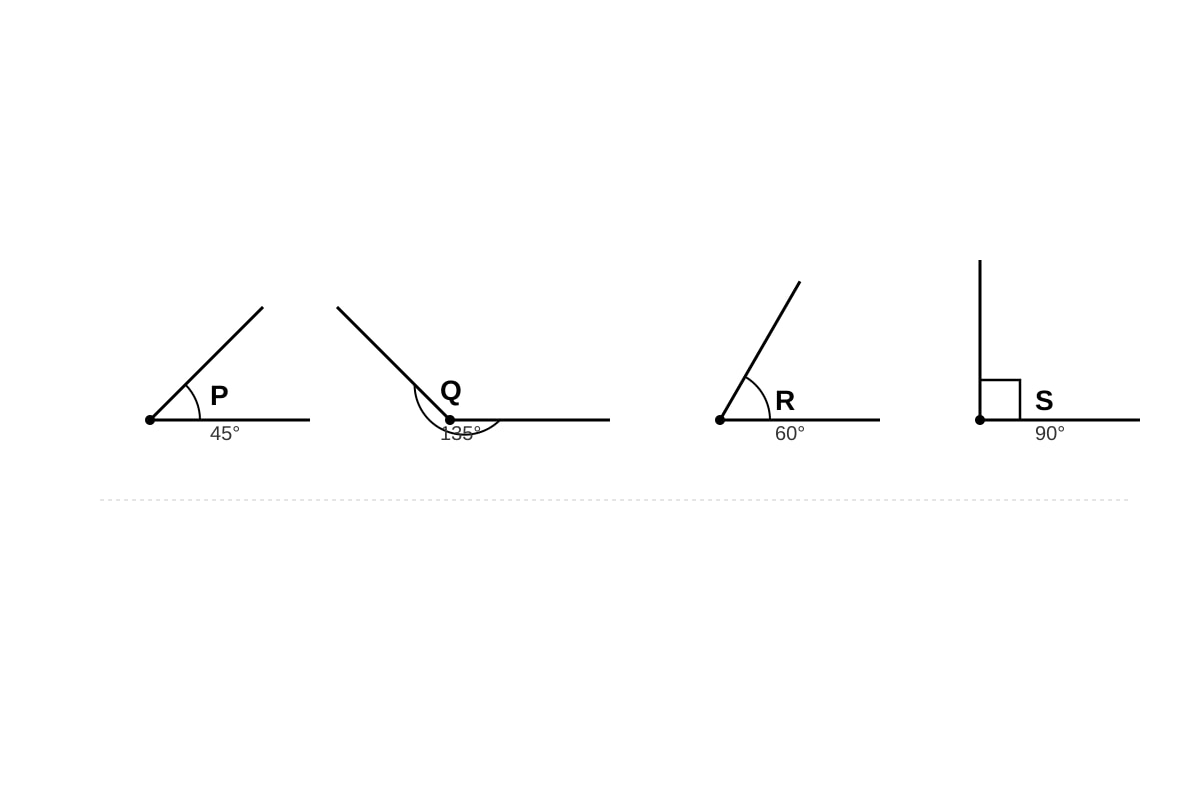
11. Look at the angles below.

<image_placeholder> id: Q11-fig1 type: diagram linked_question: Q11 description: Four angles labeled P, Q, R, and S arranged horizontally. Angle P is acute (approximately 45°). Angle Q is obtuse (approximately 135°). Angle R is acute (approximately 60°). Angle S is a right angle (90° with square corner symbol). labels: P, Q, R, S; square corner symbol on S values: approximate measures: P=45°, Q=135°, R=60°, S=90° must_show: Clear visual distinction between angle types; labels for each angle </image_placeholder>

(a) Name the angles that are acute. [2]


(b) Which angle is larger than a right angle? [1]


(c) Arrange the angles in order of size, starting with the smallest. [2]

_________________________________________________ [5]

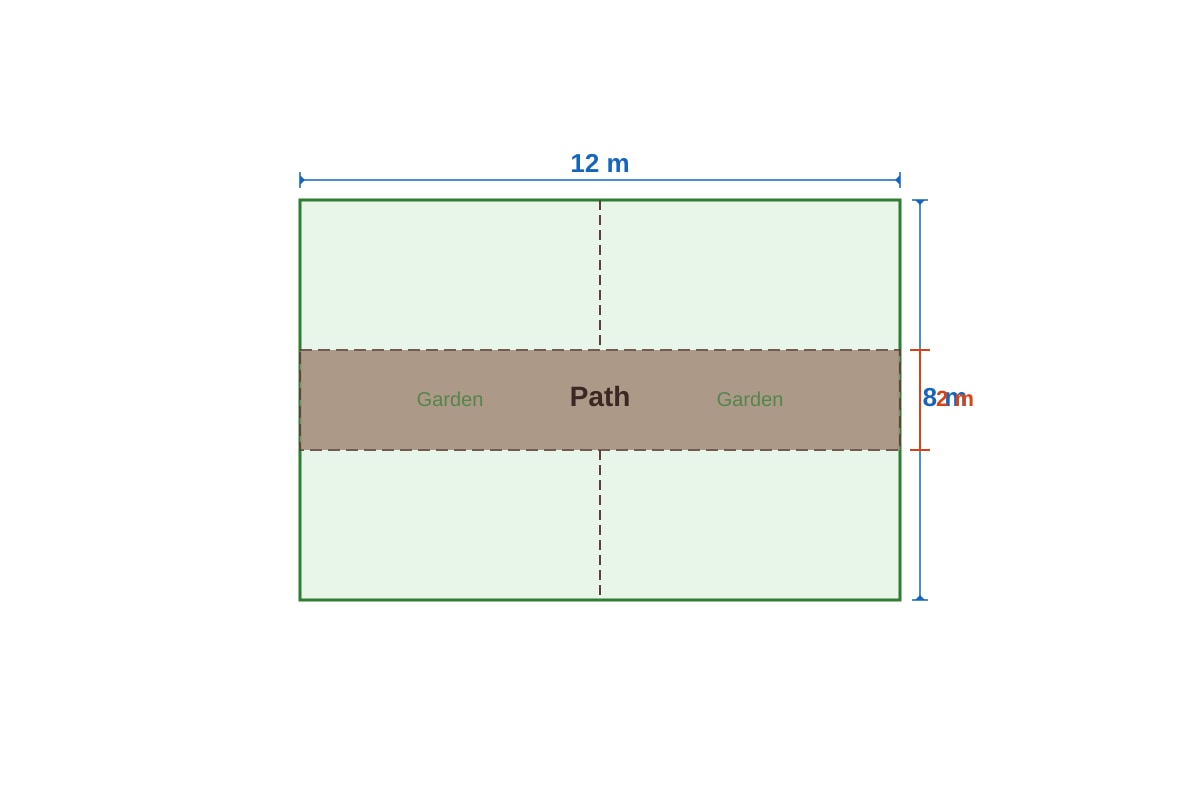
12. The figure below shows a rectangular garden.

<image_placeholder> id: Q12-fig1 type: diagram linked_question: Q12 description: A rectangle representing a garden with length 12 m and width 8 m. A dashed line divides the rectangle into two equal parts vertically, showing a path down the middle. The path is shaded. labels: length 12 m, width 8 m; "Path" labeled on shaded region values: garden length = 12 m, garden width = 8 m; path width = 2 m (centered, so 5 m from each side) must_show: Rectangle with dimensions, shaded path region, path width labeled </image_placeholder>

(a) Find the perimeter of the garden. [2]

Working:


(b) A path 2 m wide runs through the middle of the garden as shown. Find the area of the path. [3]

Working:


Answers: (a) _________________ (b) _________________ [5]

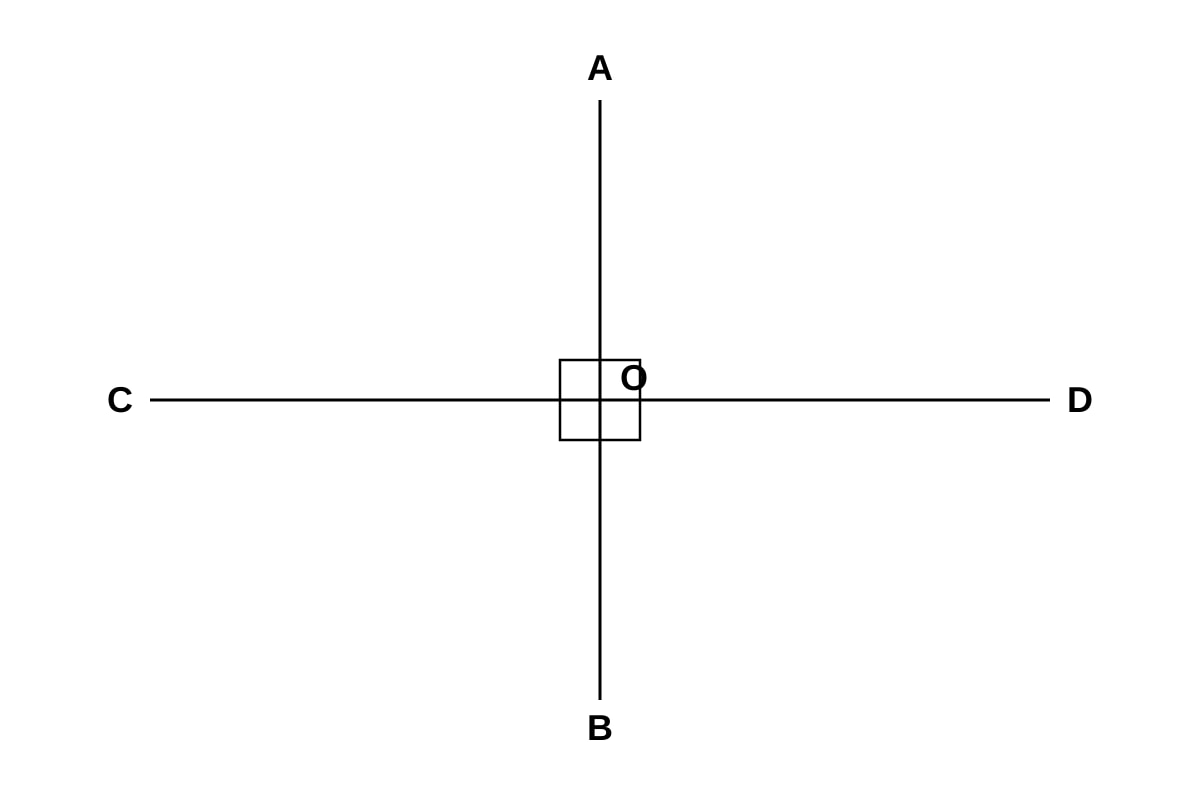
13. In the figure below, AB is perpendicular to CD. They meet at point O.

<image_placeholder> id: Q13-fig1 type: diagram linked_question: Q13 description: Two lines AB (vertical) and CD (horizontal) intersecting at point O. Line AB extends above and below O. Line CD extends left and right of O. Right angle symbols at all four angles around O (top, bottom, left, right). labels: A (top of vertical line), B (bottom of vertical line), C (left of horizontal line), D (right of horizontal line), O (intersection point); right angle symbols in all four quadrants values: none must_show: Perpendicular lines with clear right angle symbols at all four angles; labeled points </image_placeholder>

(a) Name two angles that are right angles. [2]


(b) If angle AOC = 90°, what is the size of angle AOD? [2]

Working:


Answer: _________________ [4]

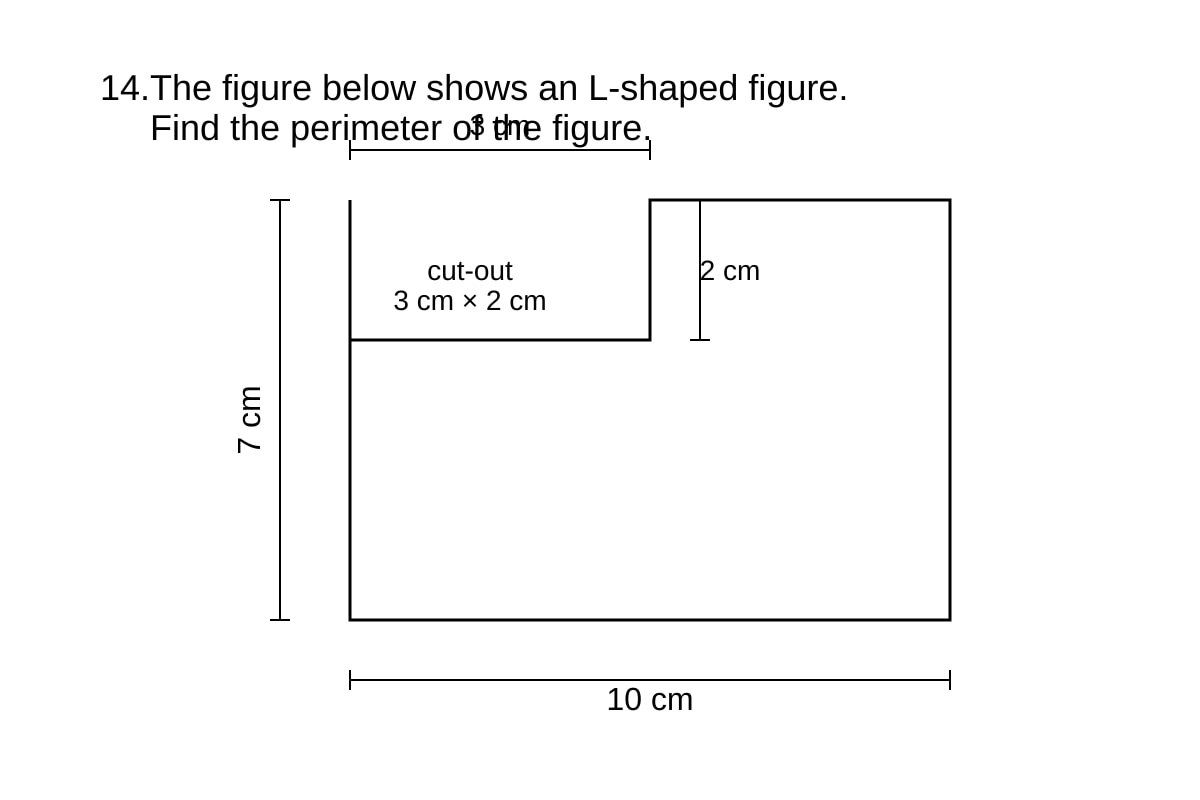
14. The figure below shows a shape with missing measurements.

<image_placeholder> id: Q14-fig1 type: diagram linked_question: Q14 description: An L-shaped composite figure made of two rectangles. The overall shape fits in a 10 cm by 7 cm bounding box. The top left corner has a 3 cm by 2 cm rectangle removed (creating the L shape). Dimensions shown: total height 7 cm, total width 10 cm, cut-out width 3 cm, cut-out height 2 cm. labels: total height 7 cm, total width 10 cm, cut-out width 3 cm, cut-out height 2 cm values: overall 10 cm × 7 cm; cut-out 3 cm × 2 cm in top-left corner must_show: All relevant dimensions labeled clearly; L-shape with cut-out corner indicated </image_placeholder>

Find the perimeter of the figure. [3]

Working:


Answer: _________________ [3]

15. Complete the following:

(a) A ___________ has 4 equal sides and 4 right angles. [1]

(b) A ___________ has 4 sides with only 1 pair of parallel sides. [1]

(c) A rectangle has ___________ pairs of parallel lines. [1]

(d) Two lines that meet at right angles are called ___________ lines. [1]

[4]

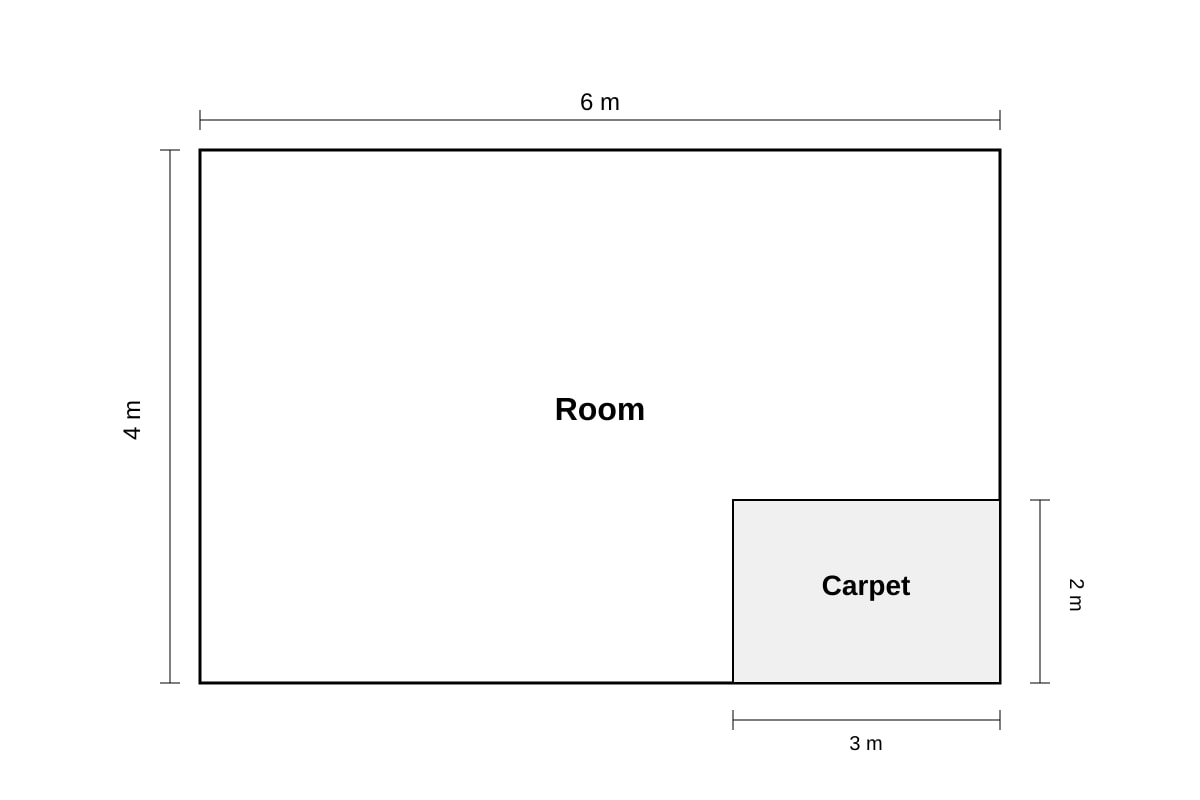
16. Look at the floor plan below.

<image_placeholder> id: Q16-fig1 type: diagram linked_question: Q16 description: A rectangular room floor plan with a smaller rectangular carpet placed in one corner. Room measures 6 m by 4 m. Carpet measures 3 m by 2 m, placed in the bottom right corner. labels: Room: 6 m, 4 m; Carpet: 3 m, 2 m; "Carpet" labeled on inner rectangle values: room 6 m × 4 m; carpet 3 m × 2 m in corner must_show: Both rectangles with dimensions, clear labeling of carpet region </image_placeholder>

(a) Find the area of the room. [1]

Working:


(b) Find the area of the carpet. [1]

Working:


(c) Find the area of the floor not covered by the carpet. [2]

Working:


Answers: (a) _________________ (b) _________________ (c) _________________ [4]


Section C: Problem Solving (Questions 17-20)

Show all your working clearly. Marks are shown in brackets.

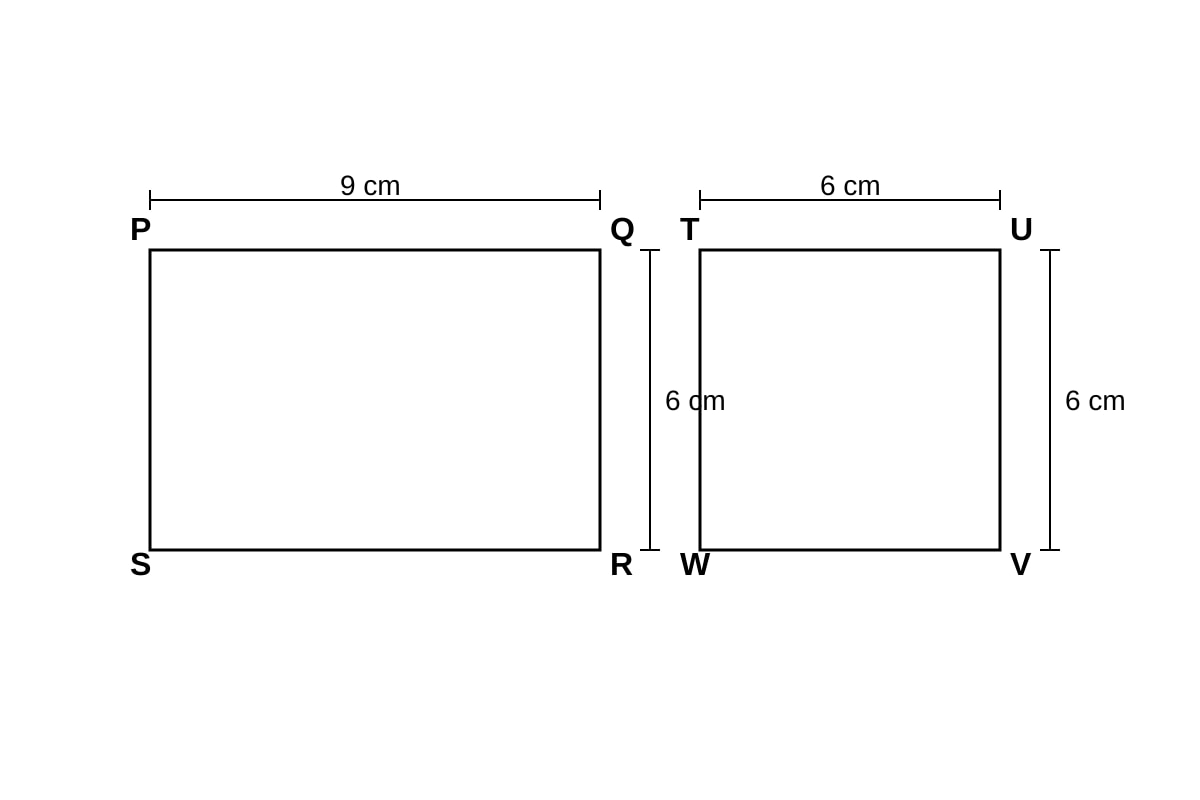
17. The figure below shows Rectangle PQRS and Square TUVW.

<image_placeholder> id: Q17-fig1 type: diagram linked_question: Q17 description: Two shapes side by side. Rectangle PQRS on left with length 9 cm and width 6 cm. Square TUVW on right with side 6 cm (same as rectangle width). Shapes are aligned at the bottom. labels: P, Q, R, S on rectangle; T, U, V, W on square; dimensions 9 cm, 6 cm on rectangle; 6 cm on square values: rectangle PQRS: 9 cm × 6 cm; square TUVW: 6 cm × 6 cm must_show: Both shapes with all vertices labeled and dimensions clearly shown </image_placeholder>

(a) Find the area of Rectangle PQRS. [2]

Working:


(b) Find the area of Square TUVW. [1]

Working:


(c) The two shapes are placed side by side to form a new figure. Find the perimeter of the new figure. [3]

Working:


Answers: (a) _________________ (b) _________________ (c) _________________ [6]

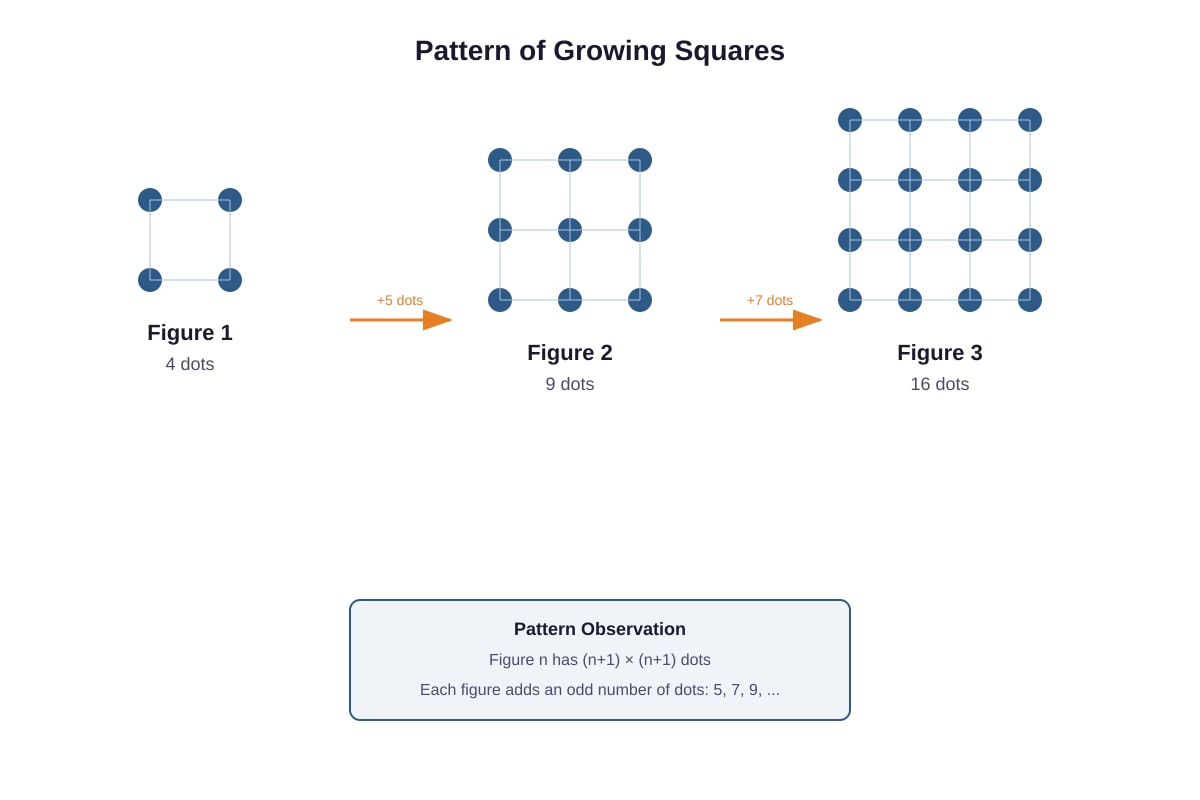
18. Study the pattern of dots below.

<image_placeholder> id: Q18-fig1 type: diagram linked_question: Q18 description: A pattern of growing squares made of dots. Figure 1: 2×2 square with 4 dots. Figure 2: 3×3 square with 9 dots. Figure 3: 4×4 square with 16 dots. Figures are labeled below each. labels: Figure 1, Figure 2, Figure 3; dot count below each values: Figure 1: 2×2 grid, 4 dots; Figure 2: 3×3 grid, 9 dots; Figure 3: 4×4 grid, 16 dots must_show: Complete dot grids for each figure, clear pattern progression, labels and counts </image_placeholder>

(a) How many dots are there in Figure 4? [1]


(b) Explain how the pattern grows. [2]


(c) How many dots would there be in Figure 6? [2]

Working:


Answers: (a) _________________ (c) _________________ [5]

19. Tom has a rectangular photo that measures 15 cm by 10 cm. He wants to put a frame around it. The frame is 2 cm wide on all sides.

(a) Draw a diagram to show the photo and the frame. Label your diagram with all the measurements. [2]

(b) Find the perimeter of the photo without the frame. [1]

Working:


(c) Find the perimeter of the outer edge of the frame. [3]

Working:


Answers: (b) _________________ (c) _________________ [6]

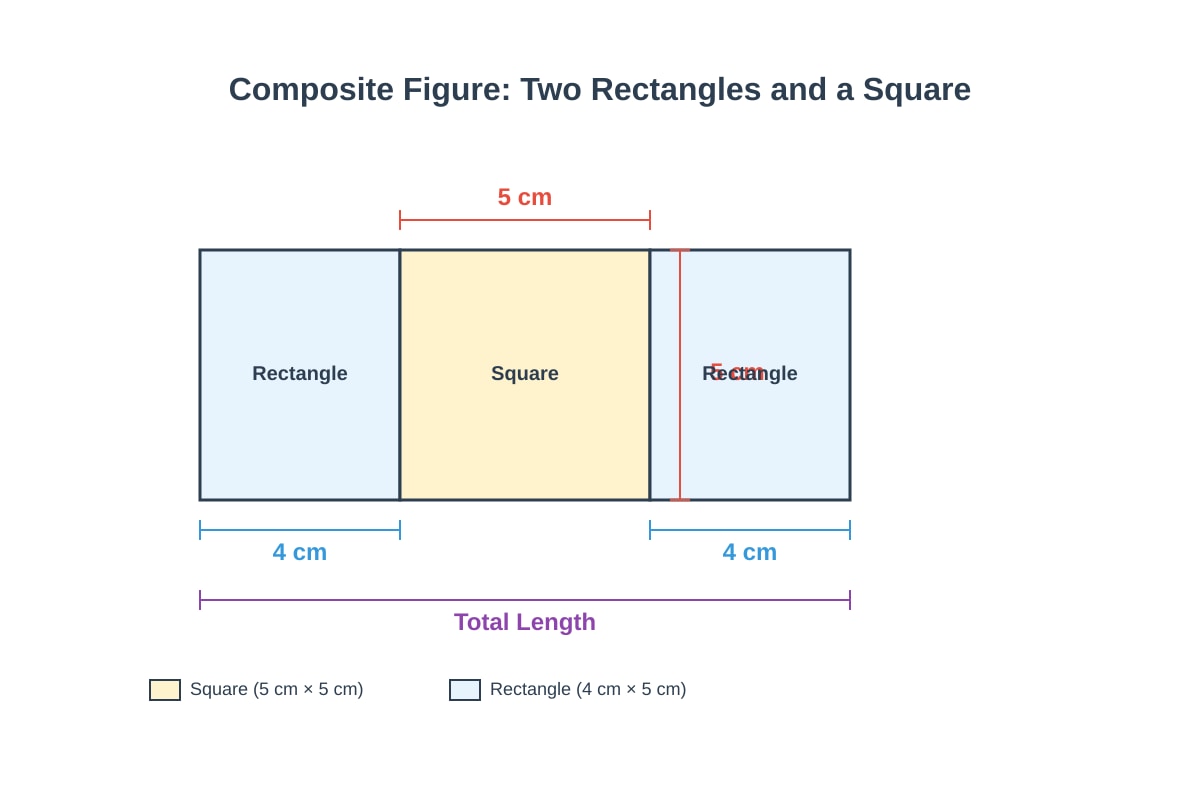
20. The figure below is made up of two identical rectangles and a square.

<image_placeholder> id: Q20-fig1 type: diagram linked_question: Q20 description: A composite figure where a square is in the middle with a rectangle attached to its left side and an identical rectangle attached to its right side. The square has side 5 cm. Each rectangle has width 4 cm and height 5 cm (same as square side), sharing the full height with the square. labels: square side 5 cm; rectangle width 4 cm, height 5 cm values: square: 5 cm × 5 cm; each rectangle: 4 cm × 5 cm must_show: Three connected shapes with dimensions, shared sides indicated or clear from alignment </image_placeholder>

(a) Find the total length of the figure. [2]

Working:


(b) Find the total area of the figure. [3]

Working:


(c) Jane says the perimeter of this figure is the same as the perimeter of a rectangle with length 13 cm and width 5 cm. Is she correct? Explain your answer. [3]

Working:


Answers: (a) _________________ (b) _________________ [8]


END OF QUIZ

Check your work before handing in.

Answers

<!-- TuitionGoWhere generation metadata: stage=5-1; model=moonshotai/kimi-k2.6:free; model_label=Kimi K2.6 Free; generated=2026-06-06; Sources: Stage 4-0 LLM templates, syllabus context, and Stage 2 evidence where available. -->

Primary 3 Mathematics Quiz - Geometry: ANSWER KEY

Total Marks: 40
Duration: 40 minutes


Section A: Multiple Choice (16 marks)

QuestionAnswerExplanation
1BAnswer B shows a right angle (90°) with the square corner symbol. This is the standard notation for a right angle. Angles smaller than 90° are acute (like A); angles larger than 90° are obtuse (like C).
24A rectangle has 4 right angles — one at each corner. You can check by looking at where each pair of adjacent sides meets at a square corner (90°).
3BParallel lines are lines that never meet and stay the same distance apart. They are shown with arrowheads. Diagram B shows parallel lines. A shows intersecting lines; C shows perpendicular lines.
4SquareA shape with 4 equal sides and 4 right angles is called a square. If the sides were equal but angles were not right angles, it could be a rhombus.
5Right angleAt 3 o'clock, the minute hand points to 12 and the hour hand points to 3. These hands are perpendicular to each other, forming a right angle (90°).
6BA parallelogram has 2 pairs of parallel sides (opposite sides are parallel). A triangle has 0 pairs; a trapezium has only 1 pair.
720 cmPerimeter of square = 4 × side = 4 × 5 cm = 20 cm.
8XAngle X is acute (approximately 30°), which is smaller than the right angle Y (90°) and the obtuse angle Z (110°). Acute angles are always smaller than right angles.

Section B: Short Answer (20 marks)

9. [3 marks total]

(a) AB and BC (or BC and CD, or CD and DA, or DA and AB) — any pair of adjacent sides [1]

(b) AB and CD (or BC and DA) — opposite sides of a rectangle are parallel [1]

(c) 4 right angles — one at each corner where two perpendicular sides meet [1]

Teaching note: In a rectangle, perpendicular means meeting at 90° (adjacent sides), and parallel means never meeting, always same distance apart (opposite sides).


10. [3 marks]

Perimeter of composite figure:

Step 1: Identify the outer edges. The square (4 cm × 4 cm) and rectangle (3 cm × 4 cm) share one side of 4 cm.

Step 2: Trace the outer boundary: top 4 cm + top right 3 cm + right side 4 cm + bottom 3 cm + bottom left 4 cm + left side 4 cm.

Or use formula: Sum of all outer sides = 4 + 3 + 4 + 3 + 4 + 4 = 22 cm

Alternative method: Perimeter of square (16 cm) + perimeter of rectangle (14 cm) − 2 × shared side (8 cm) = 16 + 14 − 8 = 22 cm. But this is complex for P3; the tracing method is preferred.

Answer: 22 cm [3]

Common mistake: Students often forget to subtract the shared side and get 16 + 14 = 30 cm. Remind them: only count the outer edges for perimeter.


11. [5 marks total]

(a) Angles P and R (both acute angles, less than 90°) [2]

(b) Angle Q (obtuse angle, greater than 90°) [1]

(c) P, R, S, Q (or using symbols: 45°, 60°, 90°, 135°) [2]

Teaching note: Acute = less than 90°; Right = exactly 90°; Obtuse = greater than 90° but less than 180°.


12. [5 marks total]

(a) Perimeter of garden = 2 × (length + width) = 2 × (12 + 8) = 2 × 20 = 40 m [2]

(b) Area of path:

  • The path runs through the middle, so it is 2 m wide and 8 m long (the width of the garden)
  • Area = 2 m × 8 m = 16 m² [3]

Common mistake: Students might use 12 m instead of 8 m. The path runs the width direction (vertically), so its length equals the garden's width (8 m), not the garden's length.


13. [4 marks total]

(a) Angle AOC and angle COB (or BOD and DOA, or AOD and DOC, etc.) — any two adjacent right angles [2]

(b) Angles on a straight line CD add to 180°.

  • Angle AOC + Angle AOD = 180°
  • 90° + Angle AOD = 180°
  • Angle AOD = 180° − 90° = 90° [2]

Teaching note: When two lines are perpendicular, all four angles around the intersection are right angles (90° each).


14. [3 marks]

Perimeter of L-shape:

Method — Trace the outer edges: Starting from top left and going clockwise:

  • Down: 7 cm, but the cut-out means we must be careful

Better approach: The L-shape fits in a 10 cm × 7 cm rectangle with a 3 cm × 2 cm corner removed.

Outer edges:

  • Top horizontal: 10 − 3 = 7 cm, then down 2 cm (inner edge), then 3 cm to corner...

Actually, trace carefully: Starting top left of notch, go right 7 cm, down 5 cm, right 3 cm, down 2 cm, left 10 cm, up 7 cm.

Or use the trick: Perimeter of L-shape = Perimeter of bounding rectangle = 2 × (10 + 7) = 34 cm

Why? The two "steps" (3 cm and 2 cm) replace the corner, keeping total distance the same.

Answer: 34 cm [3]

Teaching note: For L-shapes made from rectangles, the perimeter equals the perimeter of the bounding rectangle. Test by tracing to verify.


15. [4 marks total]

(a) Square [1]

(b) Trapezium [1]

(c) 2 [1]

(d) Perpendicular [1]


16. [4 marks total]

(a) Area of room = 6 m × 4 m = 24 m² [1]

(b) Area of carpet = 3 m × 2 m = 6 m² [1]

(c) Area not covered = 24 − 6 = 18 m² [2]


Section C: Problem Solving (24 marks)

17. [6 marks total]

(a) Area of Rectangle PQRS = length × width = 9 cm × 6 cm = 54 cm² [2]

(b) Area of Square TUVW = side × side = 6 cm × 6 cm = 36 cm² [1]

(c) When placed side by side (sharing the 6 cm side):

  • New figure dimensions: total length = 9 + 6 = 15 cm; width = 6 cm
  • Perimeter = 2 × (15 + 6) = 2 × 21 = 42 cm [3]

Alternative check: Trace outer edges: 9 + 6 + 6 + 15 = 36... wait, need to be careful. The shared 6 cm side is internal.

Outer edges: 9 cm (top of rectangle) + 6 cm (top of square) = 15 cm top; 6 cm right side; 6 cm bottom of square + 9 cm bottom of rectangle = 15 cm bottom; 6 cm left side.

Perimeter = 15 + 6 + 15 + 6 = 42 cm


18. [5 marks total]

(a) Figure 4 is a 5×5 square = 25 dots [1]

(b) The pattern grows by adding a border of dots. Figure n is an (n+1) × (n+1) square. Each new figure adds a row and a column, increasing by an odd number: 4, 9, 16, 25... these are square numbers: 2², 3², 4², 5²... [2]

(c) Figure 6: (6+1)² = 7² = 49 dots [2]

Or: Figure follows (n+1)², so Figure 6 = 7² = 49.


19. [6 marks total]

(a) Diagram should show:

  • Inner rectangle (photo): 15 cm × 10 cm
  • Outer rectangle (frame): 15+2+2 = 19 cm by 10+2+2 = 14 cm
  • Frame 2 cm wide on all sides [2]

(b) Perimeter of photo = 2 × (15 + 10) = 2 × 25 = 50 cm [1]

(c) Outer dimensions of frame: 19 cm × 14 cm Perimeter = 2 × (19 + 14) = 2 × 33 = 66 cm [3]

Common mistake: Students might think frame adds 2 cm total to each dimension, not 2 cm on EACH side (so +4 cm total).


20. [8 marks total]

(a) Total length = 4 cm + 5 cm + 4 cm = 13 cm [2]

(b) Total area:

  • Square: 5 cm × 5 cm = 25 cm²
  • Two rectangles: 2 × (4 cm × 5 cm) = 2 × 20 = 40 cm²
  • Total = 25 + 40 = 65 cm² [3]

(c) Perimeter of given figure:

  • Outer edges: 4 + 5 + 4 = 13 cm (top and bottom), 5 cm (left and right sides)
  • Perimeter = 2 × (13 + 5) = 2 × 18 = 36 cm

Perimeter of Jane's rectangle (13 cm × 5 cm):

  • 2 × (13 + 5) = 36 cm

Jane is correct. The perimeters are equal. [3]

Teaching note: Even though the shapes look different, when rectangles are attached flush along their full height, the "lost" inner edges equal the "gained" outer edges in this symmetric arrangement. The resulting perimeter matches a single rectangle with the total length and shared height.


MARK SUMMARY

SectionQuestionsMarks
A1-816
B9-1620
C17-2024
Total40