AI Generated Quiz
Primary 3 Mathematics Data Analysis Quiz
Free P3 Maths Data Analysis quiz, GLM5.3 AI version, with questions, answers, and syllabus-aligned practice for Singapore students.
These static practice materials are generated from the site's syllabus and paper-generation workflow, with source and model context shown so students and parents can evaluate the material before use.
Questions
Free quiz and exam paper access
Enter your details to view this paper
Your access is remembered on this device.
Answers
Primary 3 Mathematics Quiz - Data Analysis: Answer Key
Version: Practice Quiz 1 of 5 | Total Marks: 60
Syllabus-based practice content; not derived from past-year papers.
Answer 1. [2 marks]
Answer: 6 books
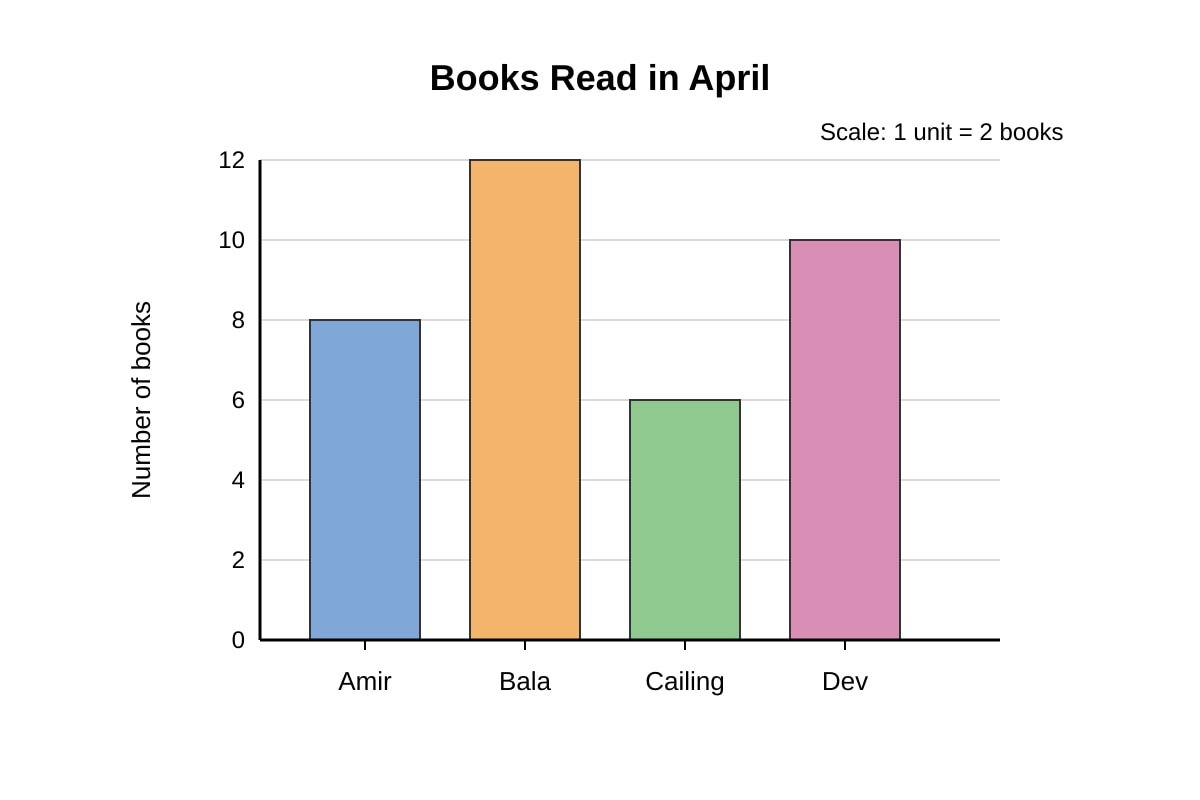
- Teaching note: A bar graph shows data as bars. Read where the top of the bar meets the scale. Cailing's bar ends at the 3rd gridline. Since 1 unit = 2 books, .
- Common mistake: Writing "3" (counting units) instead of multiplying by the scale.
Answer 2. [2 marks]
Answer: 6 books
- Working: Most books - Bala, 12 books. Fewest - Cailing, 6 books. Difference: books.
- Teaching note: "Difference" always means subtraction. First find the tallest and shortest bars, then subtract.
Answer 3. [2 marks]
Answer: 25 bottles
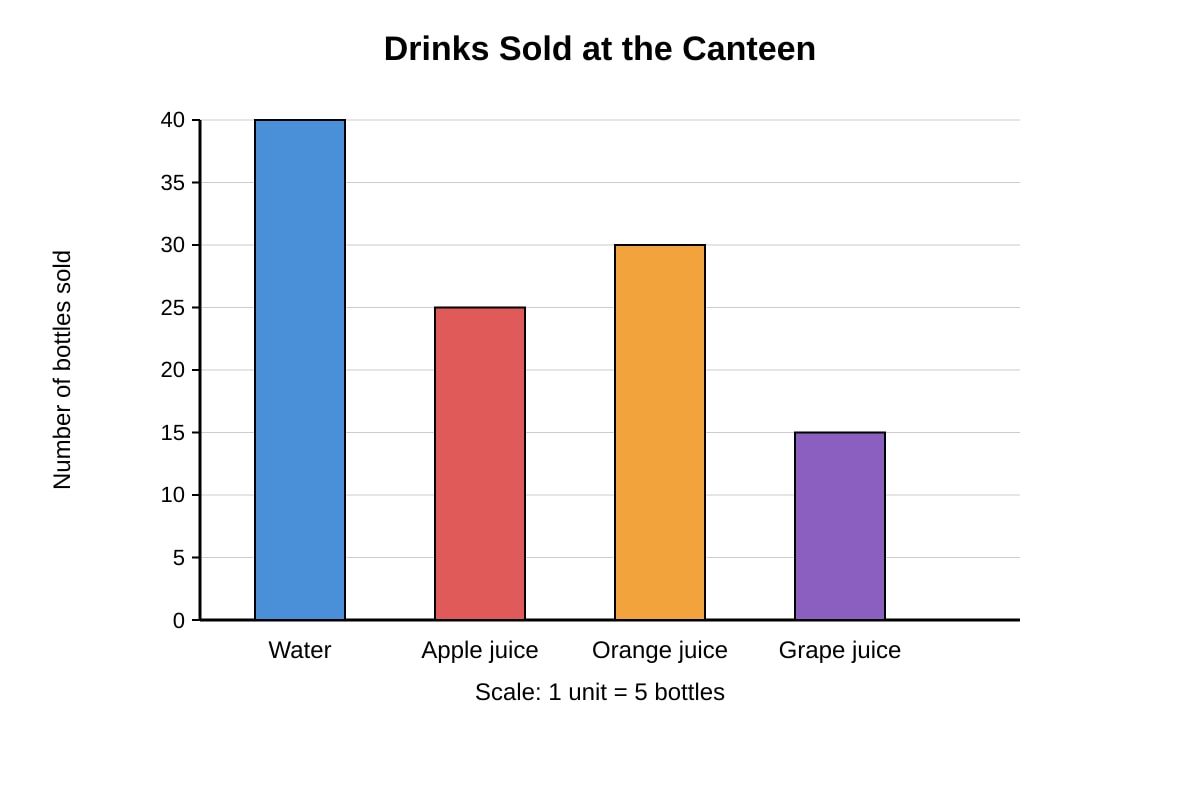
- Working: The apple juice bar ends at the 5th gridline. bottles.
- Teaching note: Always check the scale note before reading. Here each unit stands for 5 bottles, not 1.
Answer 4. [2 marks]
Answer: Water
- Working: The water bar is the tallest, reaching 40 bottles, more than orange juice (30), apple juice (25) and grape juice (15).
- Teaching note: On a bar graph, the tallest bar shows the largest value - you do not need to read every number to compare.
Answer 5. [2 marks]
Answer: 4 pupils
- Working: Fish owners = 9, cat owners = 5. pupils.
- Teaching note: "How many more" asks for a comparison, so subtract the smaller number from the larger.
Answer 6. [2 marks]
Answer: 24 pupils
- Working: Add all rows: pupils.
- Teaching note: "Altogether" means add every group. Check by adding again in a different order: .
- Common mistake: Missing one row when adding.
Answer 7. [2 marks]
Answer: Yellow House
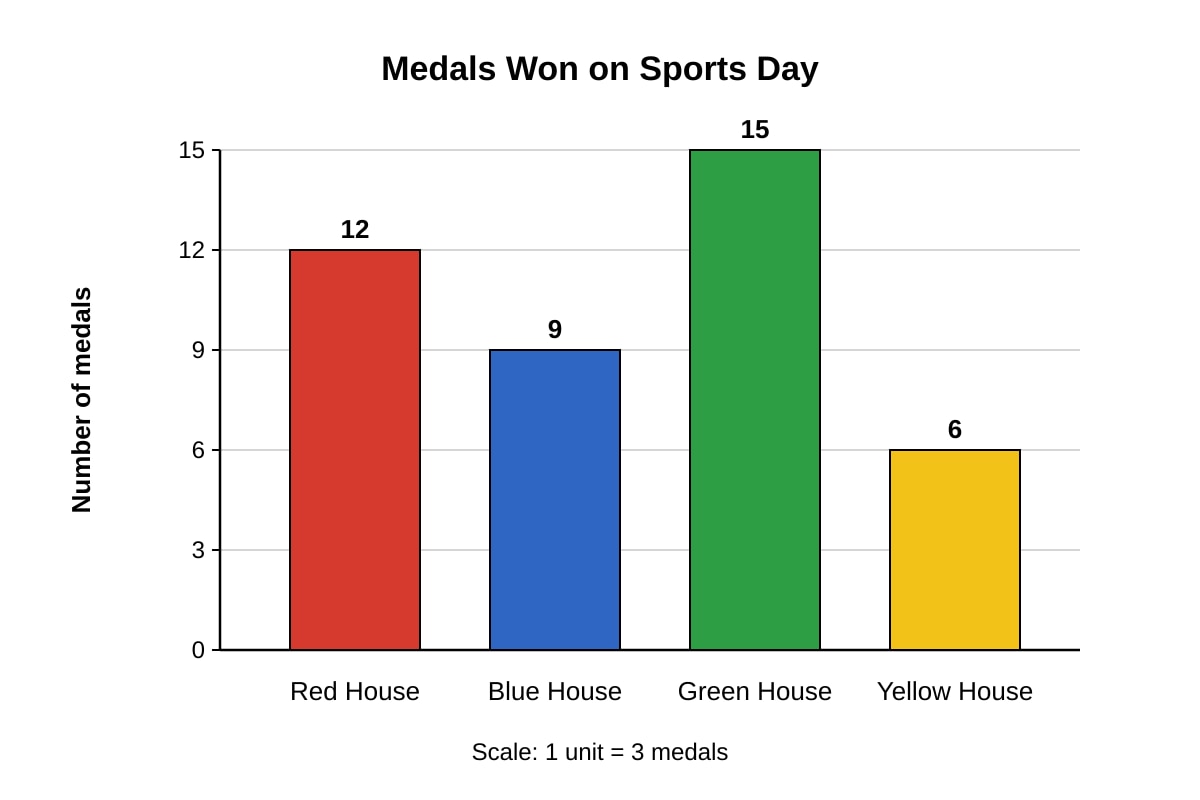
- Working: Yellow House's bar is the shortest, reaching 6 medals (2 units 3).
- Teaching note: The shortest bar gives the smallest value. Reading the value (6) confirms the comparison.
Answer 8. [2 marks]
Answer: 24 medals
- Working: Green House = 15 medals, Blue House = 9 medals. medals.
- Teaching note: Read each bar separately using the scale (Green: 5 units 3 = 15; Blue: 3 units 3 = 9), then add.
Answer 9. [3 marks]
Answer: Friday, 50 cones
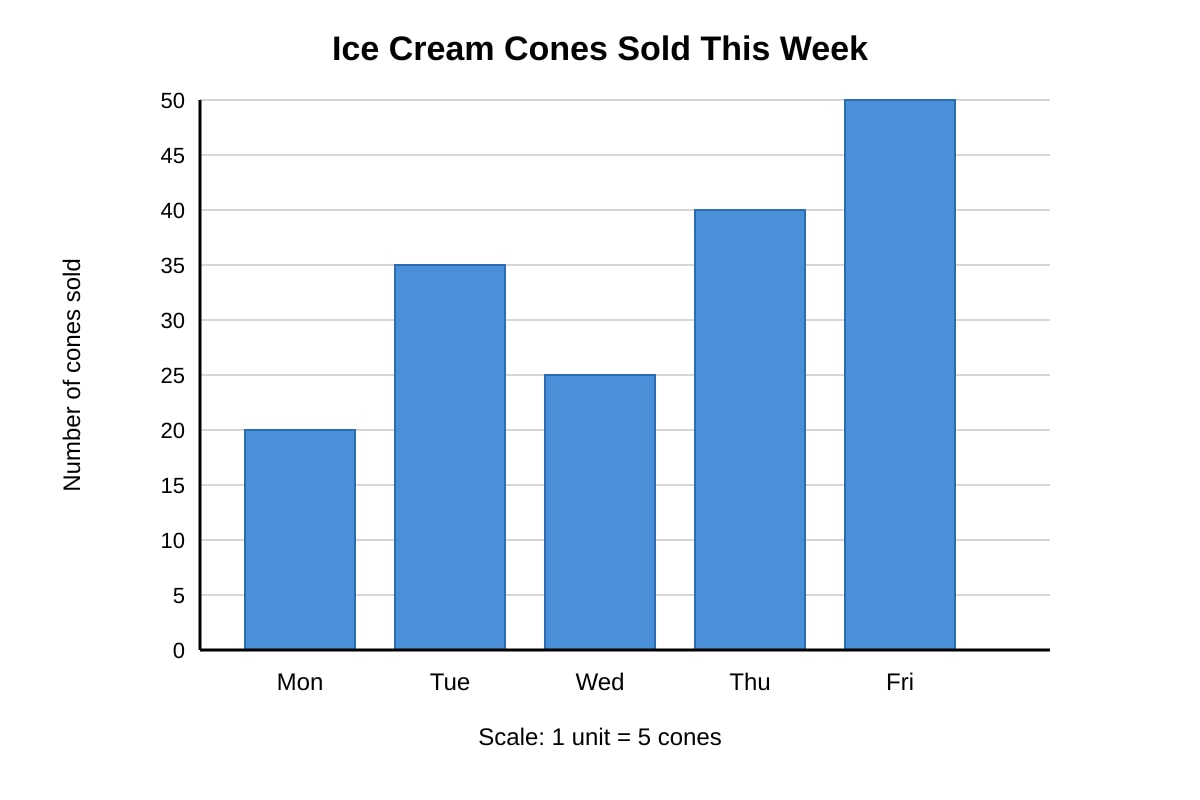
- Working: The tallest bar is Friday. It ends at the 10th gridline: cones.
- Marks: 1 mark for naming Friday, 1 mark for using the scale (), 1 mark for the answer 50.
- Common mistake: Counting gridlines as cones directly (answering 10).
Answer 10. [3 marks]
Answer: 100 cones
- Working: Tue = 35, Wed = 25, Thu = 40. Total: cones.
- Marks: 1 mark for reading each value correctly, 1 mark for adding, 1 mark for the total with units.
- Teaching note: Convert each bar to its value first, then add. Do not add bar heights in units.
Answer 11. [3 marks]
Answer: 30 cones
- Working: Friday = 50, Monday = 20. fewer cones.
- Marks: 1 mark for each correct value, 1 mark for correct subtraction.
- Teaching note: "How many fewer A than B" means B A. Take the larger amount minus the smaller.
Answer 12. [3 marks]
Answer: 84 kg
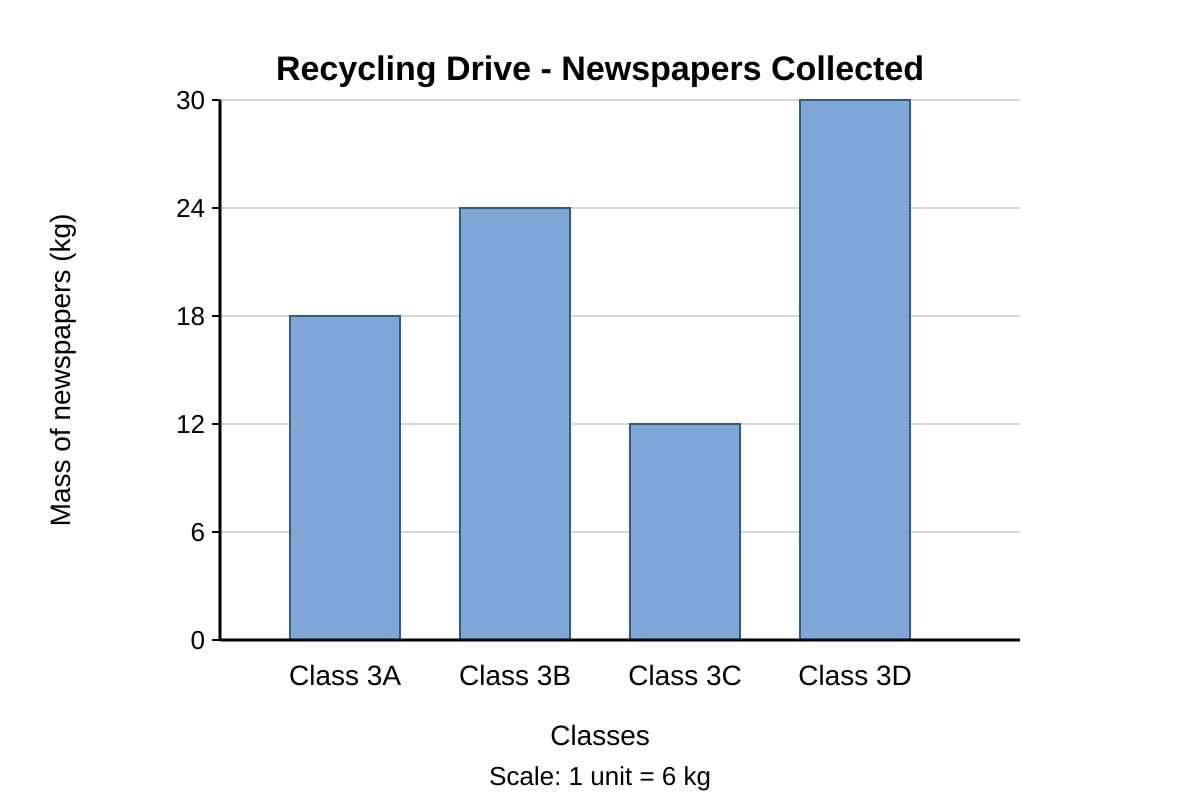
- Working: 3A = 18 kg, 3B = 24 kg, 3C = 12 kg, 3D = 30 kg. Total: kg.
- Marks: 1 mark for correct readings, 1 mark for addition, 1 mark for total with units (kg).
- Teaching note: Remember to write the unit. Mass here is measured in kilograms.
Answer 13. [3 marks]
Answer: 18 kg
- Working: 3D = 30 kg, 3C = 12 kg. kg.
- Marks: 1 mark for each value, 1 mark for subtraction with units.
- Common mistake: Comparing bar heights in units (3 units vs 2 units) and forgetting the scale of 6 kg per unit.
Answer 14. [3 marks]
Answer: Sam (25), Tina (20), Priya (15), Wei (10)
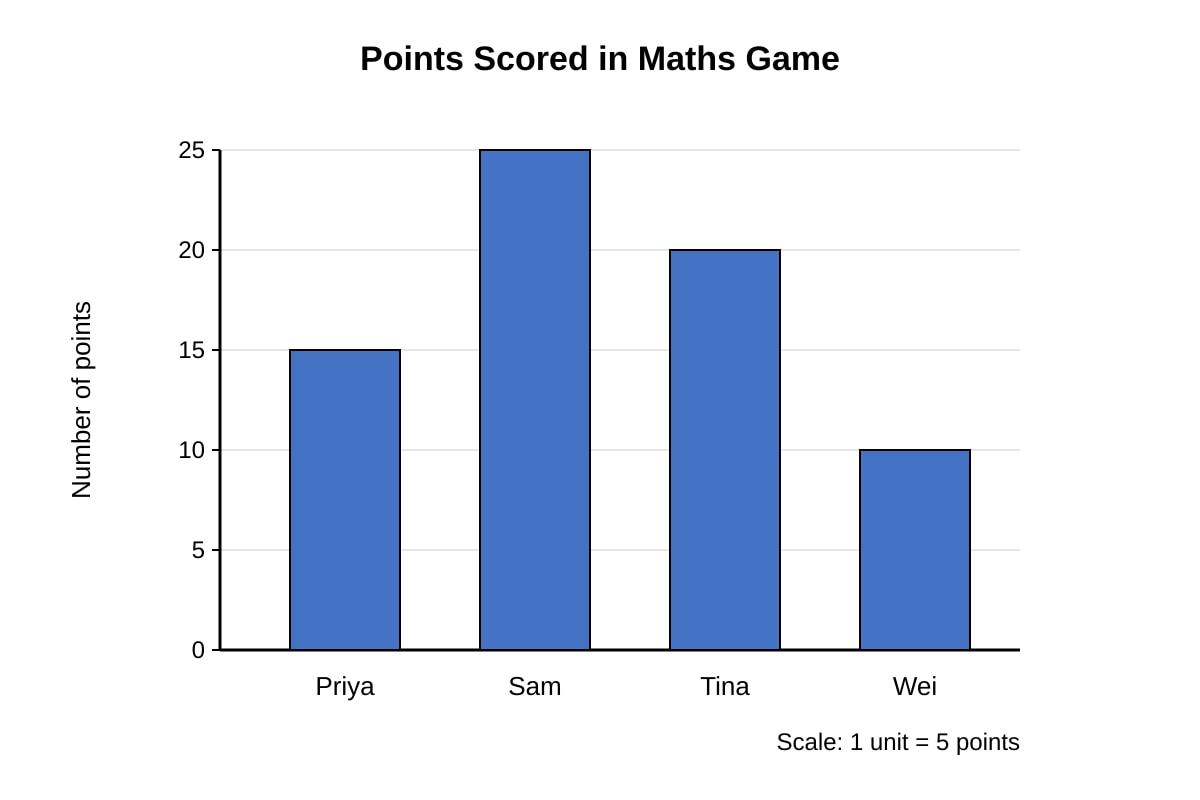
- Working: Read each bar: Sam , Tina , Priya , Wei . Then order from largest to smallest.
- Marks: 1 mark for all values correct, 2 marks for fully correct order (1 mark if only one swap).
- Teaching note: Converting every bar to its value makes ordering safe - comparing unit heights alone can lead to errors.
Answer 15. [3 marks]
Answer: No. He needed 30 more cones.
- Working:
- Step 1: Add the week's sales: cones.
- Step 2: Compare with the goal: , so the goal was not reached.
- Step 3: Find the shortfall: cones.
- Marks: 1 mark for correct total, 1 mark for the comparison/conclusion, 1 mark for 30 more cones.
- Teaching note: Multi-step data problems need you to collect values from the graph first, then decide whether to add, subtract, or both.
Answer 16. [3 marks]
Answer: Class 3E; 12 kg more than Class 3B
- Working: 3E collects 36 kg. Compare: 36 kg 30 kg (3D), so Class 3E now has the most. Difference from 3B: kg.
- Marks: 1 mark for identifying 3E, 1 mark for justifying with the comparison, 1 mark for 12 kg.
- Teaching note: New information can change the graph's "winner". Always compare the new
<stage5_quiz_answers_md>
Primary 3 Mathematics Quiz - Data Analysis: Answer Key
Version: Practice Quiz 1 of 5 | Total Marks: 60
Syllabus-based practice content; not derived from past-year papers.
Answer 1. [2 marks]
Answer: 6 books
- Teaching note: Read where the top of Cailing's bar meets the scale. It ends at the 3rd gridline. Since 1 unit = 2 books, .
- Common mistake: Writing "3" (counting units) instead of multiplying by the scale.
Answer 2. [2 marks]
Answer: 6 books
- Working: Most books - Bala, 12 books. Fewest - Cailing, 6 books. Difference: books.
- Teaching note: "Difference" always means subtraction.
Answer 3. [2 marks]
Answer: 25 bottles
- Working: The apple juice bar ends at the 5th gridline. bottles.
- Teaching note: Always check the scale note before reading.
Answer 4. [2 marks]
Answer: Water
- Working: The water bar is the tallest, reaching 40 bottles.
- Teaching note: The tallest bar shows the largest value.
Answer 5. [2 marks]
Answer: 4 pupils
- Working: Fish owners = 9, cat owners = 5. pupils.
- Teaching note: "How many more" means subtract.
Answer 6. [2 marks]
Answer: 24 pupils
- Working: pupils.
- Common mistake: Missing one row when adding.
Answer 7. [2 marks]
Answer: Yellow House
- Working: Yellow House's bar is the shortest, reaching 6 medals ().
- Teaching note: The shortest bar gives the smallest value.
Answer 8. [2 marks]
Answer: 24 medals
- Working: Green House = 15 medals, Blue House = 9 medals. medals.
- Teaching note: Read each bar using the scale first, then add.
Answer 9. [3 marks]
Answer: Friday, 50 cones
- Working: The tallest bar is Friday, ending at the 10th gridline: cones.
- Marks: 1 mark for naming Friday, 1 mark for using the scale, 1 mark for the answer 50.
- Common mistake: Counting gridlines as cones directly (answering 10).
Answer 10. [3 marks]
Answer: 100 cones
- Working: Tue = 35, Wed = 25, Thu = 40. cones.
- Marks: 1 mark for reading each value, 1 mark for adding, 1 mark for the total with units.
Answer 11. [3 marks]
Answer: 30 cones
- Working: Friday = 50, Monday = 20. fewer cones.
- Marks: 1 mark for each correct value, 1 mark for correct subtraction.
- Teaching note: "How many fewer A than B" means B A.
Answer 12. [3 marks]
Answer: 84 kg
- Working: kg.
- Marks: 1 mark for correct readings, 1 mark for addition, 1 mark for total with units (kg).
- Teaching note: Remember to write the unit.
Answer 13. [3 marks]
Answer: 18 kg
- Working: 3D = 30 kg, 3C = 12 kg. kg.
- Marks: 1 mark for each value, 1 mark for subtraction with units.
- Common mistake: Comparing unit heights and forgetting the scale of 6 kg per unit.
Answer 14. [3 marks]
Answer: Sam (25), Tina (20), Priya (15), Wei (10)
- Working: Sam , Tina , Priya , Wei . Order from largest to smallest.
- Marks: 1 mark for all values correct, 2 marks for fully correct order.
Answer 15. [3 marks]
Answer: No. He needed 30 more cones.
- Working:
- Step 1: Add the week's sales: cones.
- Step 2: Compare with the goal: , so the goal was not reached.
- Step 3: Find the shortfall: cones.
- Marks: 1 mark for the total, 1 mark for the comparison/conclusion, 1 mark for 30 more cones.
Answer 16. [3 marks]
Answer: Class 3E; 12 kg more than Class 3B
- Working: 3E collects 36 kg. Compare: 36 kg 30 kg (3D), so Class 3E now has the most. Difference from 3B: kg.
- Marks: 1 mark for identifying 3E, 1 mark for the comparison, 1 mark for 12 kg.
- Teaching note: New information can change the graph's "winner". Always compare the new value with every existing bar.
Answer 17. [5 marks]
Answer: Correctly drawn bar graph
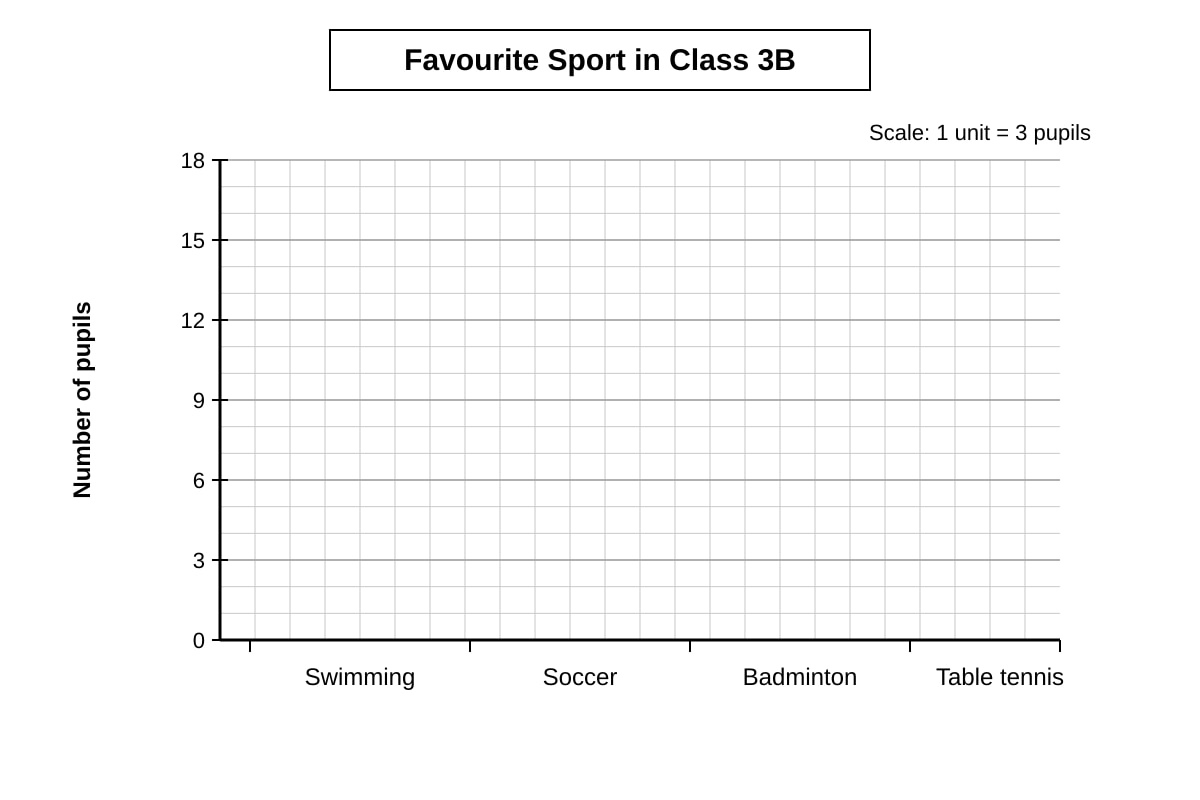
- Bars to draw (scale 1 unit = 3 pupils):
- Swimming: units high
- Soccer: units high
- Badminton: units high
- Table tennis: units high
- Marks: 1 mark for each correctly drawn bar (height and correct column); 1 mark for neat straight bars, correct title/labels and use of the given scale.
- Common mistake: Drawing bars using the raw numbers (e.g., 12 units high) instead of dividing by the scale.
Answer 18. [5 marks]
Answer: 9 pupils chose Reading.
- Working:
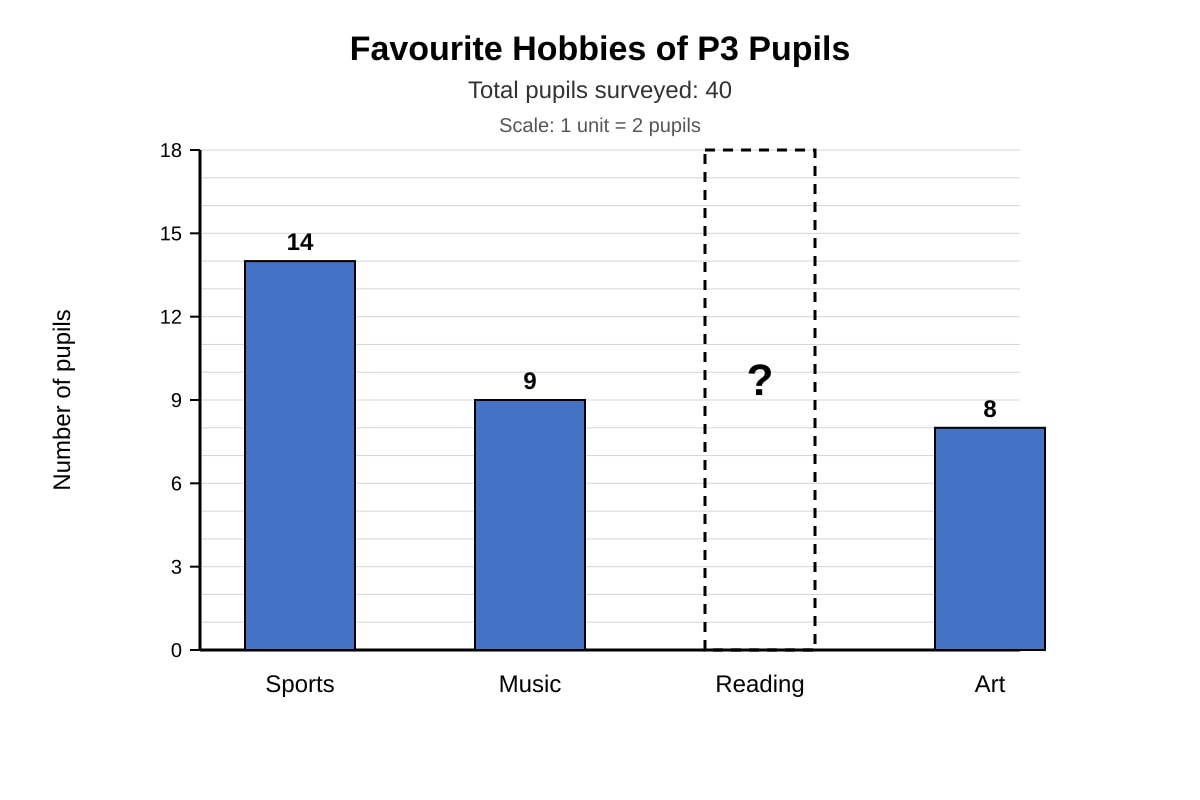
- Step 1: Add the known groups: Sports + Music + Art = pupils.
- Step 2: Subtract from the total surveyed: pupils.
- Check: . ✓
- Marks: 1 mark for method, 1 mark for 31, 2 marks for 9, 1 mark for a check or clear statement with units.
- Teaching note: When one part is unknown, use the whole minus the known parts.
Answer 19. [5 marks]
Answer: Mei has 40 stickers.
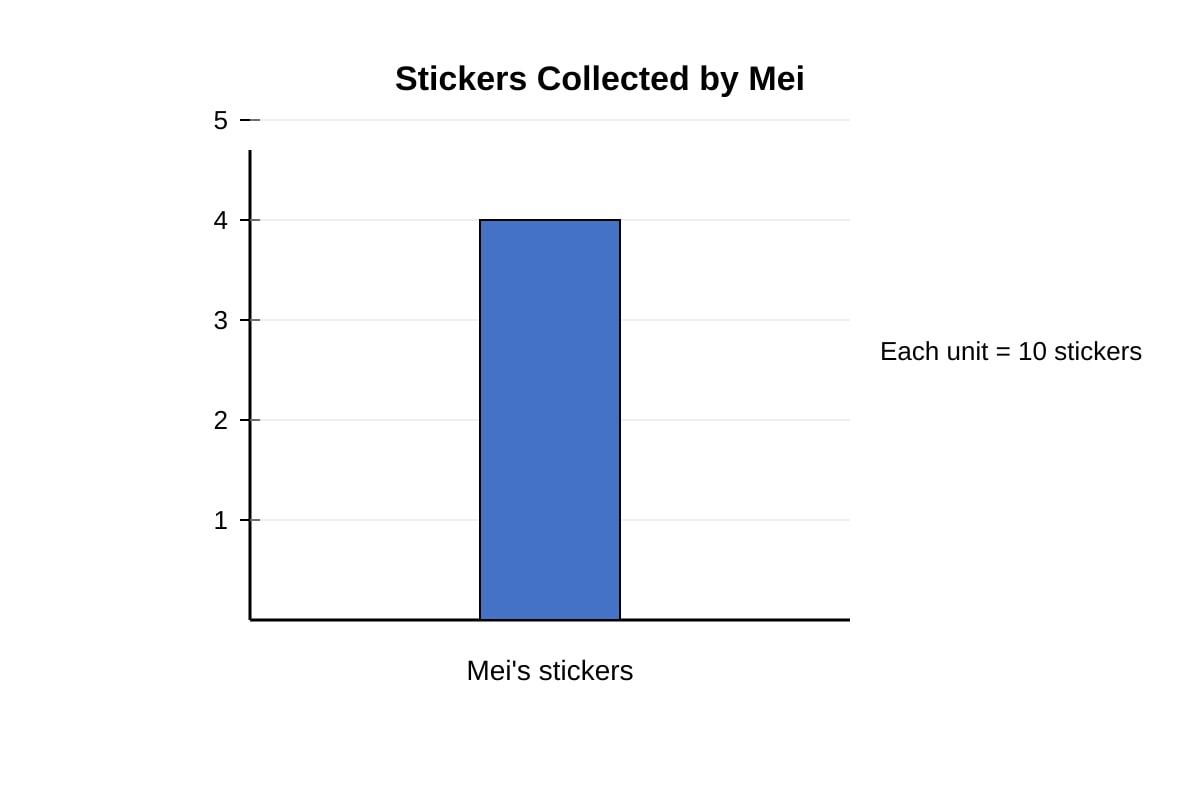
- Explanation: Ben read the height of the bar as the number of stickers. He forgot to use the scale. The graph says "Each unit = 10 stickers", and the bar rises to the 4th unit.
- Working: stickers.
- Marks: 2 marks for explaining Ben's mistake (ignoring the scale), 2 marks for multiplying by 10, 1 mark for the answer 40 stickers.
- Teaching note: On scaled picture/bar graphs, always multiply the units by what each unit stands for.
Answer 20. [5 marks]
(a) Answer: Star design; 6 more
- Working: Week 2 Week 1 = . Star sold 6 more bookmarks in Week 2 than in Week 1. Heart stayed the same, and Rainbow fell, so only Star increased. [2]
(b) Answer: Rainbow design; 3 fewer
- Working: Week 1 Week 2 = . Rainbow sold 3 fewer bookmarks in Week 2 than in Week 1. [2]
(c) Answer: 147 bookmarks
- Working: Week 1 total: . Week 2 total: . Grand total: bookmarks. [1]
- Teaching note: For two-way tables, read along the correct row or column before comparing or adding.
End of Answer Key