From Real Exams Quiz
Primary 3 Mathematics Measurement Quiz
Free Exam-Derived Kimi K2 6 Free Primary 3 Mathematics Measurement quiz with questions and answers for Singapore students. This page is rendered as a direct URL so the questions and answers can be discovered without pressing in-page buttons.
These static practice materials are generated from the site's syllabus and paper-generation workflow, with source and model context shown so students and parents can evaluate the material before use.
Questions
Primary 3 Mathematics Quiz - Measurement
Name: _________________________________ Class: _________ Date: ___________
Duration: 45 minutes
Total Marks: 40 marks
Instructions: Show your working clearly. Write your answers in the spaces provided.
Section A: Multiple Choice (Questions 1–5)
Choose the correct answer. Each question carries 1 mark.
1. What is the length of the pencil shown below?
<image_placeholder> id: Q1-fig1 type: diagram linked_question: Q1 description: A ruler showing cm and mm markings with a pencil placed horizontally above it, left end aligned with 0 mark, right end between 8.5 cm and 9 cm labels: ruler with 0, 1, 2, 3, 4, 5, 6, 7, 8, 9, 10 cm markings; pencil tip at right end values: pencil extends from 0 cm to approximately 8.7 cm must_show: clear mm subdivisions between cm marks; pencil aligned with 0 at left end; exact measurement point visible for student to read </image_placeholder>
(A) 8 cm
(B) 8.5 cm
(C) 8.7 cm
(D) 9 cm
Answer: _______
2. Mdm Tan bought 3 kg 250 g of flour. She used 1 kg 800 g to bake a cake. How much flour was left?
(A) 1 kg 450 g
(B) 1 kg 550 g
(C) 2 kg 450 g
(D) 4 kg 550 g
Answer: _______
3. Which of the following is the same as 5 m 6 cm?
(A) 56 cm
(B) 506 cm
(C) 560 cm
(D) 5006 cm
Answer: _______
4. A tank contains 4 ℓ 500 mℓ of water. Jamie pours out 750 mℓ. How much water is left in the tank?
(A) 3 ℓ 750 mℓ
(B) 3 ℓ 250 mℓ
(C) 5 ℓ 250 mℓ
(D) 5 ℓ 750 mℓ
Answer: _______
5. The mass of a packet of rice is 2 kg 500 g. What is the total mass of 4 such packets?
(A) 8 kg
(B) 10 kg
(C) 10 kg 500 g
(D) 12 kg
Answer: _______
Section B: Short Answer (Questions 6–15)
Show your working in the spaces provided. Each question carries 2 marks.
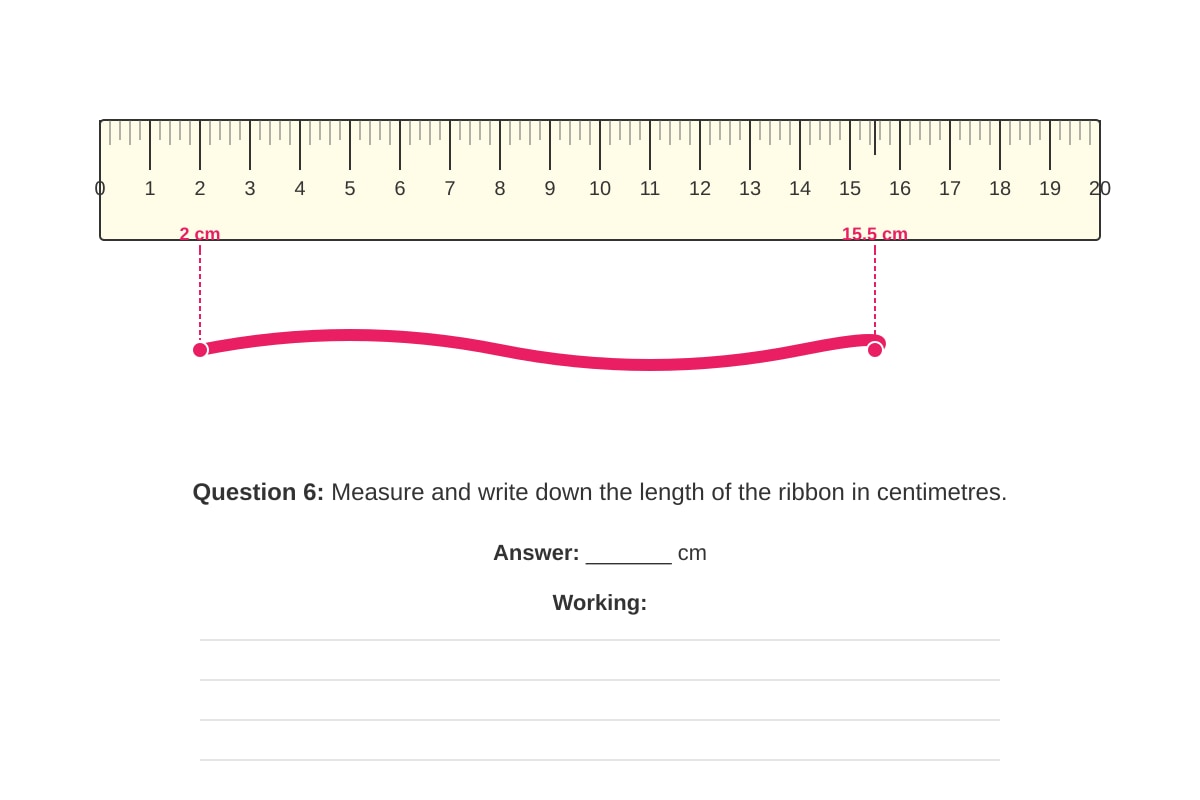
6. Measure and write down the length of the ribbon in centimetres.
<image_placeholder> id: Q6-fig1 type: diagram linked_question: Q6 description: A curved ribbon placed in a straightened position below a ruler, starting at 2 cm mark and ending at 15.5 cm mark on the ruler labels: ruler markings from 0 to 20 cm; ribbon ends clearly shown at 2 cm and 15.5 cm positions values: ribbon length to be calculated from 2 cm to 15.5 cm must_show: ribbon does NOT start at 0; both end points clearly marked; ruler with cm and mm markings visible </image_placeholder>
Answer: _______ cm
Working:
7. Convert 3 km 450 m to metres.
Answer: _______ m
Working:
8. A bottle contains 2 ℓ 250 mℓ of juice. Ken drinks 850 mℓ. How much juice is left? Give your answer in litres and millilitres.
Answer: _______ ℓ _______ mℓ
Working:
9. The total mass of 3 identical books is 1 kg 200 g. Find the mass of one book. Give your answer in grams.
Answer: _______ g
Working:
10. Mrs Lee has a rope 8 m 40 cm long. She cuts it into 4 equal pieces. What is the length of each piece? Give your answer in centimetres.
Answer: _______ cm
Working:
11. Look at the diagram below. What is the perimeter of the rectangle?
<image_placeholder> id: Q11-fig1 type: diagram linked_question: Q11 description: A rectangle with length labelled 15 cm and width labelled 8 cm; all sides labelled with measurements labels: length = 15 cm (top and bottom sides); width = 8 cm (left and right sides); four right-angle corner markers values: length 15 cm, width 8 cm must_show: clear rectangle shape with all four sides and measurements labelled; right angle symbols at corners </image_placeholder>
Answer: _______ cm
Working:
12. A rectangular field has length 50 m and breadth 25 m. John runs around the field twice. What is the total distance he runs?
Answer: _______ m
Working:
13. Complete the conversion: 4 km = _______ m
Answer: _______ m
Working:
14. A fish tank can hold 12 ℓ of water when full. It is filled to 3/4 of its capacity. How much water is in the tank? Give your answer in litres and millilitres.
Answer: _______ ℓ _______ mℓ
Working:
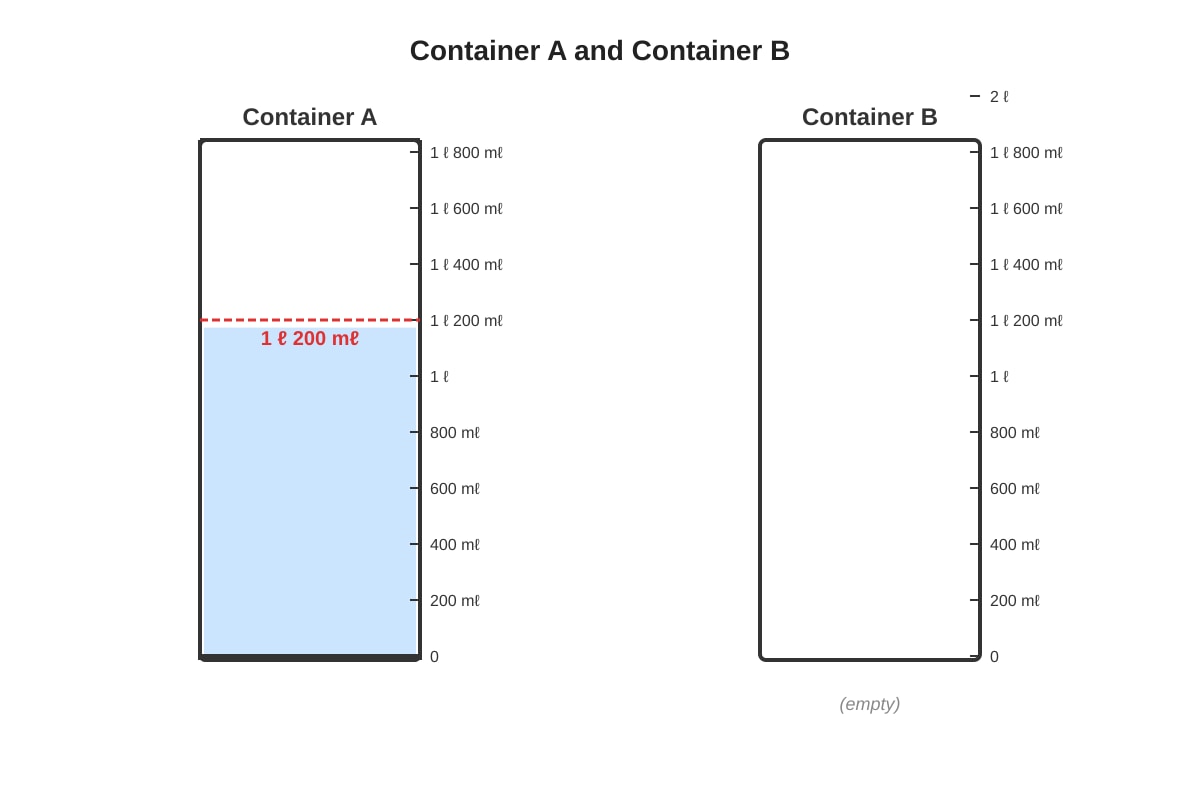
15. The diagram shows two containers. Container A has 1 ℓ 200 mℓ of water. Container B is empty. If all water from A is poured into B, what will be the reading on B?
<image_placeholder> id: Q15-fig1 type: diagram linked_question: Q15 description: Two beakers/containers side by side; Container A shown with water level at 1 litre 200 ml mark; Container B shown empty with scale markings labels: Container A with scale 0, 200 mℓ, 400 mℓ, 600 mℓ, 800 mℓ, 1 ℓ, 1 ℓ 200 mℓ, 1 ℓ 400 mℓ, 1 ℓ 600 mℓ; Container B with identical scale 0 to 2 ℓ; water level in A marked at 1 ℓ 200 mℓ values: Container A contains 1 ℓ 200 mℓ; maximum of B is 2 ℓ must_show: both containers with clear volume scales; water level in A clearly at 1 ℓ 200 mℓ; empty B with markings visible to 2 ℓ </image_placeholder>
Answer: _______ ℓ _______ mℓ
Working:
Section C: Problem Solving (Questions 16–20)
Show all your working clearly. Each question carries 4 marks.
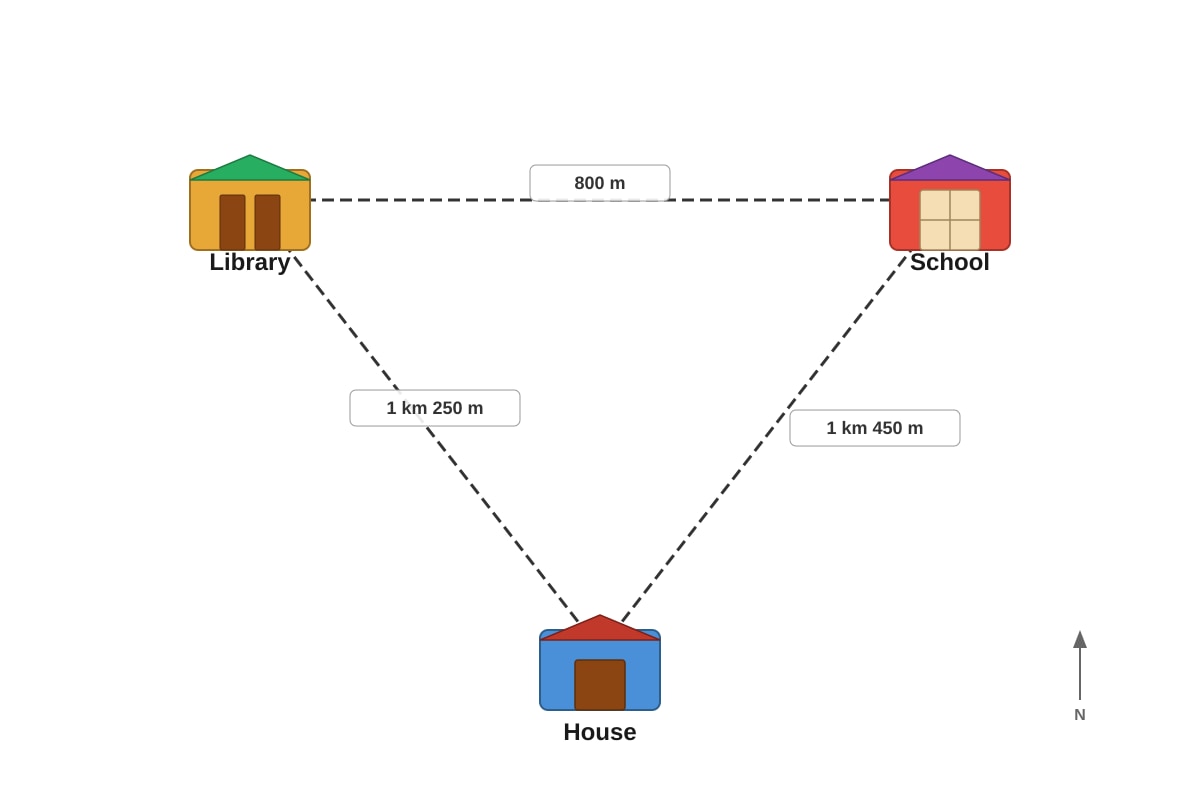
16. Peter walked from his house to the library, then to the school, and finally back home.
<image_placeholder> id: Q16-fig1 type: map linked_question: Q16 description: A simple route map showing three locations connected by straight paths: House at bottom, Library at top left, School at top right; paths marked with distances labels: House (bottom centre); Library (top left); School (top right); path House to Library = 1 km 250 m; path Library to School = 800 m; path School to House = 1 km 450 m values: House-Library: 1 km 250 m; Library-School: 800 m; School-House: 1 km 450 m must_show: three points in triangular arrangement; each path with distance label; arrow or line indicating direction of travel </image_placeholder>
(a) What is the total distance Peter walked? Give your answer in kilometres and metres. [2]
Answer: _______ km _______ m
Working:
(b) If Peter took 45 minutes to complete the entire journey, and he started at 9.15 a.m., what time did he reach home? [2]
Answer: _______
Working:
17. A baker uses 250 g of flour to make one loaf of bread.
(a) How many loaves can she make with 3 kg of flour? [2]
Answer: _______ loaves
Working:
(b) How much flour will be left over? Give your answer in grams. [2]
Answer: _______ g
Working:
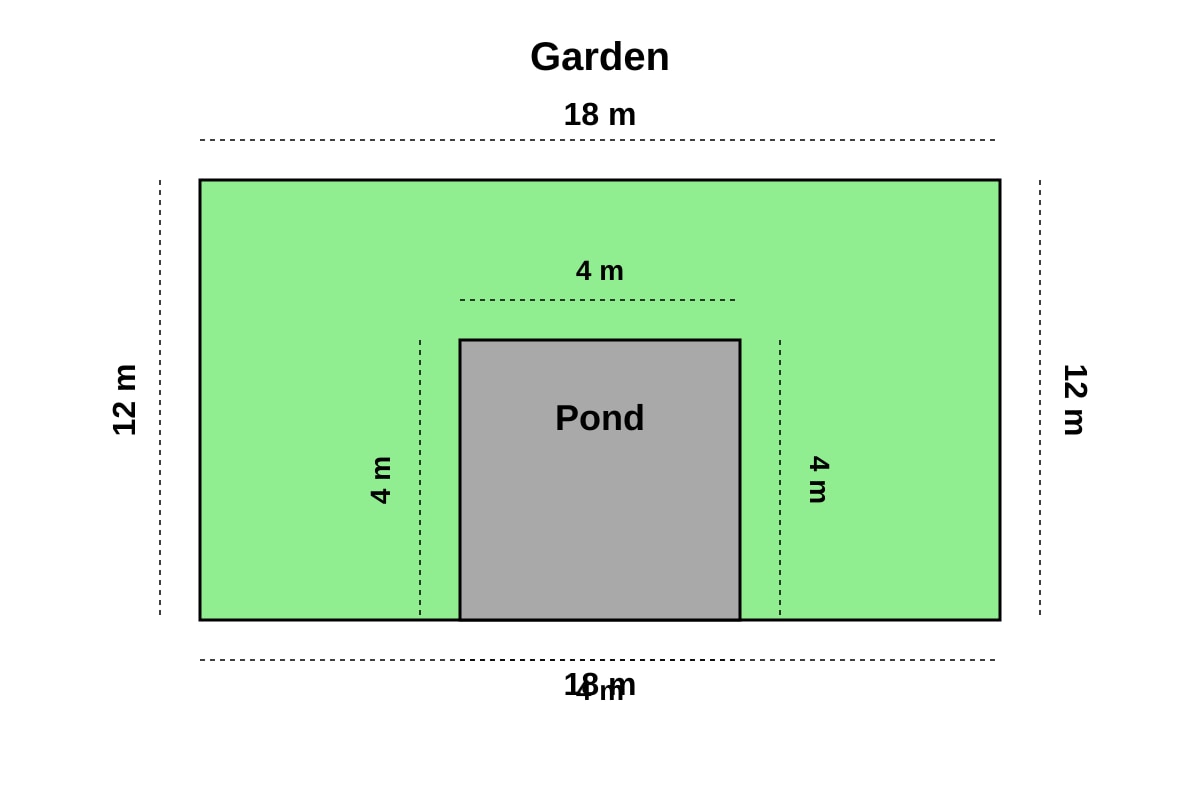
18. The diagram shows a rectangular garden with a square pond in the middle.
<image_placeholder> id: Q18-fig1 type: diagram linked_question: Q18 description: A large rectangle representing a garden with a smaller square in the centre representing a pond; all dimensions labelled labels: garden length = 18 m (outer top and bottom); garden width = 12 m (outer left and right); pond side = 4 m (all four inner sides); pond centred in garden values: garden 18 m × 12 m; pond 4 m × 4 m must_show: outer rectangle with dimensions; inner square with dimensions; clear labels for all measurements; pond greyed or distinguished from garden area </image_placeholder>
(a) Find the perimeter of the garden. [2]
Answer: _______ m
Working:
(b) The owner wants to put a fence around the pond. What length of fencing is needed? [2]
Answer: _______ m
Working:
19. A water dispenser contains 5 ℓ of water. Mrs Tan fills cups with 200 mℓ of water each.
(a) How many full cups can she fill? [2]
Answer: _______ cups
Working:
(b) How much water is left in the dispenser? Give your answer in millilitres. [2]
Answer: _______ mℓ
Working:
20. A lorry carries 8 identical sacks of rice. The total mass is 640 kg.
(a) Find the mass of one sack of rice. Give your answer in kilograms. [2]
Answer: _______ kg
Working:
(b) If the lorry's maximum load is 800 kg, how many more such sacks can it carry? [2]
Answer: _______ sacks
Working:
END OF QUIZ
Answers
Primary 3 Mathematics Quiz - Measurement: Answer Key
Total Marks: 40 marks
Section A: Multiple Choice (1 mark each)
1. Answer: (C) 8.7 cm
The pencil starts at 0 cm and ends at the 7th millimetre mark after 8 cm. Each small mark represents 1 mm, which equals 0.1 cm. Counting: 8 cm + 7 mm = 8 cm + 0.7 cm = 8.7 cm.
Teaching note: When measuring, always check where the object starts (not always at 0) and read the scale carefully. Each centimetre has 10 millimetres, so 7 mm = 0.7 cm.
2. Answer: (B) 1 kg 550 g
Step-by-step working:
- Start: 3 kg 250 g
- Used: 1 kg 800 g
Since 250 g < 800 g, we need to borrow 1 kg = 1000 g:
- 3 kg 250 g = 2 kg 1250 g
- Subtract: 2 kg 1250 g − 1 kg 800 g = 1 kg 550 g
Common mistake: Students often subtract 250 − 800 directly and get confused. Always borrow from kilograms when grams are insufficient.
3. Answer: (B) 506 cm
Step-by-step working:
- 5 m = 5 × 100 cm = 500 cm
- 6 cm = 6 cm
- Total: 500 cm + 6 cm = 506 cm
Key concept: 1 metre = 100 centimetres. Convert metres to centimetres first, then add the remaining centimetres.
4. Answer: (A) 3 ℓ 750 mℓ
Step-by-step working:
- Start: 4 ℓ 500 mℓ
- Poured out: 750 mℓ
Since 500 mℓ < 750 mℓ, borrow 1 ℓ = 1000 mℓ:
- 4 ℓ 500 mℓ = 3 ℓ 1500 mℓ
- Subtract: 3 ℓ 1500 mℓ − 750 mℓ = 3 ℓ 750 mℓ
5. Answer: (B) 10 kg
Step-by-step working:
- One packet: 2 kg 500 g
- Four packets: 4 × 2 kg 500 g
Method: Double twice
- 2 × 2 kg 500 g = 5 kg
- 2 × 5 kg = 10 kg
Alternative: Convert to grams: 2500 g × 4 = 10000 g = 10 kg.
Section B: Short Answer (2 marks each)
6. Answer: 13.5 cm (or 13 cm 5 mm)
Step-by-step working:
- Ribbon starts at: 2 cm
- Ribbon ends at: 15.5 cm (or 15 cm 5 mm)
- Length = 15.5 cm − 2 cm = 13.5 cm
Key concept: When an object does not start at 0, subtract the starting position from the ending position. This is called the difference method.
7. Answer: 3450 m
Step-by-step working:
- 3 km = 3 × 1000 m = 3000 m
- 450 m = 450 m
- Total: 3000 m + 450 m = 3450 m
Key concept: 1 kilometre = 1000 metres. Always convert the larger unit first.
8. Answer: 1 ℓ 400 mℓ
Step-by-step working:
- Start: 2 ℓ 250 mℓ
- Drank: 850 mℓ
Borrow 1 ℓ = 1000 mℓ:
- 2 ℓ 250 mℓ = 1 ℓ 1250 mℓ
- Subtract: 1 ℓ 1250 mℓ − 850 mℓ = 1 ℓ 400 mℓ
9. Answer: 400 g
Step-by-step working:
- Total mass: 1 kg 200 g = 1200 g
- Number of books: 3
- Mass of one book: 1200 g ÷ 3 = 400 g
Teaching note: Convert to a single unit (grams) before dividing. 1 kg = 1000 g, so 1 kg 200 g = 1000 g + 200 g = 1200 g.
10. Answer: 210 cm
Step-by-step working:
- Convert to single unit: 8 m 40 cm = 800 cm + 40 cm = 840 cm
- Divide by 4: 840 cm ÷ 4 = 210 cm
Check: 210 cm × 4 = 840 cm = 8 m 40 cm ✓
11. Answer: 46 cm
Step-by-step working:
- Perimeter of rectangle = length + width + length + width
- = 2 × (length + width)
- = 2 × (15 cm + 8 cm)
- = 2 × 23 cm
- = 46 cm
Formula: Perimeter of rectangle = or
12. Answer: 300 m
Step-by-step working:
- Perimeter of field = 2 × (50 m + 25 m) = 2 × 75 m = 150 m
- Two rounds: 2 × 150 m = 300 m
13. Answer: 4000 m
Step-by-step working:
- 1 km = 1000 m
- 4 km = 4 × 1000 m = 4000 m
14. Answer: 9 ℓ 0 mℓ (or 9 ℓ)
Step-by-step working:
- Full capacity: 12 ℓ
- Filled to: 3/4 of capacity
- Water in tank: 3/4 × 12 ℓ = (12 ℓ ÷ 4) × 3 = 3 ℓ × 3 = 9 ℓ
Teaching note: Fraction 3/4 means divide into 4 equal parts, then take 3 parts. 12 ÷ 4 = 3, then 3 × 3 = 9.
15. Answer: 1 ℓ 200 mℓ
Step-by-step working:
- Volume in Container A: 1 ℓ 200 mℓ
- When poured into Container B (same shape/size scale), the reading will be identical: 1 ℓ 200 mℓ
Key concept: Volume is conserved when liquid is poured between containers. The reading depends only on the amount of liquid, not the container (assuming same scale markings).
Section C: Problem Solving (4 marks each)
16. (a) Answer: 3 km 500 m [2 marks]
Step-by-step working:
- House to Library: 1 km 250 m
- Library to School: 800 m
- School to House: 1 km 450 m
Convert all to metres:
- 1 km 250 m = 1250 m
- 800 m = 800 m
- 1 km 450 m = 1450 m
Total: 1250 m + 800 m + 1450 m = 3500 m = 3 km 500 m
Mark allocation: [1] for correct method/conversion; [1] for final answer with correct units.
(b) Answer: 10.00 a.m. (or 10 a.m.) [2 marks]
Step-by-step working:
- Start time: 9.15 a.m.
- Duration: 45 minutes
- End time: 9.15 a.m. + 45 min = 10.00 a.m.
Mark allocation: [1] for correct method; [1] for correct time notation.
17. (a) Answer: 12 loaves [2 marks]
Step-by-step working:
- Total flour: 3 kg = 3000 g
- Flour per loaf: 250 g
- Number of loaves: 3000 g ÷ 250 g = 12 loaves
Method: 250 × 4 = 1000 (1 kg), so 250 × 12 = 3000 (3 kg). Mark allocation: [1] for conversion or correct method; [1] for final answer.
(b) Answer: 0 g (no flour left over) [2 marks]
Step-by-step working:
- Flour used: 12 × 250 g = 3000 g = 3 kg
- Flour available: 3 kg
- Left over: 3000 g − 3000 g = 0 g
Mark allocation: [1] for method (multiplication or recognition of exact division); [1] for final answer.
18. (a) Answer: 60 m [2 marks]
Step-by-step working:
- Perimeter of garden = 2 × (18 m + 12 m)
- = 2 × 30 m
- = 60 m
Mark allocation: [1] for correct formula/application; [1] for correct calculation.
(b) Answer: 16 m [2 marks]
Step-by-step working:
- Pond is a square with side 4 m
- Fencing needed = perimeter of pond = 4 × 4 m = 16 m
Mark allocation: [1] for identifying square perimeter formula; [1] for correct calculation.
19. (a) Answer: 25 cups [2 marks]
Step-by-step working:
- Total water: 5 ℓ = 5000 mℓ
- Cup size: 200 mℓ
- Number of cups: 5000 mℓ ÷ 200 mℓ = 25 cups
Method: 200 × 25 = 5000, or 5000 ÷ 200 = 50 ÷ 2 = 25. Mark allocation: [1] for conversion to same units; [1] for correct division and answer.
(b) Answer: 0 mℓ [2 marks]
Step-by-step working:
- Water used: 25 × 200 mℓ = 5000 mℓ = 5 ℓ
- Water available: 5 ℓ = 5000 mℓ
- Left over: 5000 mℓ − 5000 mℓ = 0 mℓ
Mark allocation: [1] for method showing water used equals total; [1] for final answer.
20. (a) Answer: 80 kg [2 marks]
Step-by-step working:
- Total mass: 640 kg
- Number of sacks: 8
- Mass per sack: 640 kg ÷ 8 = 80 kg
Method: 8 × 80 = 640, or 640 ÷ 8 = (640 ÷ 2) ÷ 4 = 320 ÷ 4 = 80. Mark allocation: [1] for correct division method; [1] for correct answer.
(b) Answer: 2 sacks [2 marks]
Step-by-step working:
- Maximum load: 800 kg
- Current load: 640 kg
- Remaining capacity: 800 kg − 640 kg = 160 kg
- Mass per sack: 80 kg (from part a)
- Additional sacks: 160 kg ÷ 80 kg = 2 sacks
Alternative method: 800 ÷ 80 = 10 sacks maximum; currently 8; so 10 − 8 = 2. Mark allocation: [1] for finding remaining capacity or maximum sacks; [1] for final answer.
END OF ANSWER KEY