From Real Exams Quiz
Primary 3 Mathematics Geometry Quiz
Free P3 Maths Geometry quiz, Exam version, with questions, answers, and syllabus-aligned practice for Singapore students.
These static practice materials are generated from the site's syllabus and paper-generation workflow, with source and model context shown so students and parents can evaluate the material before use.
Questions
Free quiz and exam paper access
Enter your details to view this paper
Your access is remembered on this device.
Answers
P3 Maths Quiz: Geometry - Answer Key
Section A: Multiple Choice Questions
Q1. Answer: (3) 90° Explanation: A right angle is exactly 90°. It looks like the corner of a square or rectangle.
Q2. Answer: (3) 26 cm Explanation: Perimeter = 2 × (length + width) = 2 × (8 + 5) = 2 × 13 = 26 cm
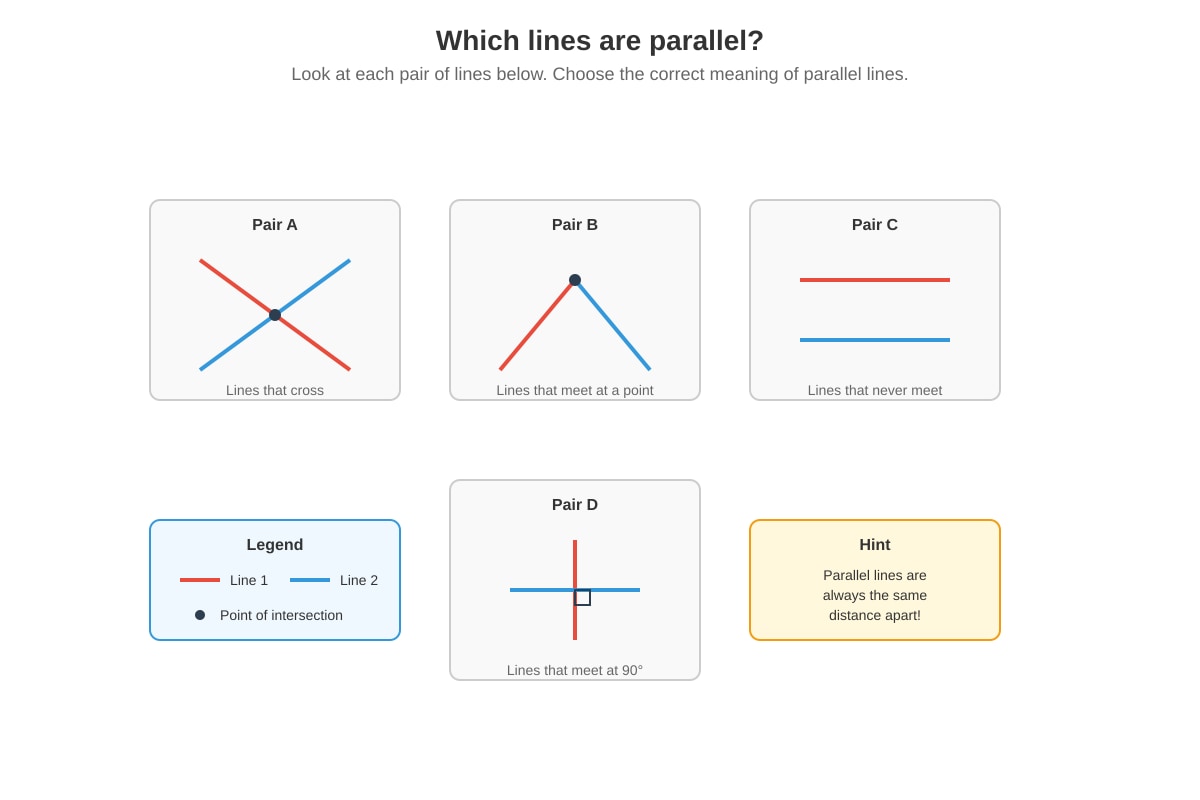
Q3. Answer: (3) Lines that never meet Explanation: Parallel lines are always the same distance apart and never meet, even if extended infinitely.
Q4. Answer: (3) 36 cm² Explanation: Area of square = side × side = 6 × 6 = 36 cm²
Q5. Answer: (3) Acute angle Explanation:
- Acute angle: less than 90°
- Right angle: exactly 90°
- Obtuse angle: between 90° and 180°
- Straight angle: exactly 180°
Section B: Short Answer Questions
Q6. Answer: 38 cm Working: Perimeter = 2 × (length + width) Perimeter = 2 × (12 + 7) Perimeter = 2 × 19 = 38 cm
Q7. Answer: 36 cm² Working: Area = length × width Area = 9 × 4 = 36 cm²
Q8. Answer: (Various possible answers depending on diagram) Example: Lines AB and CD are perpendicular. Explanation: Perpendicular lines meet at right angles (90°).
Q9. Answer: 5 cm Working: Area of square = side × side = 25 cm² So side = 5 cm (because 5 × 5 = 25)
Q10. Answer: 24 cm² Working: Top rectangle area = 6 × 2 = 12 cm² Bottom rectangle area = 4 × 3 = 12 cm² Total area = 12 + 12 = 24 cm²
Section C: Word Problems
Q11. Answer: 46 m Working: Perimeter = 2 × (length + width) Perimeter = 2 × (15 + 8) Perimeter = 2 × 23 = 46 m Mrs Tan needs 46 metres of fencing.
Q12. Answer: 108 m² Working: Area = length × width Area = 12 × 9 = 108 m² The classroom floor area is 108 m².
Q13. Answer: Perimeter = 24 cm, Area = 20 cm² Working: Count the outside edges: 12 edges × 2 cm = 24 cm perimeter Count squares: 5 squares × (2×2) = 5 × 4 = 20 cm² area
Q14. Answer: 12 m Working: Step 1: Area of rectangle = 18 × 8 = 144 m² Step 2: Area of square = side × side = 144 m² Step 3: Side of square = 12 m (because 12 × 12 = 144)
Teaching Notes
Key Skills Tested:
- Identifying angle types (acute, right, obtuse)
- Understanding parallel and perpendicular lines
- Calculating perimeter and area of rectangles and squares
- Solving problems involving composite shapes
- Real-world applications of geometry
Key Formulas:
- Perimeter of rectangle = 2 × (length + width)
- Area of rectangle = length × width
- Area of square = side × side
- Perimeter of square = 4 × side
Common Student Errors:
- Confusing perimeter and area - Adding when should multiply (or vice versa)
- Angle identification - Thinking acute means "sharp-looking" instead of <90°
- Formula errors - Using length + width instead of 2 × (length + width)
- Units confusion - Forgetting cm² for area vs cm for perimeter
- Composite shapes - Not breaking down into simpler rectangles
Visual Learning Tips:
- Use grid paper for area counting
- Draw angles with protractors
- Point out parallel lines in classroom (walls, floor tiles)
- Show perpendicular lines in everyday objects (corners)
- Use real objects for measurement practice
Extension Activities:
- Find geometric shapes around the classroom
- Measure actual objects and calculate perimeter/area
- Create composite shapes and find their areas
- Draw different types of angles and label them