From Real Exams Quiz

Primary 3 Mathematics Fractions Quiz

Free Exam-Derived Kimi K2 6 Free Primary 3 Mathematics Fractions quiz with questions and answers for Singapore students. This page is rendered as a direct URL so the questions and answers can be discovered without pressing in-page buttons.

These static practice materials are generated from the site's syllabus and paper-generation workflow, with source and model context shown so students and parents can evaluate the material before use.

Primary 3 Mathematics From Real Exams Generated by Kimi K2 6 Free Updated 2026-06-07

Questions

<!-- TuitionGoWhere generation metadata: stage=3-0; model=moonshotai/kimi-k2.6:free; model_label=Kimi K2.6 Free; generated=2026-06-06; Sources: Stage 2-1 real exam-derived templates and Stage 2-2 exam-enriched syllabus. -->

Primary 3 Mathematics Quiz - Fractions

Name: _________________________ Class: _________ Date: ___________

Score: _______ / 40

Duration: 40 minutes

Instructions: Answer all questions. Show your working clearly where required. Calculators are not allowed.


Section A: Multiple Choice (Questions 1–5)

Choose the correct answer. Each question carries 1 mark.

1. Which fraction is equivalent to 23\frac{2}{3}?

A) 46\frac{4}{6}
B) 36\frac{3}{6}
C) 26\frac{2}{6}
D) 69\frac{6}{9}

Answer: _______


2. What is the value of 58+28\frac{5}{8} + \frac{2}{8}?

A) 716\frac{7}{16}
B) 78\frac{7}{8}
C) 38\frac{3}{8}
D) 1016\frac{10}{16}

Answer: _______


3. Which of the following fractions is the largest?

A) 34\frac{3}{4}
B) 56\frac{5}{6}
C) 23\frac{2}{3}
D) 712\frac{7}{12}

Answer: _______


4. A pizza was cut into 8 equal slices. Tom ate 3 slices and Jerry ate 2 slices. What fraction of the pizza did they eat altogether?

A) 516\frac{5}{16}
B) 58\frac{5}{8}
C) 68\frac{6}{8}
D) 616\frac{6}{16}

Answer: _______


5. Simplify 1218\frac{12}{18} to its lowest terms.

A) 69\frac{6}{9}
B) 46\frac{4}{6}
C) 23\frac{2}{3}
D) 34\frac{3}{4}

Answer: _______


Section B: Short Answer (Questions 6–15)

Answer each question in the space provided. Each question carries 2 marks.

6. Write 810\frac{8}{10} as a fraction in its simplest form.

Working:


Answer: _______


7. Find the missing numerator: 35=?15\frac{3}{5} = \frac{?}{15}

Working:


Answer: _______


8. Calculate: 7949\frac{7}{9} - \frac{4}{9}

Working:


Answer: _______


9. Arrange the fractions in ascending order: 12\frac{1}{2}, 38\frac{3}{8}, 58\frac{5}{8}

Working:


Answer: _______


10. Mary had 56\frac{5}{6} of a chocolate bar. She gave 26\frac{2}{6} to her brother. What fraction of the chocolate bar does Mary have left?

Working:


Answer: _______


11. Express 1824\frac{18}{24} in its simplest form.

** Working:**


Answer: _______


12. What fraction of 2 hours is 45 minutes? Express your answer in its simplest form.

Working:


Answer: _______


13. Philip drank 310\frac{3}{10} of a bottle of juice in the morning and 410\frac{4}{10} of the bottle in the afternoon. What fraction of the bottle of juice did he drink altogether?

Working:


Answer: _______


14. A ribbon is 78\frac{7}{8} m long. Sarah cut off 14\frac{1}{4} m from the ribbon. How long is the ribbon now? (Express your answer as a fraction in its simplest form)

Working:


Answer: _______


15. Fill in the box with >>, <<, or ==: 47\frac{4}{7} >\boxed{\phantom{>}} 59\frac{5}{9}

Working:


Answer: _______


Section C: Problem Solving (Questions 16–20)

Show all your working clearly. Each question carries 4 marks.

16. John and Peter shared a cake. John ate 25\frac{2}{5} of the cake and Peter ate 15\frac{1}{5} of the cake.

(a) What fraction of the cake did they eat altogether? [2 marks]

Working:


Answer: _______

(b) What fraction of the cake was left? [2 marks]

Working:


Answer: _______


17. Mrs. Tan bought a watermelon. She gave 14\frac{1}{4} of it to her neighbour and 12\frac{1}{2} of it to her children.

(a) What fraction of the watermelon did she give away altogether? [2 marks]

Working:


Answer: _______

(b) What fraction of the watermelon was left? [2 marks]

Working:


Answer: _______


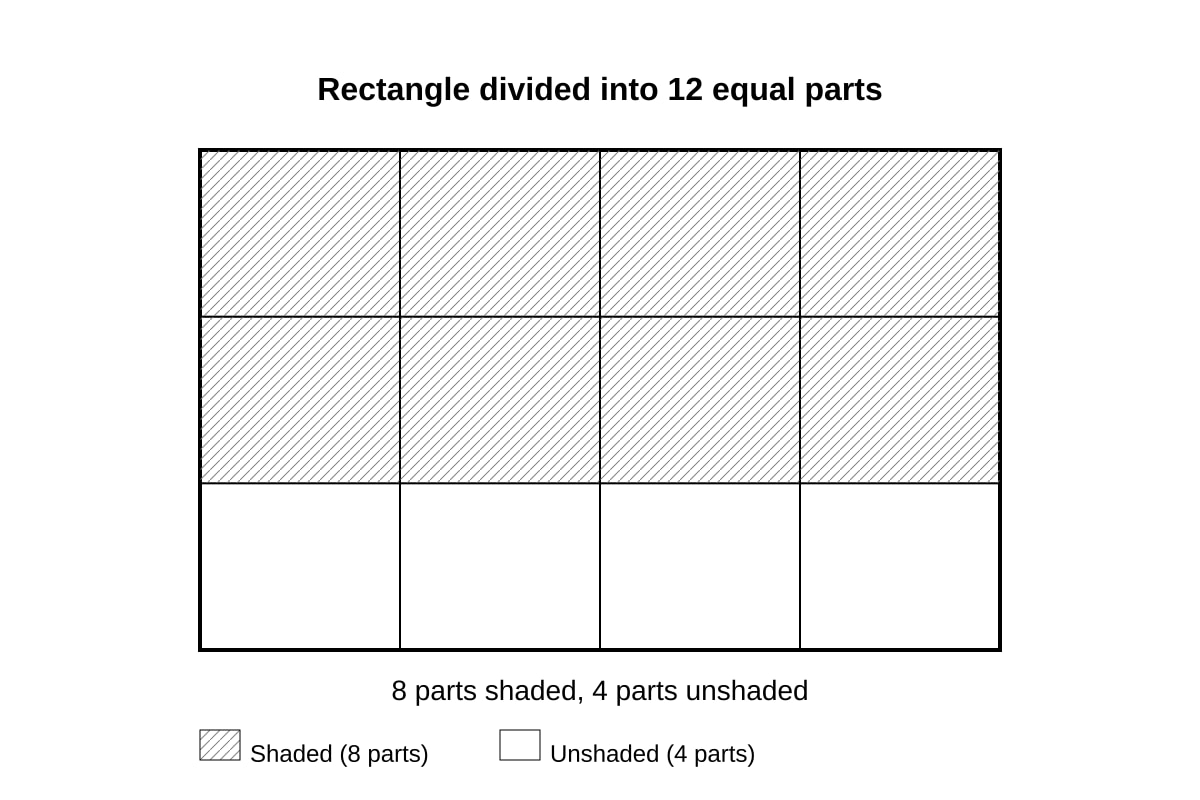
18. The figure below shows a rectangle divided into equal parts. Some parts are shaded.

<image_placeholder> id: Q18-fig1 type: diagram linked_question: 18 description: A rectangle divided into 12 equal smaller rectangles arranged in 3 rows and 4 columns, with 8 parts shaded and 4 parts unshaded labels: rectangle boundary, grid lines showing 12 equal parts values: 8 shaded parts, 4 unshaded parts, total 12 equal parts must_show: 3 rows by 4 columns of equal rectangles, clear shading of 8 parts, 4 unshaded parts visible </image_placeholder>

(a) What fraction of the figure is shaded? Give your answer in its simplest form. [2 marks]

Working:


Answer: _______

(b) What fraction of the figure is unshaded? [2 marks]

Working:


Answer: _______


19. Alice had a bottle of syrup. She used 29\frac{2}{9} of it to make drinks and 59\frac{5}{9} of it to make desserts.

(a) How much of the syrup did she use altogether? [2 marks]

Working:


Answer: _______

(b) If there was 19\frac{1}{9} of the syrup spilled, how much of the syrup was left? [2 marks]

Working:


Answer: _______


20. Three friends, Ben, Cindy, and David, shared a pizza. Ben ate 16\frac{1}{6} of the pizza, Cindy ate 13\frac{1}{3} of the pizza, and David ate the rest.

(a) What fraction of the pizza did David eat? [2 marks]

Working:


Answer: _______

(b) Who ate the most pizza? How much more than Ben did that person eat? [2 marks]

Working:


Answer: _______


End of Quiz

Section A Total: 5 marks
Section B Total: 20 marks
Section C Total: 20 marks
Grand Total: 45 marks

Check your answers if you have time remaining.

Answers

<!-- TuitionGoWhere generation metadata: stage=3-0; model=moonshotai/kimi-k2.6:free; model_label=Kimi K2.6 Free; generated=2026-06-06; Sources: Stage 2-1 real exam-derived templates and Stage 2-2 exam-enriched syllabus. -->

Primary 3 Mathematics Quiz - Fractions: Answer Key

Total Marks: 45 marks


Section A: Multiple Choice (1 mark each)

1. A) 46\frac{4}{6}

Working: To find an equivalent fraction, multiply both numerator and denominator by the same number. 23=2×23×2=46\frac{2}{3} = \frac{2 \times 2}{3 \times 2} = \frac{4}{6}. Equivalent fractions represent the same amount even though they look different. Common mistake: Choosing B (36\frac{3}{6}) which equals 12\frac{1}{2}, not 23\frac{2}{3}.


2. B) 78\frac{7}{8}

Working: When adding fractions with the same denominator, add only the numerators. Keep the denominator the same: 58+28=5+28=78\frac{5}{8} + \frac{2}{8} = \frac{5+2}{8} = \frac{7}{8}. The denominator does not change because the "size" of each part stays the same—we're just counting how many eighths we have in total. Common mistake: Adding denominators to get 716\frac{7}{16}.


3. B) 56\frac{5}{6}

Working: Convert to common denominator or compare using benchmarks. Using 12 as common denominator: 34=912\frac{3}{4} = \frac{9}{12}, 56=1012\frac{5}{6} = \frac{10}{12}, 23=812\frac{2}{3} = \frac{8}{12}, 712=712\frac{7}{12} = \frac{7}{12}. Alternatively, compare to 12\frac{1}{2}: 56\frac{5}{6} is closest to 1 (only 16\frac{1}{6} away). Teaching note: When denominators differ, find equivalent fractions with a common denominator, or compare how far each is from 1.


4. B) 58\frac{5}{8}

Working: Total slices eaten = 3+2=53 + 2 = 5 slices. Total slices = 8. Fraction eaten = 58\frac{5}{8}. The denominator stays 8 because the whole is still 8 equal slices. Commonmistake: Adding denominators to get 516\frac{5}{16} (the "total" number of slices doesn't create new slices).


5. C) 23\frac{2}{3}

Working: Simplify by dividing numerator and denominator by their highest common factor (HCF). HCF of 12 and 18 is 6. 12÷618÷6=23\frac{12 \div 6}{18 \div 6} = \frac{2}{3}. Step-by-step: factors of 12 are (1, 2, 3, 4, 6, 12); factors of 18 are (1, 2, 3, 6, 9, 18). Common factors are 1, 2, 3, 6. The largest is 6. Teaching note: A fraction is in simplest form when numerator and denominator share no common factor other than 1.


Section B: Short Answer (2 marks each)

6. 45\frac{4}{5}

Working: HCF of 8 and 10 is 2. 8÷210÷2=45\frac{8 \div 2}{10 \div 2} = \frac{4}{5}. [1 mark for correct method, 1 mark for correct answer]

Teaching note: To simplify, divide top and bottom by the same number. Keep dividing until no common factors remain. 45\frac{4}{5} cannot be simplified further because HCF of 4 and 5 is 1.


7. 9

Working: 35=?15\frac{3}{5} = \frac{?}{15}. Denominator changes from 5 to 15, which is 5×35 \times 3. So multiply numerator by 3 as well: 3×3=93 \times 3 = 9. Check: 35=915\frac{3}{5} = \frac{9}{15}. [1 mark for identifying multiplication by 3, 1 mark for answer]

Teaching note: Equivalent fractions use the same multiplication or division on both parts. Think of it as: "What times 5 equals 15?" Then do the same to the top.


8. 39=13\frac{3}{9} = \frac{1}{3}

Working: 7949=749=39=13\frac{7}{9} - \frac{4}{9} = \frac{7-4}{9} = \frac{3}{9} = \frac{1}{3}. [1 mark for 39\frac{3}{9}, 1 mark for simplifying to 13\frac{1}{3}]

Teaching note: Subtract numerators, keep denominator. Always check if answer can be simplified. 39\frac{3}{9} simplifies by dividing by 3.


9. 38\frac{3}{8}, 12\frac{1}{2}, 58\frac{5}{8}

Working: Convert to common denominator of 8: 12=48\frac{1}{2} = \frac{4}{8}. Now compare: 38\frac{3}{8}, 48\frac{4}{8}, 58\frac{5}{8}. Order is 38<48<58\frac{3}{8} < \frac{4}{8} < \frac{5}{8}. [1 mark for correct conversion or comparison method, 1 mark for correct order]

Teaching note: "Ascending" means smallest to largest. Common denominator makes comparison easy—just look at numerators.


10. 36=12\frac{3}{6} = \frac{1}{2}

Working: 5626=36=12\frac{5}{6} - \frac{2}{6} = \frac{3}{6} = \frac{1}{2}. [1 mark for 36\frac{3}{6}, 1 mark for 12\frac{1}{2} or acceptable unsimplified form if working shown]

Teaching note: "Left" means subtraction. Mary started with 56\frac{5}{6} and gave away 26\frac{2}{6}, so we subtract.


11. 34\frac{3}{4}

Working: HCF of 18 and 24. Factors of 18: 1, 2, 3, 6, 9, 18. Factors of 24: 1, 2, 3, 4, 6, 8, 12, 24. HCF is 6. 18÷624÷6=34\frac{18 \div 6}{24 \div 6} = \frac{3}{4}. [1 mark for identifying HCF or equivalent method, 1 mark for answer]

Teaching note: If stuck finding HCF, divide by any common factor (like 2, getting 912\frac{9}{12}), then divide again (34\frac{3}{4}). Both steps are valid.


12. 38\frac{3}{8}

Working: Convert to same units. 2 hours = 120 minutes. Fraction = 45120\frac{45}{120}. Simplify: HCF of 45 and 120 is 15. 45÷15120÷15=38\frac{45 \div 15}{120 \div 15} = \frac{3}{8}. [1 mark for correct unsimplified fraction or conversion, 1 mark for simplified answer]

Alternative: 1 hour = 60 min, so 45 min = 34\frac{3}{4} hour. Then 34÷2=34×12=38\frac{3}{4} \div 2 = \frac{3}{4} \times \frac{1}{2} = \frac{3}{8}. (This method is harder for P3; unit conversion is preferred.)

Teaching note: The "whole" is 2 hours (120 minutes), not 1 hour. Common mistake: Using 4560=34\frac{45}{60} = \frac{3}{4} without considering the 2 hours.


13. 710\frac{7}{10}

Working: 310+410=710\frac{3}{10} + \frac{4}{10} = \frac{7}{10}. [1 mark for correct addition, 1 mark for answer]

Teaching note: Both fractions have denominator 10, representing tenths of the same bottle. Simply add the numerators. The answer is already in simplest form.


14. 58\frac{5}{8} m

Working: 7814\frac{7}{8} - \frac{1}{4}. First convert to common denominator: 14=28\frac{1}{4} = \frac{2}{8}. Then 7828=58\frac{7}{8} - \frac{2}{8} = \frac{5}{8} m. [1 mark for common denominator conversion, 1 mark for correct subtraction and answer]

Teaching note: Cannot subtract directly because denominators differ. Find equivalent fraction: "What times 4 equals 8?" Then subtract. Keep the unit (metres) in the answer.


15. 47>59\frac{4}{7} > \frac{5}{9}

Working: Common denominator of 7 and 9 is 63. 47=3663\frac{4}{7} = \frac{36}{63} and 59=3563\frac{5}{9} = \frac{35}{63}. Since 36>3536 > 35, we have 47>59\frac{4}{7} > \frac{5}{9}. [1 mark for correct method, 1 mark for correct symbol]

Alternative: Cross-multiply: 4×9=364 \times 9 = 36 and 5×7=355 \times 7 = 35. Since 36>3536 > 35, 47>59\frac{4}{7} > \frac{5}{9}.

Teaching note: The ">" symbol opens toward the larger number, like a crocodile's mouth opening toward more food.


Section C: Problem Solving (4 marks each)

16. (a) 35\frac{3}{5}

Working: 25+15=35\frac{2}{5} + \frac{1}{5} = \frac{3}{5}. [2 marks]

(b) 25\frac{2}{5}

Working: Whole cake = 1 = 55\frac{5}{5}. Left: 5535=25\frac{5}{5} - \frac{3}{5} = \frac{2}{5}. [2 marks; 1 mark for converting 1 to 55\frac{5}{5}, 1 mark for subtraction]

Teaching note: The whole is 1, which can be written as any fraction with equal numerator and denominator. Here we need fifths. Common mistake: Writing "1 – 3" instead of dealing with fractions properly.


17. (a) 34\frac{3}{4}

Working: 14+12=14+24=34\frac{1}{4} + \frac{1}{2} = \frac{1}{4} + \frac{2}{4} = \frac{3}{4}. [2 marks; 1 mark for common denominator, 1 mark for answer]

(b) 14\frac{1}{4}

Working: 134=4434=141 - \frac{3}{4} = \frac{4}{4} - \frac{3}{4} = \frac{1}{4}. [2 marks; 1 mark for converting 1, 1 mark for answer]

Teaching note: The whole watermelon is 1. To add 14\frac{1}{4} and 12\frac{1}{2}, convert half to quarters. Note that 24\frac{2}{4} simplifies to 12\frac{1}{2}—both are correct at different stages.


18. (a) 23\frac{2}{3}

Working: From diagram: 8 shaded out of 12 equal parts = 812=23\frac{8}{12} = \frac{2}{3}. [2 marks; 1 mark for correct fraction from diagram, 1 mark for simplification]

(b) 13\frac{1}{3}

Working: 4 unshaded out of 12 = 412=13\frac{4}{12} = \frac{1}{3}. Or: 123=131 - \frac{2}{3} = \frac{1}{3}. [2 marks]

Expected visual features: Rectangle divided into 12 equal smaller rectangles (3 rows × 4 columns). 8 parts shaded (e.g., first 2 rows completely shaded, or a clear pattern). 4 parts unshaded visible. The answer requires counting shaded parts against total.


19. (a) 79\frac{7}{9}

Working: 29+59=79\frac{2}{9} + \frac{5}{9} = \frac{7}{9}. [2 marks]

(b) 19\frac{1}{9}

Working: Used: 79\frac{7}{9}. Spilled: 19\frac{1}{9}. Total gone: 79+19=89\frac{7}{9} + \frac{1}{9} = \frac{8}{9}. Left: 189=9989=191 - \frac{8}{9} = \frac{9}{9} - \frac{8}{9} = \frac{1}{9}. [2 marks; 1 mark for finding total used/spilled, 1 mark for final subtraction]

Teaching note: Two separate "losses"—used AND spilled. Must add both before finding remainder. Common mistake: Forgetting to include the spilled amount.


20. (a) 12\frac{1}{2}

Working: Total eaten by Ben and Cindy: 16+13=16+26=36=12\frac{1}{6} + \frac{1}{3} = \frac{1}{6} + \frac{2}{6} = \frac{3}{6} = \frac{1}{2}. David: 112=121 - \frac{1}{2} = \frac{1}{2}. Or directly: David = 11613=661626=36=121 - \frac{1}{6} - \frac{1}{3} = \frac{6}{6} - \frac{1}{6} - \frac{2}{6} = \frac{3}{6} = \frac{1}{2}. [2 marks]

(b) David (or Cindy, depending on interpretation); 16\frac{1}{6} more

Working: Compare amounts: Ben = 16\frac{1}{6}, Cindy = 13=26\frac{1}{3} = \frac{2}{6}, David = 36=12\frac{3}{6} = \frac{1}{2}. David ate the most. Difference from Ben: 3616=26=13\frac{3}{6} - \frac{1}{6} = \frac{2}{6} = \frac{1}{3}. Or if Cindy: 2616=16\frac{2}{6} - \frac{1}{6} = \frac{1}{6}.

Wait—rechecking: Cindy ate 13=26\frac{1}{3} = \frac{2}{6}, David ate 36\frac{3}{6}. David ate the most. David ate 3616=26=13\frac{3}{6} - \frac{1}{6} = \frac{2}{6} = \frac{1}{3} more than Ben. [2 marks; 1 mark for identifying correct person, 1 mark for correct difference]

Teaching note: Must convert all to same denominator to compare. "How much more" requires subtraction. Common mistake: Comparing without converting—13\frac{1}{3} looks smaller than 12\frac{1}{2} but need to verify.


Marking Summary

SectionQuestionsMarks per QuestionSubtotal
A1–515
B6–15220
C16–20420
Total45

For any alternative correct methods, award full marks. Deduct 12\frac{1}{2} mark for correct answer with no working in Section C only (working is required for problem solving).