AI Generated Exam Paper
Primary 3 Mathematics Practice Paper 5
Free P3 Maths Practice Paper 5, Kimi2.6 AI version, with questions, answers, and syllabus-aligned practice for Singapore students.
These static practice materials are generated from the site's syllabus and paper-generation workflow, with source and model context shown so students and parents can evaluate the material before use.
Questions
Free quiz and exam paper access
Enter your details to view this paper
Your access is remembered on this device.
Answers
TuitionGoWhere Practice Paper - Mathematics Primary 3
Answer Key: Version 5 of 5
Topic: Whole Numbers
Total Marks: 50
Section A: Multiple Choice Questions [10 marks]
Question 1 [1 mark]
Answer: D) 7 000
Explanation: The digit 7 is in the thousands place. In a 4-digit number, each place has a specific value:
- Thousands place: digit × 1 000
- Hundreds place: digit × 100
- Tens place: digit × 10
- Ones place: digit × 1
So 7 in the thousands place means 7 × 1 000 = 7 000.
Common mistake: Choosing A (7) — this confuses the digit itself with its place value.
Question 2 [1 mark]
Answer: A) 6 842
Explanation: To compare 4-digit numbers, always start from the left (thousands place):
- All numbers have 6 in the thousands place, so look at hundreds place
- 6 842 and 6 824 have 8 in hundreds place; 6 482 and 6 428 have 4
- Between 6 842 and 6 824: compare tens place → 4 > 2
Therefore 6 842 is the largest.
Method: Compare place values from left to right until you find a difference.
Question 3 [1 mark]
Answer: B) 5 700
Explanation: Rounding to the nearest hundred:
- Identify the hundreds digit: 5 6 78 → 6 is in hundreds place
- Look at the digit to the right (tens digit): 7
- If this digit is 5 or more, round UP the hundreds digit; if less than 5, round DOWN
- Since 7 ≥ 5, round 6 up to 7
- Replace digits to the right with zeros: 5 700
Question 4 [1 mark]
Answer: A) Four thousand and ninety
Explanation: 4 090 is broken down as:
- 4 000 → four thousand
- 0 hundreds → we say nothing for hundreds (or "and")
- 9 tens → ninety
- 0 ones → we don't say anything
We say "and" before the tens when there are no hundreds, so it's "four thousand and ninety."
Common mistake: "Four thousand nine hundred" would be 4 900.
Question 5 [1 mark]
Answer: B) 2 450
Explanation: Find the pattern: 2 150 → 2 250 → 2 350
- Difference: 2 250 − 2 150 = 100
- Difference: 2 350 − 2 250 = 100
The pattern increases by 100 each time.
- 2 350 + 100 = 2 450 ✓
- 2 450 + 100 = 2 550 ✓
Question 6 [1 mark]
Answer: D) 6 789
Explanation: Find where digit 6 appears and determine its value:
- A) 1 623: 6 is in hundreds place → value = 600
- B) 3 561: 6 is in tens place → value = 60
- C) 5 236: 6 is in ones place → value = 6
- D) 6 789: 6 is in thousands place → value = 6 000
The value of 6 is greatest in 6 789.
Question 7 [1 mark]
Answer: A) 8 053
Explanation: Build the number from its parts:
- 8 thousands = 8 000
- 5 tens = 50
- 3 ones = 3
Notice there are 0 hundreds. So we need a 0 in the hundreds place.
8 000 + 0 + 50 + 3 = 8 053
Question 8 [1 mark]
Answer: C) 6 567
Explanation: "2 000 more than" means we add 2 000.
4 567 + 2 000 = 6 567
Adding 2 000 only changes the thousands digit: 4 → 6.
Question 9 [1 mark]
Answer: A) 1 356
Explanation: For smallest 4-digit number: arrange digits in ascending order → 1, 3, 5, 6 → gives 1 356
For even number: the last digit must be even (2, 4, 6, 8, 0).
From digits 1, 3, 5, 6: only 6 is even, so it must be in the ones place.
Smallest number with 6 in ones place: put remaining digits (1, 3, 5) in ascending order in thousands, hundreds, tens places.
Result: 1 356 (even ✓, and smallest possible)
Question 10 [1 mark]
Answer: D) 4 923
Explanation: To find the missing number: _______ − 1 245 = 3 678
This is the same as: _______ = 3 678 + 1 245
Working:
  3 678
+ 1 245
-------
  4 923
Step by step:
- Ones: 8 + 5 = 13, write 3, carry 1
- Tens: 7 + 4 + 1 = 12, write 2, carry 1
- Hundreds: 6 + 2 + 1 = 9
- Thousands: 3 + 1 = 4
Answer: 4 923
Section B: Short Answer Questions [25 marks]
Question 11 [1 mark]
Answer: Nine thousand and forty-eight
Explanation: Break down 9 048:
- 9 000 = nine thousand
- 0 hundreds → zero hundreds (silent in words, use "and")
- 4 tens = forty
- 8 ones = eight
In Singapore convention: "Nine thousand and forty-eight"
Question 12 [2 marks]
(a) [1 mark] Answer: 7
The hundreds place is the third digit from the right: 6 7 28.
(b) [1 mark] Answer: 20 (or 2 tens)
The digit 2 is in the tens place. Its value is 2 × 10 = 20.
Common mistake: Saying "2" instead of "20". Always multiply the digit by its place value.
Question 13 [2 marks]
Answer: 3 654, 3 564, 3 465, 3 456
Explanation: All have 3 thousands, so compare hundreds:
- 3 654 has 6 hundreds (greatest)
- 3 564 has 5 hundreds
- 3 465 and 3 456 both have 4 hundreds, so compare tens: 6 > 5
Descending means from largest to smallest.
Marking: 2 marks for fully correct order; 1 mark if one number is out of place.
Question 14 [2 marks]
(a) [1 mark] Answer: 500
Working: 4 537 − 4 000 − 30 − 7 = 500
Or: 4 537 = 4 000 + 500 + 30 + 7
(b) [1 mark] Answer: 80
Working: 2 589 − 2 000 − 500 − 9 = 80
Or: 2 589 = 2 000 + 500 + 80 + 9
Question 15 [2 marks]
Answer: 7 023
Working:
  2 345
+ 4 678
-------
  7 023
Step by step:
- Ones: 5 + 8 = 13, write 3, carry 1
- Tens: 4 + 7 + 1 = 12, write 2, carry 1
- Hundreds: 3 + 6 + 1 = 10, write 0, carry 1
- Thousands: 2 + 4 + 1 = 7
Marking: 1 mark for correct working, 1 mark for final answer.
Question 16 [2 marks]
Answer: 3 033
Working:
  5 0 0 0
- 1 9 6 7
---------
  3 0 3 3
Step by step with regrouping:
- Ones: 0 − 7, need to regroup. 10 − 7 = 3
- Tens: 9 (after regrouping) − 6 = 3
- Hundreds: 9 (after regrouping) − 9 = 0
- Thousands: 4 (after regrouping) − 1 = 3
Or using standard algorithm with multiple regrouping steps shown.
Question 17 [2 marks]
Answer: 3 834 pupils
Working:
  2 456
+ 1 378
-------
  3 834
- Ones: 6 + 8 = 14, write 4, carry 1
- Tens: 5 + 7 + 1 = 13, write 3, carry 1
- Hundreds: 4 + 3 + 1 = 8
- Thousands: 2 + 1 = 3
"Altogether" means addition.
Question 18 [2 marks]
Answer: 1 755 stickers
Working:
  3 0 0 0
- 1 2 4 5
---------
  1 7 5 5
- Ones: 0 − 5, regroup: 10 − 5 = 5
- Tens: 9 − 4 = 5
- Hundreds: 9 − 2 = 7
- Thousands: 2 − 1 = 1
"Left" means subtract what was given away from what she started with.
Question 19 [2 marks]
Answer: 2 500 and 3 100
Explanation: Pattern: increases by 200 each time
- 2 100 + 200 = 2 300 ✓
- 2 300 + 200 = 2 500
- 2 500 + 200 = 2 700 ✓
- 2 700 + 200 = 2 900 ✓
- 2 900 + 200 = 3 100
Question 20 [2 marks]
(a) [1 mark] Answer: 4 962
Working: 8 962 − 4 000 = 4 962
"4 000 less than" means subtract 4 000.
(b) [1 mark] Answer: 7 930
Working: 5 430 + 2 500 = 7 930
"2 500 more than" means add 2 500.
Question 21 [2 marks]
(a) [1 mark] Answer: 7 440
Rounding to nearest ten: look at ones digit (8). Since 8 ≥ 5, round up: 7 438 → 7 440
(b) [1 mark] Answer: 7 400
Rounding to nearest hundred: look at tens digit (3). Since 3 < 5, round down: 7 4 38 → 7 400
Common mistake: Rounding to nearest hundred gives 7 400, not 7 440. Always check which place you're rounding to.
Question 22 [3 marks]
(a) [1 mark] Answer: 9 752
Greatest number: arrange digits in descending order: 9, 7, 5, 2 → 9 752
(b) [2 marks] Answer: 2 579
For smallest odd number:
- Must use all digits 2, 5, 7, 9
- Must be odd: ones digit must be odd (5, 7, or 9)
- For smallest: want smallest digits in higher places
Try: put 2 in thousands place (smallest available) Remaining: 5, 7, 9 for hundreds, tens, ones
For odd: ones can be 5, 7, or 9.
To make smallest overall: arrange remaining in ascending order as much as possible, but ensure last digit is odd.
Option 1: 2 579 (odd ✓, uses 5,7,9 in ascending order after 2) Option 2: 2 597 (odd ✓, but 597 > 579, so larger) Option 3: 2 759 (odd ✓, but larger still)
Smallest is 2 579
Marking: 1 mark for understanding "odd" constraint; 1 mark for correct arrangement. Deduct 1 if answer is even or unnecessarily large.
Question 23 [2 marks]
Answer: 4 928
Working: Greater number = smaller number + difference = 3 678 + 1 250 = 4 928
  3 678
+ 1 250
-------
  4 928
Question 24 [3 marks]
Answer: 4 808 books
Working: Books after Tuesday: 4 560 + 1 235 = 5 795 Books left after Wednesday: 5 795 − 987 = 4 808
Or in one calculation: 4 560 + 1 235 − 987 = 4 808
Step 1:  4 560
       + 1 235
       -------
         5 795

Step 2:  5 795
       -   987
       -------
         4 808
Marking: 1 mark for adding new books; 1 mark for subtracting borrowed books; 1 mark for correct final answer. Follow-through marks apply if first step is correct but arithmetic error in second.
Question 25 [3 marks]
Answer: 2 700 marbles
Working: Peter's marbles: 2 340 + 1 250 = 3 590 Mary's marbles: 3 590 − 890 = 2 700
Step 1:  2 340
       + 1 250
       -------
         3 590

Step 2:  3 590
       -   890
       -------
         2 700
"More than" → add; "fewer than" → subtract
Marking: 1 mark for Peter's marbles; 1 mark for Mary's marbles; 1 mark for correct final answer with clear working.
Section C: Problem Solving [15 marks]
Question 26 [3 marks]
Answer: 210 more Primary 4 pupils
Working: Primary 4 pupils: 5 680 − 2 945 = 2 735 Difference: 2 735 − 2 945 = wait, this gives negative...
Let me recalculate: 5 680 − 2 945 = 2 735
Check: 2 735 + 2 945 = 5 680 ✓
But 2 735 < 2 945, so there are FEWER Primary 4 pupils, not more.
Number of Primary 4 pupils = 5 680 − 2 945 = 2 735 Difference: 2 945 − 2 735 = 210
There are 210 fewer Primary 4 pupils than Primary 3 pupils.
Or if question asks "how many more Primary 4 than Primary 3": answer is −210 or state "210 fewer."
Marking scheme:
- 1 mark for finding Primary 4 pupils (2 735)
- 1 mark for correct subtraction/comparison
- 1 mark for correct interpretation of "more/fewer"
Note: The question contains a subtle twist — students must recognize that Primary 4 has fewer pupils, not more. Full marks for stating "210 fewer" or equivalent.
Question 27 [3 marks]
(a) [2 marks] Answer: 2 703 apples
Working:
  1 265
+ 1 438
-------
  2 703
- Ones: 5 + 8 = 13, write 3, carry 1
- Tens: 6 + 3 + 1 = 10, write 0, carry 1
- Hundreds: 2 + 4 + 1 = 7
- Thousands: 1 + 1 = 2
(b) [1 mark] Answer: 797 apples
Working: 3 500 − 2 703 = 797
  3 500
- 2 703
-------
    797
Question 28 [5 marks]
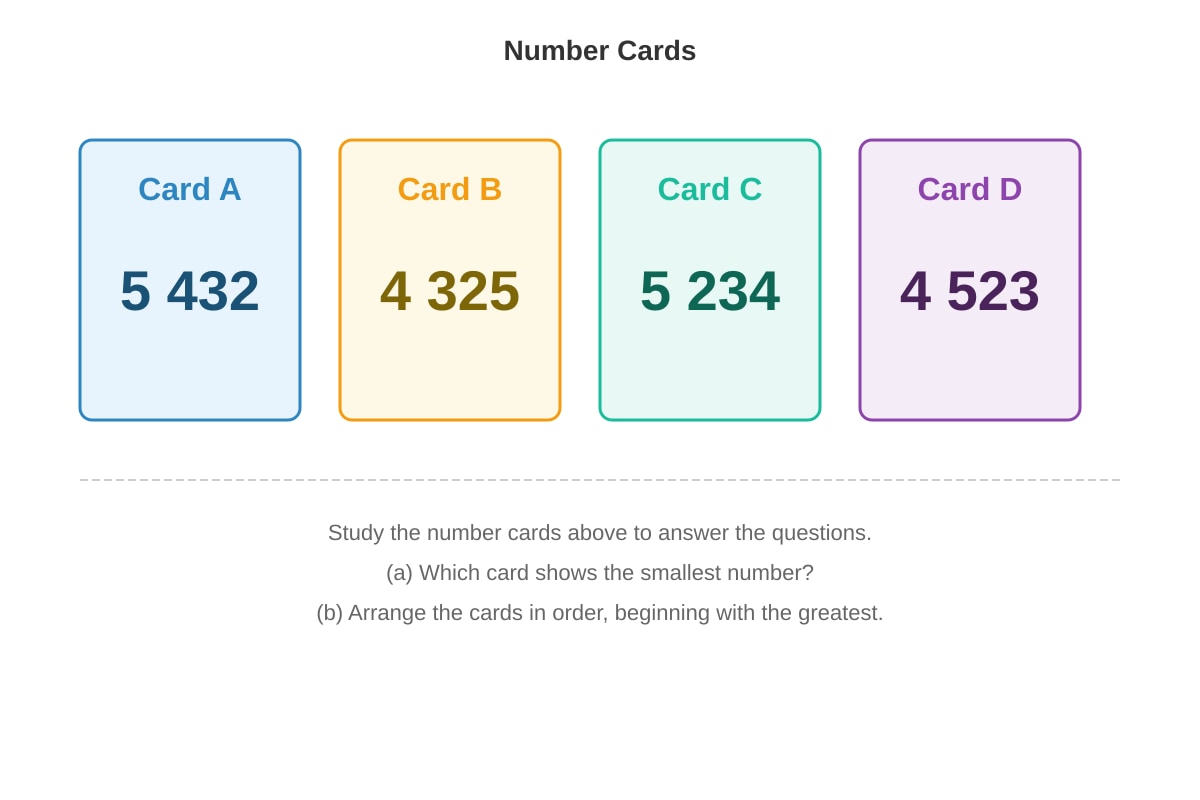
Expected visual: Four cards showing A: 5 432, B: 4 325, C: 5 234, D: 4 523
(a) [1 mark] Answer: Card B (4 325)
Comparing all: Card B starts with 4 in thousands place and has smallest value in hundreds place among 4-thousand numbers.
(b) [2 marks] Answer: A, C, D, B or 5 432, 5 234, 4 523, 4 325
Working:
- 5-thousand numbers: A (5 432) and C (5 234)
- Compare hundreds: 4 > 2, so A > C
- 4-thousand numbers: D (4 523) and B (4 325)
- Compare hundreds: 5 > 3, so D > B
Order: 5 432 > 5 234 > 4 523 > 4 325
Marking: 2 marks for fully correct; 1 mark if order reversed (ascending instead of descending).
(c) [2 marks] Answer: 1 107
Working: Greatest: 5 432 (Card A) Smallest: 4 325 (Card B)
Difference: 5 432 − 4 325 = 1 107
  5 432
- 4 325
-------
  1 107
Marking: 1 mark for identifying correct greatest and smallest; 1 mark for correct subtraction.
Question 29 [5 marks]
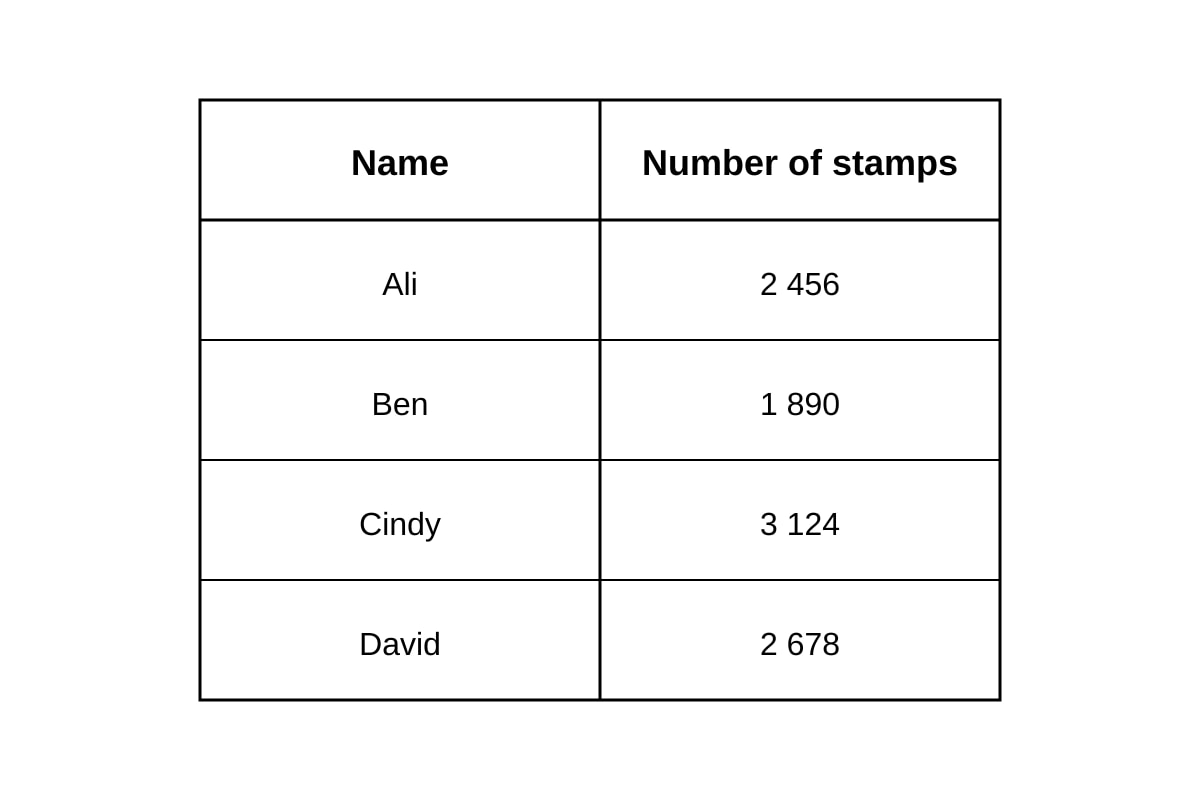
Expected visual: Table with Ali: 2 456, Ben: 1 890, Cindy: 3 124, David: 2 678
(a) [1 mark] Answer: Cindy
Cindy has 3 124 stamps, which is greater than Ali (2 456), Ben (1 890), and David (2 678).
(b) [2 marks] Answer: 4 346 stamps
Working:
  2 456
+ 1 890
-------
  4 346
- Ones: 6 + 0 = 6
- Tens: 5 + 9 = 14, write 4, carry 1
- Hundreds: 4 + 8 + 1 = 13, write 3, carry 1
- Thousands: 2 + 1 + 1 = 4
(c) [2 marks] Answer: 1 234 more stamps
Working: 3 124 − 1 890 = 1 234
  3 124
- 1 890
-------
  1 234
Question 30 [5 marks]
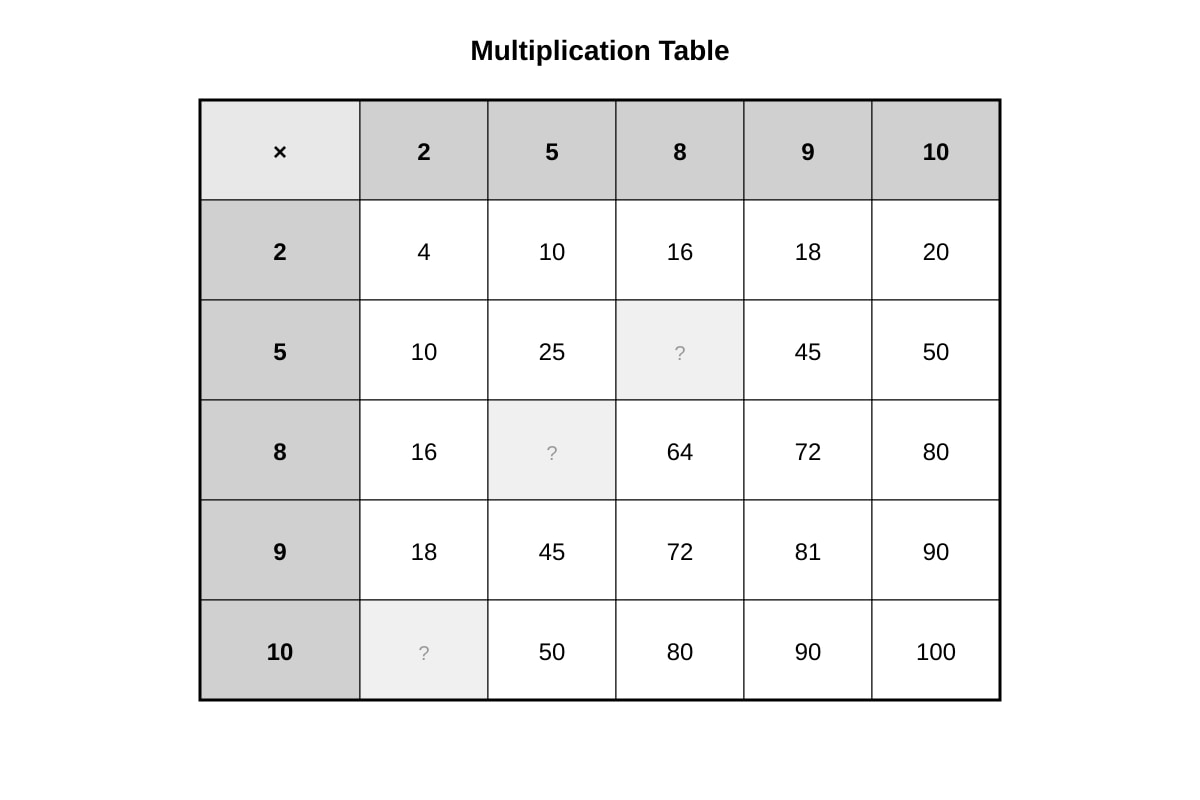
Expected visual: 5×5 multiplication table with headers 2, 5, 8, 9, 10 and some missing values.
(a) [2 marks] Answers:
Row 5, Column 8: 40 (5 × 8 = 40)
Row 8, Column 5: 40 (8 × 5 = 40 — multiplication is commutative, same answer)
Row 10, Column 2: 20 (10 × 2 = 20)
Working/understanding: The table shows products of row header × column header. Due to commutativity of multiplication, the table is symmetric across the diagonal.
(b) [1 mark] Answer: 72
From table: Row 8, Column 9 (or Row 9, Column 8) = 72
This confirms 8 × 9 = 9 × 8 = 72.
(c) [2 marks] Answer: 80 pencils
Working: 10 packets × 8 pencils per packet = 80 pencils
From table: Row 10, Column 8 (or Row 8, Column 10) = 80
10 × 8 = 80
Marking: 1 mark for using correct multiplication from table; 1 mark for correct final answer with context ("pencils").
Total Marks Summary
| Section | Marks |
|---|---|
| A | 10 |
| B | 25 |
| C | 15 |
| Total | 50 |