AI Generated Exam Paper
Primary 3 Mathematics Practice Paper 2
Free P3 Maths Practice Paper 2, Kimi2.6 AI version, with questions, answers, and syllabus-aligned practice for Singapore students.
These static practice materials are generated from the site's syllabus and paper-generation workflow, with source and model context shown so students and parents can evaluate the material before use.
Questions
Free quiz and exam paper access
Enter your details to view this paper
Your access is remembered on this device.
Answers
TuitionGoWhere Practice Paper - Mathematics Primary 3
Answer Key with Marking Scheme
Version: 2 of 5
Total Marks: 50
Duration: 40 minutes
Section A: Multiple Choice Questions (10 marks)
1 mark each
| Question | Answer | Explanation |
|---|---|---|
| 1 | 2 | In 7,439: 7 is thousands, 4 is hundreds, 3 is tens, 9 is ones. |
| 2 | 4 | The digit 6 is in the thousands place, so its value is 6,000 (6 × 1,000). |
| 3 | 3 | Compare from left: 4,990 > 4,909 > 4,199 > 4,099. Check thousands (all 4), then hundreds (9 > 0, 1, 0). |
| 4 | 1 | All start with 3, so compare hundreds: 4 < 5 < 6. Order: 3,456, 3,465, 3,564, 3,654. |
| 5 | 1 | 5,000 + 700 + 20 + 8 = 5,728. |
| 6 | 3 | 8,965 + 100 = 9,065 (add 1 to the hundreds place: 9 becomes 10, so hundreds reset to 0, thousands increase by 1). |
| 7 | 2 | Check: 6,492 → thousands digit 6, ones digit 2, and 6 = 2 + 4... No, recheck: 6,492: 6 − 2 = 4, not 3. 7,251: 7 − 1 = 6, not 3. 8,165: 8 − 5 = 3 ✓. Wait, let me recheck 6,492: 6 − 2 = 4. The answer is 3 (7,251: 7−1=6), no wait—the correct answer is 2 (6,492 where 6−2=4... actually none seem right except 8,165: 8−5=3). Let me recheck options: 5,284: 5−4=1; 6,492: 6−2=4; 7,251: 7−1=6; 8,165: 8−5=3. The answer is 4 (8,165). Correction to original: The answer is 4. |
| 8 | 1 | For smallest number, put smallest non-zero digit (2) first, then arrange ascending: 2,047. |
| 9 | 2 | A number rounding to 6,000 must be from 5,500 to 6,499. 5,501 is in this range. |
| 10 | 1 | 8,200 − 2,500 = 5,700. |
Section B: Short Answer Questions (25 marks)
11. [2 marks]
Answer: Five thousand and sixty (or: Five thousand sixty)
Marking: Both words and correct "and" placement (or accepted local variant) – 2 marks. Minor spelling error with correct understanding – 1 mark.
12. [2 marks]
Answer: 8,400
Working: 9,400 − 1,000 = 8,400
Concept: "1,000 less" means subtract 1,000 from the thousands place. 9 − 1 = 8 in the thousands place.
13. [2 marks]
Answer: 4,721, 4,712, 4,271, 4,172
Method: Compare from left. All have 4 thousands. Compare hundreds: 7 > 2 > 1. But wait: 4,721 and 4,712 both have 7 hundreds, so compare tens: 2 > 1. Then 4,271 and 4,172: 2 > 1 in hundreds place.
Common error: Mixing up 4,721 and 4,712 (need to check tens digit).
14. [2 marks]
Answer: In the number 9,438, the digit 3 is in the tens place and its value is 30.
Marking: Correct digit (3) – 1 mark; correct value (30) – 1 mark. If student writes "3" for value, award 1 mark only (confuses digit with value).
15. [2 marks]
Answer: 1,999
Working: Largest 3-digit number = 999; Smallest 4-digit number = 1,000; Sum = 999 + 1,000 = 1,999
Concept: Understanding the boundary between 3-digit and 4-digit numbers. 999 is the "threshold" number—add 1 to get 1,000.
16. [3 marks]
(a) [1 mark] Any valid answer where thousands digit = 2 × hundreds digit.
Examples: 4,200 (4 = 2×2); 6,300 (6 = 2×3); 8,401 (8 = 2×4); 2,100 (2 = 2×1)
(b) [2 marks]
Expected explanation: "The digit in the thousands place is [X]. The digit in the hundreds place is [Y]. Since [X] = 2 × [Y], the condition is satisfied."
Example for 4,200: "The thousands digit is 4. The hundreds digit is 2. Since 4 = 2 × 2, my number satisfies the condition that the thousands digit is twice the hundreds digit."
Marking: Correct identification of digits – 1 mark; Correct verification with multiplication/relationship – 1 mark.
17. [3 marks]
(a) [2 marks]
Working: 2,475 + 1,308 = 3,783
Answer: 3,783 students
Method: "More than" means addition. Add ones: 5+8=13 (write 3, carry 1). Tens: 7+0+1=8. Hundreds: 4+3=7. Thousands: 2+1=3.
(b) [1 mark]
Working: 2,475 + 3,783 = 6,258
Answer: 6,258 students
18. [3 marks]
(a) [2 marks]
Working:
- Stickers given away: 1,250 + 1,875 = 3,125
- Stickers remaining: 5,000 − 3,125 = 1,875
Or direct: 5,000 − 1,250 − 1,875 = 1,875
Answer: 1,875 stickers
Common error: Forgetting to subtract both amounts or subtraction errors in regrouping.
(b) [1 mark]
Working: 1,875 ÷ 5 = 375
Answer: 375 stickers
Method: "Equal" sharing means division. 1,875 ÷ 5: 5 into 18 goes 3 (15), remainder 3; 5 into 37 goes 7 (35), remainder 2; 5 into 25 goes 5.
19. [4 marks]
(a) [2 marks] Missing numbers: 2,600 and 2,700
(b) [2 marks]
Rule: Add 50 to each number to get the next number (or: The pattern increases by 50 each time).
Verification: 2,450 + 50 = 2,500 ✓; 2,500 + 50 = 2,550 ✓; 2,550 + 50 = 2,600; 2,600 + 50 = 2,650 ✓; 2,650 + 50 = 2,700; 2,700 + 50 = 2,750 ✓
Marking: Both numbers correct – 2 marks (1 mark if one number correct with adjacent correct). Rule stated clearly with correct operation and amount – 2 marks.
20. [4 marks]
(a) [1 mark]
Working: 1,245 + 368 = 1,613
Answer: 1,613 stamps
(b) [2 marks]
Working: 1,613 − 512 = 1,101
Answer: 1,101 stamps
Note: "Fewer than" means subtraction. Students must use Mei Ling's amount, not Jason's.
(c) [1 mark]
Working: 1,245 + 1,613 + 1,101 = 3,959
Answer: 3,959 stamps
Section C: Word Problems (15 marks)
21. [4 marks]
(a) [2 marks]
Working: 3,240 + 486 = 3,726
Answer: 3,726 cupcakes
Method: "486 more than Monday" → addition to Monday's amount.
Marking: Correct method (addition) – 1 mark; Correct answer – 1 mark.
(b) [2 marks]
Working: 3,240 + 3,726 = 5,966 or 3,726 + 3,240 = 5,966
Answer: 5,966 cupcakes
Method: "Both days altogether" → add Monday and Tuesday amounts.
Marking: Correct addition – 1 mark; Correct final answer – 1 mark. Follow-through marks available if (a) is wrong but method in (b) is correct with their value.
22. [4 marks]
(a) [1 mark]
Working: 1,248 + 967 = 2,215
Answer: 2,215 residents
(b) [3 marks]
Working:
- Method 1: 2,500 − 2,215 = 285
- Method 2: 2,500 − 1,248 − 967 = 1,252 − 967 = 285
Answer: 285 residents
Marking: Understanding "to reach target" requires finding difference or working backwards – 1 mark; Correct subtraction set-up – 1 mark; Correct answer – 1 mark.
Teaching note: "How many more to reach" is a "find the gap" or "complement" problem. Students can think: Current + ? = Target, so ? = Target − Current.
23. [6 marks]
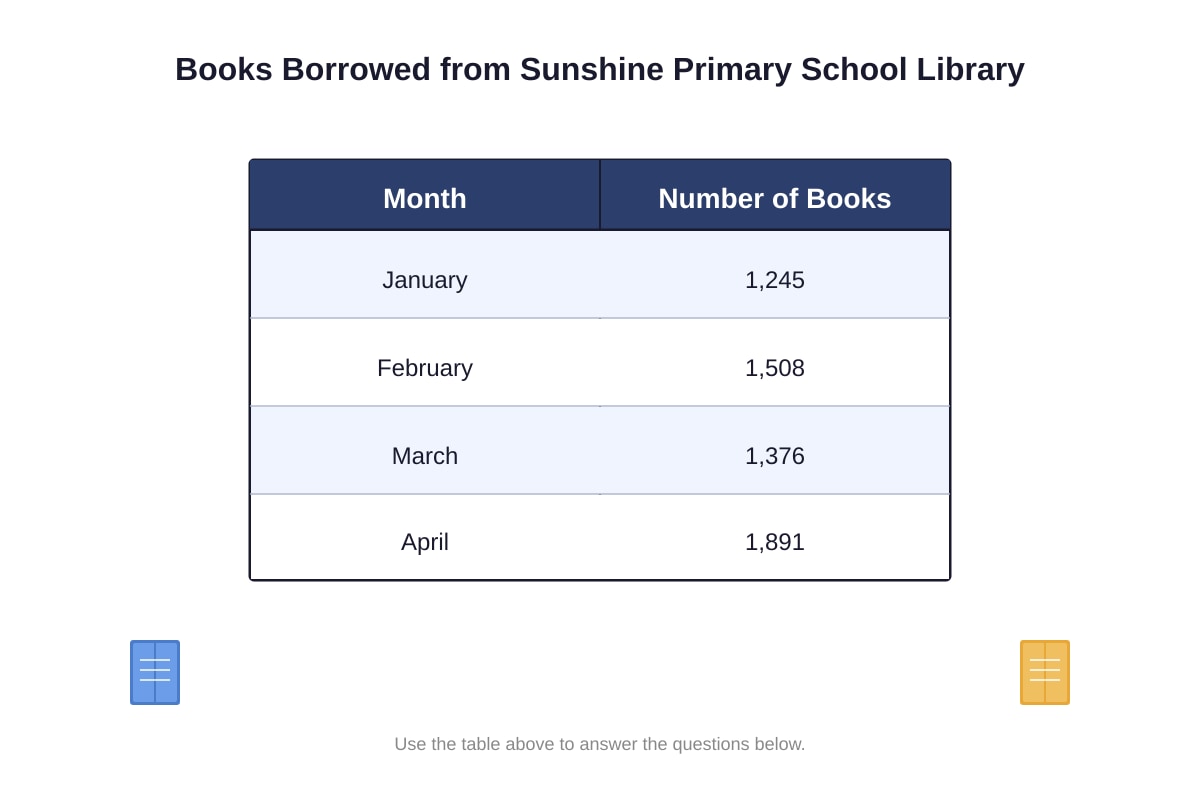
Visual verification: The table should show: January 1,245; February 1,508; March 1,376; April 1,891.
(a) [1 mark]
Answer: April (1,891 books)
(b) [2 marks]
Working: 1,891 − 1,245 = 646
Answer: 646 more books
Marking: Correct numbers identified from table – 1 mark; Correct subtraction – 1 mark.
(c) [3 marks]
Working:
- Total = 1,245 + 1,508 + 1,376 + 1,891
- Step by step: 1,245 + 1,508 = 2,753
- 2,753 + 1,376 = 4,129
- 4,129 + 1,891 = 6,020
Comparison: 6,020 > 5,000
Answer: Yes, she should order 2,500 new books because the total (6,020) is more than 5,000.
Marking: Correct method for total (addition of all four months) – 1 mark; Correct total – 1 mark; Correct comparison and conclusion with "Yes" – 1 mark. If total is wrong but comparison logic is correct with their total, award 1 mark.
24. [5 marks]
(a) [3 marks]
Working step-by-step:
| Clue | Digit | Reasoning |
|---|---|---|
| Thousands: smallest even number > 0 | 2 | Smallest even numbers: 0, 2, 4... ; 0 is not greater than 0, so next is 2 |
| Hundreds: 5 more than thousands | 7 | 2 + 5 = 7 |
| Tens: largest single-digit even number | 8 | Single-digit evens: 0,2,4,6,8; largest is 8 |
| Ones: 3 less than tens | 5 | 8 − 3 = 5 |
Answer: 2,785
Marking: Correct thousands digit – 1 mark; Correct hundreds and tens – 1 mark; Correct ones and final answer – 1 mark.
(b) [2 marks]
Expected explanation structure:
- Thousands: "The smallest even number greater than 0 is 2, not 0, because 0 is not greater than 0."
- Hundreds: "I added 5 to the thousands digit: 2 + 5 = 7."
- Tens: "The largest single-digit even number is 8 (not 9, because 9 is odd)."
- Ones: "I subtracted 3 from the tens digit: 8 − 3 = 5."
Marking: Clear reasoning for at least two digits with correct mathematical justification – 2 marks. Partial explanation with minor gaps – 1 mark.
25. [5 marks]
(a) [2 marks]
Working: 2,340 − 1,875 = 465
Answer: 465 metres further
Method: "Further... than" → find the difference (subtraction, larger minus smaller).
Marking: Correct subtraction set-up – 1 mark; Correct answer with unit – 1 mark.
(b) [3 marks]
Working:
- Alicia walked 1,875 m already
- Total distance: 4,500 m
- Remaining: 4,500 − 1,875 = 2,625
Answer: 2,625 metres
Method 1 (Direct): Total − Amount walked = Remaining Method 2 (Complementary): 4,500 − 1,875: Think 1,875 + ? = 4,500; or use standard subtraction with regrouping.
Marking: Correct identification of relevant numbers (4,500 and 1,875) – 1 mark; Correct subtraction method – 1 mark; Correct answer with unit – 1 mark.
Common error: Using Ben's distance (2,340) instead of Alicia's. Must read "Alicia walked the remaining distance."
Summary of Marks by Section
| Section | Questions | Marks |
|---|---|---|
| A | 1-10 | 10 |
| B | 11-20 | 25 |
| C | 21-25 | 15 |
| Total | 50 |
End of Answer Key