AI Generated Exam Paper
Primary 3 Mathematics Practice Paper 1
Free P3 Maths Practice Paper 1, Kimi2.6 AI version, with questions, answers, and syllabus-aligned practice for Singapore students.
These static practice materials are generated from the site's syllabus and paper-generation workflow, with source and model context shown so students and parents can evaluate the material before use.
Questions
Free quiz and exam paper access
Enter your details to view this paper
Your access is remembered on this device.
Answers
TuitionGoWhere Practice Paper Answers - Mathematics Primary 3
Version 1 of 5 – Answer Key
Section A: Multiple Choice (10 marks)
| Question | Answer | Explanation |
|---|---|---|
| 1 | D) 7 000 | In 7 439, the digit 7 is in the thousands place. The value of 7 in this position is . Common mistake: Choosing "7" (the digit itself) instead of its place value. |
| 2 | C) 4 285 | Compare digit by digit from left to right: all have 4 in thousands. In hundreds: 2 < 5 < 8. So 4 285 (hundreds digit 2) is smallest. Order: 4 285, 4 456, 4 528, 4 852. |
| 3 | B) 5 307 | . Breaking down: 5 thousands = 5000, 3 hundreds = 300, 0 tens = 0, 7 ones = 7. Total: 5000 + 300 + 0 + 7 = 5307. |
| 4 | D) 6 000 | In 6 218, the digit 6 is in the thousands place (leftmost position in a 4-digit number). Value = . |
| 5 | B) 3 654, 3 564, 3 465, 3 456 | Compare from thousands (all 3), then hundreds: 6 > 5 > 4. For 3 456 vs 3 465: tens place 5 > 6 is false, so 3 465 > 3 456. Descending order: 3654, 3564, 3465, 3456. |
| 6 | A) 2 | 8 020 = 8 thousands + 0 hundreds + 2 tens + 0 ones. The tens digit is 2, so there are 2 tens. Not "20"—that would be the value (20), but the question asks how many tens. |
| 7 | C) 6 889 | "100 more than" means add 100: . |
| 8 | A) 1 724 | "Difference between" means subtract: . Working: ; ; ; . Or standard subtraction algorithm. |
| 9 | A) 0 | Given information: thousands=4, hundreds=8 (twice 4), ones=7. Number is 4 8 _ 7. But question states the number is 4 807, so tens digit must be 0. |
| 10 | B) 10 000 | . This is the next thousand after 9 999—an important boundary number showing how 4-digit numbers roll over to 5 digits. |
Section B: Short Answer (12 marks)
11. Write 5 608 in words. [2 marks]
Answer: Five thousand, six hundred and eight
Working/Explanation:
- 5 in thousands place → "five thousand"
- 6 in hundreds place → "six hundred"
- 0 in tens place → nothing to say (we don't say "zero tens")
- 8 in ones place → "and eight"
Marking: 1 mark for "five thousand six hundred" or equivalent; 1 mark for correct handling of zero and final "and eight". Deduct 1 mark if "zero tens" or "and" is omitted incorrectly.
12. Write six thousand, two hundred and fifteen in numerals. [2 marks]
Answer: 6 215
Working/Explanation:
- "Six thousand" → 6 in thousands place: 6000
- "Two hundred" → 2 in hundreds place: 200
- "Fifteen" → 1 ten and 5 ones: 10 + 5 = 15
- Combine: 6000 + 200 + 10 + 5 = 6215
Marking: 1 mark for correct digits (6,2,1,5); 1 mark for correct place value arrangement. Deduct 1 mark if written as 600020015 or 62015.
13. What is the greatest 4-digit number that can be formed using the digits 3, 0, 7, and 2? [2 marks]
Answer: 7 320
Working/Explanation: To make the greatest number, place the largest digits in the highest place values:
- Thousands place: largest available digit = 7
- Hundreds place: next largest = 3 (can't use 7 again)
- Tens place: next largest = 2
- Ones place: remaining digit = 0
Important: 0 cannot be in the thousands place (that would make a 3-digit number).
Marking: 1 mark for identifying 7 in thousands place; 1 mark for correct complete arrangement. Deduct 1 mark if answer is 732 (3 digits) or 0732.
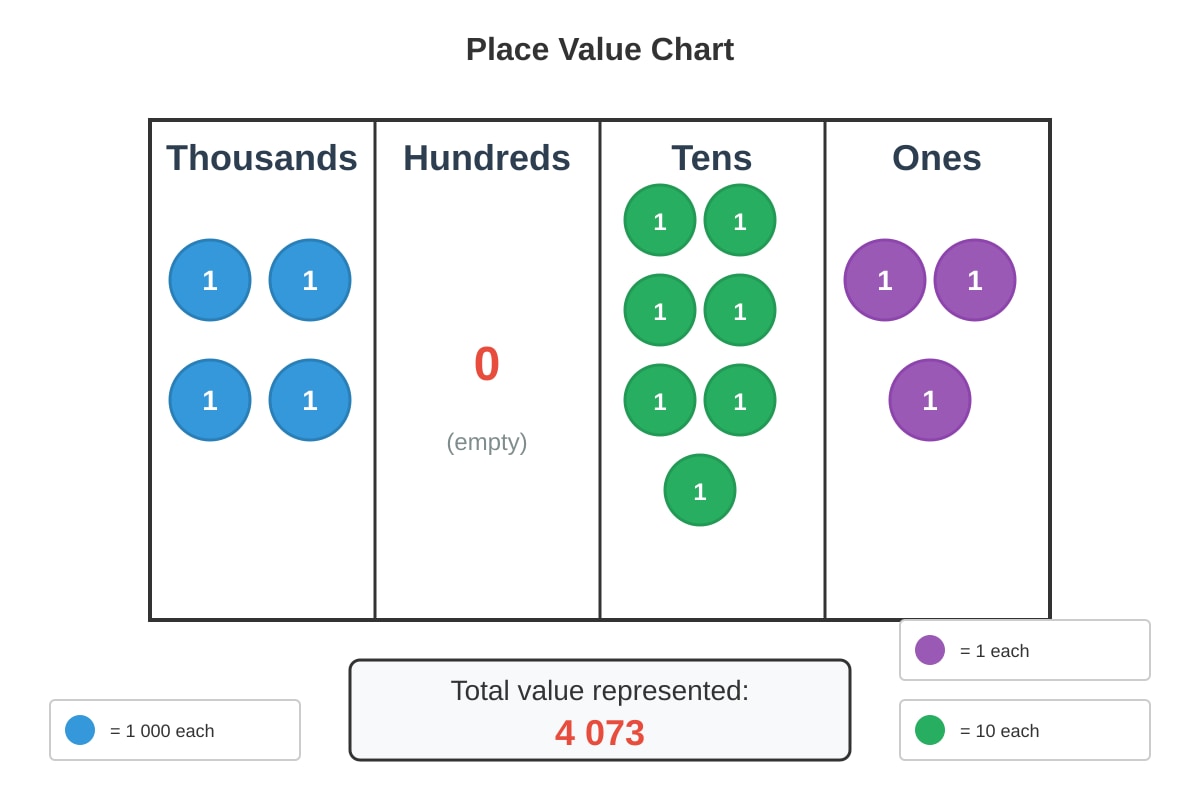
14. What is the number shown on the place value chart? [2 marks]
Answer: 4 073
Working/Explanation: The place value chart shows:
- Thousands column: 4 counters →
- Hundreds column: 0 counters →
- Tens column: 7 counters →
- Ones column: 3 counters →
Total:
Marking: 1 mark for correctly reading each column; 1 mark for correct final answer. Common error: Writing 473 (missing the thousands) or 407 (missing ones).
Expected visual features for image generation: The diagram should show 4 distinct counter tokens in Thousands, empty Hundreds, 7 tokens in Tens, 3 tokens in Ones. Clear labels above each column.
15. Find the sum of 2 345 and 4 678. [2 marks]
Answer: 7 023
Working:
  2345
+ 4678
------
Step-by-step:
- Ones: → write 3, carry 1 to tens
- Tens: (carried) → write 2, carry 1 to hundreds
- Hundreds: (carried) → write 0, carry 1 to thousands
- Thousands: (carried) → write 7
Result: 7023
Marking: 1 mark for correct method with carrying shown; 1 mark for correct final answer. Deduct 1 mark if answer is 6023 (forgotten carry) or 7033 (addition error).
16. Subtract 1 589 from 4 000. [2 marks]
Answer: 2 411
Working:
  4000
- 1589
------
Step-by-step (with regrouping):
- Ones: → need to regroup. Thousands→Hundreds→Tens→Ones chain:
- 4000 = 3 thousands + 10 hundreds
- = 3 thousands + 9 hundreds + 10 tens
- = 3 thousands + 9 hundreds + 9 tens + 10 ones
- Now subtract: (ones)
- Tens:
- Hundreds:
- Thousands:
Result: 2411
Alternative check: ✓
Marking: 1 mark for showing correct regrouping method; 1 mark for correct answer. Common error: 2589 (subtracting smaller from larger digit-by-digit without regrouping).
Section C: Word Problems (18 marks)
17. Library books problem [3 marks]
(a) How many books altogether? [2 marks]
Answer: 6 121 books
Working:
  3245 (fiction)
+ 2876 (non-fiction)
------
- Ones: → 1, carry 1
- Tens: → 2, carry 1
- Hundreds: → 1, carry 1
- Thousands:
Total: 6121
(b) How many more fiction than non-fiction? [1 mark]
Answer: 369 more fiction books
Working:
Marking breakdown:
- (a) 2 marks: 1 mark for correct addition method; 1 mark for correct total 6121
- (b) 1 mark: correct subtraction 3245 − 2876 = 369
- Common error in (b): Subtracting in wrong order (2876 − 3245 = negative, or giving 369 without specifying "more fiction")
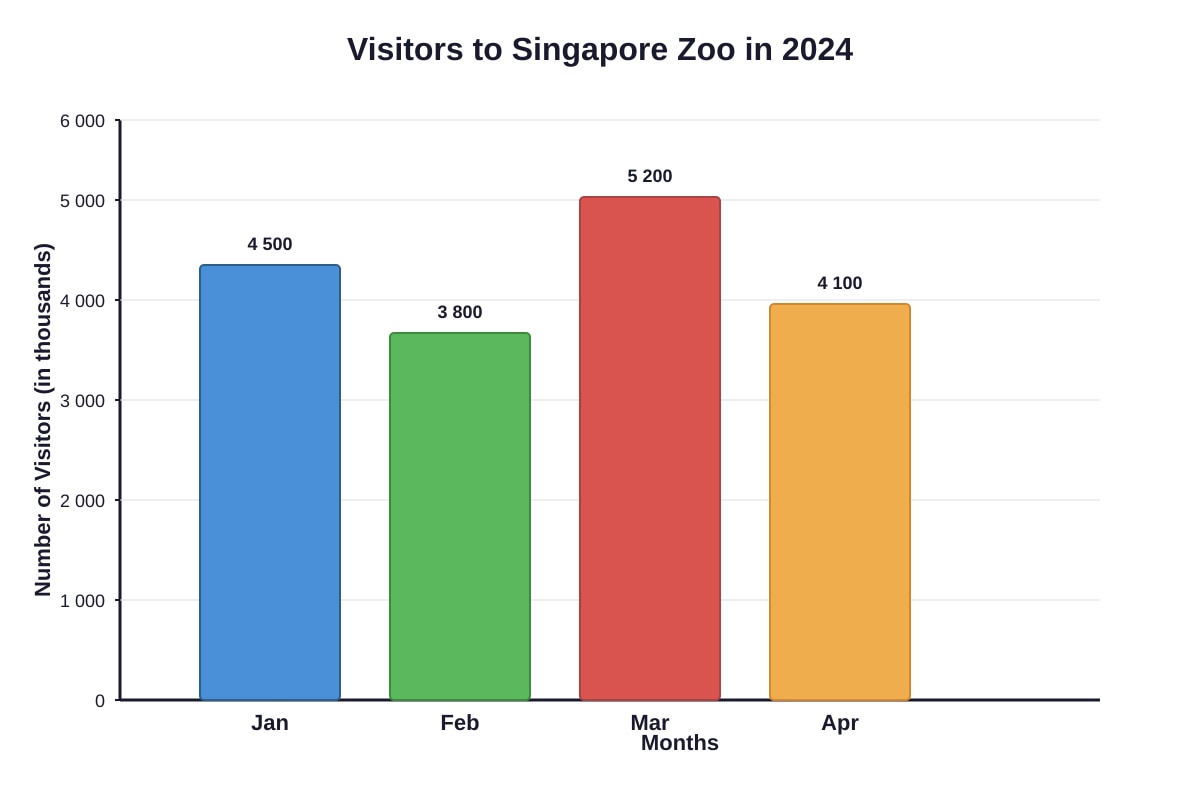
18. Singapore Zoo visitors bar graph [3 marks]
(a) In which month were there the most visitors? [1 mark]
Answer: March
Working: Compare values from bar graph: Jan 4500, Feb 3800, Mar 5200, Apr 4100. The tallest bar/highest value is March with 5200 visitors.
(b) Visitors in February and March altogether? [2 marks]
Answer: 9 000 visitors
Working:
- 3800 + 5200: 38 hundreds + 52 hundreds = 90 hundreds = 9000
Marking breakdown:
- (a) 1 mark: correct identification of March
- (b) 2 marks: 1 mark for correct values extracted (3800 and 5200); 1 mark for correct sum 9000
- Common error: Using wrong months or arithmetic mistake (e.g., 8000 instead of 9000)
Expected visual features for image generation: Horizontal or vertical bars with clear height difference; March bar clearly tallest; values labeled or readable from scale; months labeled in order Jan-Apr.
19. Mrs. Lim's stickers [6 marks]
(a) Stickers left after giving to Class 3A and 3B [2 marks]
Answer: 1 875 stickers
Working:
- Given away:
- Remaining:
  1250
+ 1875
------
  3125

  5000
- 3125
------
  1875
(b) Stickers per Class 3C pupil [2 marks]
Answer: 375 stickers
Working:
- Method: ; ;
(c) Shortage for 25 Class 3D pupils [2 marks]
Answer: 7 500 stickers
Working:
-
Each pupil gets same as 3C pupils: 375 stickers
-
Needed for 25 pupils:
-
: ; ; total = 9375
-
Or:
-
Stickers available: 1875
-
Shortage:
Alternative interpretation: If each gets the original "same number" meaning equal share of original 5000: each, no shortage needed. But context suggests (c) refers to same 375 as (b).
Clarification: If question means "same number as each 3C pupil got (375)":
- Need:
- Have: 1875
- Short by:
Marking breakdown:
- (a) 2 marks: 1 mark for finding total given away (3125); 1 mark for correct subtraction (1875)
- (b) 2 marks: 1 mark for division method; 1 mark for 375
- (c) 2 marks: 1 mark for calculating total needed ( or equivalent); 1 mark for finding shortage 7500
Common mistakes: Forgetting leftover stickers from (a) carries to (b); confusing "remaining" from original vs. after giving away.
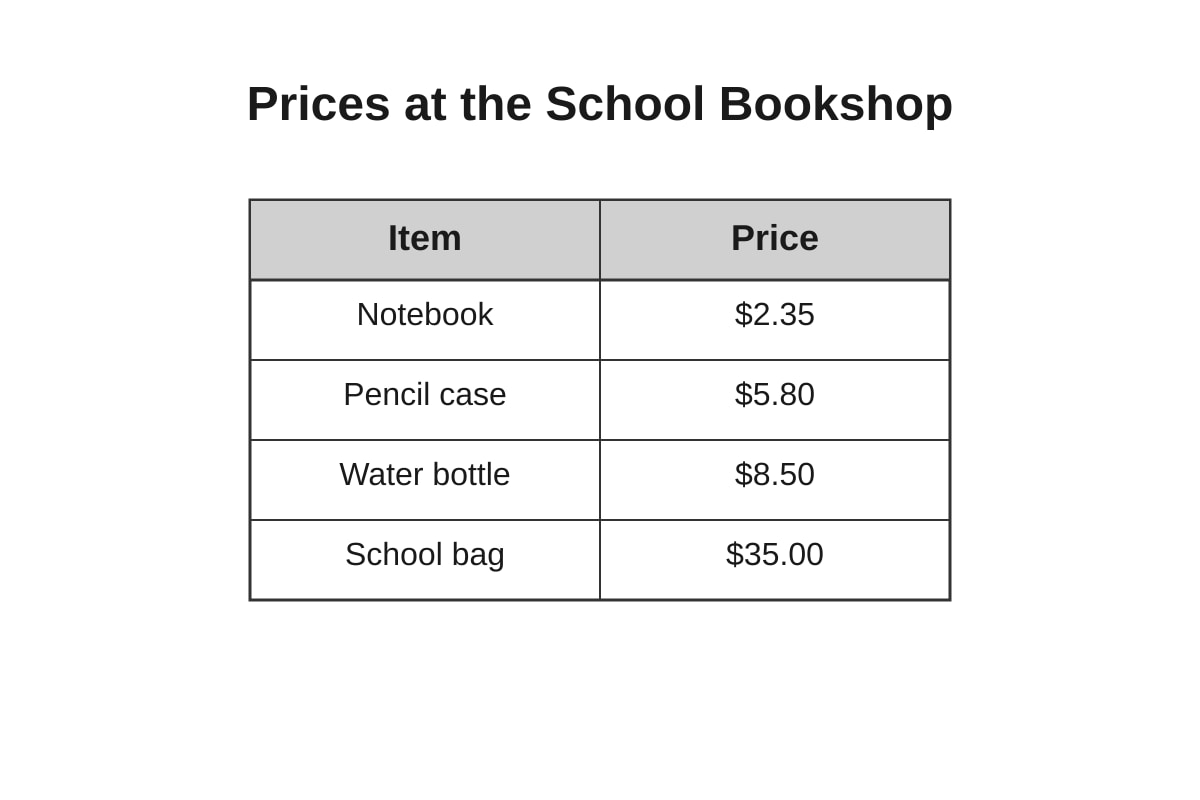
20. School bookshop prices [6 marks]
(a) Cost of notebook and pencil case [2 marks]
Answer: $8.15
Working: \2.35 + $5.80 = $8.15$
- Dollars:
- Cents: cents = $1.15
- Total:
(b) Money left after school bag and water bottle [2 marks]
Answer: $6.50
Working:
- Cost: \35.00 + $8.50 = $43.50$
- Left: \50.00 - $43.50 = $6.50$
(c) Is $20 enough for 3 notebooks? [2 marks]
Answer: **Yes, it is enough. She will have 20 > $7.05")
Working:
- Cost of 3 notebooks: \2.35 \times 3 = $7.05$
- Compare: \7.05 < $20.00$
- Yes, enough. Money left: \20.00 - $7.05 = $12.95$
Or simply: , and , so yes.
Marking breakdown:
- (a) 2 marks: 1 mark for correct addition method with decimals; 1 mark for $8.15
- (b) 2 marks: 1 mark for total cost 6.50
- (c) 2 marks: 1 mark for calculating $7.05 (3 notebooks); 1 mark for explicit comparison and conclusion "Yes"
Common mistakes: Decimal point errors (5.80 = $7.115); forgetting to compare in (c) just calculating; saying "No" when it's actually yes.
Expected visual features for image generation: Clean table with 2 columns; prices in dollars with 2 decimal places; clear item names; title at top.
Total Marks Verification
| Section | Marks | Cumulative |
|---|---|---|
| A (Q1-10) | 10 | 10 |
| B (Q11-16) | 12 | 22 |
| C (Q17-20) | 18 | 40 |
Grand Total: 40 marks ✓
Note: This practice paper is syllabus-aligned and generated from LLM-inferred templates. It is not derived from official past-year examination papers, but is designed to match the cognitive demand, format, and topic coverage appropriate for Primary 3 Mathematics (Whole Numbers focus) under the Singapore MOE syllabus.