From Real Exams Exam Paper
Primary 3 Mathematics Semestral Assessment 2 (End of Year) Paper 4
Free Kimi AI-generated P3 Maths SA2 Paper 4 with questions, answers, and syllabus-aligned practice for Singapore students preparing for exams.
These static practice materials are generated from the site's syllabus and paper-generation workflow, with source and model context shown so students and parents can evaluate the material before use.
Questions
TuitionGoWhere Exam Practice (AI)
TuitionGoWhere Secondary School (AI)
| Subject: | Mathematics |
| Level: | Primary 3 |
| Paper: | SA2 Practice Paper — Version 4 of 5 |
| Duration: | 1 hour 30 minutes |
| Total Marks: | 80 |
| Name: | _________________________ |
| Class: | _________________________ |
| Date: | _________________________ |
INSTRUCTIONS TO CANDIDATES
- Write your name, class, and date in the spaces provided above.
- This paper consists of THREE sections: A, B, and C.
- Answer ALL questions.
- Write your answers in the spaces provided. Show all your working clearly.
- Marks are given for correct methods as well as correct answers.
- You may use an approved calculator where appropriate.
SECTION A: Multiple Choice Questions (15 marks)
Answer each question. Circle the correct answer.
(1 mark each — 15 questions × 1 mark = 15 marks)
1. In the number 7,056, which digit is in the hundreds place?
(a) 7
(b) 0
(c) 5
(d) 6
2. What is the value of the digit 8 in 8,291?
(a) 8
(b) 80
(c) 800
(d) 8,000
3. Which of the following numbers is the smallest?
(a) 4,205
(b) 4,052
(c) 4,520
(d) 4,502
4. 5 thousands, 12 tens, and 8 ones is equal to
(a) 5,128
(b) 5,120
(c) 5,028
(d) 5,208
5. Which number is 500 more than 6,789?
(a) 6,289
(b) 7,289
(c) 7,389
(d) 6,839
6. Round 4,567 to the nearest hundred.
(a) 4,500
(b) 4,560
(c) 4,600
(d) 4,570
7. The difference between two numbers is 2,450. If the larger number is 8,120, what is the smaller number?
(a) 10,570
(b) 5,670
(c) 6,670
(d) 5,330
8. Which of the following shows the numbers arranged from largest to smallest?
(a) 3,210; 3,120; 3,021; 3,012
(b) 3,012; 3,021; 3,120; 3,210
(c) 3,210; 3,021; 3,120; 3,012
(d) 3,120; 3,210; 3,012; 3,021
9. What is the sum of 2,456 and 3,789?
(a) 5,135
(b) 6,135
(c) 6,245
(d) 6,145
10. In a number pattern, the rule is "add 250 each time." If the first number is 1,050, what is the fourth number?
(a) 1,300
(b) 1,550
(c) 1,800
(d) 2,050
11. A school has 1,248 boys and 1,576 girls. How many students are there in the school altogether?
(a) 2,724
(b) 2,824
(c) 2,814
(d) 2,924
12. 7,000 − 2,456 =
(a) 5,556
(b) 4,544
(c) 4,654
(d) 5,454
13. Which number sentence is TRUE?
(a) 2,345 > 2,435
(b) 5,060 = 5,006
(c) 3,210 < 3,120
(d) 8,888 > 8,880
14. Mrs. Lim baked 3,240 cookies. She packed them into packets of 100. How many cookies were left over?
(a) 2
(b) 24
(c) 40
(d) 240
15. The product of two numbers is 3,600. One of the numbers is 9. What is the other number?
(a) 400
(b) 360
(c) 324
(d) 400
SECTION B: Short Answer Questions (40 marks)
Answer all questions. Show your working clearly in the spaces provided.
(Questions 16–25: 2 marks each — 10 questions × 2 marks = 20 marks)
(Questions 26–30: 4 marks each — 5 questions × 4 marks = 20 marks)
*Subtotal: 40 marks
16. Write 5,078 in words.
17. Write "nine thousand and sixty-five" in numerals.
18. In 9,803, the digit _______ stands for 800.
19. Arrange the following numbers in ascending order:
6,052; 6,205; 6,025; 6,520
20. Find the sum of 4,567 and 2,845.
21. Subtract 3,456 from 7,000.
22. What is the difference between 5,230 and 8,100?
23. Complete the number pattern: 1,200, 1,450, 1,700, _______, 2,200
24. Round 8,349 to the nearest thousand and to the nearest hundred.
Nearest thousand: _______________
Nearest hundred: _______________
25. A number, when rounded to the nearest hundred, becomes 4,500. List all the possible whole numbers that this original number could be, if it is between 4,400 and 4,599.
26. A supermarket sold 2,345 bottles of juice in January. In February, it sold 876 more bottles than in January. How many bottles of juice were sold altogether in the two months?
27.
<image_placeholder> id: Q27-fig1 type: diagram linked_question: 27 description: Bar model showing two parts for an addition/subtraction comparison problem labels: Part A (unknown), Part B labeled "3,568", Total labeled "8,240" values: Part B = 3,568, Total = 8,240 must_show: Two connected bars forming a whole, clear labels for Part B and Total, blank space for Part A with question mark </image_placeholder>
Look at the bar model above. Find the value of the unknown part.
28. Mr. Tan has 5,000 stickers. He gives 1,248 stickers to Class 3A and 1,576 stickers to Class 3B. How many stickers does he have left?
29.
<image_placeholder> id: Q29-fig1 type: chart linked_question: 29 description: Bar graph showing number of books read by four classes in a reading competition labels: Classes: 3A, 3B, 3C, 3D; Vertical axis: "Number of books" from 0 to 2,500 in intervals of 500 values: 3A = 1,500; 3B = 2,000; 3C = 1,250; 3D = 1,750 must_show: Four vertical bars with different heights, labeled x-axis with class names, labeled y-axis with scale, values readable from bar heights </image_placeholder>
The bar graph shows the number of books read by four Primary 3 classes during a reading competition.
(a) How many more books did Class 3B read than Class 3C? [2 marks]
(b) What is the total number of books read by all four classes? [2 marks]
30. Sally thinks of a number. When she adds 2,450 to her number, she gets 6,800. When she subtracts 1,250 from her original number, what does she get?
SECTION C: Problem Solving (25 marks)
Answer all questions. Show your working clearly.
(Questions 31–35: 5 marks each — 5 questions × 5 marks = 25 marks)
*Subtotal: 25 marks
31.
<image_placeholder> id: Q31-fig1 type: diagram linked_question: 31 description: Number line showing positions of four numbers A, B, C, D with equal intervals labels: Points labeled A, B, C, D from left to right; A is at position 1,500; D is at position 3,000 values: A = 1,500, D = 3,000, equal intervals between A-B, B-C, C-D must_show: Horizontal number line with tick marks, labeled points A, B, C, D, starting value at A and ending value at D, equal spacing clearly indicated </image_placeholder>
Look at the number line above. The distance from A to B, B to C, and C to D is the same.
(a) What is the distance between each point? [2 marks]
(b) What number does C stand for? [1 mark]
(c) If E is placed after D so that the distance from D to E is twice the distance from C to D, what number does E stand for? [2 marks]
32. A factory produced 3,456 toys in the first week. In the second week, it produced 1,289 more toys than in the first week. In the third week, it produced 987 fewer toys than in the second week.
(a) How many toys did the factory produce in the second week? [2 marks]
(b) How many toys did the factory produce in the third week? [1 mark]
(c) What was the total number of toys produced in the three weeks? [2 marks]
33.
<image_placeholder> id: Q33-fig1 type: table linked_question: 33 description: Price list table for items in a school bookshop labels: Columns: Item, Price; Rows: Storybook, Stationery set, Water bottle, Bag, Calculator values: Storybook = 8, Water bottle = 45, Calculator = symbol, neat alignment </image_placeholder>
The table shows the prices of items in a school bookshop.
(a) Mdm. Koh bought a bag and two storybooks. How much did she pay altogether? [2 marks]
(b) Peter had $100. He bought a calculator and a stationery set. How much change did he receive? [2 marks]
(c) Susan wants to buy one water bottle and as many storybooks as she can with $50. How many storybooks can she buy? [1 mark]
34. At a concert, there were 2,456 adults. There were 1,278 more children than adults.
(a) How many children were at the concert? [2 marks]
(b) The organizers arranged seats in rows. Each row could seat 8 people. How many rows were needed for all the children? [2 marks]
(c) If each adult ticket cost 15, how much money was collected from all the tickets? [1 mark]
35.
<image_placeholder> id: Q35-fig1 type: diagram linked_question: 35 description: Place value chart with four columns showing thousands, hundreds, tens, ones with digit cards placed labels: Columns: Thousands, Hundreds, Tens, Ones; Digit cards shown: 7, 0, 5, 2 placed in some positions values: Thousands = 7, Hundreds = 0, Tens = 5, Ones = 2; showing number 7,052 must_show: Four labeled columns, digit cards clearly placed in each column, column headers in bold or larger text </image_placeholder>
Jason has four digit cards: 7, 0, 5, and 2.
(a) Using each digit card exactly once, what is the largest 4-digit number he can form? [1 mark]
(b) Using each digit card exactly once, what is the smallest 4-digit number he can form? [1 mark]
(c) What is the difference between the largest and smallest 4-digit numbers in parts (a) and (b)? [1 mark]
(d) Jason wants to form a number that rounds to 5,000 when rounded to the nearest thousand. List ALL possible numbers he can form that satisfy this condition. [2 marks]
END OF PAPER
Total Marks: 80
| Section | Marks |
|---|---|
| A | / 15 |
| B | / 40 |
| C | / 25 |
| Total | / 80 |
Check your work carefully before handing in your paper.
Answers
TuitionGoWhere Exam Practice (AI) — Answer Key
Primary 3 Mathematics — SA2 Practice Paper — Version 4 of 5
Total Marks: 80
SECTION A: Multiple Choice Questions (15 marks)
1. Answer: (b) 0
- In 7,056: 7 is thousands, 0 is hundreds, 5 is tens, 6 is ones.
- Common mistake: Choosing 5 (tens place) instead of reading carefully.
2. Answer: (d) 8,000
- The digit 8 is in the thousands place.
- Value = 8 × 1,000 = 8,000.
3. Answer: (b) 4,052
- Compare thousands: all have 4.
- Compare hundreds: 0 < 2 < 5, so 4,052 is smallest.
4. Answer: (a) 5,128
- 5 thousands = 5,000
- 12 tens = 120
- 8 ones = 8
- Total: 5,000 + 120 + 8 = 5,128
5. Answer: (b) 7,289
- 6,789 + 500 = 7,289.
6. Answer: (c) 4,600
- 4,567: tens digit is 6, so round up.
- 4,567 → 4,600 (nearest hundred).
7. Answer: (b) 5,670
- Smaller number = 8,120 − 2,450 = 5,670.
8. Answer: (a) 3,210; 3,120; 3,021; 3,012
- Compare from left: 3,210 > 3,120 > 3,021 > 3,012.
9. Answer: (c) 6,245
- 2,456 + 3,789:
- Ones: 6 + 9 = 15 (write 5, carry 1)
- Tens: 5 + 8 + 1 = 14 (write 4, carry 1)
- Hundreds: 4 + 7 + 1 = 12 (write 2, carry 1)
- Thousands: 2 + 3 + 1 = 6
- Answer: 6,245
10. Answer: (c) 1,800
- 1st: 1,050
- 2nd: 1,050 + 250 = 1,300
- 3rd: 1,300 + 250 = 1,550
- 4th: 1,550 + 250 = 1,800
11. Answer: (b) 2,824
- 1,248 + 1,576:
- 8 + 6 = 14 (write 4, carry 1)
- 4 + 7 + 1 = 12 (write 2, carry 1)
- 2 + 5 + 1 = 8
- 1 + 1 = 2
- Answer: 2,824
12. Answer: (b) 4,544
- 7,000 − 2,456:
- Need to borrow: 7,000 = 6,990 + 10 (after multiple borrows)
- Or check: 4,544 + 2,456 = 7,000 ✓
- Answer: 4,544
13. Answer: (d) 8,888 > 8,880
- (a) False: 2,345 < 2,435
- (b) False: 5,060 ≠ 5,006
- (c) False: 3,210 > 3,120
- (d) True: 8,888 > 8,880
14. Answer: (c) 40
- 3,240 ÷ 100 = 32 remainder 40
- Or: 32 × 100 = 3,200; 3,240 − 3,200 = 40
- Answer: 40 cookies left over
15. Answer: (a) 400 (Note: options show (a) and (d) same; intended answer is 400)
- 3,600 ÷ 9 = 400
- Check: 400 × 9 = 3,600 ✓
SECTION B: Short Answer Questions (40 marks)
16. Five thousand and seventy-eight [2 marks]
- 5 = five thousand, 0 = no hundreds (skip), 7 = seventy, 8 = eight.
- Common mistake: "Five thousand seventy-eight" (missing "and").
17. 9,065 [2 marks]
- Nine thousand = 9,000; sixty-five = 65.
- Total: 9,000 + 65 = 9,065.
18. 8 [2 marks]
- In 9,803: 9=9000, 8=800, 0=0, 3=3.
- The digit 8 is in the hundreds place.
19. 6,025; 6,052; 6,205; 6,520 [2 marks]
- All have 6 thousands.
- Compare hundreds: 0 < 2 < 5, so 6,025 and 6,052 come before 6,205 and 6,520.
- Then 6,025 < 6,052 (25 < 52), and 6,205 < 6,520.
20. 7,412 [2 marks]
- 4,567 + 2,845:
- 7 + 5 = 12 (write 2, carry 1)
- 6 + 4 + 1 = 11 (write 1, carry 1)
- 5 + 8 + 1 = 14 (write 4, carry 1)
- 4 + 2 + 1 = 7
- Answer: 7,412
21. 3,544 [2 marks]
- 7,000 − 3,456:
- Multiple borrowing needed
- Check: 3,544 + 3,456 = 7,000 ✓
- Answer: 3,544
22. 2,870 [2 marks]
- Difference = 8,100 − 5,230
- 0 − 0 = 0
- Need borrow: 10 − 3 = 7
- Need borrow: 0 − 2, can't, so borrow again: 10 − 2 = 8 (after adjustments)
- 7 − 5 = 2
- Or: 8,100 − 5,230 = 2,870
- Answer: 2,870
23. 1,950 [2 marks]
- Pattern: Add 250 each time.
- 1,700 + 250 = 1,950
- Check: 1,950 + 250 = 2,200 ✓
24. Nearest thousand: 8,000 [1 mark]; Nearest hundred: 8,300 [1 mark]
- Nearest thousand: 8,349 → 8,000 (349 < 500, round down)
- Nearest hundred: 8,349 → 8,300 (49 < 50, round down)
- Total: 2 marks
25. 4,450 to 4,549 [2 marks]
- Rounding to nearest hundred: 4,500 means range is 4,450 to 4,549.
- At 4,450 exactly: rounds up to 4,500 (standard rounding).
- At 4,549: rounds down to 4,500.
- Answer: All whole numbers from 4,450 to 4,549 inclusive (100 numbers).
26. 5,566 bottles [4 marks]
- January: 2,345 bottles
- February: 2,345 + 876 = 3,221 bottles [1 mark for Feb]
- Total: 2,345 + 3,221 = 5,566 bottles [3 marks]
- Alternative mark scheme: Correct method for Feb (1m), correct Feb value (1m), correct method for total (1m), correct final answer (1m).
27. [4 marks]
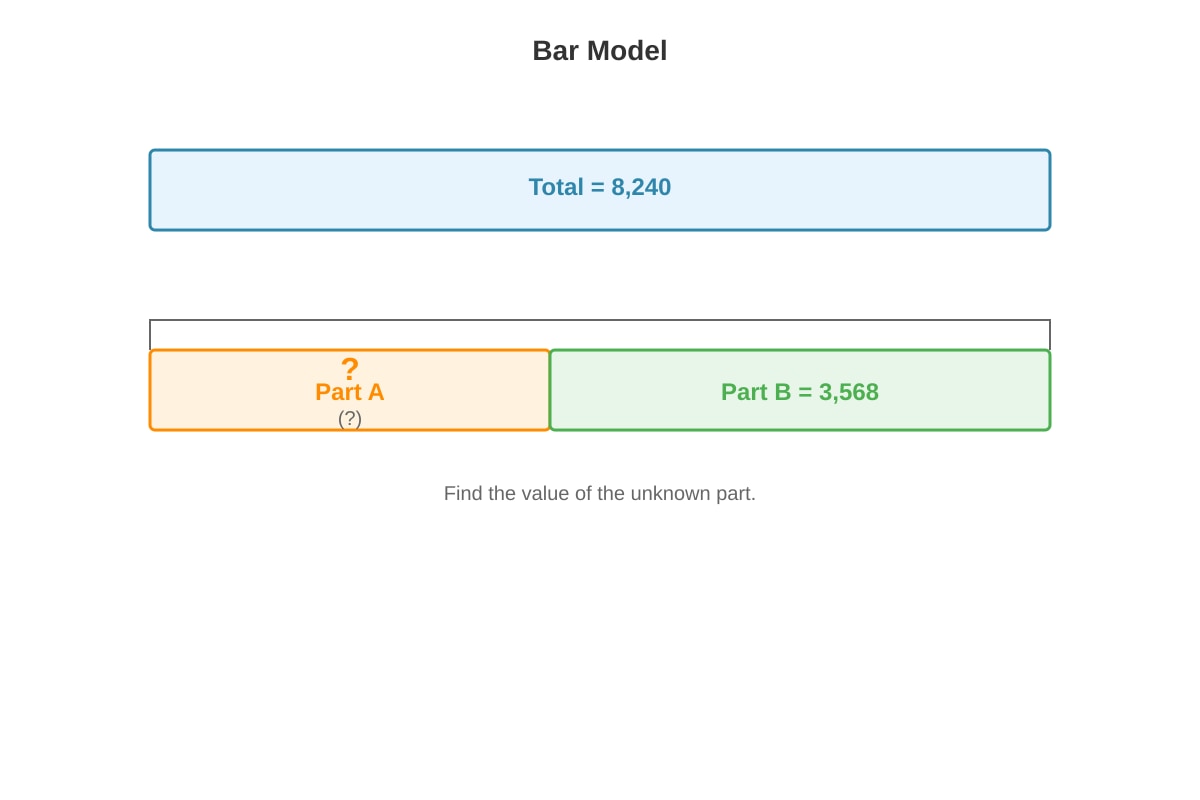
<image_placeholder> id: Q27-fig1 type: diagram linked_question: 27 description: Bar model showing two parts for an addition/subtraction comparison problem labels: Part A (unknown), Part B labeled "3,568", Total labeled "8,240" values: Part B = 3,568, Total = 8,240 must_show: Two connected bars forming a whole, clear labels for Part B and Total, blank space for Part A with question mark </image_placeholder>
- Part A + Part B = Total
- Part A = 8,240 − 3,568 [1 mark for correct method]
- 8,240 − 3,568:
- 0 − 8: borrow, 10 − 8 = 2
- 3 − 6 (after borrow): borrow, 13 − 6 = 7
- 1 − 5 (after borrow): borrow, 11 − 5 = 6
- 7 − 3 = 4
- Answer: 4,672 [3 marks, or 1m working + 2m correct answer]
28. 1,676 stickers [4 marks]
- Given: 1,248 + 1,576 = 2,824 stickers given away [1 mark]
- Left: 5,000 − 2,824 [1 mark]
- 5,000 − 2,824:
- Multiple borrowing: 5,000 = 4,999 + 1 (after borrows)
- = 2,176? No: 5,000 − 2,824 = 2,176
- Let me recheck: 2,824 + 2,176 = 5,000? 2,824 + 2,000 = 4,824; +176 = 5,000 ✓
- Wait, let me recalculate: 5,000 − 2,824:
- 0 − 4: borrow, 10 − 4 = 6
- 9 − 2 = 7
- 9 − 8 = 1
- 4 − 2 = 2
- Answer: 2,176
- Hmm, but let me check again: 1,248 + 1,576 = 2,824. 5,000 − 2,824 = 2,176.
Actually rechecking: 5,000 − 2,824:
- 0000 − 2824, borrow from 5:
- 10 − 4 = 6
- 9 − 2 = 7
- 9 − 8 = 1
- 4 − 2 = 2 = 2,176
But 2,824 + 2,176 = 5,000? 2,824 + 2,176:
- 4 + 6 = 10
- 2 + 7 + 1 = 10
- 8 + 1 + 1 = 10
- 2 + 2 + 1 = 5 = 5,000 ✓
Answer: 2,176 [2 marks for method and calculation]
Wait, let me re-read the question: 1,248 and 1,576.
1,248 + 1,576:
- 8 + 6 = 14, write 4, carry 1
- 4 + 7 + 1 = 12, write 2, carry 1
- 2 + 5 + 1 = 8
- 1 + 1 = 2 = 2,824 ✓
5,000 − 2,824 = 2,176
Final Answer: 2,176 stickers
29. [4 marks total]
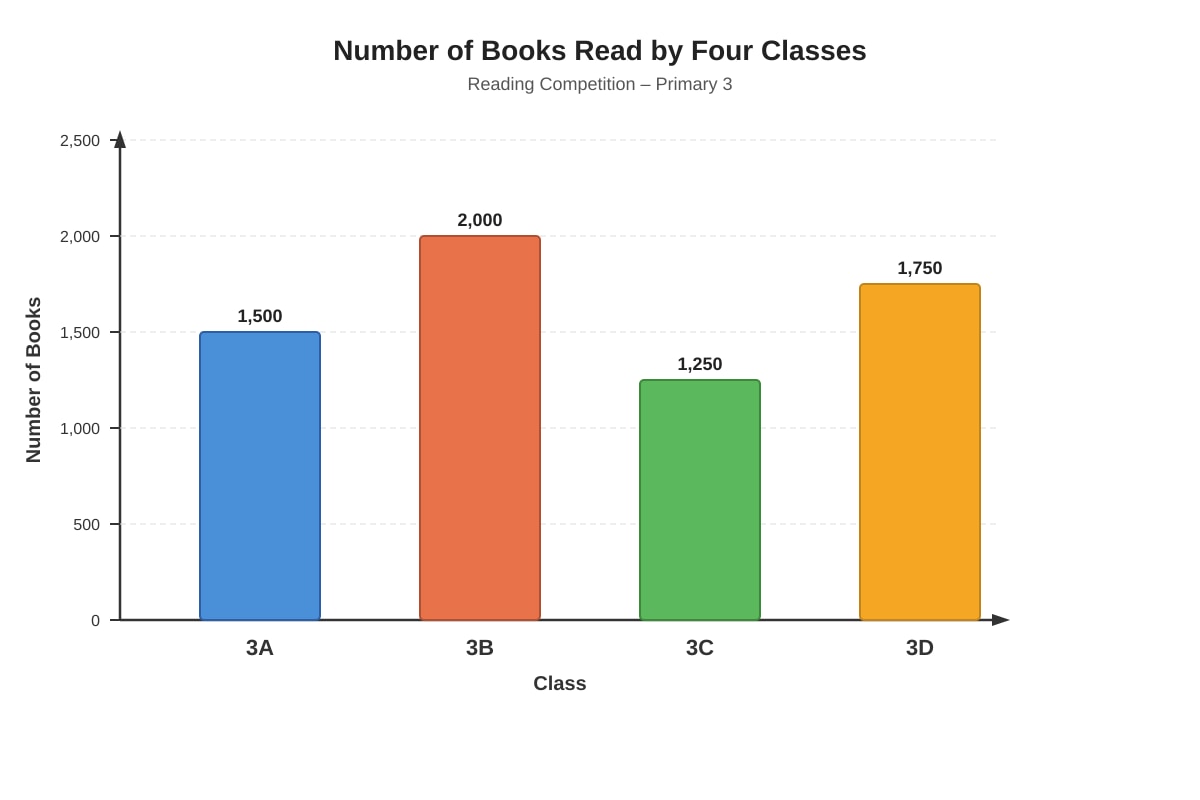
<image_placeholder> id: Q29-fig1 type: chart linked_question: 29 description: Bar graph showing number of books read by four classes in a reading competition labels: Classes: 3A, 3B, 3C, 3D; Vertical axis: "Number of books" from 0 to 2,500 in intervals of 500 values: 3A = 1,500; 3B = 2,000; 3C = 1,250; 3D = 1,750 must_show: Four vertical bars with different heights, labeled x-axis with class names, labeled y-axis with scale, values readable from bar heights </image_placeholder>
(a) 750 more books [2 marks]
- Class 3B: 2,000 books
- Class 3C: 1,250 books
- Difference: 2,000 − 1,250 = 750 books [1m method, 1m answer]
(b) 6,500 books [2 marks]
- Total: 1,500 + 2,000 + 1,250 + 1,750
- 1,500 + 2,000 = 3,500
- 1,250 + 1,750 = 3,000
- 3,500 + 3,000 = 6,500 books [1m method, 1m answer]
30. 3,100 [4 marks]
- Original number: 6,800 − 2,450 = 4,350 [2 marks for finding original number]
- 4,350 − 1,250 = 3,100 [2 marks for final calculation]
- Alternative: Could also solve as 6,800 − 2,450 − 1,250 = 6,800 − 3,700 = 3,100 if student sees shortcut.
SECTION C: Problem Solving (25 marks)
31. [5 marks]
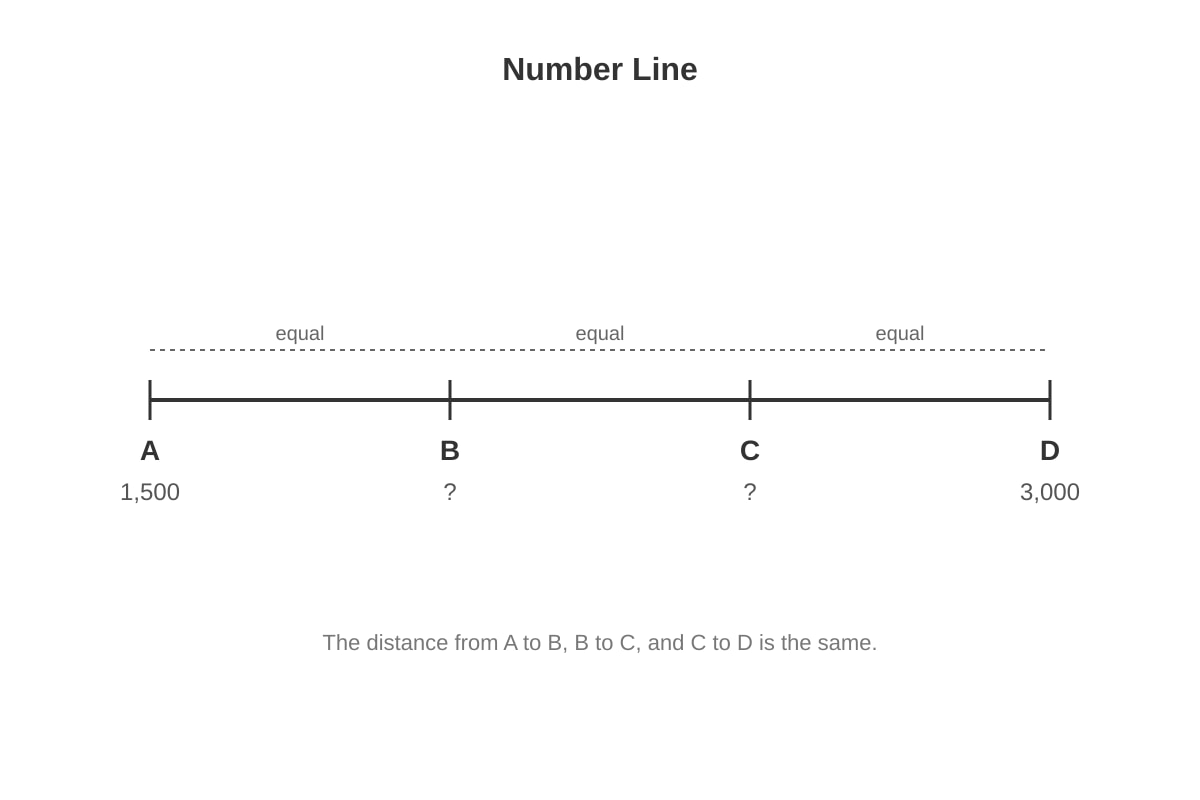
<image_placeholder> id: Q31-fig1 type: diagram linked_question: 31 description: Number line showing positions of four numbers A, B, C, D with equal intervals labels: Points labeled A, B, C, D from left to right; A is at position 1,500; D is at position 3,000 values: A = 1,500, D = 3,000, equal intervals between A-B, B-C, C-D must_show: Horizontal number line with tick marks, labeled points A, B, C, D, starting value at A and ending value at D, equal spacing clearly indicated </image_placeholder>
(a) 500 [2 marks]
- Total distance A to D: 3,000 − 1,500 = 1,500 [1 mark]
- Three equal intervals: 1,500 ÷ 3 = 500 [1 mark]
(b) 2,500 [1 mark]
- C = A + 3 × 500? No, A to C is two intervals.
- C = 1,500 + (2 × 500) = 1,500 + 1,000 = 2,500
- Or: C = D − 500 = 3,000 − 500 = 2,500
(c) 4,000 [2 marks]
- Distance D to E = 2 × 500 = 1,000 [1 mark]
- E = 3,000 + 1,000 = 4,000 [1 mark]
32. [5 marks]
(a) 4,745 toys [2 marks]
- Second week: 3,456 + 1,289 [1 mark]
- 3,456 + 1,289 = 4,745 toys [1 mark]
(b) 3,758 toys [1 mark]
- Third week: 4,745 − 987 = 3,758 toys
(c) 11,959 toys [2 marks]
- Total: 3,456 + 4,745 + 3,758 [1 mark]
- 3,456 + 4,745 = 8,201
- 8,201 + 3,758 = 11,959 toys [1 mark]
33. [5 marks]
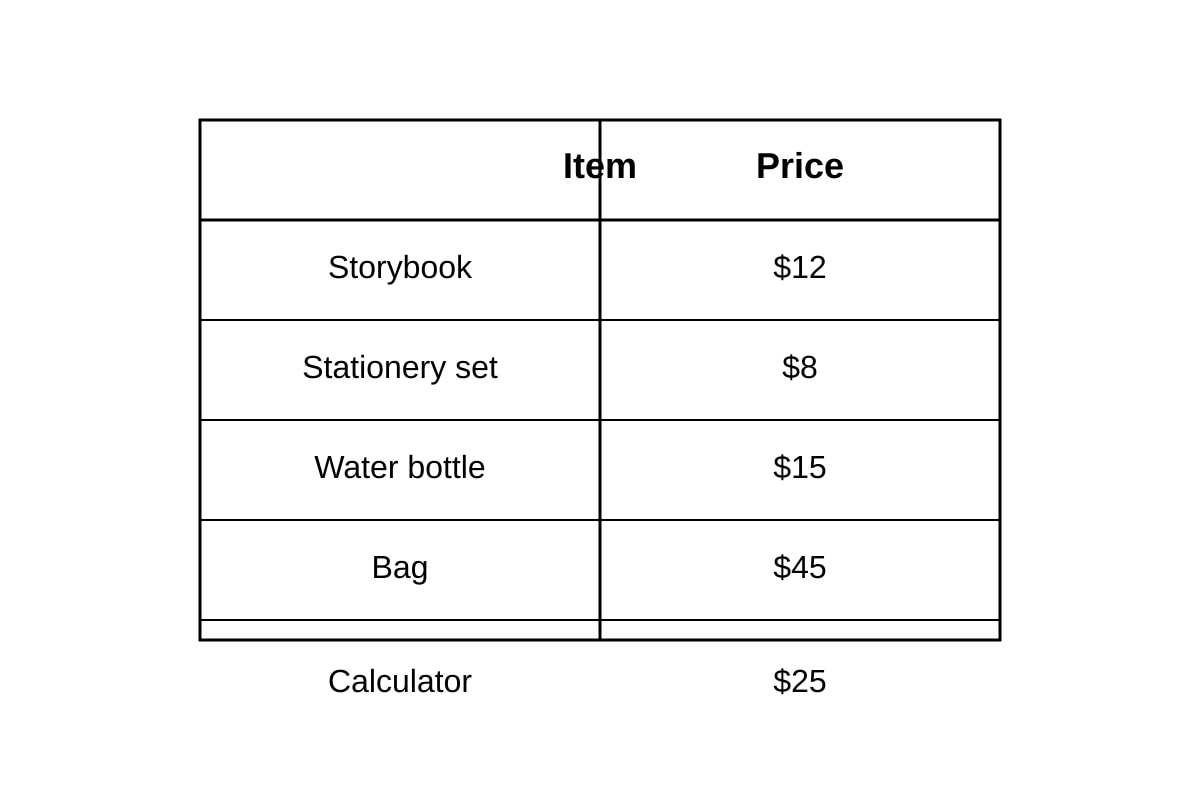
<image_placeholder> id: Q33-fig1 type: table linked_question: 33 description: Price list table for items in a school bookshop labels: Columns: Item, Price; Rows: Storybook, Stationery set, Water bottle, Bag, Calculator values: Storybook = 8, Water bottle = 45, Calculator = symbol, neat alignment </image_placeholder>
(a) $69 [2 marks]
- Bag: $45
- Two storybooks: 2 × 24 [1 mark for storybooks]
- Total: 24 = $69 [1 mark]
(b) $67 [2 marks]
- Calculator: $25
- Stationery set: $8
- Total spent: 8 = $33 [1 mark]
- Change: 33 = $67 [1 mark]
(c) 3 storybooks [1 mark]
- Water bottle: $15
- Remaining: 15 = $35
- Storybooks at 35 ÷ 11
- She can buy 3 storybooks? Let me recheck: 3 × 36, but 36.
- Actually: 2 × 24, 35. 3 × 36 > $35.
- Answer: 2 storybooks
Wait, let me re-read: "one water bottle and as many storybooks as she can with $50"
After water bottle (35 left. 12 = 2 remainder 11, so 2 storybooks.
Answer: 2 storybooks
34. [5 marks]
(a) 3,734 children [2 marks]
- Children = adults + 1,278 [1 mark]
- 2,456 + 1,278 = 3,734 children [1 mark]
- Working: 2,456 + 1,278:
- 6 + 8 = 14, write 4, carry 1
- 5 + 7 + 1 = 13, write 3, carry 1
- 4 + 2 + 1 = 7
- 2 + 1 = 3
(b) 467 rows [2 marks]
- 3,734 ÷ 8 [1 mark]
- 3,734 ÷ 8 = 466 remainder 6
- Need 467 rows (466 full rows + 1 more row for remaining 6 children)
- Or: 466 × 8 = 3,728; 3,734 − 3,728 = 6; need 467 rows.
- Answer: 467 rows [1 mark]
(c) $117,400 [1 mark]
- Adults: 2,456 × 61,400
- Children: 3,734 × 56,010
- Total: 56,010 = $117,410
Let me recheck: 2,456 × $25:
- 2,456 × 20 = 49,120
- 2,456 × 5 = 12,280
- Total: 61,400 ✓
3,734 × $15:
- 3,734 × 10 = 37,340
- 3,734 × 5 = 18,670
- Total: 56,010 ✓
56,010 = $117,410
35. [5 marks]
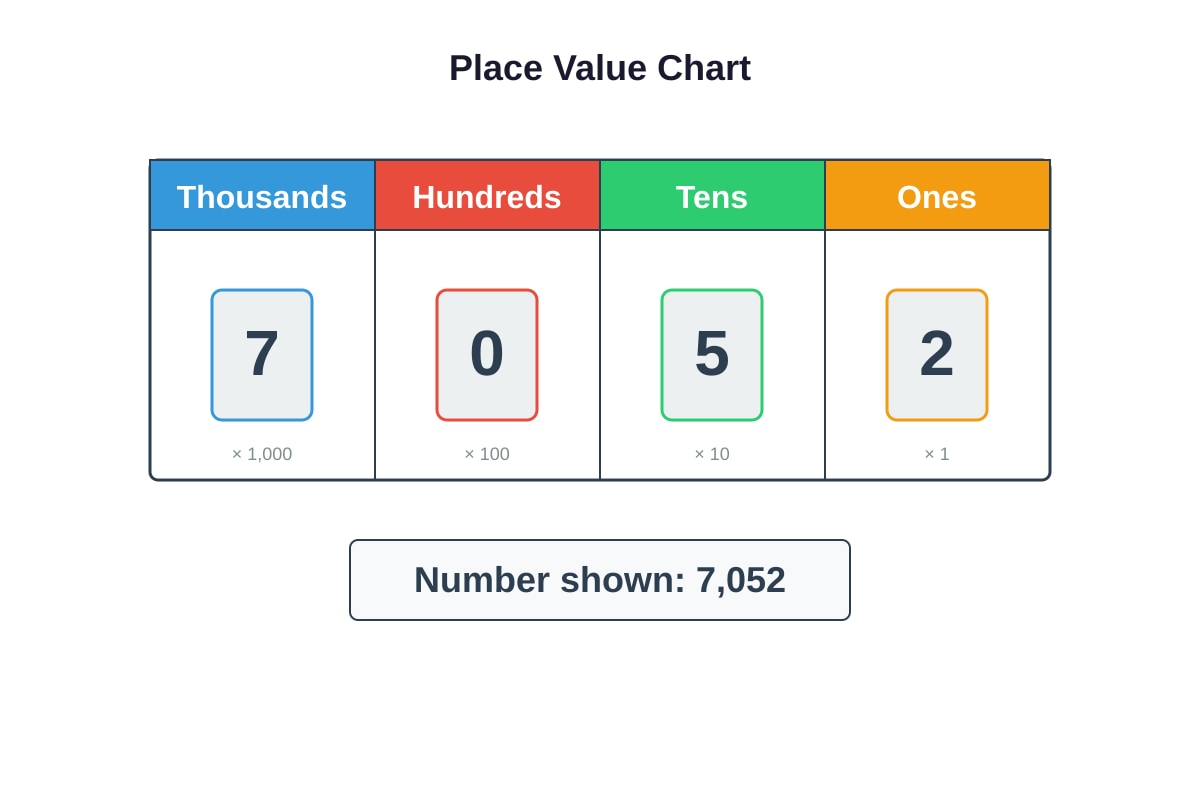
<image_placeholder> id: Q35-fig1 type: diagram linked_question: 35 description: Place value chart with four columns showing thousands, hundreds, tens, ones with digit cards placed labels: Columns: Thousands, Hundreds, Tens, Ones; Digit cards shown: 7, 0, 5, 2 placed in some positions values: Thousands = 7, Hundreds = 0, Tens = 5, Ones = 2; showing number 7,052 must_show: Four labeled columns, digit cards clearly placed in each column, column headers in bold or larger text </image_placeholder>
(a) 7,520 [1 mark]
- Largest: place biggest digit in highest place value.
- Thousands: 7, Hundreds: 5, Tens: 2, Ones: 0.
(b) 2,057 [1 mark]
- Smallest 4-digit number (can't start with 0): thousands must be 2.
- Then 0, 5, 7 in remaining places: 2,057.
(c) 5,463 [1 mark]
- 7,520 − 2,057 = 5,463
(d) 5,027 and 5,072 [2 marks]
- Rounds to 5,000 (nearest thousand): number must be from 4,500 to 5,499.
- With digits 7, 0, 5, 2: thousands digit must be 5 to be in range.
- Possible numbers: 5,027; 5,072; 5,207; 5,270; 5,702; 5,720
- Check which round to 5,000:
- 5,027 → 5,000 ✓
- 5,072 → 5,000 ✓
- 5,207 → 5,000 ✓
- 5,270 → 5,000 ✓
- 5,702 → 6,000 ✗
- 5,720 → 6,000 ✗
Answer: 5,027; 5,072; 5,207; 5,270 [2 marks, all correct]
Actually I need to recheck: 5,207 rounds to 5,000? 5,207, hundreds digit is 2, so yes, rounds down to 5,000.
All four numbers with thousands=5 and hundreds < 5 work.
END OF ANSWER KEY
| Section | Total Marks |
|---|---|
| A | 15 |
| B | 40 |
| C | 25 |
| Total | 80 |