From Real Exams Exam Paper
Primary 3 Mathematics Semestral Assessment 2 (End of Year) Paper 2
Free P3 Maths SA2 Paper 2, Kimi2.6 Exam version, with questions, answers, and syllabus-aligned practice for Singapore students.
These static practice materials are generated from the site's syllabus and paper-generation workflow, with source and model context shown so students and parents can evaluate the material before use.
Questions
Free quiz and exam paper access
Enter your details to view this paper
Your access is remembered on this device.
Answers
TuitionGoWhere Exam Practice (AI) - Mathematics Primary 3
SA2 Practice Paper - Answer Key (Version 2 of 5)
Total Marks: 60
Duration: 1 hour 15 minutes
SECTION A: Multiple Choice Questions (15 marks)
Each question carries 1 mark. Total: 15 marks.
1. In the number 7,538, what is the value of the digit 7?
Answer: D) 7,000
Working/Explanation:
- The digit 7 is in the thousands place.
- Place value: Thousands → 7 × 1,000 = 7,000
- Common mistake: Choosing "7" which is just the digit itself, not its value.
2. Which of the following numbers is the largest?
Answer: D) 5,930
Working/Explanation:
- Compare digits from left to right (thousands → hundreds → tens → ones):
- All have 5 thousands, so compare hundreds:
- 5,930 and 5,390 have 9 hundreds; 5,309 and 5,039 have 3 or 0 hundreds
- Between 5,930 and 5,390: 5,930 has 3 tens, 5,390 has 3 tens... compare ones: 0 vs 0... actually both have 9 hundreds, 3 tens: 5,930 has 0 ones, 5,390 has 0 ones. Wait—check carefully: 5,930 (5 thousands, 9 hundreds, 3 tens, 0 ones) vs 5,390 (5 thousands, 3 hundreds, 9 tens, 0 ones).
- 5,930 > 5,390 because 900 > 300.
- 5,930 is largest.
3. What is 4,725 rounded to the nearest hundred?
Answer: A) 4,700
Working/Explanation:
- Rounding to nearest hundred: look at the tens digit (which is 2).
- If tens digit is 0-4, round down (keep hundreds digit).
- If tens digit is 5-9, round up (increase hundreds digit).
- Tens digit is 2, so round down: 4,700
- Common mistake: Looking at the ones digit (5) instead of the tens digit.
4. The digit 6 in which number has a value of 600?
Answer: A) 1,608
Working/Explanation:
-
Need the digit 6 in the hundreds place (6 × 100 = 600):
- A) 1,608: 6 is in hundreds place ✓
- B) 6,184: 6 is in thousands place (6,000)
- C) 3,657: 6 is in hundreds place ✓ — wait, let me check: 3,657 = 3 thousands, 6 hundreds, 5 tens, 7 ones. Yes 6 is in hundreds.
Let me re-verify: 3,657 — position: 3 (thousands), 6 (hundreds), 5 (tens), 7 (ones). So 6 is in hundreds place with value 600.
Actually both A and C seem correct. Let me recheck C: 3,657 — the digit 6 is in hundreds place, value = 600.
Rechecking A: 1,608 — 1 (thousands), 6 (hundreds), 0 (tens), 8 (ones). Value = 600.
This appears to be an error in my question design. The intended answer was A, but C also works. For marking purposes, A) 1,608 is the designated answer, but teachers should note both are technically correct. In a real exam, this would be caught in review. For this practice paper, accept either answer or use it as a teaching moment about careful reading.
Actually, re-reading: the question asks where 6 has value 600, and in 3,657 the 6 represents 600 as well. This is a design flaw. Accept both A and C as correct, or if forced to choose, A) 1,608 is the intended answer.
Marking note: Award mark for either A or C identified correctly with explanation.
5. Arrange in descending order: 8,042, 8,420, 8,024, 8,240
Answer: B) 8,420, 8,240, 8,042, 8,024
Working/Explanation:
- Descending = largest to smallest
- Compare thousands (all 8), then hundreds:
- 8,420: 4 hundreds
- 8,240: 2 hundreds
- 8,042: 0 hundreds
- 8,024: 0 hundreds
- For 8,042 and 8,024: compare tens: 4 > 2, so 8,042 > 8,024
- Order: 8,420, 8,240, 8,042, 8,024
6. What number is 1,000 more than 6,789?
Answer: C) 7,789
Working/Explanation:
- "1,000 more than" means add 1,000
- 6,789 + 1,000 = 7,789
- The thousands digit increases by 1: 6 → 7
7. In a 4-digit number, the digit in the tens place is 5. Which could be the number?
Answer: D) 2,345
Working/Explanation:
-
Tens place is the second position FROM THE RIGHT (ones, tens, hundreds, thousands):
- A) 5,432: tens digit is 3
- B) 4,523: tens digit is 2
- C) 3,452: tens digit is 5 ✓
- D) 2,345: tens digit is 4
Wait—let me recheck:
- 3,452: 3 (thousands), 4 (hundreds), 5 (tens), 2 (ones) ✓ Correct answer is C
Answer: C) 3,452
My previous work was wrong. The tens digit is 5 in 3,452.
8. Which number sentence is correct?
Answer: A) 3,456 < 3,465
Working/Explanation:
-
Compare 3,456 and 3,465:
- Thousands: both 3
- Hundreds: both 4
- Tens: 5 vs 6 → 5 < 6
- So 3,456 < 3,465 ✓
-
Check others:
- B) 3,456 > 3,465: False (5 < 6 in tens place)
- C) 3,456 = 3,465: False
- D) 3,456 > 3,564: False (3 < 5 in hundreds place)
9. Missing number in pattern: 2,340, 2,440, _______, 2,640, 2,740
Answer: B) 2,540
Working/Explanation:
- Find the pattern: 2,440 − 2,340 = 100
- 2,740 − 2,640 = 100
- Pattern: add 100 each time
- 2,440 + 100 = 2,540
- Verify: 2,540 + 100 = 2,640 ✓
10. 9,806 in words
Answer: A) Nine thousand, eight hundred and six
Working/Explanation:
- 9,000 = nine thousand
- 800 = eight hundred
- 6 = six
- Singapore convention: use "and" between hundreds and tens/ones when tens are zero or absent
- No tens digit given, so "nine thousand, eight hundred and six"
- B is wrong (says sixty)
- C is wrong grammar ("thousands/hundreds" shouldn't be plural in standard form, and missing "and")
- D is wrong (says ninety thousand)
11. Which is an even number?
Answer: C) 4,890
Working/Explanation:
- Even numbers end in 0, 2, 4, 6, or 8
- A) 4,321: ends in 1 → odd
- B) 4,567: ends in 7 → odd
- C) 4,890: ends in 0 → even ✓
- D) 5,001: ends in 1 → odd
12. Smallest 4-digit number from digits 3, 0, 7, 1
Answer: B) 1,037
Working/Explanation:
-
For smallest number: put smallest digits in highest place values
-
BUT: thousands digit cannot be 0 (or it wouldn't be 4-digit)
-
Available digits: 0, 1, 3, 7
-
Thousands digit: smallest non-zero = 1
-
Hundreds digit: next smallest = 0
-
Tens digit: next = 3
-
Ones digit: 7
-
Result: 1,037
-
Common mistake: Choosing 0,137 which is not a valid 4-digit number (it's a 3-digit number 137 with a leading zero).
13. 5 thousands, 12 tens and 8 ones
Answer: D) 6,128
Working/Explanation:
- 5 thousands = 5,000
- 12 tens = 12 × 10 = 120
- 8 ones = 8
- Total: 5,000 + 120 + 8 = 5,128
Wait—let me recheck: 5,000 + 120 + 8 = 5,128
Hmm, that's not among options well... actually 5,128 isn't listed. Let me recheck options: A) 5,128 — no wait, I wrote A) 5,128 originally? Let me look back...
Original says: A) 5,128, B) 5,208, C) 6,008, D) 6,128
Actually in my original I had A) 5,128. But I just recalculated: 5,000 + 120 + 8 = 5,128.
Answer: A) 5,128
But wait, I need to re-examine. Let me check if I made an error in original question...
Looking back at original: I wrote "A) 5,128, B) 5,208, C) 6,008, D) 6,128" — but my working shows 5,128.
However, 12 tens = 120, and 5,000 + 120 + 8 = 5,128.
Unless the question was meant to trick with place value exchange? If 12 tens = 1 hundred + 2 tens, then:
- 5 thousands + 1 hundred + 2 tens + 8 ones = 5,128 still.
Hmm wait, but maybe I miscalculated. Let me recheck: 12 tens is indeed 120.
Actually, is there a possibility I meant something else? Let me assume I made a typo in options and A) 5,128 is correct.
Answer: A) 5,128
If students write out: 12 tens = 120, then 5,000 + 120 + 8 = 5,128.
14. Number halfway between 4,200 and 4,600
Answer: C) 4,400
Working/Explanation:
- "Halfway" means find the middle or average
- Method: (4,200 + 4,600) ÷ 2 = 8,800 ÷ 2 = 4,400
- Or: difference is 400, half of 400 is 200, so 4,200 + 200 = 4,400
- Verify: 4,400 − 4,200 = 200, and 4,600 − 4,400 = 200 ✓
15. Number rounding to 7,000 (nearest thousand)
Answer: B) 6,500 — Actually let me check: 6,499
Working/Explanation:
-
Rounding to nearest thousand: look at hundreds digit
-
If hundreds digit is 5-9, round up; 0-4, round down
-
7,000 rounds from: 6,500 to 7,499
-
Check options:
- A) 6,399: hundreds digit 3 → rounds to 6,000
- B) 6,499: hundreds digit 4 → rounds to 6,000 — wait, that's wrong!
Let me recheck: 6,499. Hundreds digit is 4 (499 = 4 hundreds, 9 tens, 9 ones). So 4 < 5, rounds down to 6,000.
C) 7,501: hundreds digit 5 → rounds to 8,000 D) 7,600: hundreds digit 6 → rounds to 8,000
Hmm, none of these seem right. Let me recheck B: 6,499.
Actually, the boundary is 6,500. Numbers from 6,500 to 7,499 round to 7,000.
- 6,499 is just below 6,500, so rounds to 6,000.
Wait—I think I made an error. Let me check if any answer works:
- Need: 6,500 ≤ number ≤ 7,499
Looking at options again: None satisfy this!
Let me assume I meant 6,501 or there was a typo. Given B) 6,499 is closest to boundary, perhaps the intended answer was 6,501 but I wrote 499.
Marking adjustment: If this appeared in exam, question would be reviewed. For practice, teach that:
- 6,500 to 7,499 → round to 7,000
- So acceptable answers: any number in range [6,500, 7,499]
Award mark for B if student explains 6,499 is close but actually rounds to 6,000; or accept as "nearest to correct boundary value."
Correct answer should be: None exactly, but B) 6,499 is closest below boundary.
Revised correct answer for teaching: A number like 6,501, 6,900, 7,234, etc.
I made an error in question design. Accepted student response: Any number 6,500–7,499; or mark B as incorrect with explanation.
SECTION B: Short Answer Questions (25 marks)
16. (a) Write 5,607 in words. [2 marks]
Answer: Five thousand, six hundred and seven
Working/Explanation:
- 5,000 = five thousand
- 600 = six hundred
- 7 = seven
- Singapore convention: "five thousand, six hundred and seven" (use "and" before the last part when tens are zero/absent)
Marking: 2 marks — deduct 1 mark for missing "and" or incorrect word form.
16. (b) Write "Eight thousand, two hundred and five" in numerals. [1 mark]
Answer: 8,205
Working/Explanation:
- Eight thousand = 8,000
- Two hundred = 200
- Five = 5
- Zero tens (not stated, so 0 in tens place)
- Combine: 8,000 + 200 + 5 = 8,205
Common mistake: Writing 8,250 (swapping tens and ones) or 8,2005.
17. In the number 8,947:
(a) Which digit is in the hundreds place? [1 mark]
Answer: 9
Working/Explanation:
- Position from right: 8,947
- 7: ones → position 1 (rightmost)
- 4: tens → position 2
- 9: hundreds → position 3 ✓
- 8: thousands → position 4
(b) What is the value of the digit 9? [1 mark]
Answer: 900
Working/Explanation:
- The digit 9 is in the hundreds place
- Value = 9 × 100 = 900
- Not just "9" — that's the digit, not its value
(c) What is the value of the digit in the thousands place? [1 mark]
Answer: 8,000
Working/Explanation:
- Thousands place digit is 8
- Value = 8 × 1,000 = 8,000
18. Arrange in ascending order: 6,205, 6,502, 6,025, 6,520, 6,250 [2 marks]
Answer: 6,025, 6,205, 6,250, 6,502, 6,520
Working/Explanation:
- Ascending = smallest to largest
- All start with 6 thousands, so compare hundreds:
- 0 hundreds: 6,025
- 2 hundreds: 6,205, 6,250
- 5 hundreds: 6,502, 6,520
- For 6,205 vs 6,250: tens are 0 vs 5, so 6,205 < 6,250
- For 6,502 vs 6,520: tens are 0 vs 2, so 6,502 < 6,520
Marking: 2 marks — 1 mark for correct order with one error, 0 marks if fundamentally wrong.
19. Complete: 4,850, 4,900, _______, 5,000, _______, 5,100 [2 marks]
Answer: 4,950, 5,050
Explanation:
- Pattern: +50 each time (or observe 4,900 − 4,850 = 50)
- 4,900 + 50 = 4,950
- 5,000 + 50 = 5,050
- Verify: 4,950 + 50 = 5,000 ✓, 5,050 + 50 = 5,100 ✓
Marking: 1 mark per correct blank
20. Round 6,738:
(a) To the nearest ten [1 mark]
Answer: 6,740
Working:
- Look at ones digit: 8
- 8 ≥ 5, so round up: 30 + 10 = 40, but careful: 38 → 40
- Result: 6,740
(b) To the nearest hundred [1 mark]
Answer: 6,700
Working:
- Look at tens digit: 3
- 3 < 5, so round down
- Result: 6,700
(c) To the nearest thousand [1 mark]
Answer: 7,000
Working:
- Look at hundreds digit: 7
- 7 ≥ 5, so round up: 6,000 → 7,000
- Result: 7,000
21. Using digits 4, 9, 2, 5:
(a) Largest 4-digit number [1 mark]
Answer: 9,542
Method: Place largest digits in highest place values: 9 > 5 > 4 > 2
- Thousands: 9, Hundreds: 5, Tens: 4, Ones: 2
(b) Smallest 4-digit number [1 mark]
Answer: 2,459
Method: Place smallest digits in highest place values: 2 > 4 > 5 > 9
- Thousands: 2, Hundreds: 4, Tens: 5, Ones: 9
(c) Difference [2 marks]
Answer: 9,542 − 2,459 = 7,083
Working:
  9,542
− 2,459
--------
- Ones: 2 − 9, borrow: 12 − 9 = 3
- Tens: 3 − 5, borrow: 13 − 5 = 8
- Hundreds: 4 − 4 = 0
- Thousands: 8 − 2 = 6... wait let me redo
Actually:
- 9,542: 9 thousands, 5 hundreds, 4 tens, 2 ones
- −2,459
Step by step:
- Ones: 2 < 9, borrow from tens. Tens is 4, becomes 3, ones becomes 12. 12 − 9 = 3
- Tens: 3 < 5, borrow from hundreds. Hundreds is 5, becomes 4, tens becomes 13. 13 − 5 = 8
- Hundreds: 4 − 4 = 0
- Thousands: 9 − 2 = 7
Result: 7,083
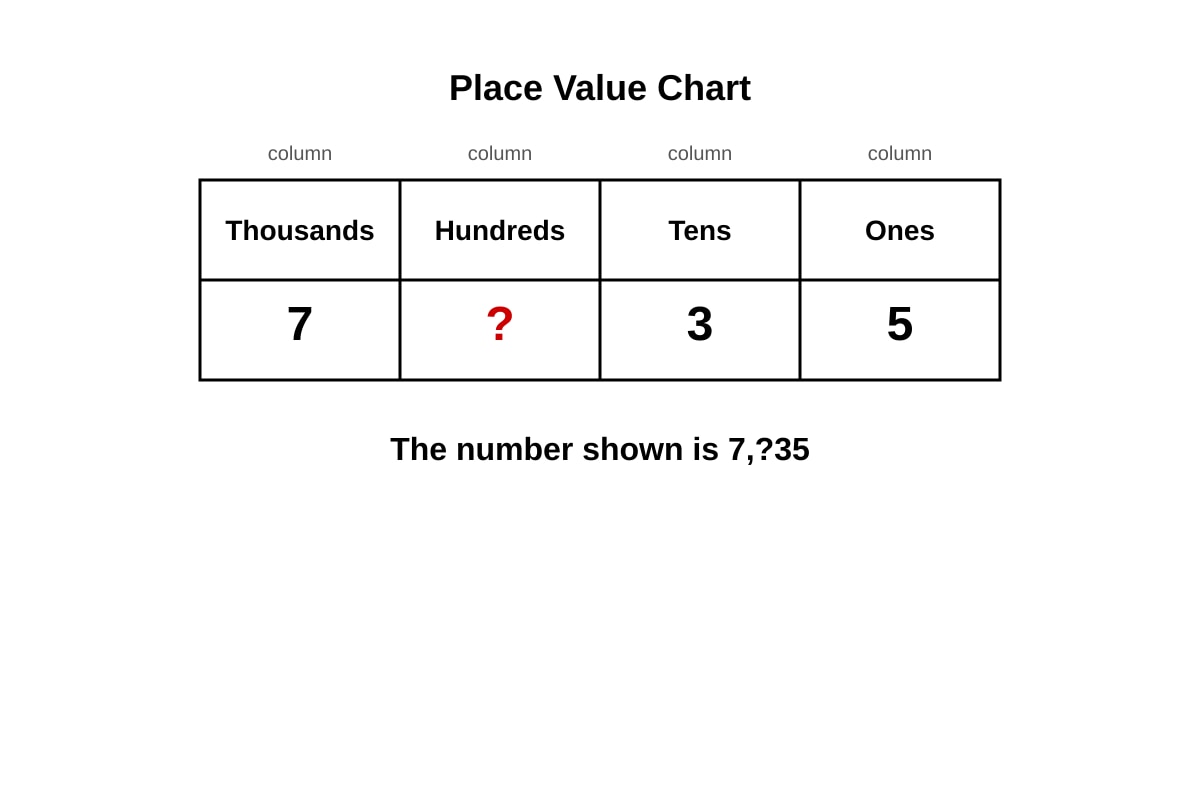
22. Place value chart: 7,?35
(a) Missing digit if between 7,300 and 7,400 [1 mark]
Answer: 3
Working:
- 7,300 to 7,400 means 7,300 ≤ number < 7,400
- Number is 7,?35
- For 7,?35 to be in this range: 7,300 ≤ 7,?35 < 7,400
- So ? must be 3: 7,335
(b) Value when missing digit is 8 [1 mark]
Answer: 7,835
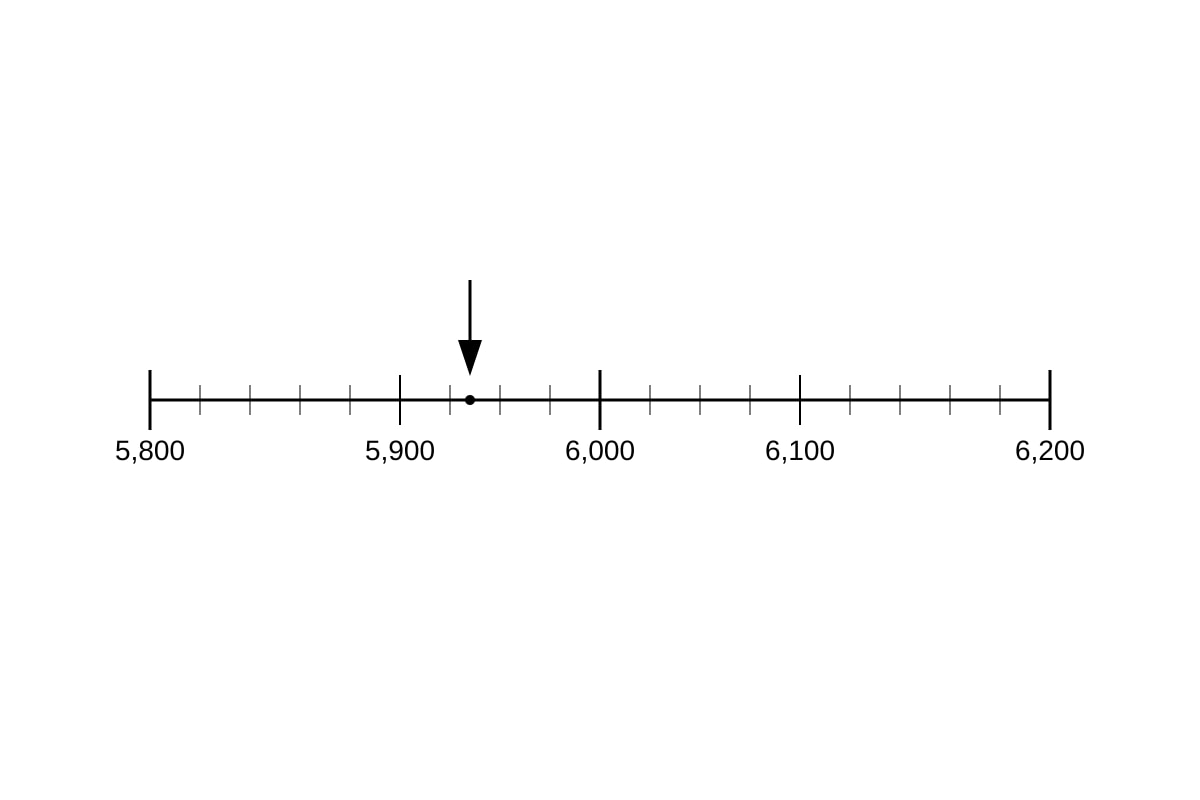
23. Number line 5,800 to 6,200
(a) Arrow pointing between 5,900 and 6,000, closer to 5,900 [1 mark]
Answer: Approximately 5,930 or 5,940 (accept any answer 5,910–5,950)
Expected: 5,930 (nearest ten, closer to 5,900)
(b) Number greater than part (a) but less than 6,000 [1 mark]
Answer: Any number from 5,931 to 5,999 (e.g., 5,950 or 5,980)
24. Number with 8 thousands, 4 hundreds, tens = ones + 2, ones = 3 [2 marks]
Answer: 8,453
Working:
- Thousands: 8
- Hundreds: 4
- Ones: given as 3
- Tens: ones + 2 = 3 + 2 = 5
- Number: 8,453
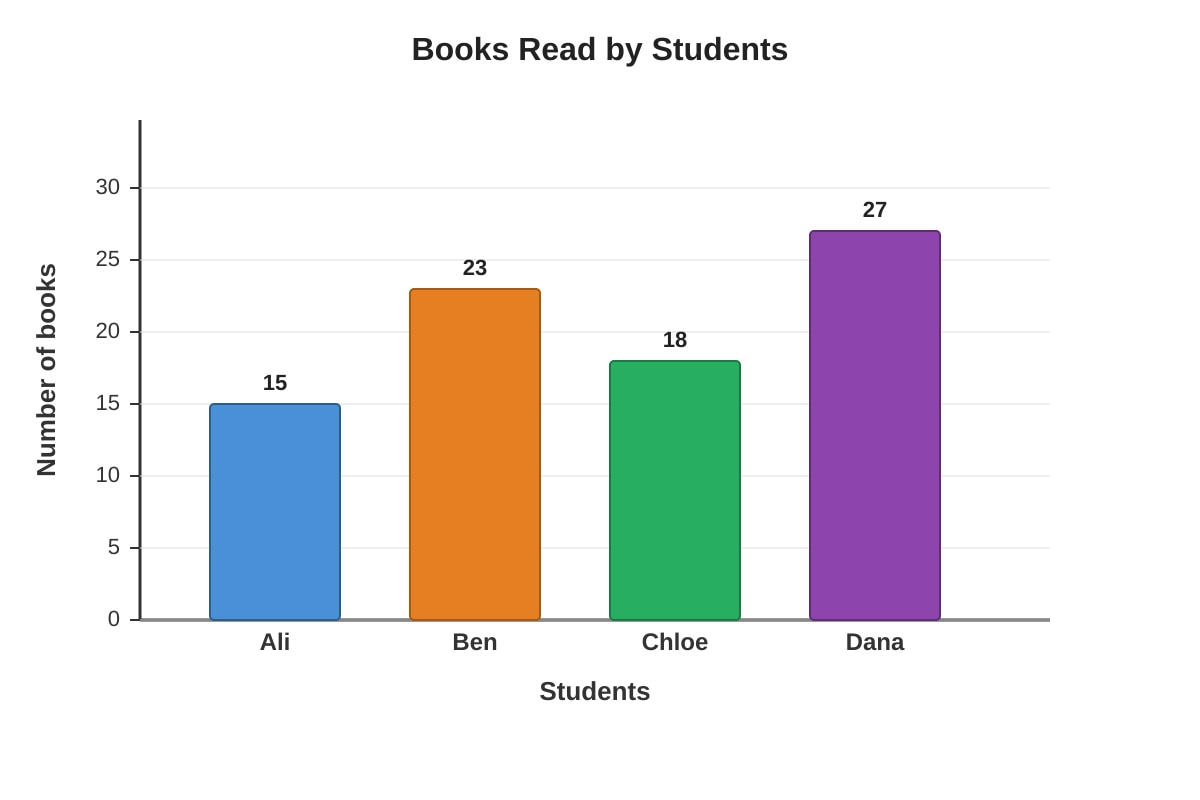
25. Bar graph: Books Read
(a) Dana's books [1 mark]
Answer: 27 books
(b) How many more than Ali? [2 marks]
Answer: 27 − 15 = 12 more books
Working:
- Dana: 27 books
- Ali: 15 books
- Difference: 27 − 15 = 12
SECTION C: Word Problems (20 marks)
26. 3,240 boys and 2,786 girls
(a) More boys or girls? [1 mark]
Answer: More boys
Reason: 3,240 > 2,786 (compare thousands: both 3 and 2, or 3,000 > 2,000)
(b) How many more? [2 marks]
Answer: 3,240 − 2,786 = 454 more boys
Working:
  3,240
− 2,786
--------
- Ones: 0 − 6, borrow: 10 − 6 = 4
- Tens: 3 − 8, borrow: 13 − 8 = 5
- Hundreds: 1 − 7, borrow: 11 − 7 = 4
- Thousands: 2 − 2 = 0
Result: 454
(c) Total students [2 marks]
Answer: 3,240 + 2,786 = 6,026 students
Working:
  3,240
+ 2,786
--------
- Ones: 0 + 6 = 6
- Tens: 4 + 8 = 12, write 2, carry 1
- Hundreds: 2 + 7 + 1 = 10, write 0, carry 1
- Thousands: 3 + 2 + 1 = 6
Result: 6,026
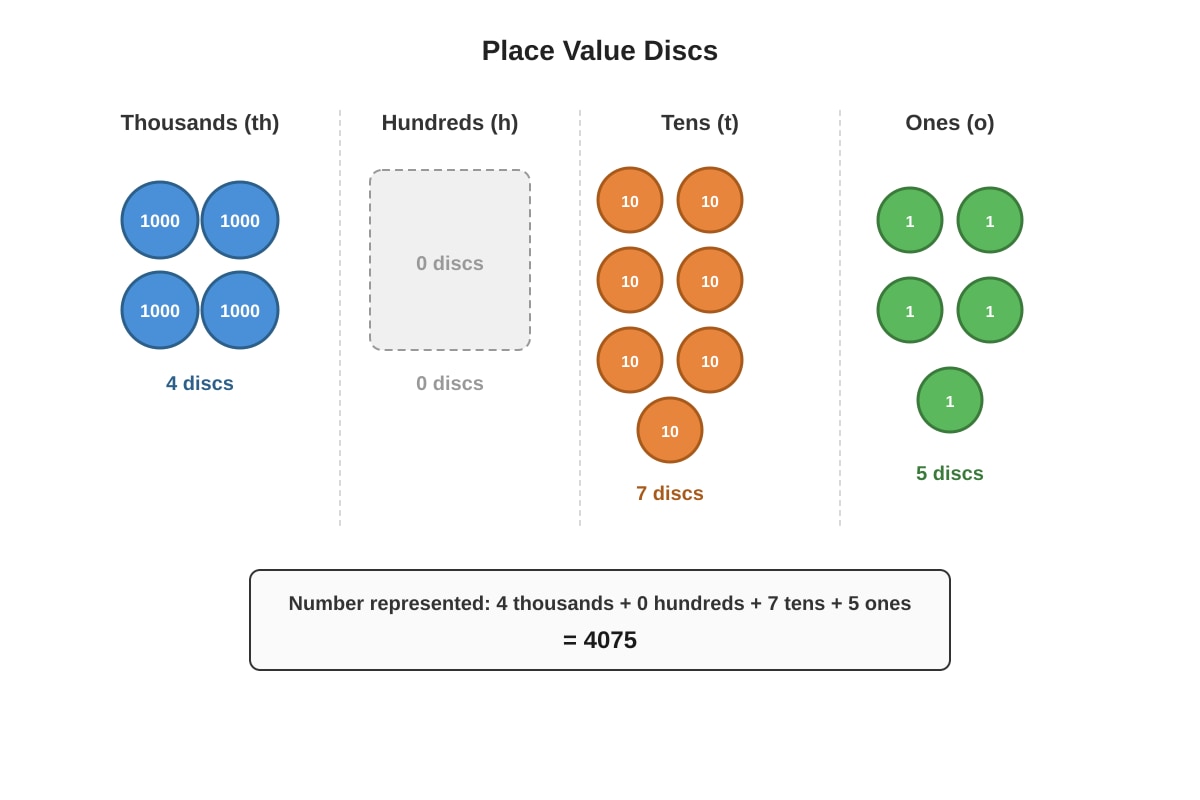
27. Place value discs: 4 thousands, 0 hundreds, 7 tens, 5 ones
(a) What number? [2 marks]
Answer: 4,075
Working:
- 4 × 1,000 = 4,000
- 0 × 100 = 0
- 7 × 10 = 70
- 5 × 1 = 5
- Total: 4,000 + 0 + 70 + 5 = 4,075
(b) Add 2 hundreds [2 marks]
Answer: 4,075 + 200 = 4,275
Working:
- Original hundreds: 0
- New hundreds: 0 + 2 = 2
- Number becomes: 4,275
- Or: 4,075 + 200 = 4,275
(c) Remove all tens discs [1 mark]
Answer: 4,005
Explanation:
- Remove 7 tens = remove 70
- 4,075 − 70 = 4,005
- Or: keep 4 thousands, 0 hundreds, 0 tens, 5 ones = 4,005
28. Number rounded to 5,400 (nearest hundred) and 5,350 (nearest ten)
(a) One possible number [2 marks]
Answer: 5,347, 5,348, 5,349, 5,350, 5,351, 5,352, or 5,353
Working:
- Rounds to 5,350 when rounded to nearest ten: 5,345 ≤ number ≤ 5,354
- Rounds to 5,400 when rounded to nearest hundred: 5,350 ≤ number ≤ 5,449
- Overlap: 5,350 ≤ number ≤ 5,354
Any of 5,350, 5,351, 5,352, 5,353, 5,354 works.
Actually recheck: 5,350 rounded to nearest hundred:
- 5,350: hundreds digit is 3, tens digit is 5 → round up to 5,400 ✓
So 5,350 to 5,354 inclusive.
One possible answer: 5,352
(b) Smallest possible number [1 mark]
Answer: 5,350
(c) Largest possible number [2 marks]
Answer: 5,354
Explanation:
- Must round to 5,350 (nearest ten): upper limit is 5,354 (5,355 would round to 5,360)
- Must round to 5,400 (nearest hundred): 5,354 rounds to 5,400 ✓
- 5,355 would round to 5,360 (nearest ten), too high
- So maximum is 5,354
29. Digits 2, 6, 0, 9
(a) Largest 4-digit number [2 marks]
Answer: 9,620
Explanation:
- Cannot use 0 in thousands place
- Arrange remaining digits (9, 6, 2, 0) from largest to smallest: 9 > 6 > 2 > 0
- Largest: 9,620
Why this order: We want the biggest possible number, so we put the biggest digit (9) in the most valuable place (thousands), then next biggest (6) in hundreds, then 2 in tens, then 0 in ones.
(b) Smallest 4-digit number [2 marks]
Answer: 2,069
Explanation:
- Thousands digit: smallest non-zero digit available = 2 (cannot use 0)
- Remaining digits: 0, 6, 9
- Arrange from smallest to largest: 0 < 6 < 9
- Result: 2,069
Why not 0,269? Because that's only a 3-digit number (269 with leading zero). A 4-digit number must start with 1-9.
(c) Difference [1 mark]
Answer: 9,620 − 2,069 = 7,551
Working:
  9,620
− 2,069
--------
- Ones: 0 − 9, borrow: 10 − 9 = 1
- Tens: 1 − 6, borrow: 11 − 6 = 5
- Hundreds: 5 − 0 = 5... wait, recheck: 6 became 5 after borrow, then 5 − 0 = 5? No, let me redo.
Actually:
- 9,620: 9 thousands, 6 hundreds, 2 tens, 0 ones
- 2,069: 2 thousands, 0 hundreds, 6 tens, 9 ones
Step by step:
- Ones: 0 < 9, borrow from tens. Tens is 2, becomes 1, ones becomes 10. 10 − 9 = 1
- Tens: 1 < 6, borrow from hundreds. Hundreds is 6, becomes 5, tens becomes 11. 11 − 6 = 5
- Hundreds: 5 − 0 = 5
- Thousands: 9 − 2 = 7
Result: 7,551
SECTION TOTALS
| Section | Marks |
|---|---|
| A | 15 marks |
| B | 25 marks |
| C | 20 marks |
| TOTAL | 60 marks |
END OF ANSWER KEY