From Real Exams Exam Paper
Primary 3 Mathematics Semestral Assessment 2 (End of Year) Paper 1
Free P3 Maths SA2 Paper 1, Kimi2.6 Exam version, with questions, answers, and syllabus-aligned practice for Singapore students.
These static practice materials are generated from the site's syllabus and paper-generation workflow, with source and model context shown so students and parents can evaluate the material before use.
Questions
Free quiz and exam paper access
Enter your details to view this paper
Your access is remembered on this device.
Answers
TuitionGoWhere Exam Practice (AI)
SA2 Practice Paper - Mathematics Primary 3
Version 1 of 5 - ANSWER KEY
SECTION A: Multiple-Choice Questions (20 marks)
1. [2 marks] 3
Teaching note: In the number 7 358, we read the digits from left to right by place value: 7 is thousands, 3 is hundreds, 5 is tens, 8 is ones. The digit in the hundreds place is 3. Common mistake: Confusing "hundreds place" with "value of the hundreds digit" (which would be 300).
2. [2 marks] 4 000
Teaching note: The digit 4 is in the thousands place in 4 926. Its value is 4 × 1 000 = 4 000. Common mistake: Choosing "4" which is just the digit itself, not its value. The word "value" always means we multiply the digit by its place value.
3. [2 marks] 6 840
Teaching note: To compare 4-digit numbers, start from the thousands place and move right if needed. All have 6 thousands. In hundreds place: 8 > 4, so 6 840 and 6 804 are larger than the others. Compare these two: both have 8 hundreds, then 4 > 0 in the tens place. So 6 840 is largest.
4. [2 marks] 3 102, 3 120, 3 201, 3 210
Teaching note: All start with 3 thousands. Compare hundreds: 1 < 2, so 3 102 and 3 120 come before 3 201 and 3 210. Between 3 102 and 3 120: 0 < 2 in tens place. Between 3 201 and 3 210: 0 < 1 in tens place. Ascending order means smallest to largest (going up like stairs).
5. [2 marks] 5 307
Teaching note: Break down: 5 000 + 300 + 0 tens + 7 ones = 5 307. Check: there are no tens mentioned, so we need 0 in the tens place as a placeholder. Common mistake: Writing 5 37 or 537, forgetting the thousands and the zero placeholder.
6. [2 marks] 6 945
Teaching note: "100 more than" means add 100. 6 845 + 100 = 6 945. The hundreds digit increases from 8 to 9. Using place value: 6 845 + 100 = 6 000 + 800 + 40 + 5 + 100 = 6 000 + 900 + 40 + 5 = 6 945.
7. [2 marks] 5 000
Teaching note: To round to the nearest thousand, look at the hundreds digit. In 4 567, the hundreds digit is 5. The rule is: 5 or more, round up; 4 or less, round down. Since 5 ≥ 5, we round 4 thousands up to 5 000. Common mistake: Rounding to 4 000 by looking at the thousands digit rather than the hundreds digit.
8. [2 marks] 2 500
Teaching note: Find the pattern: 2 300 − 2 100 = 200. So we add 200 each time. 2 300 + 200 = 2 500. Verify: 2 500 + 200 = 2 700 ✓ This is an arithmetic sequence with common difference 200.
9. [2 marks] 4 544
Teaching note: Use standard subtraction with regrouping:
  8 0 0 0
- 3 4 5 6
-----------
  4 5 4 4
Step 1: 0 − 6 (can't), regroup: 10 − 6 = 4 Step 2: 9 − 5 = 4 (after regrouping) Step 3: 9 − 4 = 5 (after regrouping) Step 4: 7 − 3 = 4 (after regrouping)
10. [2 marks] 2 000 × 2
Teaching note: Calculate each:
- 3 000 + 2 000 = 5 000
- 5 000 − 500 = 4 500
- 2 000 × 2 = 4 000... wait, let me recheck: 2 000 × 2 = 4 000
Actually: 3 000 + 2 000 = 5 000; 5 000 − 500 = 4 500; 2 000 × 2 = 4 000; 9 000 ÷ 2 = 4 500.
So 3 000 + 2 000 = 5 000 is largest. The correct answer is 3 000 + 2 000.
SECTION B: Short-Answer and Structured Questions (30 marks)
11. [1 mark] Five thousand six hundred and eight
Teaching note: Write in words with proper place value. 5 thousands, 6 hundreds, 0 tens (say "six hundred"), 8 ones ("and eight"). The word "and" connects hundreds to the tens/ones. In Singapore format, we include "and" before the last two digits.
12 (a). [1 mark] 9 000
Teaching note: The digit 9 is in the thousands place. Value = 9 × 1 000 = 9 000.
12 (b). [1 mark] 100
Teaching note: The digit 1 is in the hundreds place. Value = 1 × 100 = 100.
13. [1 mark] 200
Teaching note: 6 250 = 6 000 + ? + 50. Using place value: 6 250 = 6 000 + 200 + 50. The missing value is 200. This represents 2 hundreds.
14. [2 marks] 4 980, 4 908, 4 890, 4 089
Teaching note: Descending order means largest to smallest (going down).
Step 1: All have 4 thousands except 4 089 (which is smallest). Step 2: Compare 4 980, 4 908, 4 890: all have 9 hundreds. Step 3: Compare tens: 8 > 0, so 4 980 > 4 908? No wait: 4 980 has 8 tens, 4 908 has 0 tens, 4 890 has 9 tens.
Correct order: 4 980 (9 thousands, 8 tens) → actually re-compare:
- 4 980: 9 hundreds, 8 tens
- 4 908: 9 hundreds, 0 tens
- 4 890: 8 hundreds, 9 tens
So 4 980 > 4 908 > 4 890 > 4 089
Marking: [2] fully correct; [1] one number out of place; [0] more errors.
15. [2 marks] 2 100, 2 700 (one mark each blank)
Teaching note: Pattern: 1 800 − 1 500 = 300. Common difference is 300.
- 1 800 + 300 = 2 100
- 2 400 + 300 = 2 700
Verify: 1 500, 1 800, 2 100, 2 400, 2 700 — each increases by 300 ✓
16. [2 marks] 6 245
Teaching note: Use standard addition algorithm:
  3 4 5 6
+ 2 7 8 9
-----------
  6 2 4 5
Step by step:
- Ones: 6 + 9 = 15, write 5, carry 1 to tens
- Tens: 5 + 8 + 1 = 14, write 4, carry 1 to hundreds
- Hundreds: 4 + 7 + 1 = 12, write 2, carry 1 to thousands
- Thousands: 3 + 2 + 1 = 6
Final answer: 6 245
Marking: [1] correct method with one calculation error; [2] fully correct.
17. [2 marks] 2 655
Teaching note: "Subtract 2 345 from 5 000" means 5 000 − 2 345.
  5 0 0 0
- 2 3 4 5
-----------
  2 6 5 5
Step by step with regrouping:
- Ones: 0 − 5, can't, regroup: 10 − 5 = 5
- Tens: 9 − 4 = 5 (after regrouping)
- Hundreds: 9 − 3 = 6 (after regrouping)
- Thousands: 4 − 2 = 2 (after regrouping)
Common mistake: Writing 2 345 − 5 000 = −2 655. Watch the order: "subtract A from B" means B − A.
18. [2 marks] 4 325 pupils
Teaching note: "Altogether" means addition.
- Boys: 2 450
- Girls: 1 875
- Total: 2 450 + 1 875
Working:
  2 4 5 0
+ 1 8 7 5
-----------
  4 3 2 5
2 450 + 1 875 = 4 325
Marking: [1] correct method with calculation error; [2] fully correct with units.
19. [3 marks] $551
Teaching note: Two-step problem: find total cost first, then find change.
Step 1: Total cost = 1 850
  2 5 9 9
+ 1 8 5 0
-----------
  4 4 4 9
Total = $4 449
Step 2: Change = 4 449
  5 0 0 0
- 4 4 4 9
-----------
    5 5 1
Change = $551
Marking breakdown:
- [1] correct total cost ($4 449)
- [1] correct method for change with correct subtraction
- [1] correct final answer with $ unit
Common mistake: Forgetting to add total cost first, or subtracting 5 000 only.
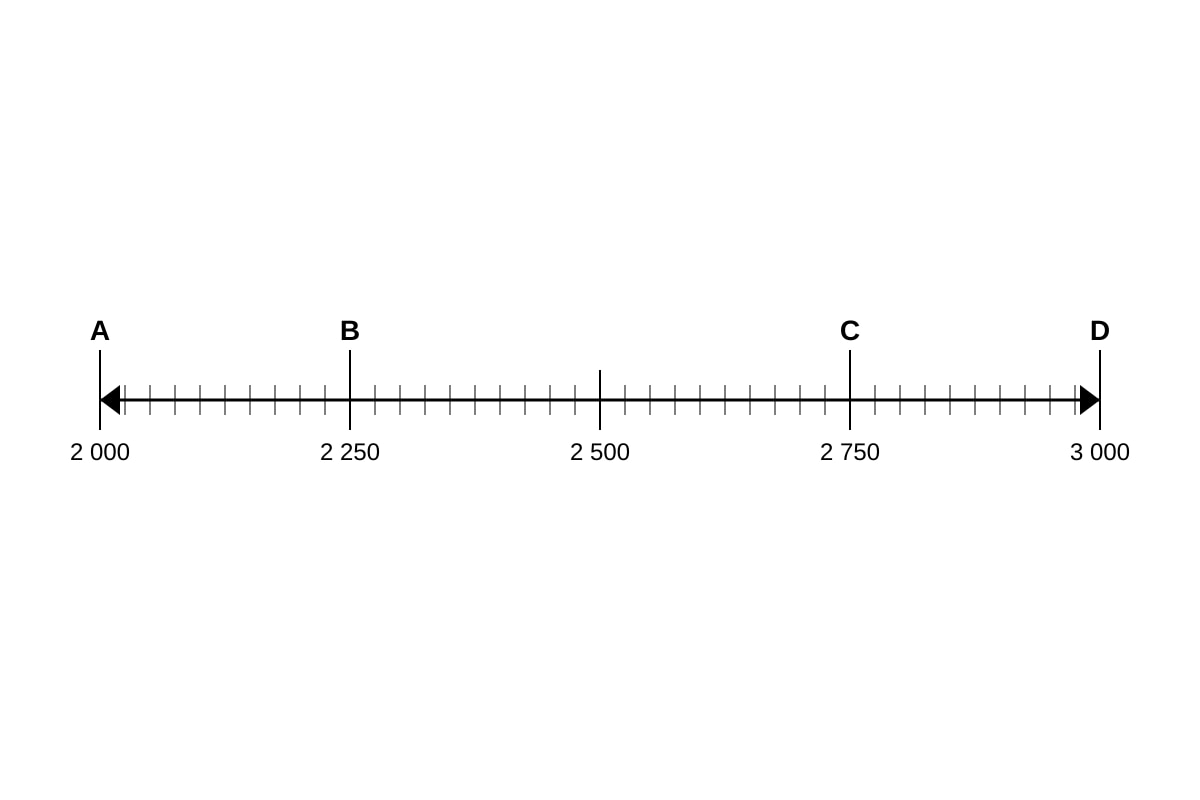
20. Refer to number line showing points A(2 000), B(2 250), C(2 750), D(3 000) with interval 250.
(a) [1 mark] 2 750
Teaching note: Point C is located at 2 750 on the number line, which is 3 major intervals from A (2 000 + 250 + 250 + 250 = 2 750, or 2 000 + 750 = 2 750).
(b) [2 marks] 750
Teaching note: Point B = 2 250, Point D = 3 000. Difference = 3 000 − 2 250 = 750
Working shown:
- Point D: 3 000
- Point B: 2 250
- 3 000 − 2 250 = 750
Or count intervals: from B to D is 3 intervals of 250 = 750.
Marking: [1] identify both values correctly; [1] correct subtraction.
(c) [1 mark] 750
Teaching note: Point A = 2 000, Point C = 2 750. 2 750 − 2 000 = 750. So Point A is 750 less than Point C.
(d) [1 mark] Any number from 2 251 to 2 749 inclusive
Teaching note: "Between" in primary mathematics typically means strictly between (not including the endpoints). Any whole number greater than 2 250 and less than 2 750 is acceptable. Examples: 2 300, 2 500, 2 749. Common mistake: Writing 2 250 or 2 750, which are the endpoints, not between.
TOTAL MARKS: 50
Section A: 20 marks Section B: 30 marks