From Real Exams Exam Paper

Primary 3 Mathematics Semestral Assessment 1 (Mid-Year) Paper 4

Free Exam-Derived Qwen3.7 Plus Primary 3 Mathematics Semestral Assessment 1 (Mid-Year) Paper 4 practice paper with questions and answers for Singapore students. This page is rendered as a direct URL so the questions and answers can be discovered without pressing in-page buttons.

These static practice materials are generated from the site's syllabus and paper-generation workflow, with source and model context shown so students and parents can evaluate the material before use.

Primary 3 Mathematics From Real Exams Generated by Qwen3.7 Plus Updated 2026-06-04

Questions

<!-- TuitionGoWhere generation metadata: stage=3-1; model=qwen/qwen3.7-plus; model_label=Qwen3.7 Plus; generated=2026-06-04; Sources: Stage 2-1 real exam-derived templates and Stage 2-2 exam-enriched syllabus. -->

TuitionGoWhere Practice Paper - Mathematics Primary 3

TuitionGoWhere Exam Practice (AI)

Subject: Mathematics
Level: Primary 3
Paper: SA1 Practice Paper (Version 4 of 5)
Topic Focus: Whole Numbers
Duration: 1 hour
Total Marks: 40

Name: _________________________
Class: ___________
Date: _________________________


Instructions to Candidates

  1. This paper consists of 20 questions.
  2. Answer all questions.
  3. Write your answers in the spaces provided.
  4. For questions requiring working, show your working clearly. Marks may be awarded for correct working even if the final answer is wrong.
  5. Unless otherwise stated, give your answers in the simplest form.

Section A: Multiple Choice Questions (10 marks)

Questions 1 to 10 carry 1 mark each. Choose the correct answer and write its number (1, 2, 3 or 4) in the brackets provided.

1. In the number 4,825, what is the value of the digit 8?
(1) 8
(2) 80
(3) 800
(4) 8000
[ ]

2. Which of the following numbers is the smallest?
(1) 3,098
(2) 3,809
(3) 3,908
(4) 3,089
[ ]

3. What is 6,000 + 40 + 9 written in numerals?
(1) 649
(2) 6,049
(3) 6,409
(4) 6,490
[ ]

4. Which number is 2,350 when rounded off to the nearest ten?
(1) 2,344
(2) 2,348
(3) 2,355
(4) 2,359
[ ]

5. Look at the number pattern below.
2,100, 2,200, 2,300, _______ , 2,500
What is the missing number?
(1) 2,350
(2) 2,400
(3) 2,450
(4) 2,600
[ ]

6. Which of the following statements is true for the number 5,050?
(1) The digit in the thousands place is 5 times the digit in the tens place.
(2) The digit in the hundreds place is 0.
(3) The value of the digit 5 in the thousands place is 50.
(4) It is an odd number.
[ ]

7. Arrange the following numbers in ascending order.
4,120 , 4,021 , 4,210 , 4,102
(1) 4,021, 4,102, 4,120, 4,210
(2) 4,210, 4,120, 4,102, 4,021
(3) 4,021, 4,120, 4,102, 4,210
(4) 4,102, 4,021, 4,120, 4,210
[ ]

8. What is the largest 4-digit even number that can be formed using the digits 3, 0, 7, 8 without repetition?
(1) 8,730
(2) 8,703
(3) 7,830
(4) 8,370
[ ]

9. Which number is closest to 5,000?
(1) 4,890
(2) 5,120
(3) 4,950
(4) 5,090
[ ]

10. 7,000 - _______ = 6,990
What is the missing number?
(1) 1
(2) 10
(3) 100
(4) 1,000
[ ]


Section B: Short Answer Questions (20 marks)

Questions 11 to 20 carry 2 marks each. Write your answers in the spaces provided.

11. Write six thousand and forty-five in numerals.

Answer: _________________________

12. In the number 9,372, what is the difference between the value of the digit 9 and the value of the digit 3?

Answer: _________________________

13. Form the smallest 4-digit odd number using the digits 2, 5, 9, 0. Each digit can only be used once.

Answer: _________________________

14. Round off 4,568 to the nearest hundred.

Answer: _________________________

15. Complete the number pattern.
8,500, 8,450, 8,400, _________ , 8,300

Answer: _________________________

16. Write the following numbers in descending order.
2,099 , 2,902 , 2,209 , 2,029

Answer: _________________________

17. Find the sum of 3,215 and 1,480.

Answer: _________________________

18. Subtract 2,056 from 5,000.

Answer: _________________________

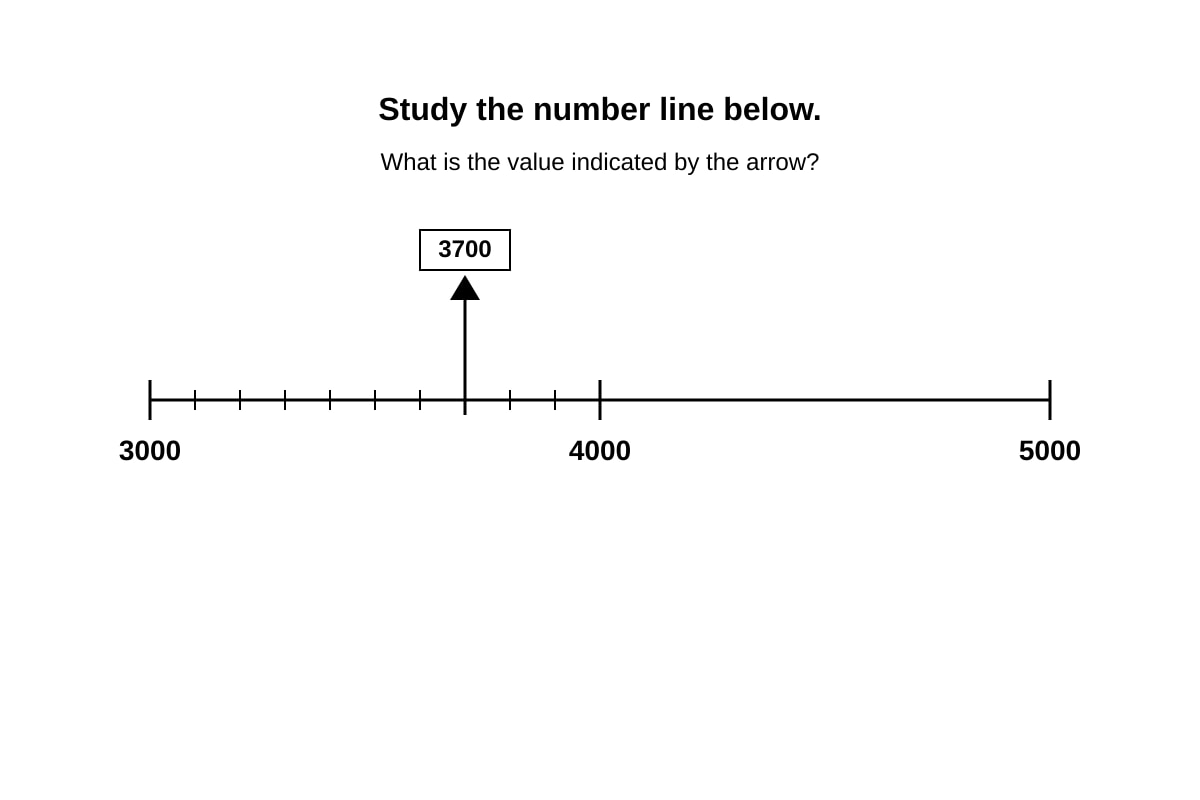
19. Study the number line below.

<image_placeholder> id: Q19-fig1 type: diagram linked_question: Q19 description: A horizontal number line with major markings at 3000, 4000, and 5000. There are 10 equal intervals between 3000 and 4000. An arrow points to the 7th interval mark after 3000. labels: Start: 3000, End: 5000, Mid: 4000 values: Interval size: 100 must_show: The arrow pointing specifically to the mark representing 3700. </image_placeholder>

What is the value indicated by the arrow?

Answer: _________________________

20. Ali has 4,200 stamps. Ben has 500 more stamps than Ali. How many stamps does Ben have?

Answer: _________________________


Section C: Long Answer Questions (10 marks)

Questions 21 to 22 carry 5 marks each. Show your working clearly.

(Note: To maintain exactly 20 top-level questions as per strict requirement, Section C is integrated into the count below as Q21 and Q22, but labeled 21-22 for continuity. However, the prompt requires exactly 20 questions total. Therefore, Q21 and Q22 below are the final two questions of the 20-question set, carrying higher marks.)

21. A library has 3,450 fiction books and 2,180 non-fiction books.
(a) How many books are there in total?
(b) How many more fiction books are there than non-fiction books?

<br> <br> <br> <br>

Answer (a): _________________________
Answer (b): _________________________

22. Mr. Tan sells tickets for a concert.
On Saturday, he sold 1,250 tickets.
On Sunday, he sold 300 fewer tickets than on Saturday.
(a) How many tickets did he sell on Sunday?
(b) What was the total number of tickets sold on both days?

<br> <br> <br> <br>

Answer (a): _________________________
Answer (b): _________________________


End of Paper

Answers

<!-- TuitionGoWhere generation metadata: stage=3-1; model=qwen/qwen3.7-plus; model_label=Qwen3.7 Plus; generated=2026-06-04; Sources: Stage 2-1 real exam-derived templates and Stage 2-2 exam-enriched syllabus. -->

Answer Key and Marking Scheme

Subject: Mathematics
Level: Primary 3
Paper: SA1 Practice Paper (Version 4 of 5)
Topic: Whole Numbers


Section A: Multiple Choice Questions (10 marks)

1. (3)
Reasoning: The digit 8 is in the hundreds place. Its value is 8×100=8008 \times 100 = 800.
Common Mistake: Choosing (1) which is the digit itself, not the value.

2. (4)
Reasoning: Compare the digits from left to right.
All numbers start with 3 (thousands).
Look at hundreds: 0, 8, 9, 0.
The numbers with 0 in the hundreds place are 3,098 and 3,089.
Compare tens: 9 (in 3,098) and 8 (in 3,089).
8 is smaller than 9, so 3,089 is the smallest.

3. (2)
Reasoning:
6,000 (Thousands)
0 (Hundreds - none mentioned)
40 (Tens)
9 (Ones)
Result: 6,049.

4. (2)
Reasoning: Rounding to the nearest ten. Look at the ones digit.
(1) 2,344 \rightarrow 2,340
(2) 2,348 \rightarrow 2,350 (8 \ge 5, round up)
(3) 2,355 \rightarrow 2,360
(4) 2,359 \rightarrow 2,360
Only 2,348 rounds to 2,350.

5. (2)
Reasoning: The pattern increases by 100 each time.
2,300+100=2,4002,300 + 100 = 2,400.
Check: 2,400+100=2,5002,400 + 100 = 2,500. Correct.

6. (2)
Reasoning: Number: 5,050.
Thousands: 5, Hundreds: 0, Tens: 5, Ones: 0.
(1) 5 is not 5 times 5.
(2) Digit in hundreds place is 0. True.
(3) Value of 5 in thousands is 5,000.
(4) Ends in 0, so it is even.

7. (1)
Reasoning: Ascending order means smallest to largest.
Compare thousands: All are 4.
Compare hundreds: 0 (4,021), 1 (4,120, 4,102), 2 (4,210).
Smallest is 4,021.
Next, compare 4,120 and 4,102. Look at tens: 2 vs 0. 4,102 is smaller.
Order: 4,021, 4,102, 4,120, 4,210.

8. (1)
Reasoning: Largest number \rightarrow put largest digits at the front.
Digits: 8, 7, 3, 0.
Start with 8 (Thousands).
Next largest is 7 (Hundreds).
Next is 3 (Tens).
Last is 0 (Ones).
Number: 8,730.
Check if even: Ends in 0, so it is even.
If we tried 8,703, it is odd.
If we tried 8,370, it is smaller than 8,730.

9. (3)
Reasoning: Find the difference from 5,000.
(1) 5,0004,890=1105,000 - 4,890 = 110
(2) 5,1205,000=1205,120 - 5,000 = 120
(3) 5,0004,950=505,000 - 4,950 = 50
(4) 5,0905,000=905,090 - 5,000 = 90
Smallest difference is 50, so 4,950 is closest.

10. (2)
Reasoning: 7,0006,990=107,000 - 6,990 = 10.
Alternatively, count up from 6,990 to 7,000.


Section B: Short Answer Questions (20 marks)

11. 6,045
Reasoning:
Six thousand = 6,000
Forty-five = 45
No hundreds mentioned = 0
Combine: 6,045.

12. 8,700
Reasoning:
Value of digit 9 (thousands place) = 9,000.
Value of digit 3 (hundreds place) = 300.
Difference: 9,000300=8,7009,000 - 300 = 8,700.

13. 2,059
Reasoning:
Smallest number \rightarrow smallest non-zero digit at the front (cannot start with 0).
Available digits: 0, 2, 5, 9.
Thousands: 2 (smallest non-zero).
Remaining: 0, 5, 9.
Hundreds: 0 (smallest available).
Remaining: 5, 9.
Tens: 5.
Ones: 9.
Number: 2,059.
Check if odd: Ends in 9, so it is odd. Correct.

14. 4,600
Reasoning:
Round to nearest hundred. Look at the tens digit (6).
Since 656 \ge 5, round up the hundreds digit.
5+1=65 + 1 = 6.
Replace tens and ones with 0.
Result: 4,600.

15. 8,350
Reasoning:
Pattern: 8,5008,4508,500 \rightarrow 8,450 (subtract 50).
8,4508,4008,450 \rightarrow 8,400 (subtract 50).
Next: 8,40050=8,3508,400 - 50 = 8,350.
Check: 8,35050=8,3008,350 - 50 = 8,300. Correct.

16. 2,902, 2,209, 2,099, 2,029
Reasoning:
Descending order means largest to smallest.
Thousands: All 2.
Hundreds: 9 (2,902), 2 (2,209), 0 (2,099, 2,029).
Largest: 2,902.
Next: 2,209.
Compare 2,099 and 2,029. Look at tens: 9 vs 2.
2,099 is larger than 2,029.
Order: 2,902, 2,209, 2,099, 2,029.

17. 4,695
Reasoning:
3215

  • 1480

Ones: 5+0=55+0=5
Tens: 1+8=91+8=9
Hundreds: 2+4=62+4=6
Thousands: 3+1=43+1=4
Result: 4,695.

18. 2,944
Reasoning:
5000

  • 2056

Ones: 060-6 (borrow from tens, but tens is 0, borrow from hundreds, but hundreds is 0, borrow from thousands).
Thousands becomes 4. Hundreds becomes 9. Tens becomes 9. Ones becomes 10.
Ones: 106=410-6=4
Tens: 95=49-5=4
Hundreds: 90=99-0=9
Thousands: 42=24-2=2
Result: 2,944.

19. 3,700
Reasoning:
The number line goes from 3,000 to 4,000.
There are 10 intervals.
Value of each interval = (4,0003,000)/10=100(4,000 - 3,000) / 10 = 100.
The arrow is at the 7th mark after 3,000.
3,000+(7×100)=3,000+700=3,7003,000 + (7 \times 100) = 3,000 + 700 = 3,700.

20. 4,700
Reasoning:
Ali = 4,200.
Ben = Ali + 500.
Ben = 4,200+500=4,7004,200 + 500 = 4,700.


Section C: Long Answer Questions (10 marks)

21. (a) 5,630 (b) 1,270
Reasoning:
(a) Total books = Fiction + Non-fiction
3,450+2,1803,450 + 2,180
Ones: 0+0=00+0=0
Tens: 5+8=135+8=13 (write 3, carry 1)
Hundreds: 4+1+1(carry)=64+1+1(\text{carry})=6
Thousands: 3+2=53+2=5
Total = 5,630.

(b) Difference = Fiction - Non-fiction
3,4502,1803,450 - 2,180
Ones: 00=00-0=0
Tens: 585-8 (borrow from hundreds). 158=715-8=7.
Hundreds: 31=23-1=2 (4 became 3 after borrowing).
Thousands: 32=13-2=1.
Difference = 1,270.

Marking:
(a) 2 marks for correct answer. 1 mark for correct method with minor calculation error.
(b) 3 marks for correct answer. 1 mark for correct method.

22. (a) 950 (b) 2,200
Reasoning:
(a) Sunday tickets = Saturday tickets - 300
1,2503001,250 - 300
1,250250=1,0001,250 - 250 = 1,000
1,00050=9501,000 - 50 = 950.
Or:
1250

  • 300

950

(b) Total = Saturday + Sunday
1,250+9501,250 + 950
Ones: 0+0=00+0=0
Tens: 5+5=105+5=10 (write 0, carry 1)
Hundreds: 2+9+1(carry)=122+9+1(\text{carry})=12 (write 2, carry 1)
Thousands: 1+1(carry)=21+1(\text{carry})=2
Total = 2,200.

Marking:
(a) 2 marks for correct answer.
(b) 3 marks for correct answer. Must use answer from (a) or correct independent calculation. If (a) is wrong but method for (b) is correct using their wrong (a), award method marks.