AI Generated Quiz
Primary 3 English Oral Quiz
Free Kimi AI-generated P3 English Oral quiz with questions, answers, and syllabus-aligned practice for Singapore students preparing for school assessments.
These static practice materials are generated from the site's syllabus and paper-generation workflow, with source and model context shown so students and parents can evaluate the material before use.
Questions
Primary 3 English Quiz - Oral
Name: ______________________ Class: ________ Date: ____________
Duration: 30 minutes
Total Marks: 30
Instructions: Read each question carefully. Answer all questions in the spaces provided. This quiz tests your listening, viewing, and speaking preparation skills.
Section A: Listening for Understanding (Questions 1–8) [8 marks]
Instructions: Read each scenario. Choose the best answer.
1. You hear this announcement over the PA system at school:
"Attention all students. Tomorrow's spelling test, originally scheduled for Period 3, has been postponed to Friday due to the school assembly. Please bring your spelling folders on Friday instead."
What should you do?
Answer: _____________________________________________________________ [1 mark]
2. Listen to this conversation between two classmates:
Ming: "I think we should meet at the library after school to work on our project."
Sarah: "The library closes at 4 pm today. How about the canteen instead? We can use the tables near the book corner."
Where do they finally decide to meet?
Answer: _____________________________________________________________ [1 mark]
3. You hear this announcement on the MRT:
"Next station, Ang Mo Kio. Passengers heading to Bishan, please alight here and transfer to the Circle Line. Please mind the platform gap."
What must a passenger going to Bishan do?
Answer: _____________________________________________________________ [1 mark]
4. Your teacher reads this instruction to the class:
"For today's art lesson, you will need your sketchbook, a 2B pencil, and watercolour paints. You do NOT need your colour pencils today."
Which item should you take out of your bag?
Answer: _____________________________________________________________ [1 mark]
5. You overhear this conversation at the hawker centre:
Auntie: "The chicken rice here is 3.50. The noodle stall next door doesn't have morning discounts."
What can you conclude about buying chicken rice before 11 am?
Answer: _____________________________________________________________ [1 mark]
6. A podcast speaker says:
"Many people think that bats are blind. This is a myth. Bats can actually see quite well, but they use echolocation to find food in the dark. Echolocation means they make sounds and listen for echoes to know where objects are."
Why does the speaker mention echolocation?
Answer: _____________________________________________________________ [1 mark]
7. In a oral examination, the examiner shows you this picture and asks:
<image_placeholder> id: Q7-fig1 type: diagram linked_question: Q7 description: A busy Singapore wet market scene with vegetable stalls, fish mongers, shoppers carrying bags, and a tissue paper auntie in the corner labels: vegetable stall (Stall 1), fish monger (Stall 2), tissue paper seller, shoppers with bags, wet floor sign values: none must_show: multiple stalls, elderly shoppers, slippery floor area, price signs in Chinese and English, hanging plastic bags </image_placeholder>
"Look at this picture. What do you think happened before this scene?"
Give ONE possible answer based on clues in the picture:
Answer: _____________________________________________________________ [1 mark]
8. You listen to this story being read aloud:
"Mei was walking home from school when she noticed a small puppy hiding under a bench at the bus stop. It was trembling and had no collar. Mei sat down beside it and gently patted its head. After a few minutes, the puppy wagged its tail and licked her hand."
How did the puppy's feelings change during the story?
Answer: _____________________________________________________________ [1 mark]
Section B: Speaking and Presentation (Questions 9–14) [10 marks]
Instructions: These questions prepare you for Stimulus-Based Conversation. Read each stimulus and answer as you would in an oral examination.
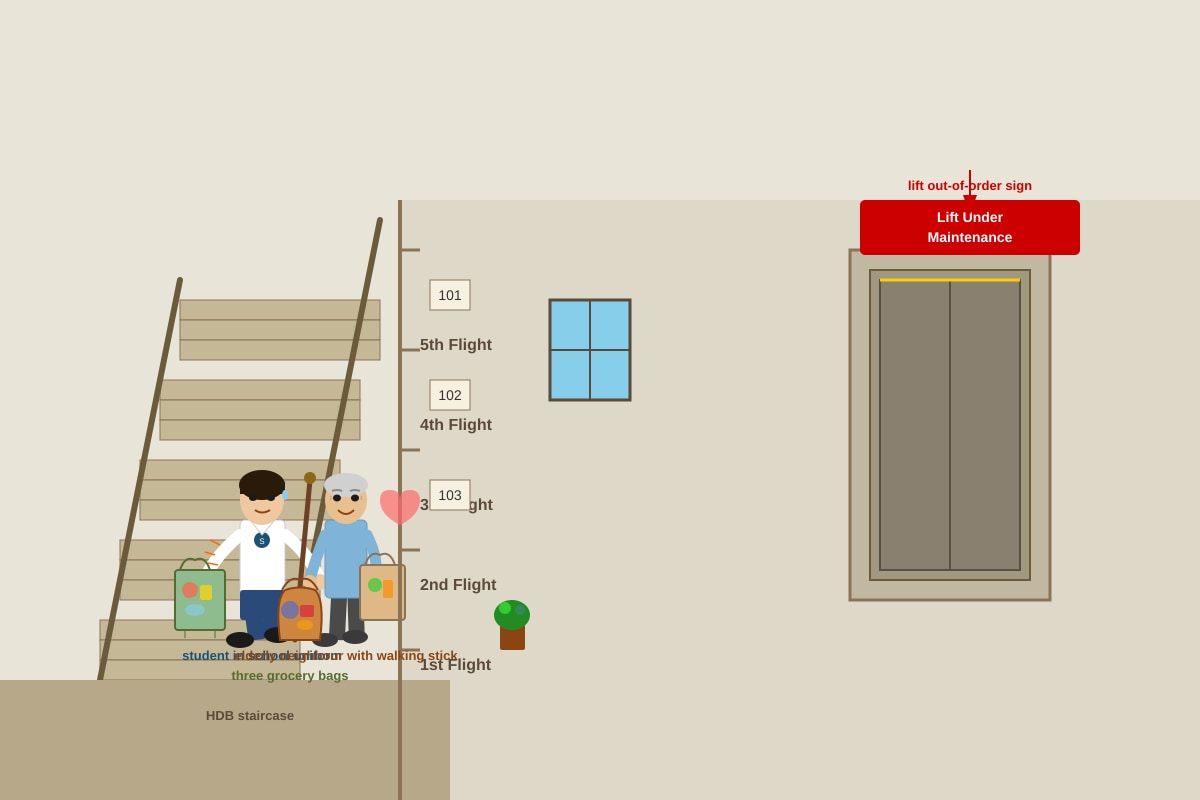
9. Your teacher shows you this picture in class:
<image_placeholder> id: Q9-fig1 type: source_image linked_question: Q9 description: A Primary 3 student helping an elderly neighbour carry groceries up a HDB flat staircase labels: student in school uniform, elderly neighbour with walking stick, grocery bags, HDB staircase, lift out-of-order sign values: three grocery bags, five flights of stairs indicated on wall must_show: expressions of both people, heavy bags, effort shown in posture, neighbour's grateful expression, "Lift Under Maintenance" sign </image_placeholder>
Your teacher asks: "Why do you think the boy is helping his neighbour?"
Write what you would say in the oral examination:
Answer: _____________________________________________________________
_______________________________________________________________________ [2 marks]
10. In your oral preparation, you are given this topic card:
TOPIC: My Favourite Singapore Festival
Your teacher asks: "Tell me about a festival you enjoy in Singapore. Why do you like it?"
Write what you would say:
Answer: _____________________________________________________________
_______________________________________________________________________ [2 marks]
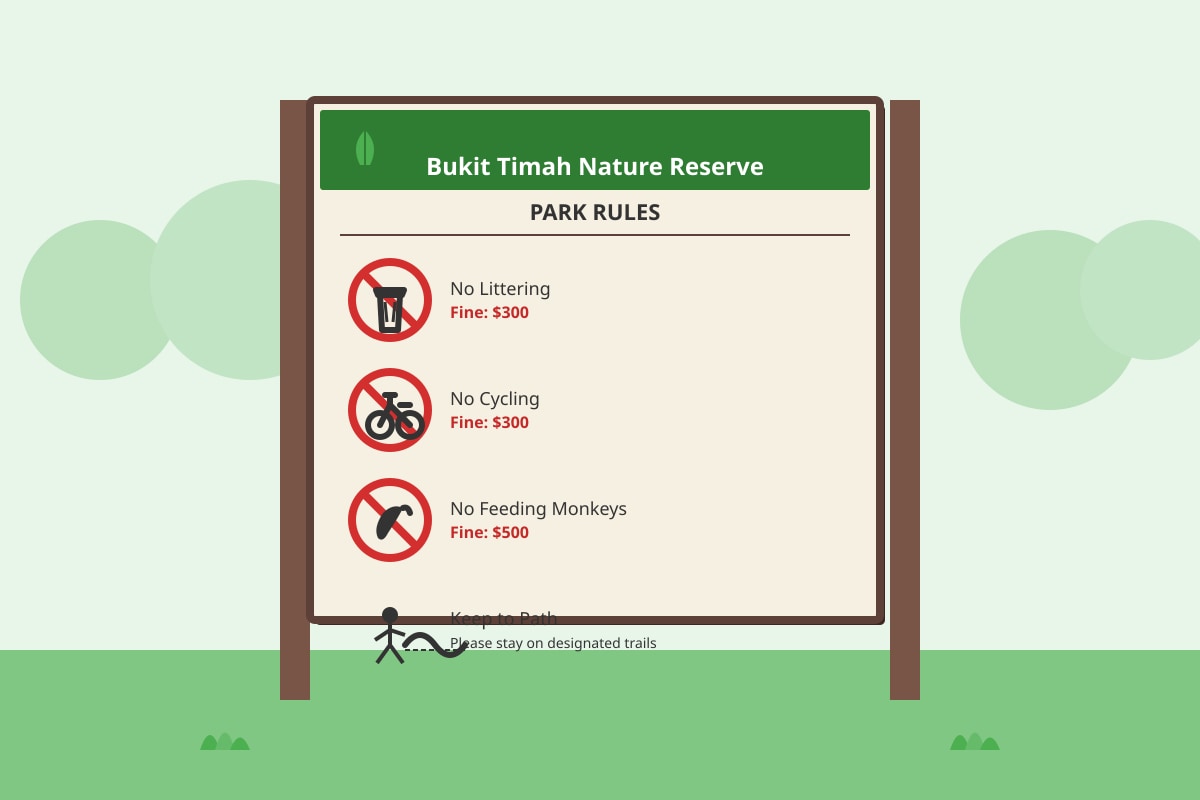
11. Look at this sign displayed at a park:
<image_placeholder> id: Q11-fig1 type: source_image linked_question: Q11 description: A Singapore park notice board with multiple rules and symbols labels: "No Littering" (crossed bin), "No Cycling" (crossed bicycle), "No Feeding Monkeys" (crossed banana), "Keep to Path" (walking person), fine amounts listed values: fine for littering: 500 must_show: all four symbols clearly, red circle-slash prohibition style, park name "Bukit Timah Nature Reserve" at top, NParks logo </image_placeholder>
Your examiner asks: "Which rule do you think is most important? Why?"
Give your answer with a reason:
Answer: _____________________________________________________________
_______________________________________________________________________ [2 marks]
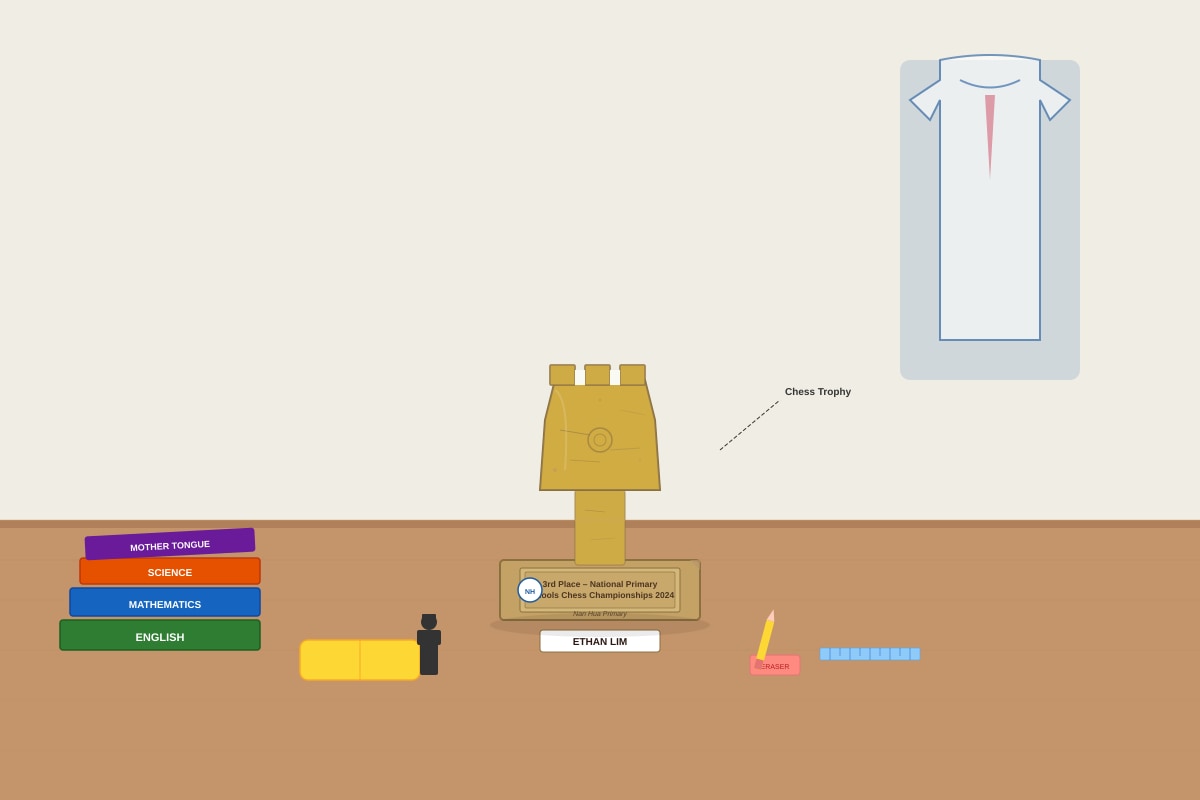
12. You are preparing for Show-and-Tell. You bring this item:
<image_placeholder> id: Q12-fig1 type: source_image linked_question: Q12 description: A well-used chess trophy with scratched base and faded gold colour, sitting on a student's desk with school books labels: "3rd Place – National Primary Schools Chess Championships 2024" engraved on plaque, student's name "ETHAN LIM", school badge "Nan Hua Primary" values: 2024, 3rd place must_show: wear and tear on trophy, proud display context, engraved text legible, school context with uniform in background </image_placeholder>
Write two points you would mention about this item and why it is special to you:
_______________________________________________________________________ [2 marks]
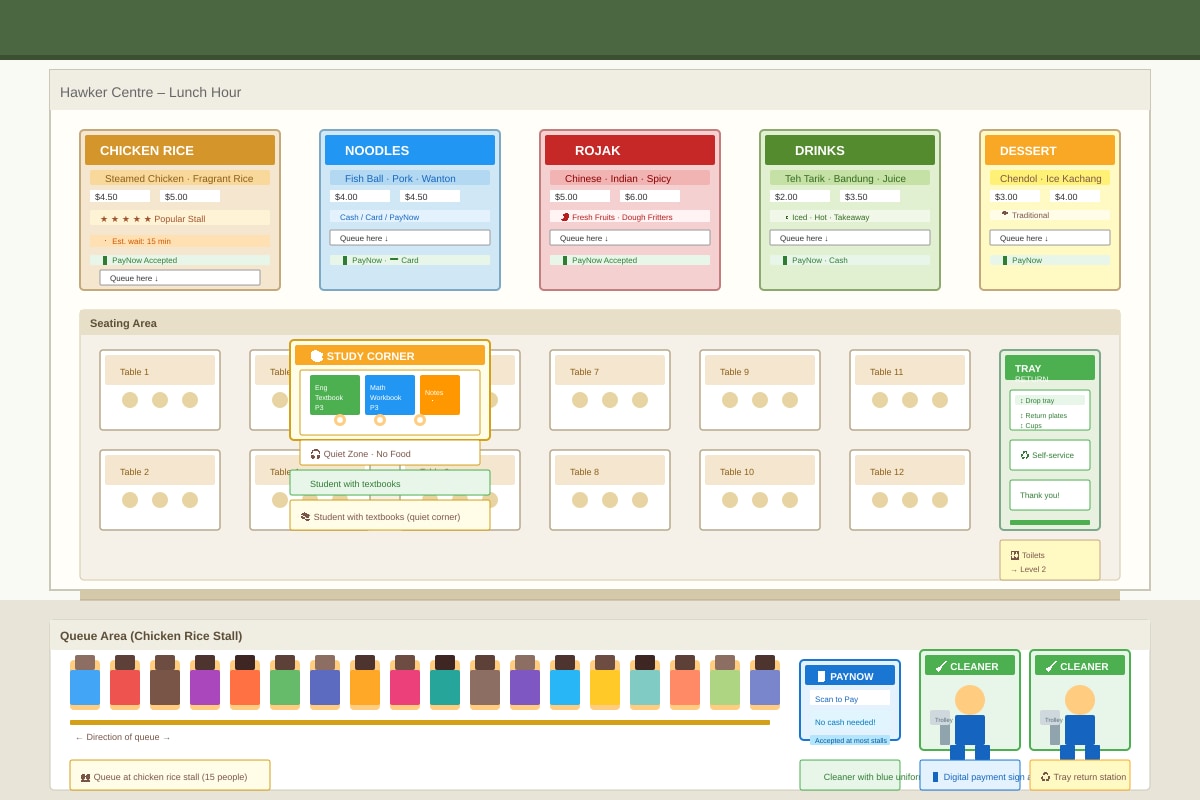
13. Your teacher gives you this photograph to discuss:
<image_placeholder> id: Q13-fig1 type: source_image linked_question: Q13 description: A Singapore hawker centre during rush hour with long queues, cleaners wiping tables, and a student studying at one corner table labels: queue at chicken rice stall, cleaner with blue uniform and trolley, student with textbooks, digital payment sign at one stall, tray return station values: approximately 15 people in queue, 3 cleaners visible, 1 student must_show: contrast between busy queue area and quiet study corner, modern digital payment alongside traditional hawker setting, self-service tray return </image_placeholder>
Your teacher asks: "What can you tell me about this place? What do people do here?"
Write your response:
_______________________________________________________________________ [2 marks]
14. For your oral examination, you practise responding to this unexpected question:
Your examiner asks: "You said you like reading. What would you do if your best friend said reading is boring?"
Write a thoughtful response showing how you would handle this situation:
_______________________________________________________________________ [2 marks]
Section C: Viewing with Critical Awareness (Questions 15–20) [12 marks]
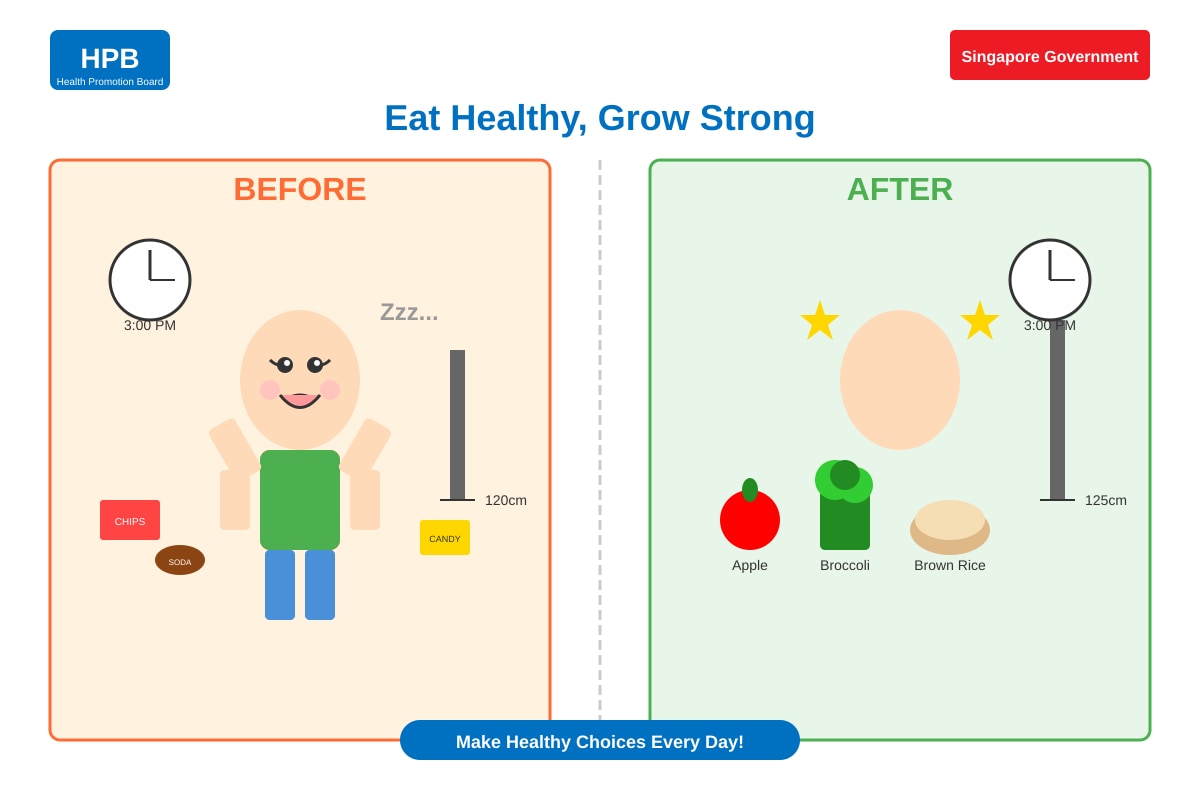
15. You watch this advertisement on television:
<image_placeholder> id: Q15-fig1 type: source_image linked_question: Q15 description: A Health Promotion Board poster showing a before-and-after comparison for healthy eating labels: "Before" side: tired child with junk food wrappers; "After" side: energetic child with fruits and vegetables, "Eat Healthy, Grow Strong" slogan, HPB logo values: height measurement showing growth, clock showing same time of day (3pm) must_show: clear contrast in energy levels, same child represented, Singapore government campaign branding, specific healthy foods labelled (apple, broccoli, brown rice) </image_placeholder>
(a) What message is this poster trying to tell you? [1 mark]
(b) Give ONE clue from the picture that shows the "after" child is healthier. [1 mark]
16. Study this infographic from a children's science magazine:
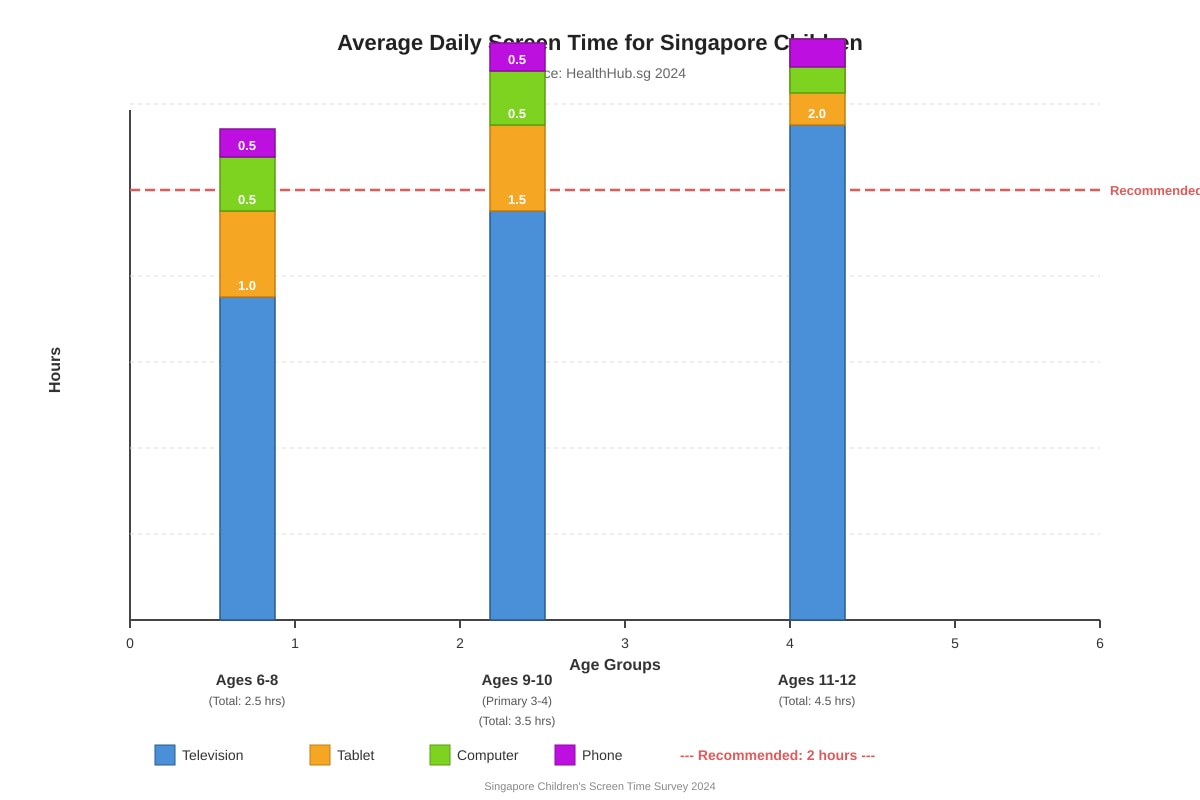
<image_placeholder> id: Q16-fig1 type: chart linked_question: Q16 description: A bar chart showing average daily screen time for different age groups of Singapore children labels: Ages 6-8, Ages 9-10 (Primary 3-4), Ages 11-12; horizontal axis: hours from 0-6; each bar colour-coded by device type (television, tablet, computer, phone) values: Ages 6-8: 2.5 hours total; Ages 9-10: 3.5 hours total; Ages 11-12: 4.5 hours total; television remains constant 1 hour across all groups, phone use increases with age must_show: exact numerical values on bars, Singapore context mention, "Recommended: 2 hours" horizontal dashed line across chart, source "HealthHub.sg 2024" </image_placeholder>
(a) How many hours of screen time does the chart show for Primary 3-4 students (Ages 9-10)? [1 mark]
(b) The recommended screen time is 2 hours. What is ONE thing you notice about Primary 3-4 students compared to this recommendation? [1 mark]
17. You view this scene from a documentary about Singapore:
<image_placeholder> id: Q17-fig1 type: source_image linked_question: Q17 description: A split-screen comparison of Singapore River in 1970s and 2020s labels: Left side: "1970s" – bumboats, hawkers on boats, murky brown water; Right side: "2020s" – clean river, Esplanade and Marina Bay Sands in background, tourist boat, QR code sign for river cruise booking values: dates clearly marked, "50 Years of Change" title banner must_show: dramatic environmental transformation, same geographical location recognisable by bridges, modernization versus traditional elements, Singapore skyline landmarks </image_placeholder>
Your teacher asks: "What has changed about the Singapore River? Give TWO differences you can see."
_______________________________________________________________________ [2 marks]
18. Watch this short video clip in class (described below):
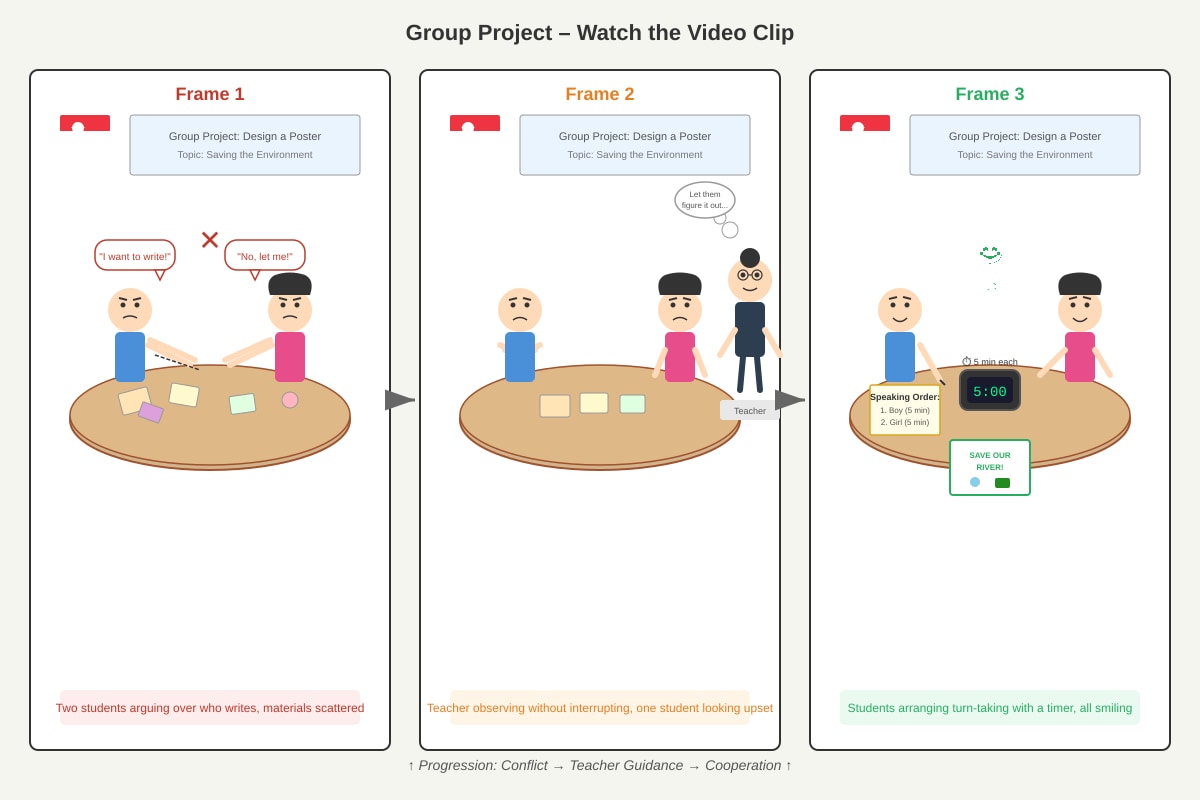
<image_placeholder> id: Q18-fig1 type: source_image linked_question: Q18 description: Three frames from a video showing a group project in a Singapore classroom labels: Frame 1: Two students arguing over who writes, materials scattered; Frame 2: Teacher observing without interrupting, one student looking upset; Frame 3: Students arranging turn-taking with a timer, all smiling values: Timer set to 5 minutes per person must_show: progression from conflict to resolution, Singapore classroom with national flag, group work furniture arrangement, visible cooperation strategy (timer and paper with speaking order) </image_placeholder>
(a) What problem do the students have in Frame 1? [1 mark]
(b) How do the students solve their problem by Frame 3? [1 mark]
19. You are shown this photograph from a news article:
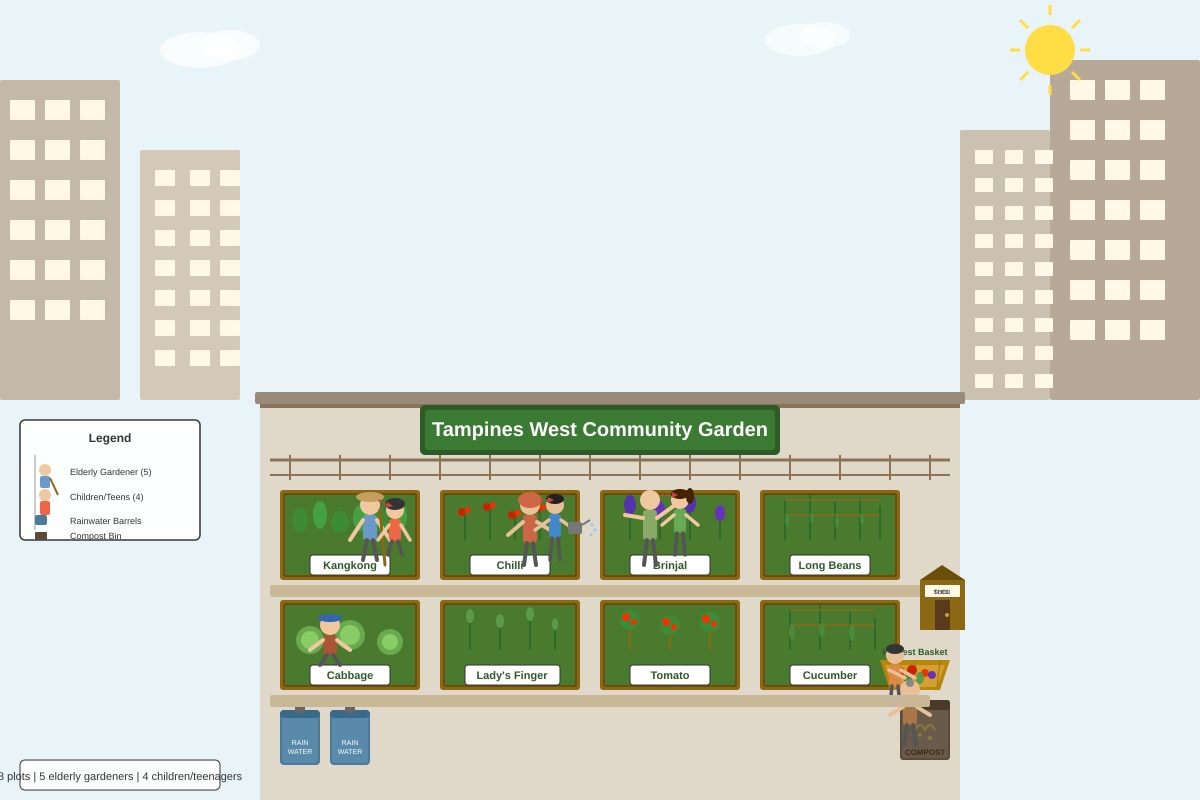
<image_placeholder> id: Q19-fig1 type: source_image linked_question: Q19 description: A community garden on a HDB rooftop with elderly and young residents gardening together labels: "Tampines West Community Garden" sign, vegetable plots with labels (kangkong, chilli, brinjal), rainwater collection barrels, compost bin, intergenerational interaction values: 8 plots, 5 elderly gardeners, 4 children/teenagers, harvest basket with vegetables must_show: collaboration between age groups, sustainable features clearly visible, HDB rooftop setting with surrounding buildings, named vegetables typical of Singapore cooking </image_placeholder>
Your examiner asks: "Why do you think this community garden is good for the neighbourhood? Give TWO reasons."
_______________________________________________________________________ [2 marks]
20. Study this poster from your school:
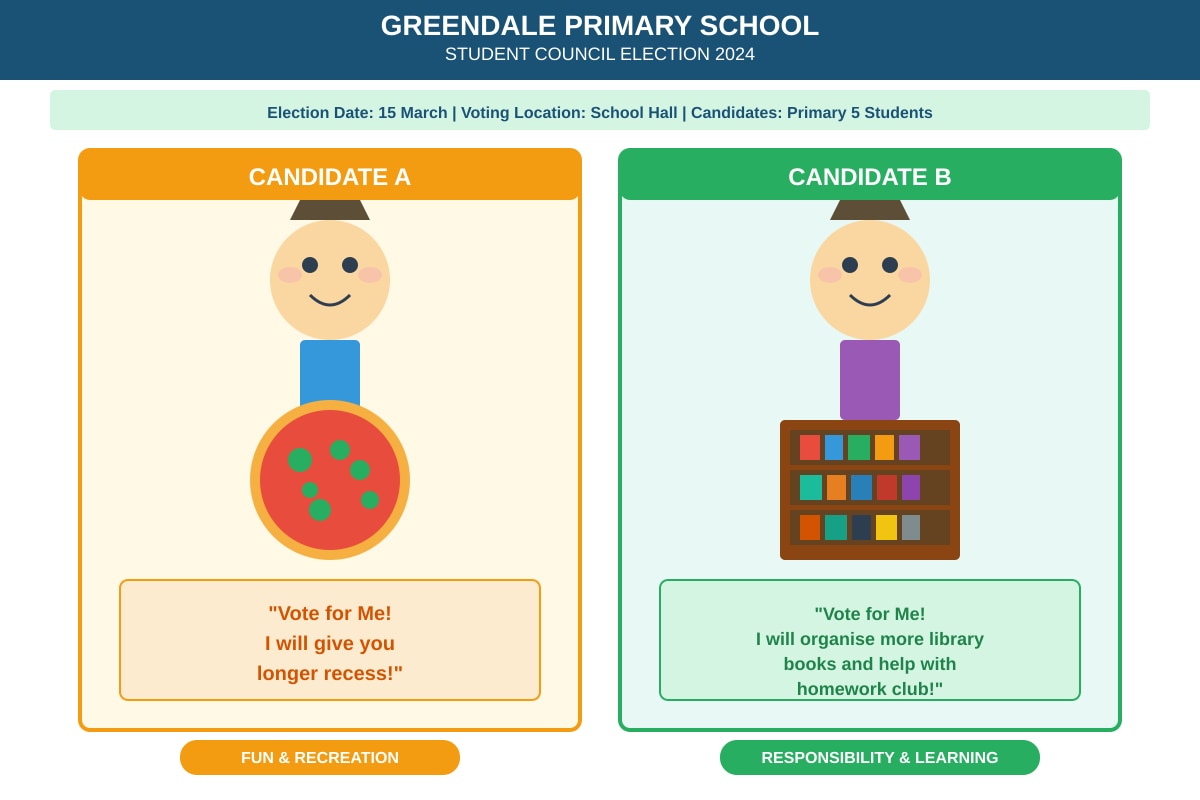
<image_placeholder> id: Q20-fig1 type: source_image linked_question: Q20 description: A student council election poster with two candidates shown labels: Candidate A poster: "Vote for Me! I will give you longer recess!" with picture of pizza; Candidate B poster: "Vote for Me! I will organise more library books and help with homework club!" with picture of organised bookshelf values: both are Primary 5 students, election date "15 March", voting location "School Hall" must_show: contrast in campaign promises (fun vs. responsibility), age-appropriate student faces, official school header, democratic process context </image_placeholder>
Your teacher asks: "Which candidate would you vote for? Why? Give ONE reason based on what you see."
_______________________________________________________________________ [2 marks]
END OF QUIZ
[Total: 30 marks]
Answers
Primary 3 English Quiz - Oral: Answer Key
Total Marks: 30
Duration: 30 minutes
Section A: Listening for Understanding (8 marks)
1. Bring your spelling folders on Friday (instead of Period 3 tomorrow). [1 mark]
Teaching note: Listen for changed details. Key words are "postponed to Friday" and "bring your spelling folders on Friday instead." Common mistake: Students may focus on "tomorrow" from the first part without hearing the change.
2. The canteen (tables near the book corner). [1 mark]
Teaching note: Sarah suggests a new location because the library closes. "Instead" signals a change. Must include "canteen" for full mark.
3. Alight at Ang Mo Kio and transfer to the Circle Line. [1 mark]
Teaching note: Two actions needed: (a) alight, (b) transfer. Accept "get off at Ang Mo Kio and change to Circle Line." Common mistake: Missing the transfer action.
4. Sketchbook, 2B pencil, and watercolour paints. [1 mark]
Teaching note: Question asks what TO take out, not what NOT to take. Accept any of the three items or all three. Understanding negative instruction "do NOT need colour pencils" is tested.
5. It is cheaper / you save 50 cents / it costs 4. [1 mark]
Teaching note: Inferential reasoning about value. Accept any statement of price difference or saving. Common mistake: Stating just the prices without the comparison.
6. To explain HOW bats find food in the dark / to explain what echolocation means / to give an example of how bats survive without needing good eyesight in darkness. [1 mark]
Teaching note: The speaker mentions echolocation to explain a bat adaptation. Accept answers showing purpose: explanation of a process. The "why" is about supporting the main point that bats are not actually handicapped by darkness.
7. Possible answers (accept any reasonable inference from visual clues):
- The floor was recently washed / it rained, so they put out a wet floor sign [1 mark]
- A market worker put out fresh vegetables for morning shoppers [1 mark]
- The tissue paper auntie arrived early to find a good spot to sell her packets [1 mark]
Teaching note: "Before" requires backward inference from visual evidence. Any plausible causal inference using picture clues earns the mark. Must reference specific visual element (wet floor sign, fresh produce, tissue seller's position).
8. The puppy changed from scared/trembling/fearful to happy/comforted/trusting. [1 mark]
Teaching note: Identify emotional change using text evidence. "Trembling" → "wagged its tail and licked her hand" shows the transformation. Accept emotion words or behavioural descriptions indicating the same emotional journey.
Section B: Speaking and Presentation (10 marks)
9. Sample answer (2 marks):
"I think the boy is helping his neighbour because the lift is under maintenance, so the neighbour cannot use it. The neighbour has a walking stick and heavy grocery bags, so climbing five flights of stairs would be very difficult for her. The boy is being kind and responsible by using his strength to help someone who needs it." [2 marks]
Marking breakdown:
- Identify specific reason (lift broken / stairs hard for elderly person): 1 mark
- Explain why the situation is difficult OR why the boy's action is good: 1 mark
Teaching note: Use visual evidence systematically. The out-of-order sign, walking stick, heavy bags, and stairs are all clues. Encourage students to describe what they see then interpret. Common mistake: Generic "he is helpful" without linking to picture evidence.
10. Sample answer structure (2 marks):
"One festival I really enjoy is Chinese New Year / Hari Raya / Deepavali / Christmas. [Festival name] I like it because my whole family comes together to celebrate. [Reason 1] We prepare special food like [specific food], and I get to help my [family member] with [activity]. [Reason 2 with detail] The best part is [specific tradition] because it makes me feel [emotion]." [2 marks]
Marking breakdown:
- Name a specific Singapore festival: 1 mark
- Give at least ONE reason with specific details (food, activity, feeling, family): 1 mark
Teaching note: "Tell me about" requires naming + elaboration. Penalise vague answers ("I like it because it is fun"). Reward cultural specificity and personal connection. Accept any major Singapore festival with appropriate details.
11. Sample answer (2 marks):
"I think the 'No Feeding Monkeys' rule is most important because a $500 fine shows it is very serious. Feeding monkeys makes them aggressive and they might attack people. Also, monkeys should find their own natural food in the forest, not depend on human food which is unhealthy for them." [2 marks]
Marking breakdown:
- State which rule: 1 mark
- Give reason linked to consequences, safety, or ecosystem health: 1 mark
Teaching note: Any of the four rules accepted with valid reason. Higher-level reasoning connects to consequences beyond immediate situation. Note the fine values as contextual clue ("most important" may correlate with highest fine, but accept other reasoned choices).
12. Sample answer (2 marks):
"First, I would mention that I won third place at the National Primary Schools Chess Championships in 2024, which was very competitive. The trophy is special because it reminds me of how I practised every day after school and learned to stay calm under pressure. Even though the trophy is now scratched and faded, the memories of working hard and representing my school make it precious to me." [2 marks]
Marking breakdown:
- One point about the item's origin/achievement: 1 mark
- One point about personal significance with emotional connection: 1 mark
Teaching note: Show-and-Tell requires factual description PLUS personal meaning. The worn condition invites storytelling about history and emotional value. Common mistake: Only describing physical appearance without personal significance.
13. Sample answer (2 marks):
"This place is a hawker centre in Singapore where people buy affordable local food. I can tell this because there is a long queue at a chicken rice stall, which is very popular. There are also cleaners keeping the place tidy, and a student is studying at the corner table, so it is a community space where people do different activities. The digital payment sign shows it is modern but still traditional." [2 marks]
Marking breakdown:
- Identify place and basic function: 1 mark
- Describe at least TWO activities visible in image with evidence: 1 mark
Teaching note: Train students to read busy scenes systematically: people (what are they doing?), setting features, contrasts. The digital/traditional contrast and the study corner are higher-level observations.
14. Sample answer (2 marks):
"I would first ask my friend what kinds of books they have tried. Then I might suggest a book about their hobby, like football or Minecraft, to show that reading can match their interests. I would not force them, but I would offer to read together or share exciting parts from my favourite books. I would respect their opinion while gently showing them more options." [2 marks]
Marking breakdown:
- Show respectful, non-confrontational approach: 1 mark
- Include specific strategy or alternative suggestion: 1 mark
Teaching note: This tests social-emotional reasoning and persuasive communication. Best answers show empathy + practical strategy, not just disagreement. Common mistake: Arguing or dismissing friend's view ("They are wrong").
Section C: Viewing with Critical Awareness (12 marks)
15. (a) The poster tells you / encourages you to eat healthy food (fruits and vegetables) so you can be energetic and grow strong / tall. [1 mark]
Teaching note: Message = call to action + benefit. Accept "healthy eating makes you strong/grow well." Must include both behaviour and outcome.
(b) The "after" child is smiling/standing straight/taller on the growth chart/holding healthy foods/clock shows same time but child has more energy. [1 mark]
Teaching note: Any specific visual contrast element earns the mark. The height measurement and clock are designed inferential clues.
16. (a) 3.5 hours [1 mark]
Teaching note: Direct data extraction from chart. Must include unit or clear number.
(b) Primary 3-4 students exceed the recommendation by 1.5 hours / their screen time is more than recommended / only television use is within the limit but other devices push total over. [1 mark]
Teaching note: Comparison must reference the 2-hour recommendation line. Accept any mathematically correct comparison or observation about composition (phone use increasing).
17. Two differences (2 marks):
- The water was murky brown before but is clean now [1 mark]
- There were bumboats and hawkers selling food from boats before, but now there are tourist boats and modern buildings [1 mark]
- There are modern buildings like Esplanade and Marina Bay Sands now but not before [1 mark]
- You can book river cruises with a QR code now, showing technology change [1 mark]
Teaching note: Any TWO valid contrasts earn marks. Must be explicitly visible in image description. Environmental, economic activity, and technological changes are all observable.
18. (a) The students are arguing about who will write / they cannot agree on how to share the work / materials are messy because they are not cooperating. [1 mark]
(b) They use a timer so everyone gets equal turns / they made a speaking order list / they take turns for 5 minutes each. [1 mark]
Teaching note: Frame analysis requires reading sequential images. Problem in Frame 1: conflict. Resolution in Frame 3: structured turn-taking. Accept specific mechanism (timer, list) or general description of fair sharing.
19. Two reasons (2 marks):
- It brings elderly and young people together to make friends across generations [1 mark]
- It provides fresh vegetables for healthy cooking / saves money on groceries [1 mark]
- It teaches children gardening skills and where food comes from [1 mark]
- The rainwater collection and compost bin help the environment / makes gardening sustainable [1 mark]
- It makes the neighbourhood beautiful and gives residents pride [1 mark]
Teaching note: Any TWO reasons with social, environmental, educational, or community benefit. Higher marks for specific reference to visible elements (intergenerational, sustainability features).
20. Sample answer (2 marks):
"I would vote for Candidate B because organising library books and helping with homework club helps students learn better at school. Longer recess is fun but does not help the school community as much as supporting learning. A good student leader should think about what helps everyone improve, not just what is immediately enjoyable." [2 marks]
Marking breakdown:
- State candidate: 1 mark
- Give reasoned justification comparing BOTH candidates' promises: 1 mark
Teaching note: This tests critical evaluation and civic reasoning. Reward thoughtful comparison over personal preference alone. Both candidates acceptable if reasoned well.
END OF ANSWER KEY