AI Generated Quiz
Primary 3 English Oral Quiz
Free P3 English Oral quiz, AI version, with questions, answers, and syllabus-aligned practice for Singapore students.
These static practice materials are generated from the site's syllabus and paper-generation workflow, with source and model context shown so students and parents can evaluate the material before use.
Questions
Free quiz and exam paper access
Enter your details to view this paper
Your access is remembered on this device.
Answers
Primary 3 English Quiz - Oral: Answer Key
Total Marks: 20
Section A: Reading Aloud (Questions 1–5)
Instructions for marking: Award 1 mark for each sentence read clearly with appropriate expression, correct pronunciation, and attention to punctuation. No marks are deducted for minor stumbles if the student self-corrects and continues smoothly.
Question 1 (1 mark)
Answer: The student should read: "The little kitten hid behind the big green sofa." Explanation: The student should read this sentence with a natural, storytelling tone. Emphasise the words "little" and "big" slightly to show contrast. Pause briefly at the end of the sentence. The comma is not present, so the student should read it as one smooth phrase. Common mistake: Reading too quickly and running words together. Encourage the student to slow down and pronounce each word clearly.
Question 2 (1 mark)
Answer: The student should read: "Please pass me the red pencil," said Mei Ling. Explanation: This sentence contains dialogue. The student should use a slightly different tone for the spoken part ("Please pass me the red pencil") to show that someone is speaking. The tag ("said Mei Ling") should be read in a normal narrative voice. The comma inside the quotation marks indicates a slight pause. Common mistake: Not changing tone for the dialogue part. Remind the student that when we read dialogue, we should sound like the character speaking.
Question 3 (1 mark)
Answer: The student should read: "After the rain stopped, the children played in the puddles." Explanation: This sentence has a time clause at the beginning. The student should read "After the rain stopped" with a slight rise in pitch, then pause at the comma before reading the main clause. This shows the sequence of events. Common mistake: Ignoring the comma and reading the whole sentence without a pause. The comma helps the listener understand the order of events.
Question 4 (1 mark)
Answer: The student should read: "Wow! What a beautiful rainbow we saw today!" Explanation: This is an exclamatory sentence. The student should read it with excitement and energy. The word "Wow!" should be read with emphasis, and the exclamation mark at the end signals a strong feeling. The voice should go up in pitch to show surprise and delight. Common mistake: Reading in a flat, unexcited tone. Encourage the student to imagine they are actually seeing a beautiful rainbow.
Question 5 (1 mark)
Answer: The student should read: "My grandmother tells the best stories about her childhood in Kampong Glam." Explanation: This sentence has a warm, personal tone. The student should read it with a sense of fondness. The word "best" can be emphasised slightly. "Kampong Glam" is a place name in Singapore and should be pronounced clearly. The sentence flows naturally without a need for dramatic pauses. Common mistake: Mispronouncing "Kampong Glam" or reading too quickly through the place name.
Section B: Picture Description (Questions 6–10)
Instructions for marking: Award 1 mark for a clear description that includes at least two details from the picture. Award the second mark for using full sentences with correct grammar and appropriate vocabulary. Accept any reasonable description that matches the picture.
Question 6 (2 marks)
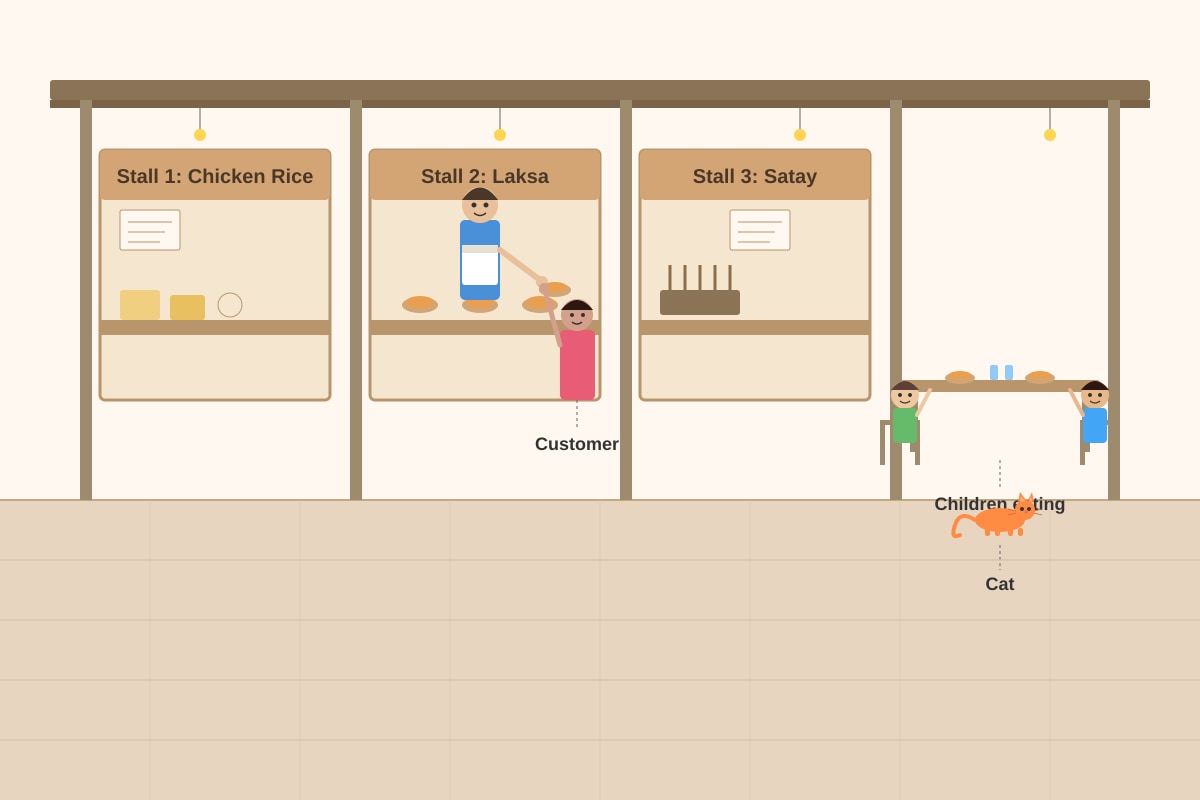
Expected answer: "This is a hawker centre. There are three food stalls selling chicken rice, laksa, and satay. A stallholder is serving a customer. Two children are sitting at a table eating. A cat is sitting under a table." Explanation: The student should describe the setting (hawker centre), the stalls and what they sell, the people (stallholder, customer, children), and the cat. Using specific vocabulary like "stallholder," "serving," and "hawker centre" shows good word choice. The student should use the present tense to describe what is happening in the picture. Marking notes:
- 1 mark: Mentions at least two elements (e.g., "There is a cat and children eating.")
- 2 marks: Gives a fuller description with 3+ details in complete sentences.
Question 7 (2 marks)
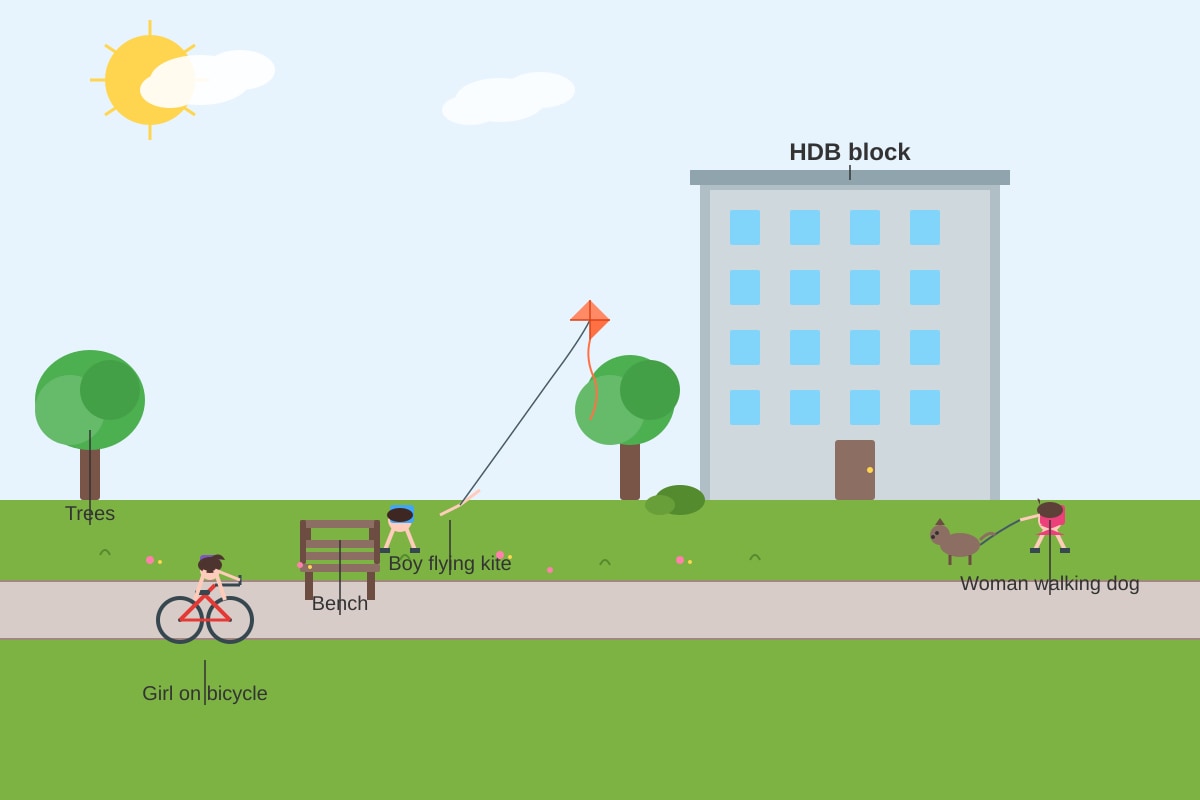
Expected answer: "This is a park near an HDB block. A boy is flying a kite. A girl is riding a bicycle. A woman is walking a dog. There are two trees and a bench in the park." Explanation: The student should identify the setting (park near HDB block) and describe the actions of each person. Using present continuous tense ("is flying," "is riding," "is walking") is appropriate for describing a picture. Mentioning the trees and bench adds detail. Marking notes:
- 1 mark: Describes at least two people/actions.
- 2 marks: Describes the setting and all three people's actions in full sentences.
Question 8 (2 marks)
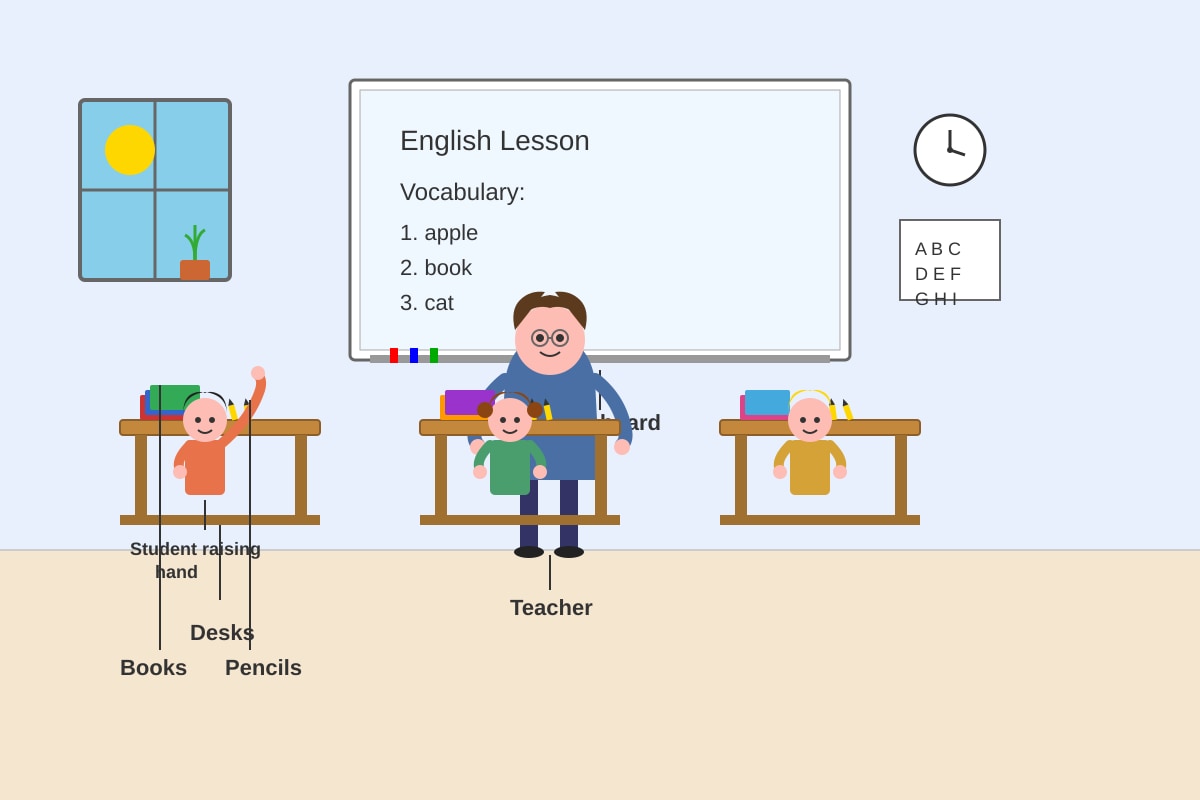
Expected answer: "This is a classroom. A teacher is standing at the front near a whiteboard. Three students are sitting at their desks. One student is raising her hand to answer a question. There are books and pencils on the desks." Explanation: The student should identify the classroom setting, describe the teacher's position, and describe what the students are doing. The detail about the student raising her hand shows careful observation. Using "to answer a question" adds inference about why the hand is raised. Marking notes:
- 1 mark: Mentions the teacher and students.
- 2 marks: Includes specific actions (standing, raising hand) and objects (whiteboard, desks, books).
Question 9 (2 marks)
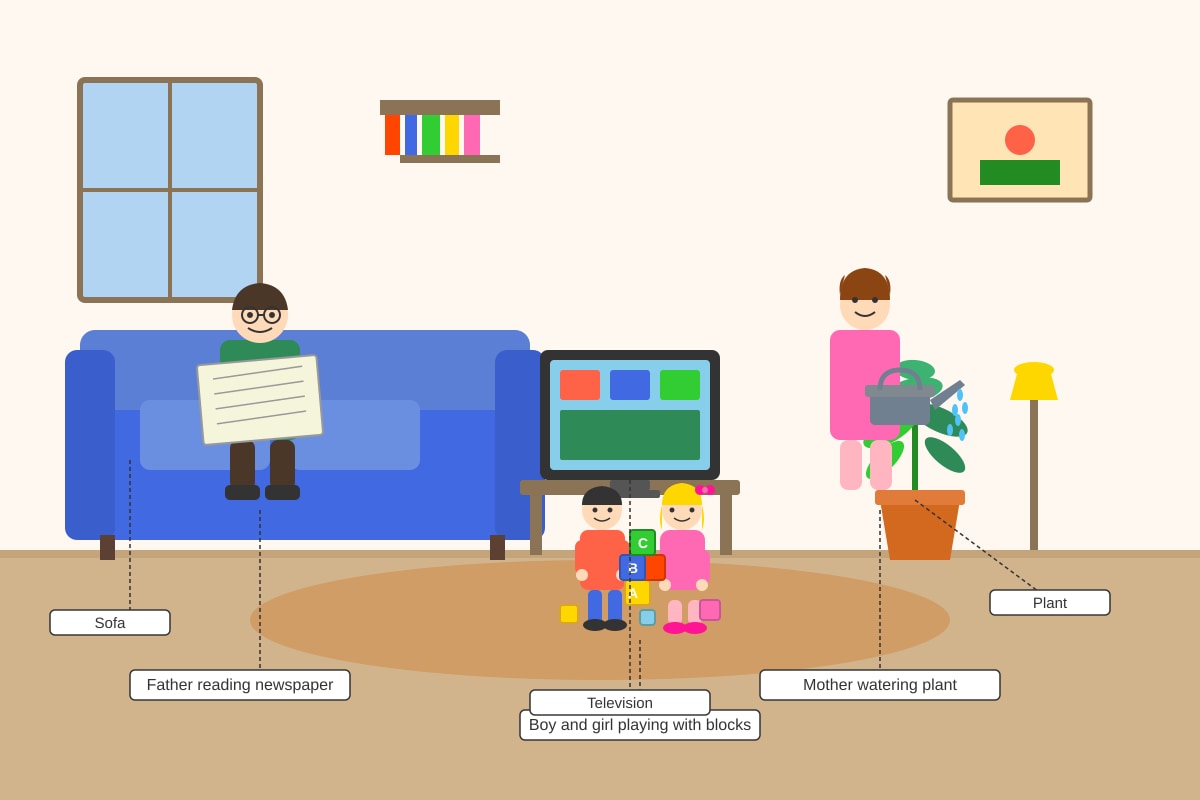
Expected answer: "This is a family in a living room. The father is reading a newspaper on the sofa. The mother is watering a plant. The boy and girl are playing with building blocks on the floor. There is a television on a table." Explanation: The student should describe each family member's activity. Using "father," "mother," "boy," and "girl" shows clear identification. The present continuous tense is used correctly. Mentioning the television and plant adds detail about the room. Marking notes:
- 1 mark: Describes at least two family members.
- 2 marks: Describes all four family members and at least one object in the room.
Question 10 (2 marks)
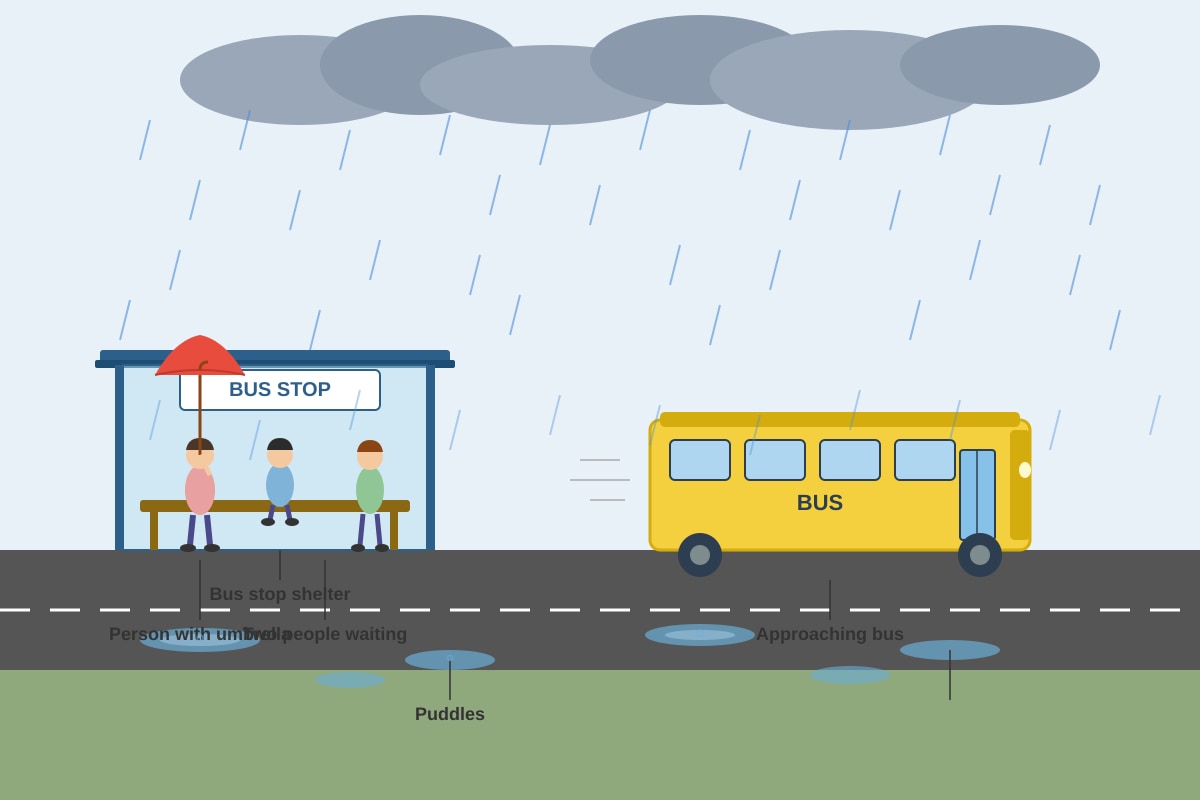
Expected answer: "It is a rainy day. Three people are waiting at a bus stop shelter. One person is holding an umbrella. A bus is coming down the road. There are puddles on the ground." Explanation: The student should describe the weather (rainy), the location (bus stop), the people waiting, and the approaching bus. Mentioning the puddles shows attention to detail. The student can use "is coming" or "is approaching" to describe the bus. Marking notes:
- 1 mark: Mentions the bus stop and at least one person.
- 2 marks: Describes the weather, the people, the bus, and the puddles.
Section C: Conversation and Response (Questions 11–20)
Instructions for marking: Award 1 mark for a response that is appropriate to the situation, polite, and grammatically correct. Accept any reasonable answer that fits the context.
Question 11 (1 mark)
Expected answer: "Excuse me, could you help me find a book about dinosaurs?" Explanation: The student should use polite language ("Excuse me," "could you") and clearly state their request. The librarian is a person in authority, so politeness is important. The question should be a request, not a demand. Common mistake: Saying "Give me a dinosaur book" without polite words. Remind the student to always use "please" or "could you" when asking for help.
Question 12 (1 mark)
Expected answer: "Don't worry, I can help you look for your pencil. Maybe we can share mine for now." Explanation: The student should show empathy and offer help. The response should be kind and supportive. Offering a solution (looking together or sharing) shows good social skills. Common mistake: Saying something unkind like "That's not my problem." The student should learn to be a good friend.
Question 13 (1 mark)
Expected answer: "I'm so sorry! Are you okay? It was an accident." Explanation: The student should apologise immediately and check if the other person is okay. Explaining that it was an accident shows good manners. The tone should be sincere. Common mistake: Saying nothing or just "Sorry" without checking on the person. A full apology is more appropriate.
Question 14 (1 mark)
Expected answer: "My favourite hobby is reading. I like to read adventure stories because they are exciting." Explanation: The student should state the hobby clearly and give a reason why they like it. The response should be a complete sentence. Speaking to the class means the student should imagine they are talking to a group. Common mistake: Just saying "Reading" without any explanation. The student should learn to give a short, complete answer.
Question 15 (1 mark)
Expected answer: "Uncle, can I have one plate of chicken rice, please?" Explanation: The student should use polite language ("please") and address the stallholder appropriately ("Uncle" is a common respectful term in Singapore). The order should be clear and specific. Common mistake: Saying "I want chicken rice" without "please" or addressing the stallholder. Politeness is important in service settings.
Question 16 (1 mark)
Expected answer: "Today I learned about the water cycle in science class. I found out that water evaporates from the sea and becomes rain." Explanation: The student should mention one specific thing they learned and give a brief detail. The response should be a complete sentence. This shows the student can recall and share information. Common mistake: Saying "I don't remember" or "Nothing." Encourage the student to think of one thing from their day.
Question 17 (1 mark)
Expected answer: "Excuse me, do you need help? I can show you where that place is." Explanation: The student should offer help politely. The tourist may not speak English well, so the student should speak clearly and slowly. Offering to show the location is very helpful. Common mistake: Staring at the tourist without saying anything. The student should learn to be helpful and friendly to visitors.
Question 18 (1 mark)
Expected answer: "How about we play football for half an hour and then play basketball for half an hour?" Explanation: The student should suggest a compromise that includes both activities. This shows good problem-solving and social skills. The response should be fair to both friends. Common mistake: Insisting on only basketball. The student should learn to find a solution that makes everyone happy.
Question 19 (1 mark)
Expected answer: "Excuse me, may I have a piece of cake, please?" Explanation: The student should use polite request language ("may I," "please"). The request should be specific ("a piece of cake"). This shows good manners in a social setting. Common mistake: Grabbing the cake without asking. The student should always ask politely, especially at a party.
Question 20 (1 mark)
Expected answer: "I am excited to see the white tigers because I have never seen one before." Explanation: The student should name one animal or exhibit and give a reason for their excitement. The response should be a complete sentence. This shows the student can express personal interest and enthusiasm. Common mistake: Just saying "The animals" without being specific. Encourage the student to choose one thing and explain why.
End of Answer Key