AI Generated Quiz
Primary 3 English Composition Quiz
Free P3 English Composition quiz, AI version, with questions, answers, and syllabus-aligned practice for Singapore students.
These static practice materials are generated from the site's syllabus and paper-generation workflow, with source and model context shown so students and parents can evaluate the material before use.
Questions
Free quiz and exam paper access
Enter your details to view this paper
Your access is remembered on this device.
Answers
Answer Key: Primary 3 English Quiz - Composition
Section A: Planning a Composition (10 marks)
1. Answer: (2) [1 mark] Explanation: A topic sentence introduces the main idea of the paragraph. Option (2) clearly tells the reader who (my family and I), what (went to the zoo), when (last Saturday), and where (Singapore Zoo). This is a strong opening sentence. Options (1) and (4) are too general, and option (3) is a simple statement of feeling without context.
2. Answer: (4) [1 mark] Explanation: A story should start with the situation before the problem occurs. Option (4) shows the puppy happy and safe, which sets up the contrast for when it gets lost. Options (1), (2), and (3) describe events that happen after the puppy is already lost, so they belong in the middle of the story.
3. Answer: (2) [1 mark] Explanation: A good ending wraps up the story and tells the reader how the characters felt or what they learned. Option (2) provides a satisfying conclusion by sharing the character's happiness and the team's celebration. Options (1) and (3) are details from the middle of the story. Option (4) is just an action without a sense of closure.
4. Answer: (2) [1 mark] Explanation: The topic is "A Kind Deed," so the main event must be an act of kindness. Option (2) clearly describes a kind act (helping an elderly neighbour). Options (1), (3), and (4) do not involve kindness to others.
5. Answer: (3) [1 mark] Explanation: Before writing, you should plan your ideas. Brainstorming what will happen in the beginning, middle, and end gives your story a clear structure. Options (1) and (2) are steps you do after you have written a draft. Option (4) is not a necessary part of planning a written composition.
Section B: Understanding Pictures and Sequence (10 marks)
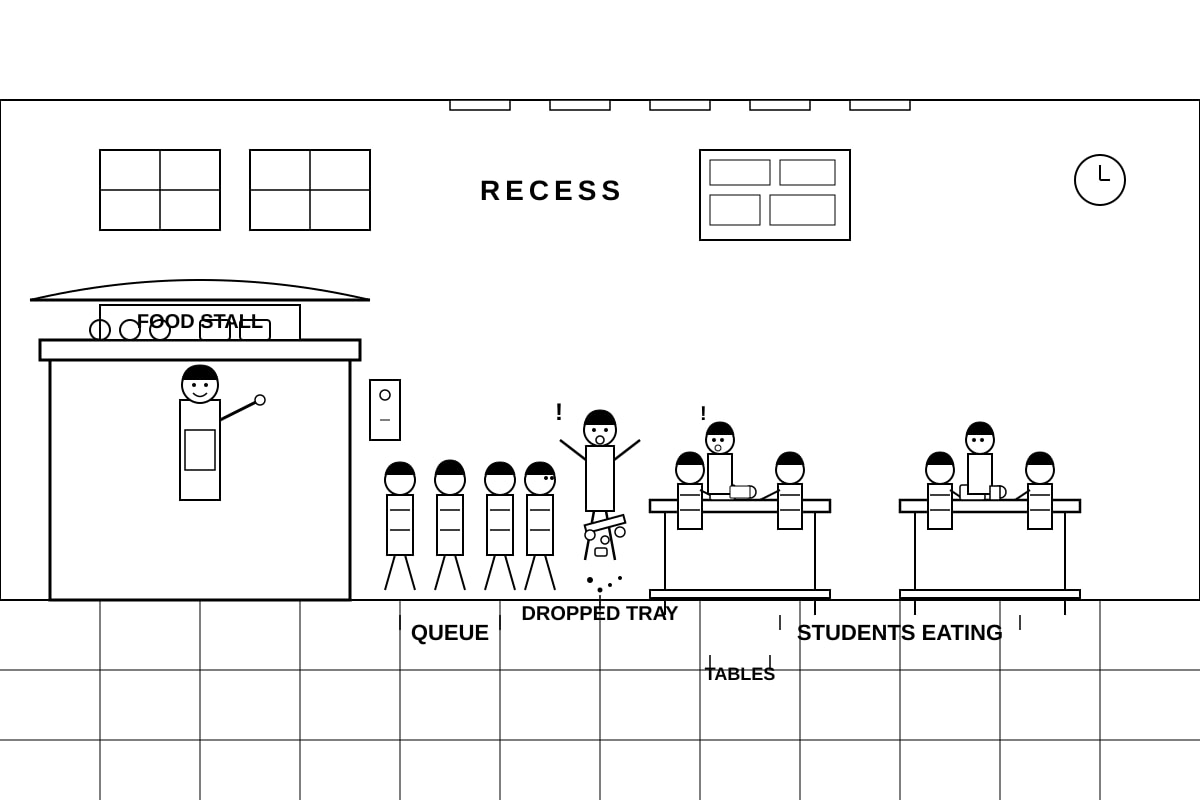
6. Answer: (2) [1 mark] Explanation: The picture shows a student dropping a tray of food in the canteen. This is the main action happening. The other options describe scenes that are not shown in the picture.
7. Answer: (2) [1 mark] Explanation: Time-order words like "first," "next," and "finally" should follow the actual sequence of events. The correct order for getting ready for bed is: change into pyjamas (first), brush teeth (next), then go to bed (finally). Option (2) is the only one with the correct sequence.
8. Answer: (2) [1 mark] Explanation: The topic is "A Rainy Day," so the setting description should match a rainy day. Option (2) describes heavy rain and wind, which fits the topic perfectly. Options (1) and (3) describe sunny weather and play, which do not match. Option (4) is about eating, not the weather.
9. Answer: (3) [1 mark] Explanation: "The End" is used to finish a story, not to start one. Good ways to start include asking a question to hook the reader (1), describing the weather to set the scene (2), or starting with a character doing something to create immediate interest (4).
10. Answer: (2) [1 mark] Explanation: Every good composition has three main parts: a beginning (introduces characters and setting), a middle (the main events or problem), and an end (the resolution and conclusion). Option (1) is for a book cover. Option (3) are elements of a story, not the structural parts. Option (4) are time-order words, not parts of a composition.
Section C: Building Sentences and Paragraphs (10 marks)
11. [2 marks] Correct Answer: Amin was late for school because he missed the bus. Explanation: The word "because" is used to show the reason for something. The reason Amin was late is that he missed the bus. The sentence can also be written as: "Because he missed the bus, Amin was late for school." Both are correct. [1 mark for correct use of "because", 1 mark for a complete and grammatically correct sentence.]
12. [2 marks] Example Correct Answer: The hungry boy ate the chocolate cake. Explanation: Adjectives are describing words. They add detail and make the sentence more interesting. Many answers are possible, such as "small/greedy/tired boy" and "delicious/big/birthday cake." [1 mark for each appropriate adjective. Accept any sensible adjective that fits the context.]
13. [1 mark] Example Correct Answer: The man strode into the room. / The man marched into the room. / The man tiptoed into the room. Explanation: "Walked" is a simple verb. Using a more specific verb like "strode" (walked with confidence), "marched" (walked with purpose), or "tiptoed" (walked quietly) creates a clearer picture for the reader. [Accept any verb that is more descriptive than "walked" and makes sense in the sentence.]
14. [1 mark] Correct Answer: The school bus arrives at eight o'clock every morning. Explanation: The paragraph is about a family picnic at East Coast Park. Sentences (a), (b), and (d) all describe events related to this picnic. Sentence (c) is about a school bus routine, which is a completely different topic and does not belong.
15. [2 marks] Example Correct Answer: I went to the library and borrowed three books. / I wanted to read a storybook, but it was already borrowed by someone else. Explanation: A compound sentence joins two simple sentences with a conjunction like "and" (to add information) or "but" (to show contrast). [1 mark for a complete sentence about a trip to the library, 1 mark for correct use of "and" or "but".]
Section D: Writing a Short Composition (20 marks)
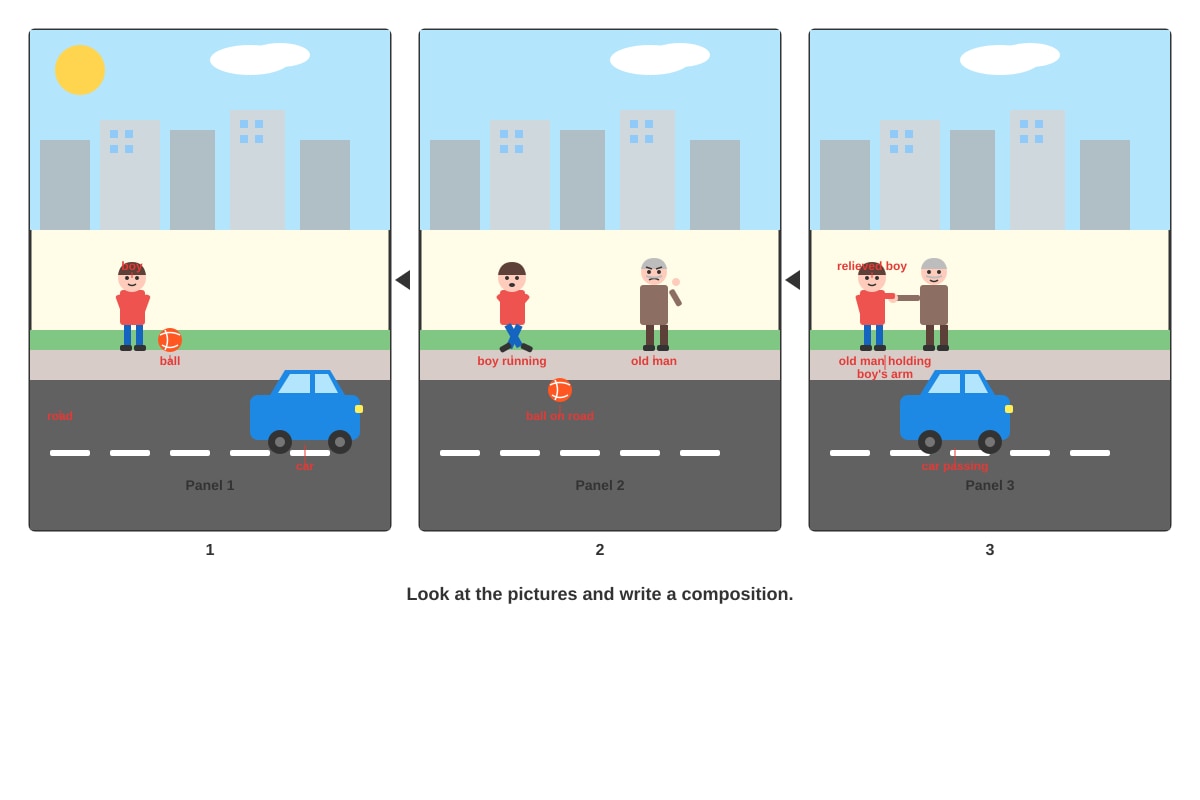
16. [1 mark] Example Correct Answer: The Brave Old Man / A Narrow Escape / A Lesson Learned Explanation: The title should reflect the main idea of the story based on the pictures. Accept any title that is relevant to the sequence shown.
17. [5 marks] Example Correct Answer: One sunny afternoon, a boy named Ravi was playing with his red ball near a busy road. He was kicking the ball high into the air and catching it. He did not notice the cars speeding by. Explanation: The beginning should introduce the character and setting, and set up the situation before the problem occurs. [Award marks for clear introduction, use of descriptive details, and logical start to the story.]
18. [6 marks] Example Correct Answer: Suddenly, Ravi kicked the ball too hard. It bounced onto the road! Without thinking, Ravi ran after it. An old man who was standing nearby saw what was happening. He looked very worried because a car was coming fast. Just as Ravi was about to step onto the road, the old man quickly reached out and held Ravi's arm tightly. "Stop!" he shouted. Explanation: The middle should describe the main events: the ball going onto the road, the boy running, and the old man's intervention. [Award marks for clear sequence, use of time-order words, and descriptive language.]
19. [5 marks] Example Correct Answer: The car zoomed past, just missing them. Ravi was very scared but also very grateful. He thanked the old man for saving him. The old man smiled and said, "Always be careful near the road." Ravi learned a valuable lesson that day and promised never to play near a busy road again. Explanation: The end should resolve the story, showing the outcome and how the characters felt or what they learned. [Award marks for a satisfying conclusion, emotional response, and lesson learned.]
20. [3 marks] Example Correct Answer: I improved the sentence "The car passed by" to "The car zoomed past, just missing them" because it makes the action more exciting. Explanation: This question checks the student's self-editing and reflection. [Award marks for identifying a specific improvement, explaining why it is better, and demonstrating awareness of spelling, grammar, or punctuation.]
Marking Scheme for Questions 16-20:
| Criteria | Excellent (8-7) | Good (6-5) | Satisfactory (4-3) | Needs Improvement (2-1) |
|---|---|---|---|---|
| Content (8 marks) | Story is complete with a clear beginning, middle, and end. All three pictures are used. Events are logical and interesting. | Story has a clear beginning, middle, and end. Most pictures are used. Events are mostly logical. | Story has some structure but may be missing a part. Some pictures are used. Events may be confusing. | Story is incomplete or does not follow the pictures. Events are hard to follow. |
| Language & Organisation (8 marks) | Excellent use of time-order words (first, next, then, finally). Good sentence variety. Descriptive words are used effectively. | Good use of time-order words. Sentences are mostly well-formed. Some descriptive language. | Some time-order words used. Sentences are simple but clear. Limited descriptive language. | Few or no time-order words. Sentences are short and repetitive. No descriptive language. |
| Grammar & Spelling (4 marks) | No or very few errors in grammar, spelling, and punctuation. | A few minor errors that do not affect understanding. | Several errors that may affect understanding. | Many errors that make the composition difficult to read. |
Model Answer for Reference:
Title: The Brave Old Man
Beginning (Question 17): One sunny afternoon, a boy named Ravi was playing with his red ball near a busy road. He was kicking the ball high into the air and catching it. He did not notice the cars speeding by.
Middle (Question 18): Suddenly, Ravi kicked the ball too hard. It bounced onto the road! Without thinking, Ravi ran after it. An old man who was standing nearby saw what was happening. He looked very worried because a car was coming fast. Just as Ravi was about to step onto the road, the old man quickly reached out and held Ravi's arm tightly. "Stop!" he shouted.
End (Question 19): The car zoomed past, just missing them. Ravi was very scared but also very grateful. He thanked the old man for saving him. The old man smiled and said, "Always be careful near the road." Ravi learned a valuable lesson that day and promised never to play near a busy road again.
Improved Sentence (Question 20): I improved the sentence "The car passed by" to "The car zoomed past, just missing them" because it makes the action more exciting and shows how close the danger was.