AI Generated Exam Paper
Primary 3 English Practice Paper 4
Free P3 English Practice Paper 4, Kimi2.6 AI version, with questions, answers, and syllabus-aligned practice for Singapore students.
These static practice materials are generated from the site's syllabus and paper-generation workflow, with source and model context shown so students and parents can evaluate the material before use.
Questions
Free quiz and exam paper access
Enter your details to view this paper
Your access is remembered on this device.
Answers
TuitionGoWhere Practice Paper - English Primary 3
Answer Key and Marking Scheme
Version 4 of 5
Section A: Grammar and Vocabulary (20 marks)
Question 1 (1 mark)
Answer: (2) go
Explanation: "My brother and sister" is a compound subject with two people connected by "and." When two subjects are joined by "and," they become plural, so we use the plural verb "go" without the "-es" ending. "Goes" is only for he/she/it (singular). "Going" and "gone" need helper verbs.
Common mistake: Choosing "goes" because students forget that two subjects joined by "and" need a plural verb.
Question 2 (1 mark)
Answer: (3) went
Explanation: The time marker "Yesterday" tells us this action happened in the past and is finished. "Went" is the simple past tense of "go." We use simple past for completed actions at a specific time in the past. "Go" is base form, "goes" is present tense for he/she/it, and "going" needs a helper verb like "is" or "was."
Question 3 (1 mark)
Answer: (1) on
Explanation: "On" is the correct preposition for placing something on a surface (the shelf). "In" would mean inside something enclosed. "At" is for general locations. "Under" means below, which does not fit the context of putting books away properly.
Question 4 (1 mark)
Answer: (2) an
Explanation: We use "an" before words that begin with a vowel sound. "Elephant" starts with the vowel sound /e/. We use "a" before consonant sounds. "The" would only work if we had already mentioned this specific elephant before. No article is incorrect here because we are referring to one non-specific elephant.
Question 5 (1 mark)
Answer: (2) his
Explanation: We need a possessive pronoun to show that the pencil case belongs to Ming Wei. "His" shows ownership. "Him" is an object pronoun (used after verbs/prepositions). "He" is a subject pronoun (does the action). "Himself" is a reflexive pronoun (only when the subject and object are the same person).
Question 6 (1 mark)
Answer: (2) nor
Explanation: "Neither...nor" is a fixed pair in English. They work together as correlative conjunctions to join two negative choices. "Neither...or" is grammatically incorrect. "Neither...and" and "Neither...but" do not exist as standard pairs.
Question 7 (1 mark)
Answer: (3) tallest
Explanation: The phrase "I have ever seen" signals a superlative comparison — comparing this building to ALL other buildings the speaker has seen. We use "tallest" (superlative form with "-est"). "Tall" is the base form. "Taller" is comparative (comparing two things). "More tall" is not correct English; we do not use "more" with one-syllable adjectives.
Question 8 (1 mark)
Answer: (2) or
Explanation: "Or" presents a choice between two options when you can only have one. "And" would mean both together. "But" shows contrast. "So" shows result. The phrase "but not both" confirms this is an exclusive choice, requiring "or."
Question 9 (1 mark)
Answer: (3) butterflies
Explanation: For nouns ending in consonant + "y," we change "y" to "i" and add "-es." So "butterfly" → "butterflies." "Butterflys" and "butterflyes" do not follow this spelling rule. "Butterfly" is singular, but "many" requires a plural noun.
Spelling rule: When a noun ends in vowel + "y" (like "toy"), just add "-s": toys. When it ends in consonant + "y," change to "ies": baby → babies, lady → ladies.
Question 10 (1 mark)
Answer: (3) must
Explanation: "Must" expresses strong obligation or necessity — finishing homework before watching TV is a rule or requirement. "Can" expresses ability/permission. "May" expresses permission/possibility. "Might" expresses weak possibility. The context suggests a necessary duty, making "must" the strongest and most appropriate choice.
Question 11 (2.5 marks: 0.5 mark per correct error found)
Expected visual features from Q11-fig1: The image shows Aunty Rosnah's fruit stall at Tekka Market with price tags for durians (2), apples (0.50 each). The tropical market setting with awning provides authentic Singapore context for the grammar exercise.
| Error Number | Wrong Word | Correct Word | Explanation |
|---|---|---|---|
| 1 | sell | sells | "Aunty Rosnah" is singular (she), so verb needs "-s" for simple present. |
| 2 | wake | wakes | Singular subject "she" needs "-s" ending in present tense. |
| 3 | customer | customers | "Many" requires plural noun; also follows "them" later. |
| 4 | buy | bought | Time marker "Yesterday" requires simple past tense. |
| 5 | their | his | The tourist (singular, from context) should use "his" or "her"; or change to "the tourist's." |
Alternative accepted for Error 5: "buy" → "bought" (if counted as different error, then "their" → "her" for female tourist)
Marking: 0.5 mark for each correctly identified and corrected error. Accept minor variations if grammatically correct and clearly identified.
Question 12 (2.5 marks: 0.5 mark per correct error found)
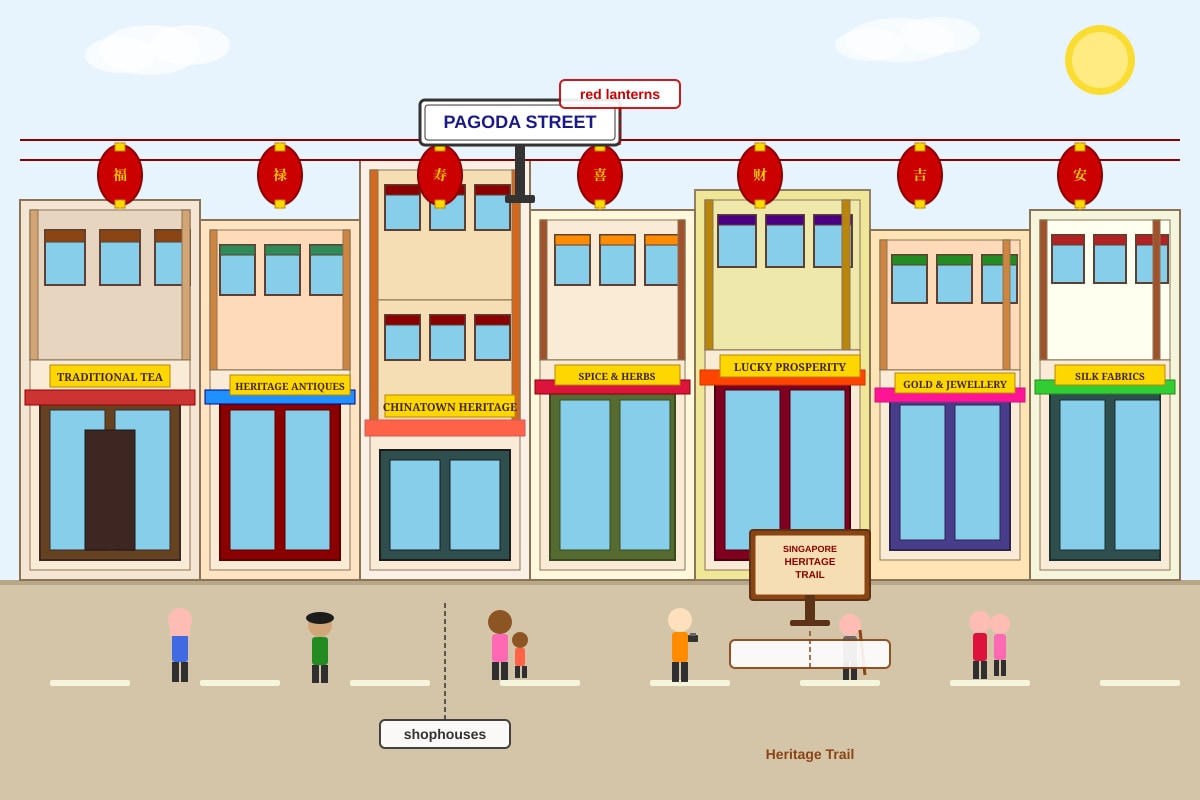
Expected visual features from Q12-fig1: The image shows Singapore's Chinatown with Pagoda Street sign, traditional shophouses, red lanterns overhead, and a heritage trail marker. The bustling street atmosphere provides context for the class visit described.
| Error Number | Wrong Word/Phrase | Correct Word/Phrase | Explanation |
|---|---|---|---|
| 1 | visit | visited | "Last month" = finished past time, so simple past tense. |
| 2 | learns | learned/learnt | Past tense needed for completed action. |
| 3 | walks | walked | Past tense to match sequence of events. |
| 4 | see | saw | Past tense needed; "see" is base form. |
| 5 | explain | explained | Past tense; also consider "explained to them" (preposition needed). |
Note: "explain them" → "explained to them" is also acceptable as the grammar correction for Error 5 if identified as preposition error. Accept "explained" alone for 0.5 mark.
Marking: 0.5 mark for each correctly identified and corrected error.
Question 13 (2.5 marks: 0.5 mark per correct answer)
Answers:
(1) builds
(2) is
(3) has
(4) borrowed
(5) helped
Explanations:
(1) builds: "National Library Board" is treated as a single organisation (singular), so we add "-s" for simple present tense. We use simple present for facts that are generally true.
(2) is: "My favourite library" is singular, so we use "is." "Are/were" would be for plural subjects. We use present tense because this is the speaker's current favourite.
(3) has: "It" refers to the library (singular), so we use "has." "Have" is for plural subjects (I/you/we/they) or used with "does/did." "Had" would change the meaning to past tense, which doesn't fit.
(4) borrowed: "Last Saturday" specifies a completed past time, so we need simple past tense. "Borrow" is base form, "borrows" is present for he/she/it, "borrowing" needs a helper verb.
(5) helped: The story continues in past tense (consistent with "borrowed"), so we use simple past "helped." The librarian performed this completed action in the past.
Question 14 (2.5 marks: 0.5 mark per correct answer)
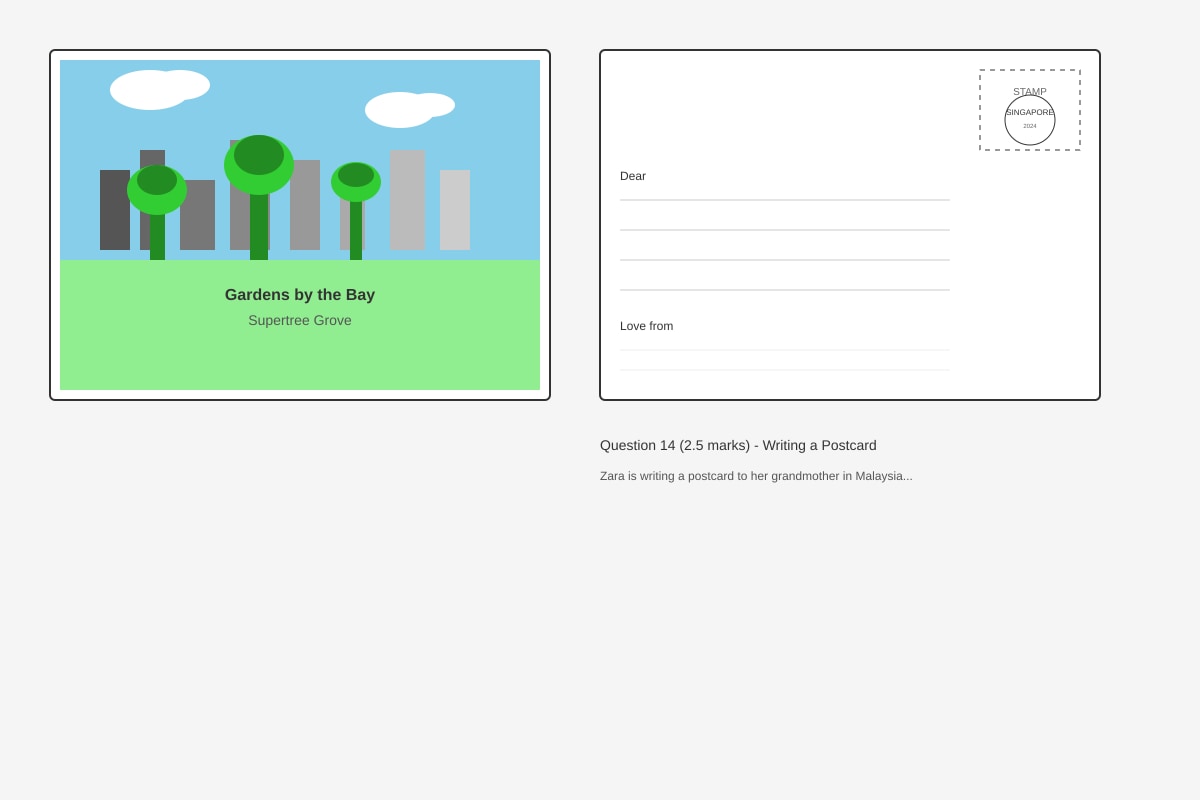
Expected visual features from Q14-fig1: The image shows a postcard with front (Gardens by the Bay Supertree Grove view with Marina Bay skyline) and back (address lines, message space, stamp box with Singapore postmark). This visual reinforces the writing-a-postcard context for Zara's exercise.
Answers:
(1) I
(2) visited
(3) are
(4) took
(5) will
Explanations:
(1) I: We need a subject pronoun to do the action of "having a wonderful time." "I" is the subject pronoun for the speaker. "My" is possessive (shows ownership). "Me" is an object pronoun (used after verbs/prepositions).
(2) visited: "Yesterday" requires simple past tense. We are describing a completed action at a specific past time.
(3) are: "The Supertrees" is plural (more than one), so we need the plural verb "are." "Is/was" are singular. "Were" would work if describing how they looked in the past, but since Zara is still seeing them now (writing the postcard during the trip), present tense "are" is more natural.
(4) took: The action of taking photos is completed (she already has them), so we use simple past. The postcard is written after the photos were taken.
(5) will: "Tonight" refers to a future time from when the postcard is written. "Will" expresses future intention/plan. "Would" is conditional or past future. "Can" expresses ability/permission. "Must" expresses necessity — but watching the light show is a plan, not an obligation.
Section A Total: 20 marks
Section B: Comprehension (20 marks)
Question 15 (2 marks)
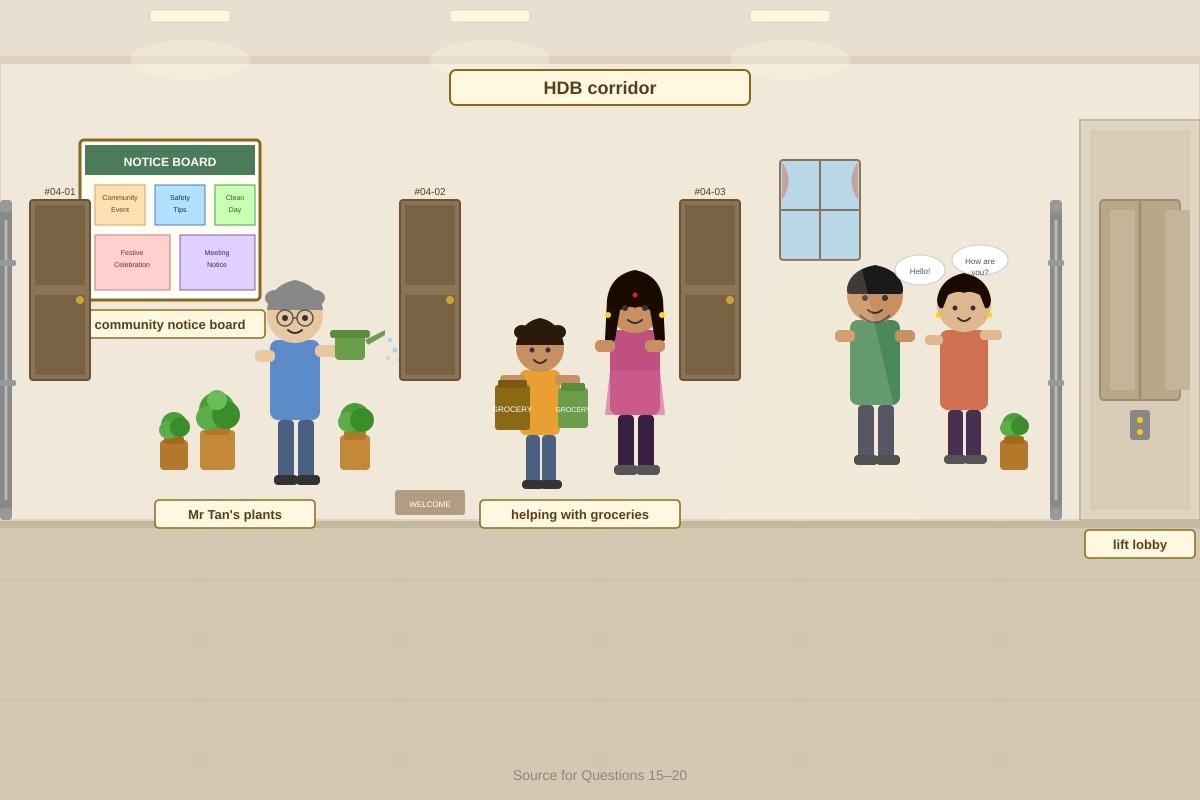
Expected visual features from Q15-fig1: The image shows a typical Singapore HDB block corridor with Mr Tan's potted plants along the railing, him watering plants while greeting neighbours, the community notice board, and people interacting near the lift lobby. This visual establishes the corridor setting described in the passage.
Answer: Mr Tan puts his plant pots along the corridor because he loves to grow plants / because he enjoys gardening. However, he makes sure they do not block the way for people walking by.
Mark breakdown: 1 mark for identifying his love of plants/gardening; 1 mark for noting he keeps the corridor clear/safe for others.
Evidence from text: "Mr Tan...loves to grow plants. He puts his pots along the corridor, but he always makes sure they do not block the way."
Explanation: This question tests literal comprehension with a slight inference. Students must notice the contrast in the sentence — Mr Tan has plants (his interest) BUT ensures safety for others (his consideration).
Question 16 (2 marks)
Answer: Struggled
Explanation: The word "struggled" means to try very hard with difficulty. In context, "she struggled to walk" tells us Mrs Lee found walking difficult because her bags were heavy. Students should quote the exact word from paragraph 2.
Marking: 2 marks for correct word. Accept "struggled" only — do not accept synonyms as this asks for the word from the passage.
Question 17 (2 marks)
Answer: Any two of the following (indicate in own words):
- Bring food to neighbours who are sick / look after unwell neighbours
- Watch over neighbours' homes when they go on holiday / help guard their house
- Help carry heavy things / assist with difficult tasks (like Jamal helping Mrs Lee)
- Share food during festivals / celebrate together
- Exchange recipes / share cooking knowledge
- Chat together and share news / socialise regularly
- Look out for each other's safety and wellbeing
Marking: 1 mark for each valid point in own words. Must be clearly different from each other. Do not accept direct copying from text without some rephrasing.
Question 18 (2 marks)
Answer: The writer says neighbours become like family because they care for one another deeply / they share important moments together / they help each other in times of need / they celebrate and share things together.
Key points to award marks:
- 1 mark for identifying shared activities (festivals, celebrations, food sharing, daily interactions)
- 1 mark for identifying emotional care/support (helping when sick, watching homes, looking out for each other)
Explanation: "Like family" suggests emotional bonds, not just living nearby. The writer gives examples of mutual care (sickness, holidays), shared joy (festivals), and regular togetherness — all characteristics of family relationships.
Question 19 (6 marks)
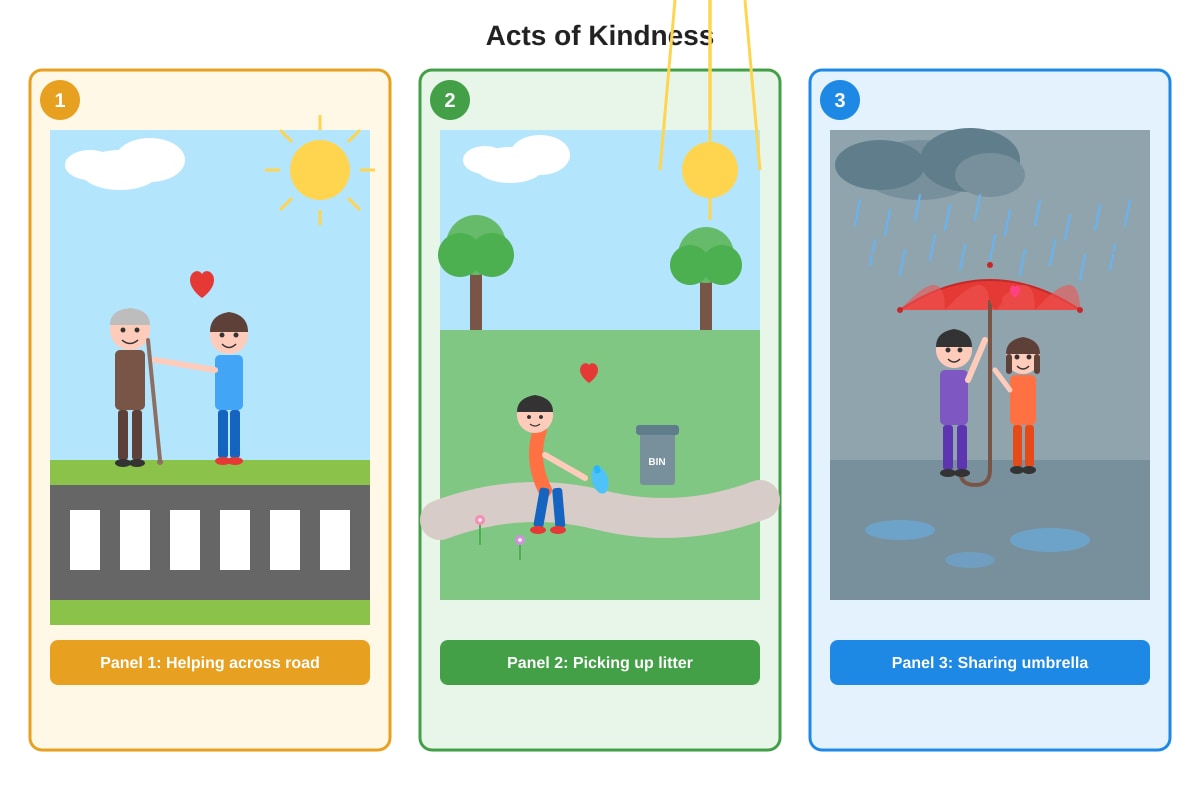
Expected visual features from Q19-fig1: The image shows three comic panels: Panel 1 shows helping an elderly person cross the road; Panel 2 shows picking up litter in a park; Panel 3 shows sharing an umbrella in the rain. The visual prompts students to think of their own small kindness examples.
Marking descriptors:
| Mark | Descriptor |
|---|---|
| 5–6 | Clear, specific personal or observed example with concrete details (who, what, where, when); explicit explanation of how it made a positive difference; at least 50 words; good grammar and coherence. |
| 3–4 | Relevant example provided with some details; explanation of difference present but may lack depth or specificity; near 50 words; generally clear writing. |
| 1–2 | Vague or generic example; little explanation of impact; may be under length or have significant coherence issues. |
| 0 | No answer, completely irrelevant, or unable to assess. |
Sample response (not for direct marking, as guide only):
"Last month, I saw an elderly auntie struggling with her heavy trolley bag at the MRT station. I asked if I could help, and I carried her bag up the flight of stairs. She was very thankful and said I reminded her of her grandson. Her smile made me feel proud. Even though it was a small thing, I learned that helping others can brighten their whole day."
Key elements this demonstrates: Specific situation (MRT station, elderly auntie, heavy bag); concrete action (offered help, carried upstairs); clear difference made (her thanks, her smile, brightened her day); meets length requirement.
Question 20 (6 marks)
Marking descriptors:
| Mark | Descriptor |
|---|---|
| 5–6 | Clear personal opinion with at least two well-developed reasons; reasons are logically connected to the opinion; specific examples or elaboration for each reason; at least 50 words; coherent and well-expressed. |
| 3–4 | Clear opinion with one or two reasons; some elaboration but may lack depth or specific examples; near 50 words; generally clear. |
| 1–2 | Opinion stated but reasons weak, underdeveloped, or generic; may be under length or have significant coherence issues. |
| 0 | No answer, completely irrelevant, or unable to assess. |
Sample response (guide only):
"I think the best thing about living close to neighbours is having people who can help you in emergencies. Once, my grandmother fell at home and our neighbour heard her calling. She rushed over and called for an ambulance. We were very grateful. Also, neighbours make life less lonely for elderly people who live alone. My neighbour's grandfather often eats dinner with us because his children work overseas. This way, he does not feel sad eating by himself."
Key elements: Clear opinion stated; Reason 1 with specific example (emergency help, grandmother, ambulance); Reason 2 with specific example (elderly loneliness, neighbour's grandfather, dinner together); both reasons directly support "best thing."
Section B Total: 20 marks
Section C: Editing and Transformation (10 marks)
Question 21 (5 marks: 1 mark per error identified and corrected)
Passage with corrections shown:
Our school canteen <u>sell</u> → sells many types of food. The noodles stall <u>are</u> → is the most popular because their chicken noodles <u>is</u> → are delicious. Every day, long queues form outside this stall. The auntie who <u>run</u> → runs the stall always <u>remember</u> → remembers my order. Last week, she <u>give</u> → gave me an extra egg because I was her hundredth customer that day. I <u>eat</u> → eat there whenever I can!
| Error | Original | Correction | Grammar Point |
|---|---|---|---|
| 1 | sell | sells | Subject-verb agreement: singular subject "canteen" |
| 2 | are | is | Subject-verb agreement: singular "stall" |
| 3 | is | are | Subject-verb agreement: plural "noodles" (the dish) treated as plural here |
| 4 | run | runs | Subject-verb agreement: singular "auntie" |
| 5 | remember | remembers | Subject-verb agreement: singular "auntie" (who runs) |
| 6 | give | gave | Tense: "Last week" requires past tense |
| 7 | eat | ate | Alternative error if "eat" is changed, but "eat" is actually correct for "whenever I can" (habit). The sixth and seventh errors are progressive: students should find 5 of these 6 clear errors. The clearest five are sell/sells, are/is, run/runs, remember/remembers, give/gave. |
Clarification on marking: Any five correctly identified and corrected errors from the passage. The errors in subject-verb agreement are most prominent. Accept "noodles is/are" as either correction depending on student's justification (Singapore English treats "noodles" as plural; standard English also prefers "are" for noodles). "Eat" does not need correction as "whenever I can" takes present tense for habitual action.
Question 22 (5 marks: 1 mark per correct transformation)
(a) The children play happily in the playground.
Explanation: Simple present tense "play" replaces "played." Remove "-ed" ending. "Children" is plural, so base form "play" without "-s."
(b) No one in our estate bakes better cookies than my mother. / No one bakes better cookies in our estate than my mother.
Explanation: "No one...than" structure creates a superlative comparison equivalent to "the best." Must preserve meaning that mother's cookies are superior to all others. Must include "than" for comparative structure to work.
(c) Mei Ling asked Tom to help her carry those books / Mei Ling asked Tom to help her carry those books.
Explanation: Reported speech changes: quotation marks removed; "said...please help me" → "asked...to help her"; first person "me" → third person "her"; "these" → "those" (distancing in reported speech); imperative/request structure becomes infinitive "to help."
(d) The bus was so crowded that we could not find a seat.
Explanation: "So...that" structure shows cause and effect. "So" + adjective ("crowded") + "that" + result clause. Must maintain original meaning: extreme crowding caused inability to find seats.
(e) This is my brother's kite.
Explanation: "Belongs to X" → "is X's [possessive]" or "This kite is my brother's." Must use possessive apostrophe + "s" for singular brother. "This is" requires rephrasing the sentence structure.
Section C Total: 10 marks
GRAND TOTAL: 50 marks
Time estimate verification for 50-minute paper:
- Section A: 20 questions × ~1.5 min average = 30 minutes
- Section B: Reading passage (~2 min) + 6 questions × (~2.5 min) = 17 minutes
- Section C: 2 questions × (~3 min) = 6 minutes
- Buffer for review: ~5-7 minutes
- Total: approximately 50 minutes ✓
Section mark verification: 20 + 20 + 10 = 50 marks ✓
Question count verification: 22 numbered items (Q1-Q22), with subparts in Q22; all top-level questions accounted for ✓
Stage 5 provenance note: This content is LLM-generated from syllabus-aligned templates, not derived from specific past-year papers. Question patterns reflect common P3 grammar competencies: subject-verb agreement, tense consistency, article and preposition use, error identification and correction, and sentence transformation. Local Singapore contexts (Tekka Market, Chinatown, HDB life, Gardens by the Bay) provide culturally appropriate practice aligned with the interpreted MOE Primary English Syllabus 2020.