AI Generated Exam Paper
Primary 3 English Practice Paper 3
Free P3 English Practice Paper 3, Kimi2.6 AI version, with questions, answers, and syllabus-aligned practice for Singapore students.
These static practice materials are generated from the site's syllabus and paper-generation workflow, with source and model context shown so students and parents can evaluate the material before use.
Questions
Free quiz and exam paper access
Enter your details to view this paper
Your access is remembered on this device.
Answers
TuitionGoWhere Practice Paper (AI) - Answer Key
Version 3 of 5
Subject: English | Level: Primary 3 | Paper: Practice Paper
Total Marks: 50
SECTION A: GRAMMAR & LANGUAGE USE [25 marks]
Part 1: Choose the Correct Word [10 marks]
1. (4) were
Teaching Note: "Yesterday afternoon" signals past tense. "Children" is plural, so we need the plural past tense verb "were," not the singular "was."
- "Is/are" = present tense (incorrect for yesterday)
- "Was" = singular past (incorrect for plural subject)
2. (2) cooks
Teaching Note: "Every Sunday" shows a habitual action in the present. For third person singular subjects (he, she, it, singular nouns like "my mother"), add "-s" or "-es" to the base verb.
- "Cook" = missing third person singular marker
- "Cooked" = past tense (incorrect for habitual present)
- "Cooking" = incomplete without auxiliary verb
3. (1) want
Teaching Note: With "neither...nor," the verb agrees with the nearer subject. Here "friends" (plural) is nearer than "Tom," so we use the plural verb "want." This is the proximity rule for correlative conjunctions.
4. (2) moves
Teaching Note: Collective nouns like "herd," "flock," or "team" take singular verbs when the group acts as one unit. The elephants move together as a single group, so "moves" is correct.
5. (4) is flying
Teaching Note: "Look!" signals an action happening right now. This requires the present continuous tense: am/is/are + verb-ing. "Kite" is singular, so "is flying."
6. (2) on
Teaching Note: "On" is used for surfaces. Books rest on the surface of a shelf. "In" would mean inside something enclosed; "under" is opposite in meaning; "at" is for specific points.
7. (2) for
Teaching Note: We wait for someone/something. This is a fixed preposition pattern. "Wait to" needs a verb after it (e.g., "wait to eat"); "wait at" needs a location (e.g., "wait at the station").
8. (3) above
Teaching Note: "Above" means higher than without touching. The plane flew higher than the clouds without going through them. "Through" would mean piercing; "across" is for surfaces; "between" needs two distinct things.
9. (2) from
Teaching Note: We borrow something from a source. This shows movement of the object toward the borrower. "Borrow to" would indicate direction opposite to the actual meaning.
10. (3) between
Teaching Note: "Between" is used with exactly two specific times (2 p.m. and 4 p.m.). "During" needs a duration without specified endpoints; "at/on" don't fit with two time points.
Part 2: Articles & Quantifiers [5 marks]
11. (2) an
Teaching Note: "Honest" begins with a vowel sound (silent 'h', pronounced /ˈɒnɪst/). We use "an" before words starting with vowel sounds, regardless of the written letter. Compare: "a honest man" is incorrect because the sound matters, not the spelling.
12. (3) the
Teaching Note: Use "the" for specific, unique items known to both speaker and listener. There's only one salt container being requested in this specific context. "A/an" would suggest any salt, not the specific container needed.
13. (3) All
Teaching Note: The context implies complete success—every single student remembered. "Many" and "some" don't convey certainty; "each" requires singular verb ("each student remembers").
14. (2) much
Teaching Note: "Water" is uncountable. Use "much" for uncountable nouns in negative sentences. "Many" and "a few" are for countable nouns; "some" is typically positive.
15. (3) Every
Teaching Note: "Every" + singular noun + singular verb expresses a rule applying to all members individually. "Every student must attend" creates a mandatory requirement. "Most/several/some" don't create the same universal obligation.
Part 3: Error Correction & Transformation [10 marks]
16. Five grammar errors identified and corrected: [5 marks: 1 mark each]
| Error | Correction | Grammar Rule Applied |
|---|---|---|
| goes | went | Past tense needed for "last Saturday" |
| seen | saw | "Seen" needs "have/has/had"; simple past is "saw" |
| was | were | Plural subject "elephants" needs plural verb |
| are | were | Past tense needed (consistent with narrative time) |
| want | wanted | Past tense needed; also "is" should be "was" |
Acceptable alternative for error 5: "is" → "was" (also past tense error)
Marking Note: Accept either "want/wanted" or "is/was" as the fifth error, but students must identify five distinct errors. Full mark for each correct error-correction pair.
17. Verb transformations: [5 marks: ½ mark each, rounded up to whole number for final scoring if needed]
| Answer | Tense/Pattern | |
|---|---|---|
| (1) | wakes | Simple present, habitual action, 3rd person singular |
| (2) | brushes | Simple present, habitual, '-es' after 'sh' |
| (3) | packs | Simple present, habitual, 3rd person singular |
| (4) | woke | Simple past (irregular verb: wake-woke-woken) |
| (5) | did not ring / didn't ring | Negative simple past with base verb after auxiliary |
| (6) | rushed | Simple past, narrative sequence |
| (7) | missed | Simple past, narrative sequence |
| (8) | drove | Simple past (irregular: drive-drove-driven) |
| (9) | promised | Simple past, narrative conclusion |
| (10) | goes | Simple present, habitual, future intention in present |
Marking Note: Deduct ½ mark for each error; accept minor spelling variations if tense is correct. Maximum 5 marks (whole number).
SECTION B: COMPREHENSION [15 marks]
18.(a) A lion and a fish. [1]
Marking: Accept "a lion's head and a fish's body/body and tail." Must name both animals. 0 marks if only one animal given.
18.(b) Workers were repairing the water pump. / There was a sign saying that the water pump was being repaired. [2]
Marking: 2 marks for mention of repair work and water pump; 1 mark for partial answer mentioning repair without specifying what; 0 marks for vague "it was broken."
18.(c) He learned that even when things don't go as expected, there is still something good to notice/see. / He learned to look for the positive in disappointing situations. [2]
Marking: 2 marks for inferential understanding connecting disappointment to unexpected benefit; 1 mark for literal restatement without the life lesson; 0 marks for merely saying he was disappointed.
19. "Fascinated" means very interested or strongly attracted to something. In the passage, Ravi is captivated by the Merlion and wants to know more about it, shown by his question to his grandmother. [2]
Marking: 1 mark for correct definition (very interested/strongly attracted/thoroughly intrigued); 1 mark for contextual evidence from passage (his question/curiosity about the Merlion). Award full marks only if both definition and contextual application are present.
20. Two acceptable reasons: [2]
Possible answers:
- Writing helps preserve details that memory might forget later
- Rereading the writing brings back the feelings and images of the experience
- Drawing pictures alongside writing creates visual memories
- Writing helps organize thoughts and feelings about what happened
- A journal creates a personal record to share with others or reflect on later
Marking: 1 mark for each valid reason expressed in student's own words. Must be distinct reasons, not restatements of the same idea. Accept reasons showing understanding of memory, reflection, or record-keeping functions.
SECTION C: WRITING [10 marks]
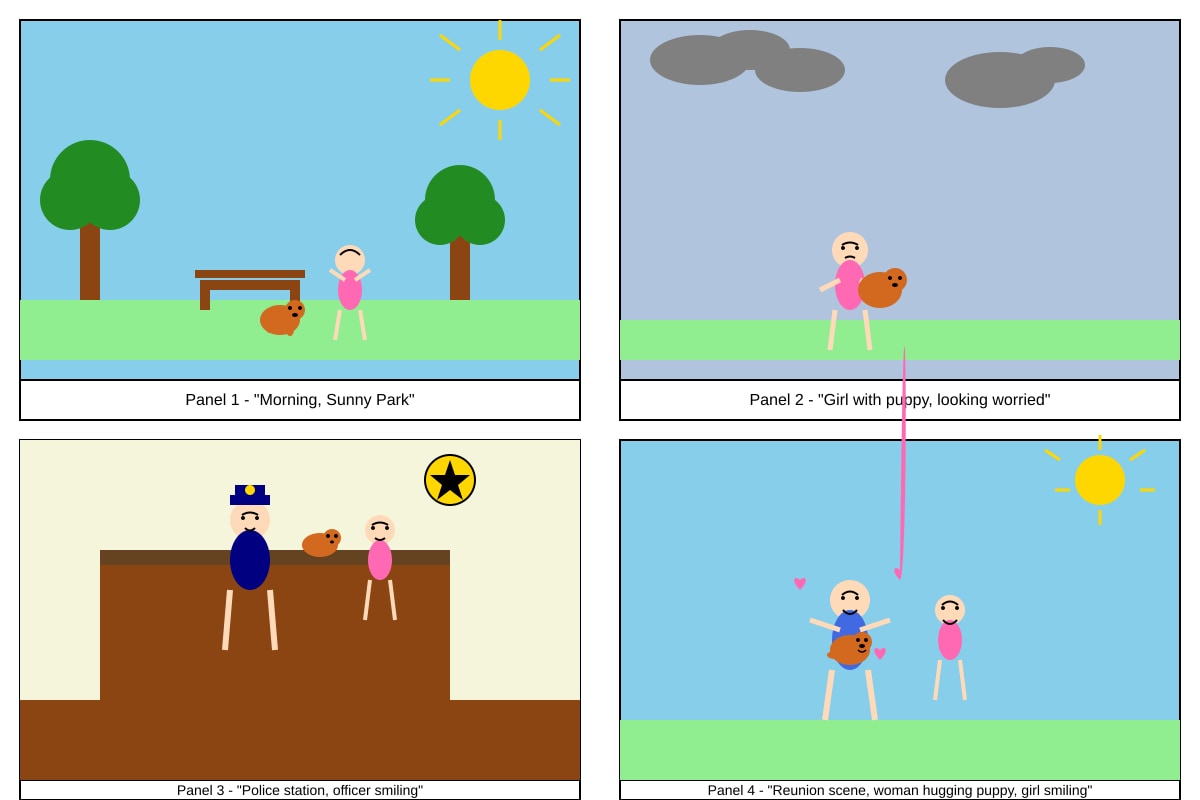
21. Marking Descriptors for Picture Sequence Story:
| Mark Band | Description | Features |
|---|---|---|
| 9-10 | Excellent | Complete story with clear beginning, middle, end; all 4 pictures referenced; correct grammar throughout; accurate spelling; varied sentence structures; at least 60 words; effective use of helping words |
| 7-8 | Good | Mostly complete story with 3-4 pictures; minor grammar errors; adequate vocabulary; clear sequencing; near 60 words; some helping words used |
| 5-6 | Satisfactory | Basic story with 2-3 pictures; several grammar errors; simple sentences; below 60 words but coherent; limited helping words |
| 3-4 | Developing | Fragmented story; major grammar errors; fewer than 40 words; unclear sequence; 1-2 pictures only |
| 1-2 | Limited | Incomplete or incoherent; very few words; minimal relevance to pictures |
| 0 | No response / Irrelevant | No story or completely off-topic |
Content Points Expected (based on image sequence):
- Panel 1: Girl (name if invented) in park, sunny day, discovers puppy
- Panel 2: Puppy looks lost/abandoned, girl feels worried, decision to help
- Panel 3: Taking puppy to police station, officer assists
- Panel 4: Owner found, grateful reunion, girl feels happy/relieved
Mandatory Elements to Check:
- At least 60 words (count and note actual word count)
- All four scenes incorporated
- Past tense narrative consistency
- Paragraphing present or logical flow
- At least one helping word used appropriately
Common Errors to Flag:
- Tense inconsistency (mixing present and past)
- Missing articles ("a puppy" not "puppy")
- Incorrect prepositions ("at the park" not "in park")
- Run-on sentences or sentence fragments
TOTAL MARKS: 50
Section A: 25 | Section B: 15 | Section C: 10