AI Generated Exam Paper
Primary 3 English Practice Paper 1
Free P3 English Practice Paper 1, Kimi2.6 AI version, with questions, answers, and syllabus-aligned practice for Singapore students.
These static practice materials are generated from the site's syllabus and paper-generation workflow, with source and model context shown so students and parents can evaluate the material before use.
Questions
Free quiz and exam paper access
Enter your details to view this paper
Your access is remembered on this device.
Answers
TuitionGoWhere Practice Paper - English Primary 3 (Version 1)
Answer Key and Marking Scheme
Total Marks: 50
Section A: Grammar MCQ (Questions 1–10)
20 marks (2 marks each)
1. Answer: (1) is
Explanation: "Class" is a collective noun treated as singular in formal Singapore English. Even though it refers to many pupils, the noun itself is singular, so it takes the singular verb "is."
- Common mistake: Choosing "are" because pupils are plural.
- Teaching point: Collective nouns (team, class, family, group) usually take singular verbs when considered as one unit.
2. Answer: (2) She went to the library yesterday.
Explanation: "Went" is the simple past tense of "go." The irregular verb changes from go → went → gone.
- "Goed" (1) is a common over-regularization error.
- "Going" (3) needs "was" for past continuous.
- "Gone" (4) needs "has" for present perfect.
3. Answer: (2) an
Explanation: Use "an" before words beginning with a vowel sound. "Astronaut" starts with the vowel sound /æ/.
- Teaching point: A/An choice depends on sound, not letter—"a university" (y-sound) but "an hour" (silent h).
4. Answer: (3) under
Explanation: "Under" is a preposition showing position/place relationship between "cat" and "table." "During" is also a preposition (time), but only "under" is listed.
5. Answer: (3) They
Explanation: "Amir and his sister" = plural (two people), so use plural pronoun "They."
- "He" = one male; "She" = one female; "We" = includes the speaker.
6. Answer: (2) The dogs bark loudly every morning.
Explanation: Plural subject "dogs" needs plural verb "bark" (no -s).
- (1) "barks" = singular verb with plural subject (error)
- (3) "barking" = missing auxiliary verb
- (4) "dog" = singular subject with plural verb (error)
7. Answer: (3) will have lived
Explanation: "By next month" = future perfect tense marker (completed action before a future time). Structure: will + have + past participle.
- "By" + time point → future perfect
8. Answer: (2) This durian is sweeter than that one.
Explanation: One-syllable adjectives form comparatives with "-er" (sweet → sweeter), not "more."
- "More sweeter" = double comparative (wrong)
- "Most sweeter" = incorrect combination
- "Sweet than" = missing comparative form
9. Answer: (3) must
Explanation: "Must" expresses strong obligation/necessity—homework before TV is a rule.
- "Can" = ability; "may" = permission; "might" = possibility (too weak for this context)
10. Answer: (4) "What time is it?" asked Mother.
Explanation: Questions end with question mark inside quotation marks. "Mother" is capitalized as a name substitute here (direct address).
- (1) Missing question mark and comma
- (2) Question mark outside, "mother" not capitalized
- (3) Comma instead of question mark
Section B: Grammar in Context (Questions 11–15)
15 marks
11. (a) Incorrect: are → Correct: is (1 mark)
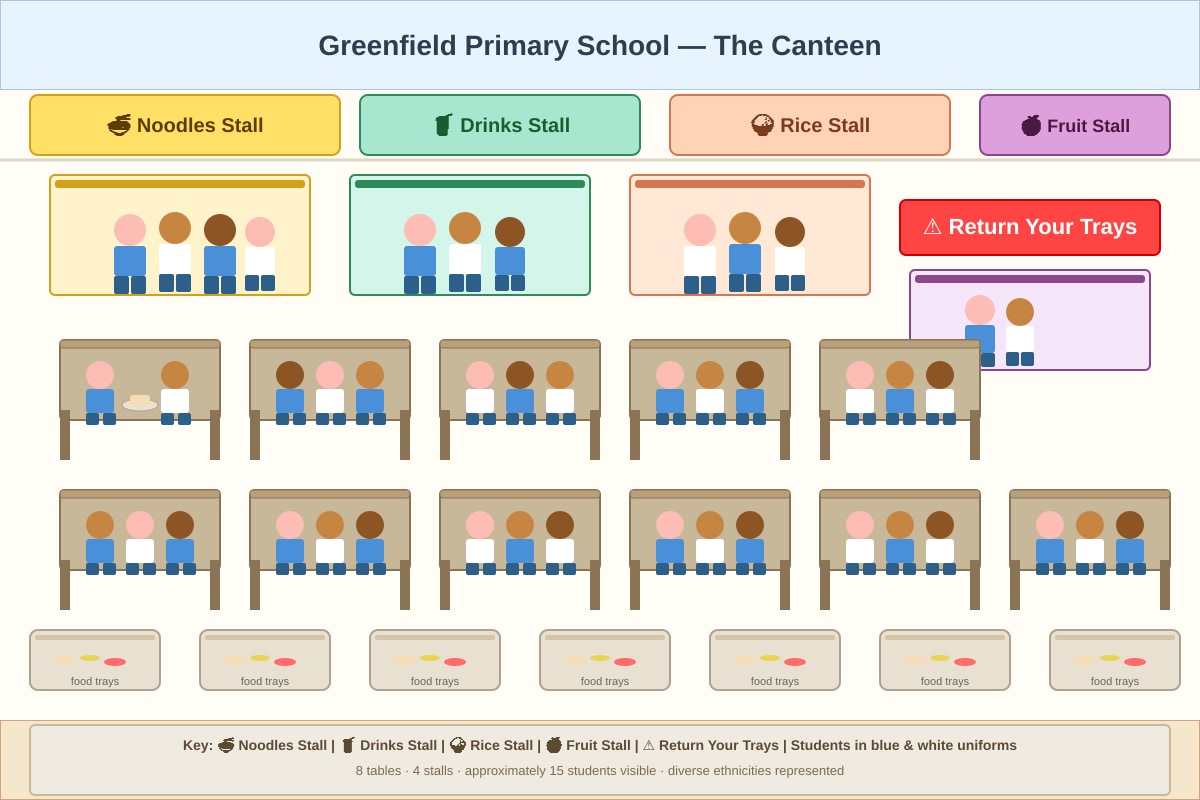
(b) During recess, the canteen at Greenfield Primary School is always crowded with hungry students. (1 mark)
Marking notes: Both parts needed for full marks. Must show "is" as correction and complete sentence.
12. (a) "Queues" is wrong because the subject "children" is plural, so the verb must be plural "queue" (without -s). The singular form "queues" would only work with "child" or "he/she." (2 marks)
(b) queue (1 mark)
Teaching note: Present simple tense—singular subjects add -s (he/she/it queues), but plural subjects use base form (they/we/children queue).
13. Error 1: These → This or is → are (1 mark) Error 2: noodles is → noodles are (or These → This to match "is") (1 mark)
Correct sentence: "These noodles are delicious!" OR "This noodle is delicious!" (1 mark)
Teaching note: "Noodles" is plural, so needs plural verb "are." Alternatively, singular "noodle" with singular "is." Both corrections accepted if internally consistent.
14. (a) "Did" is correct because Raju is asking about a past observation (he noticed the sign earlier, before speaking). The present perfect "Have you seen" would also work, but simple past "Did you see" is acceptable for a completed past action. (2 marks)
(b) It says 'Return Your Trays' (1 mark)
Teaching note: Third person singular in present simple adds -s: I say, you say, he/she/it says.
15. Correction: helps → help (1 mark)
Explanation: "Should" is a modal verb. Modal verbs (can, could, must, should, will, would, may, might) are always followed by the base form of the verb, without "to" and without -s. Even with plural subjects, modals use base form: "we should help," "she should help." (2 marks)
Common mistake: Adding -s after modals is a frequent P3 error.
Section C: Grammar Transformation and Application (Questions 16–20)
15 marks
16. Tommy walked to school with his neighbours every morning. (2 marks)
Marking breakdown:
- Correct past tense verb "walked": 1 mark
- Rest of sentence unchanged: 1 mark
Teaching note: Regular verbs add -ed for past tense. "Every morning" stays as a habitual time marker; past tense here describes a former habit.
17. Although/Though the weather was hot, the children still played outside. OR: The weather was hot, but the children still played outside. OR: Despite the hot weather, the children still played outside. (3 marks)
Marking breakdown:
- Appropriate conjunction showing contrast: 1 mark
- Correct punctuation (comma placement): 1 mark
- Sentence makes sense grammatically: 1 mark
Teaching note: "Although/though" and "but" show concession/contrast. "Despite" requires noun phrase (the hot weather). Do not accept "Because" or "So"—wrong logical relationship.
18. The kitten was rescued from the tall tree by the firefighter. (3 marks)
Marking breakdown:
- Object becomes subject: "The kitten" + was/were: 1 mark
- Correct past participle: "rescued": 1 mark
- "By" + agent retained correctly: 1 mark
Alternative: The kitten was rescued by the firefighter from the tall tree. (Preposition placement flexible)
Teaching note: Passive voice structure: object + was/were + past participle + by + subject. Past tense passive for this context.
19. Corrected paragraph with four corrections: (4 marks)
"Last Saturday, my family and I went to the Singapore Zoo. We saw many animals, including elephants and giraffes. My brother was very excited when the tiger roared loudly. It was a wonderful day."
Markings: 1 mark per error corrected (max 4):
- "me" → "I" (subject pronoun needed)
- "go" → "went" (simple past tense)
- "seen" → "saw" (simple past, not past participle; or "had seen" for past perfect)
- "elephant" → "elephants" (parallel with "giraffes")
- "exciting" → "excited" (-ed adjective for feelings, -ing for things that cause feelings)
- "roars" → "roared" (tense consistency in past narrative)
- "were" → "was" (singular "It")
Full marks for any four correct corrections with coherent paragraph. Accept reasonable alternatives that maintain past tense narrative.
20. (3 marks) — 1 mark per sentence, all three required elements must be present
Required elements:
- (a) Singular subject with correct verb agreement: e.g., "My mother cooks the best chicken rice." (1 mark)
- (b) Preposition of place: e.g., "She buys the ingredients at the wet market in Tampines." (1 mark)
- (c) Past tense: e.g., "Last week, we ate chicken rice at a food court." (1 mark)
Sample full-credit answer:
- My grandmother makes delicious laksa. (singular + verb agreement)
- She buys the prawns at the market near her flat. (preposition of place)
- Yesterday, I finished two big bowls at her house. (past tense)
Teaching note: Check all three grammar features are demonstrated. Context (favourite food) should be clear. Creative responses accepted if grammatically correct.
Section Mark Verification
| Section | Marks |
|---|---|
| A (Q1–10) | 20 |
| B (Q11–15) | 15 |
| C (Q16–20) | 15 |
| Total | 50 |
End of Answer Key