From Real Exams Exam Paper
Primary 3 English Semestral Assessment 2 (End of Year) Paper 4
Free P3 English SA2 Paper 4, Kimi2.6 Exam version, with questions, answers, and syllabus-aligned practice for Singapore students.
These static practice materials are generated from the site's syllabus and paper-generation workflow, with source and model context shown so students and parents can evaluate the material before use.
Questions
Free quiz and exam paper access
Enter your details to view this paper
Your access is remembered on this device.
Answers
TuitionGoWhere Exam Practice (AI) - SA2 English Primary 3
Answer Key and Marking Scheme
Version 4 of 5
Section A: Grammar MCQ (10 marks)
Question 1 — 1 mark
Answer: (3) is
Working/Reasoning:
- "Bouquet" is the singular subject (the head noun in the phrase "bouquet of flowers")
- In subject-verb agreement, the noun before "of" determines whether the verb is singular or plural
- "Bouquet" = singular, so we need "is" (singular verb)
- Common mistake: Students look at "flowers" (plural) and choose "are" — always find the head noun before "of"
Question 2 — 1 mark
Answer: (2) know
Working/Reasoning:
- With "neither...nor...", the verb agrees with the noun closest to it (proximity rule)
- "Students" is plural and closest to the verb gap
- Therefore: plural verb "know" needed
- "The students know" = correct subject-verb agreement
Question 3 — 1 mark
Answer: (2) will be taking
Working/Reasoning:
- Time marker "By next month" indicates a future action in progress at a specific future time
- "Will be taking" = future continuous tense, used for actions happening at a specific future moment
- "Will have taken" (future perfect) would mean completed by next month, but examinations happen during the month
- "Will take" (simple future) doesn't emphasize the ongoing nature of the examination period
Question 4 — 1 mark
Answer: (3) were playing
Working/Reasoning:
- Two past actions: (a) children playing, (b) rain starting
- "When it started to rain" = specific moment in the past when one action interrupted another
- "Were playing" = past continuous for the longer background action
- "Started" = simple past for the interrupting action
- Pattern: Past continuous + when + simple past = ongoing action interrupted by sudden action
Question 5 — 1 mark
Answer: (2) has
Working/Reasoning:
- "Each of the dogs" = singular subject (each = every single one individually)
- "Each," "every," "either," "neither" are always singular and take singular verbs
- Therefore: "Each...has" (singular verb)
- Common mistake: Students see "dogs" (plural) and choose "have"
Question 6 — 1 mark
Answer: (3) were
Working/Reasoning:
- This is a Type 2 conditional (unreal present/future situation)
- Structure: If + past simple, would + base verb
- For the verb "to be," we always use "were" for all subjects in formal/subjunctive conditionals
- "If I were" = standard correct form (even though "I" normally takes "was")
- Teaching note: "If I was" is common in speech but "were" is required in formal writing and grammar tests
Question 7 — 1 mark
Answer: (2) was written
Working/Reasoning:
- Time marker "yesterday" = simple past tense required
- Passive voice needed (the letter doesn't write itself)
- Simple past passive = was/were + past participle
- "The letter" = singular, so "was written"
- "Has been written" (present perfect passive) is wrong because "yesterday" is finished past time
Question 8 — 1 mark
Answer: (2) want
Working/Reasoning:
- "Not only...but also..." follows the same proximity rule as "neither...nor..."
- The verb agrees with the noun closest to it: "his brothers" (plural)
- Therefore: plural verb "want"
- "Brothers want" = correct subject-verb agreement
Question 9 — 1 mark
Answer: (1) goes; walked
Working/Reasoning:
- First blank: "usually" = habitual action = simple present tense
- "She" = third person singular, so "goes" with -es ending
- Second blank: "today" with contrast word "but" = specific completed action in past = simple past
- "Walked" = simple past of "walk"
- This sentence shows tense contrast: habitual (simple present) vs. specific past (simple past)
Question 10 — 1 mark
Answer: (3) had been eaten
Working/Reasoning:
- Two past actions: (a) cake being eaten, (b) arriving at party
- "By the time we arrived" = the cake eating was completed BEFORE the arrival
- Past perfect passive = had been + past participle, for the earlier of two past actions
- "Had been eaten" shows the cake was completely consumed before they got there
Section B: Grammar Cloze (10 marks)
Question 11 — 2 marks
Answer: went
Marking: 2 marks for correct past tense form; 1 mark if "go" or "gone" written
Working/Reasoning:
- Time marker "Last Saturday" = specific completed time in the past
- Simple past tense required
- "Go" → "went" (irregular verb — must be memorized)
- No -ed ending because this is an irregular verb
Question 12 — 2 marks
Answer: arrived
Marking: 2 marks for correct simple past; 1 mark if "arrive" or "arriving"
Working/Reasoning:
- Continues the same time frame (Last Saturday morning)
- Simple past for completed past action
- "Arrive" → regular verb → add -ed → "arrived"
- Double 'r' because of the 'r' at the end of the base form? No — "arrive" ends in 'e', so just add 'd', but standard spelling is "arrived" (the 'i' is dropped in pronunciation, not spelling)
Question 13 — 2 marks
Answer: was shining / shone
Marking: 2 marks for either correct form; 1 mark if "shine" or "shining" alone
Working/Reasoning:
- Describing the background situation at a specific past moment (9 o'clock arrival time)
- Past continuous "was shining" = weather condition in progress when they arrived
- "Shone" (simple past) also acceptable as a completed description
- Teaching note: Past continuous emphasizes the ongoing nature; simple past states the fact
Question 14 — 2 marks
Answer: were queuing / queued
Marking: 2 marks for correct form; 1 mark if "queue" or "queueing" misspelled
Working/Reasoning:
- "Many visitors" = plural subject
- Past continuous "were queuing" = action in progress when they arrived
- OR simple past "queued" = completed action
- Spelling note: "queue" → add -ing → "queuing" (British spelling preferred in Singapore) or "queueing"
- Teaching tip: The unusual spelling of "queue" (Q-U-E-U-E) often causes errors
Question 15 — 2 marks
Answer: were walking / walked
Marking: 2 marks for correct form; 1 mark if "walk" or "walking" alone
Working/Reasoning:
- "While we...around, we saw" = past continuous for longer action + simple past for shorter action
- Past continuous "were walking" = the ongoing background activity during which something happened
- Simple past "walked" also grammatically possible but less precise for the temporal relationship
Section C: Grammar Application (20 marks)
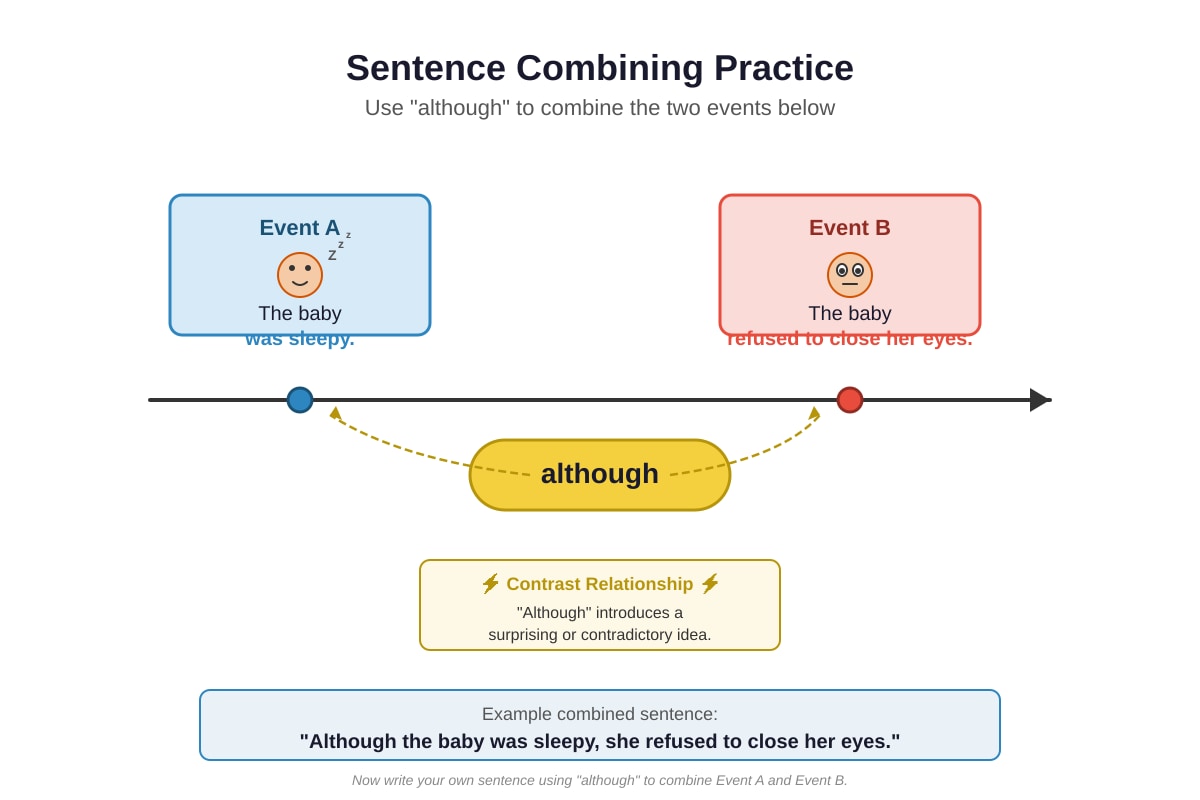
Question 16(a) — 2 marks
Answer: Although the baby was sleepy, she refused to close her eyes.
OR: The baby refused to close her eyes although she was sleepy.
Marking:
- 2 marks: Correct use of "although" + complete meaning preserved + grammatically correct sentence
- 1 mark: "Although" used but minor error (e.g., missing subject, wrong conjunction form)
- 0 marks: Wrong conjunction used or meaning changed
Working/Reasoning:
- "Although" introduces a contrast/concession — it shows that one fact is surprising given another fact
- Structure: Although + clause, + main clause OR Main clause + although + clause
- Common mistake: Using "but" with "although" — never use both together (e.g., "Although...but..." = wrong)
Question 16(b) — 2 marks
Answer: Despite the hot weather, we still went for a run.
OR: We still went for a run despite the hot weather.
Marking:
- 2 marks: "Despite" + noun phrase (not clause) + correct sentence structure
- 1 mark: "Despite" used but followed by clause (e.g., "despite it was hot" — common error) or minor structure issue
- 0 marks: Wrong word class used
Working/Reasoning:
- "Despite" is a preposition → must be followed by a noun phrase, not a clause
- "The hot weather" = noun phrase (article + adjective + noun)
- Critical difference: "Although" + clause/S+V; "Despite" + noun phrase
- Common error: "Despite it was hot" — wrong because "it was hot" is a clause (S+V)
- Correct alternatives: "Despite the heat" / "Despite the hot weather" / "Despite being hot"
Question 17 — 4 marks
Answer: Tom told his mother that he had finished his homework.
Marking:
- 4 marks: Perfect reported speech with all changes correct
- 3 marks: One element wrong (e.g., tense not backshifted, pronoun error)
- 2 marks: Two elements wrong
- 1 mark: Attempted but significant errors
- 0 marks: Direct speech repeated or unrecognizable attempt
Working/Reasoning:
- Step 1 — Remove quotation marks and comma: "I have finished my homework," Tom told his mother → Tom told his mother...
- Step 2 — Backshift tense: Present perfect "have finished" → past perfect "had finished" (one tense back because reporting verb "told" is past)
- Step 3 — Change pronoun: "I" → "he" (Tom is male, reported by narrator)
- Step 4 — Add "that": Optional but preferred in formal reported speech; can be omitted
- Step 5 — Remove comma: No comma needed after "that"
- Summary of changes: I→he; have finished→had finished; add "that"
Question 18(a) — 2 marks
Answer: The group of singers is rehearsing for the concert.
Marking: 2 marks for corrected sentence; 1 mark if "group" identified as singular but sentence not fully corrected
Working/Reasoning:
- Step 1 — Identify the true subject: "Group" (singular collective noun), not "singers"
- Step 2 — Check verb: "are" = plural verb → incorrect
- Step 3 — Correct to singular: "is" (singular verb)
- Rule: In "The [collective noun] of [plural noun]", the collective noun determines singularity/plurality
- "Group," "team," "crowd," "class" = singular when acting as one unit
Question 18(b) — 2 marks
Answer: My mother, together with my aunts, is going to the market.
Marking: 2 marks for corrected sentence; 1 mark if "mother" identified as subject but preposition structure not explained
Working/Reasoning:
- Step 1 — Isolate the main subject: Cross out the parenthetical phrase "together with my aunts"
- Step 2 — Read without parenthetical: "My mother...are going" → clearly wrong
- Step 3 — Correct verb: "is going" to match singular "mother"
- Rule: Phrases with "together with," "as well as," "along with" are parenthetical — they do NOT change the number of the main subject
- Common error: Students add all nouns together: "mother + aunts = plural" — this is wrong for these particular phrases
Question 19 — 4 marks
Answer: The plants are watered by the gardener every morning.
Marking:
- 4 marks: Correct passive with same tense, all elements correct
- 3 marks: One element wrong (tense changed, agent missing, wrong participle)
- 2 marks: Two elements wrong but passive attempted
- 1 mark: Recognizable attempt with significant errors
- 0 marks: Active voice maintained or unrecognizable
Working/Reasoning:
- Step 1 — Identify original tense: "waters" = simple present
- Step 2 — Move object to subject position: "The plants" becomes new subject
- Step 3 — Form passive verb: am/is/are + past participle; "are watered" (plural subject = "are")
- Step 4 — Add agent with "by": "by the gardener" (optional but requested by "using the passive voice" — agent should be kept if specified)
- Step 5 — Keep time expression: "every morning" stays in same position
- Tense preservation check: Simple present active → Simple present passive ✓
Question 20(a) — 2 marks
Answer: The hikers spending three nights on the mountain happened first.
OR: The hikers had already spent three nights on the mountain before the rescue team arrived.
Marking: 2 marks for correct identification with clear reasoning; 1 mark for correct answer without explanation
Working/Reasoning:
- Step 1 — Analyze timeline: Past perfect "had already spent" = earlier past action
- Step 2 — Analyze simple past "arrived" = later past action
- Step 3 — Past perfect usage: Always shows "the past before the past" — an action completed before another past moment
- Conclusion: The hikers' three nights were completed before the arrival
Question 20(b) — 2 marks
Answer: Past perfect tense. It is used to show that one action was completed before another action in the past.
Marking:
- 1 mark: Correctly identify "past perfect tense" / "past perfect"
- 1 mark: Explain the "before another past action" relationship
Working/Reasoning:
- Tense name: Past perfect = had + past participle (had spent)
- Function: Expresses the "earlier past" — when we need to show that one past event preceded another
- Structure signal: "had already" + past participle = completion before a later past point
- Comparison with other tenses:
- Present perfect: past action with present connection
- Simple past: completed past action (no earlier/later comparison)
- Past perfect: earlier of two past actions
- In this sentence: The spending was finished, then the arrival happened
Summary Marking Table
| Section | Question Range | Marks |
|---|---|---|
| A | 1-10 | 10 marks |
| B | 11-15 | 10 marks |
| C | 16-20 | 20 marks |
| Total | 1-20 | 40 marks |
Common Error Alert (For Teachers/Students)
| Error Pattern | Example | Correction |
|---|---|---|
| "Of" phrase confusion | "The group of students are..." | "The group of students is..." |
| "Neither/nor" proximity | "Neither the teachers nor the student are..." | "Neither the teachers nor the student is..." |
| "Despite" + clause | "Despite it was hot..." | "Despite the heat..." (noun phrase) |
| Past perfect overuse | Using "had" for any past action | Only for the earlier of two past actions |
| Reported speech no backshift | "He said he is tired" (when said is past) | "He said he was tired" |