From Real Exams Quiz
Primary 3 Chinese Writing Quiz
Free P3 Chinese Writing quiz, Exam version, with questions, answers, and syllabus-aligned practice for Singapore students.
These static practice materials are generated from the site's syllabus and paper-generation workflow, with source and model context shown so students and parents can evaluate the material before use.
Questions
Free quiz and exam paper access
Enter your details to view this paper
Your access is remembered on this device.
Answers
Primary 3 Chinese Quiz - Writing: Answer Key
Total Marks: 20
Section A: 辨字测验 (Character Recognition) — Questions 1-5
Q1. Answer: B. 园 (1 mark)
Explanation: The sentence says "去公( )散步" (go to the park for a walk). The word "公园" (park) is a common compound word.
- A. 圆 means "round" (circle shape)
- B. 园 means "garden/park" — correct
- C. 员 means "member"
- D. 远 means "far"
Common mistake: Students may confuse 园 (garden) with 圆 (round) because they sound similar (yuán).
Q2. Answer: A. 掉 (1 mark)
Explanation: The sentence says "杯子打( )了" (the cup was knocked and fell). The word "打掉" means "knocked down/dropped".
- A. 掉 means "to fall/drop" — correct
- B. 钓 means "to fish"
- C. 调 means "to adjust"
- D. 跳 means "to jump"
Common mistake: Students may confuse 掉 (diào, to fall) with 钓 (diào, to fish) because they are homophones.
Q3. Answer: A. 耐 (1 mark)
Explanation: The sentence says "做事情要有( )心" (need patience when doing things). The word "耐心" means "patience".
- A. 耐 means "patient/endure" — correct
- B. 奈 is rarely used alone, appears in "奈何" (what to do)
- C. 乃 is a classical word meaning "then/be"
- D. 奶 means "milk"
Common mistake: Students may choose 奶 (nǎi) because it sounds similar to 耐 (nài).
Q4. Answer: A. 非 (1 mark)
Explanation: The sentence says "( )常喜欢阅读" (really likes reading). The word "非常" means "very/really".
- A. 非 means "not/very (in 非常)" — correct
- B. 飞 means "to fly"
- C. 啡 appears in "咖啡" (coffee)
- D. 肥 means "fat"
Common mistake: Students may confuse 非 (fēi) with 飞 (fēi) because they are homophones.
Q5. Answer: A. 认 (1 mark)
Explanation: The sentence says "( )真听讲" (listen attentively). The word "认真" means "serious/careful".
- A. 认 means "to recognize" (in 认真 = serious) — correct
- B. 人 means "person"
- C. 任 means "to appoint/task"
- D. 忍 means "to endure"
Common mistake: Students may choose 任 (rèn) because it sounds similar to 认 (rèn).
Section B: 词语选择 (Vocabulary Selection) — Questions 6-10
Q6. Answer: B. 害羞 (1 mark)
Explanation: The sentence says "妹妹很( ),看到陌生人就会躲在妈妈身后" (younger sister is very ___, she hides behind mummy when she sees strangers).
- A. 勇敢 (brave) — contradicts hiding behaviour
- B. 害羞 (shy) — correct, hiding from strangers shows shyness
- C. 生气 (angry) — no evidence of anger
- D. 高兴 (happy) — no evidence of happiness
Teaching note: Look for context clues in the sentence. Hiding behind mother indicates shyness.
Q7. Answer: A. 只要 (1 mark)
Explanation: The sentence says "( )努力,才能取得好成绩" (___ work hard, then can get good results).
- A. 只要 (as long as) — correct, "只要努力,才能取得好成绩" (as long as you work hard, you can get good results)
- B. 虽然 (although) — requires a contrasting clause
- C. 因为 (because) — requires a reason clause
- D. 如果 (if) — "如果努力" means "if work hard", but the sentence structure with 才能 suggests 只要 is better
Teaching note: 只要……才能…… is a common pattern meaning "as long as...then can..."
Q8. Answer: C. 准时 (1 mark)
Explanation: The sentence says "爷爷每天( )去公园打太极拳" (grandfather goes to the park to do tai chi ___ every day).
- A. 突然 (suddenly) — doesn't fit with "每天" (every day)
- B. 已经 (already) — doesn't fit grammatically here
- C. 准时 (on time/punctually) — correct, describes regular habit
- D. 马上 (immediately) — doesn't fit with "每天"
Teaching note: "每天" indicates a regular routine, so we need a word that describes regularity.
Q9. Answer: A. 认真地 (1 mark)
Explanation: The sentence says "同学们( )完成了老师布置的作业" (classmates ___ completed the homework assigned by the teacher).
- A. 认真地 (seriously/carefully) — correct, describes doing homework properly
- B. 慢慢地 (slowly) — possible but less natural for completing homework
- C. 轻轻地 (gently) — doesn't fit with completing homework
- D. 高高地 (highly) — doesn't fit
Teaching note: 地 is used before verbs to form adverbial phrases. 认真地完成 means "to complete seriously".
Q10. Answer: B. 有趣 (1 mark)
Explanation: The sentence says "这个故事很( ),大家都听得津津有味" (this story is very ___, everyone listened with great interest).
- A. 无聊 (boring) — contradicts "津津有味" (with great interest)
- B. 有趣 (interesting) — correct, matches the reaction
- C. 难过 (sad) — doesn't match the context
- D. 简单 (simple) — doesn't explain why everyone is interested
Teaching note: "津津有味" is a key clue — it means listening with great enjoyment, so the story must be interesting.
Section C: 词语搭配 (Word Collocation) — Questions 11-15
Q11. Answer: (1) 保护 (1 mark)
Explanation: 爱护保护 (care for and protect) — "爱护" and "保护" are synonyms that form a natural collocation meaning "to care for and protect".
Teaching note: 爱护 (ài hù) and 保护 (bǎo hù) both relate to caring for something. Together they form a common phrase.
Q12. Answer: (6) 任务 (1 mark)
Explanation: 完成任务 (complete the task) — "完成" (to complete) pairs with "任务" (task).
Teaching note: 完成 + 任务 is a very common verb-object collocation in Chinese.
Q13. Answer: (5) 强壮 (1 mark)
Explanation: 强壮身体 (strong body) — "强壮" (strong) describes "身体" (body).
Teaching note: 强壮 is an adjective used to describe a strong, healthy body.
Q14. Answer: (3) 准时 (1 mark)
Explanation: 准时上学 (arrive at school on time) — "准时" (on time) modifies "上学" (go to school).
Teaching note: 准时 is an adverb meaning "punctually/on time". It commonly pairs with 上学, 上班, 到达.
Q15. Answer: (4) 摆动 (1 mark)
Explanation: 摆动尾巴 (wag the tail) — "摆动" (to sway/wag) pairs with "尾巴" (tail).
Teaching note: Animals wag their tails (摆动尾巴). This is a natural action collocation.
Section D: 造句 (Sentence Construction) — Questions 16-18
Q16. Sample Answer: 因为今天下雨,所以我们没有去公园玩。 (1 mark)
Explanation: The pattern 因为……所以…… means "because...therefore...".
- First clause: 因为 + reason (because it rained today)
- Second clause: 所以 + result (so we didn't go to the park)
Marking notes: - 1 mark: Correct use of both 因为 and 所以 in the correct order
- 0.5 mark: Uses one part correctly but not the other
- 0 mark: Neither part used correctly or sentence is incomplete
Common mistake: Students may use 因为 without 所以, or put them in the wrong order.
Q17. Sample Answer: 我一边唱歌,一边跳舞。 (1 mark)
Explanation: The pattern 一边……一边…… means "while doing one thing, doing another simultaneously".
- Both actions happen at the same time
- Structure: 一边 + action 1 + 一边 + action 2
Marking notes: - 1 mark: Correct use of both 一边, with two simultaneous actions
- 0.5 mark: Uses one 一边 correctly
- 0 mark: Actions are not simultaneous or structure is wrong
Common mistake: Students may use 一边 for sequential actions (e.g., 我一边吃饭,一边睡觉 — these cannot happen at the same time).
Q18. Sample Answer: 我先做作业,再去看电视。 (1 mark)
Explanation: The pattern 先……再…… means "first...then..." indicating sequence.
- 先 + first action
- 再 + second action (after the first)
Marking notes: - 1 mark: Correct use of both 先 and 再 with clear sequence
- 0.5 mark: Uses one part correctly
- 0 mark: No clear sequence or structure wrong
Common mistake: Students may confuse 再 with 在 (both pronounced zài).
Section E: 短文写作 (Paragraph Writing) — Questions 19-20
Q19. Sample Answer: (1 mark)
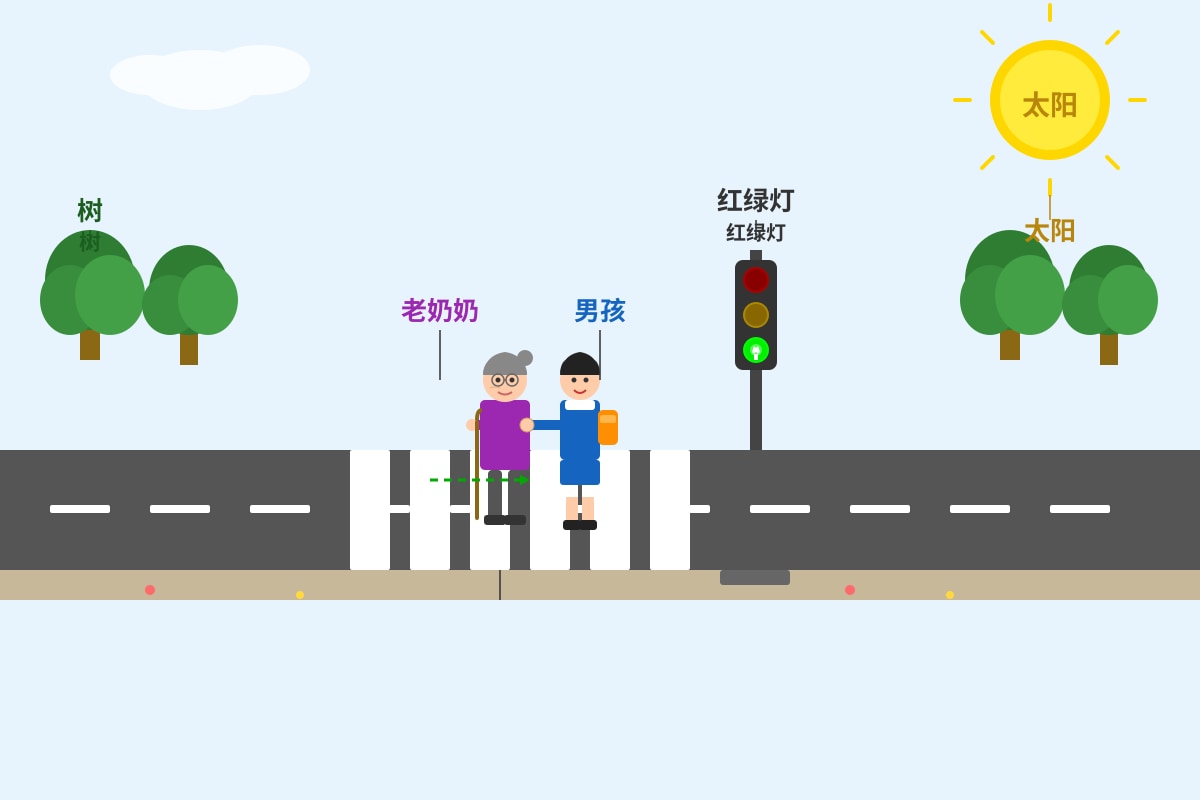
句子1:小明扶着老奶奶过马路。
句子2:老奶奶对小明说:“谢谢你,你真是个好孩子。”
Explanation: The picture shows a boy helping an elderly woman cross the road at a zebra crossing.
Marking notes:
- 1 mark: Two complete sentences that accurately describe the picture (boy helping elderly woman cross road)
- 0.5 mark: One correct sentence, or two sentences that only partially describe the picture
- 0 mark: Sentences are incomplete or do not relate to the picture
Expected visual features: The image must show: a boy, an elderly woman, a zebra crossing, a green traffic light, and a sunny day with trees. The boy should be holding the woman's hand while crossing.
Q20. Sample Answer: (1 mark)
我的好朋友是小明。他长得高高的,有一双大大的眼睛。我们每天一起上学,一起做功课。周末的时候,我们还会一起去公园踢足球。我很喜欢和他一起玩。
Explanation: The paragraph should include:
- Who the friend is (name)
- What the friend looks like (appearance)
- What activities they do together
- A concluding sentence expressing feelings
Marking notes:
- 1 mark: 4-5 complete sentences covering all three required elements (who, appearance, activities)
- 0.5 mark: 3 sentences or missing one required element
- 0 mark: Fewer than 3 sentences, or sentences are incomplete/off-topic
Teaching note: Remind students to use full stops at the end of each sentence and to write in complete sentences, not fragments.
— 答案完 —