From Real Exams Quiz
Primary 3 Chinese Speaking Quiz
Free P3 Chinese Speaking quiz, Kimi2.6 Exam version, with questions, answers, and syllabus-aligned practice for Singapore students.
These static practice materials are generated from the site's syllabus and paper-generation workflow, with source and model context shown so students and parents can evaluate the material before use.
Questions
Free quiz and exam paper access
Enter your details to view this paper
Your access is remembered on this device.
Answers
Primary 3 Chinese Quiz - Speaking — Answer Key
Total Marks: 40
Section A: 选择正确的词语 [5 marks]
1. C 朗读
- Marking: 1 mark for correct answer.
- Teaching note: "朗读" means to read aloud, typically with expression and clarity, which fits the context of performing on stage and captivating the audience. "告诉" (tell) and "说话" (speak) are too general; "大喊" (shout) suggests yelling, which is inappropriate for storytelling. When speaking or performing, we use "朗读" for prepared, expressive reading.
2. C 音量
- Marking: 1 mark for correct answer.
- Teaching note: "音量" means volume/loudness of sound. The key phrase "让大家听清楚" (let everyone hear clearly) directly relates to appropriate volume. "重量" (weight), "速度" (speed), and "高度" (height) are irrelevant to auditory clarity. In oral communication, adjusting 音量 ensures your message reaches all listeners.
3. C 练习
- Marking: 1 mark for correct answer.
- Teaching note: "练习" means to practice/rehearse. Before a competition, one practices repeatedly to prepare. "睡觉" (sleep), "准备" (prepare—too broad), and "吃饭" (eat) do not convey the repeated rehearsal implied by "很多次" (many times). Speaking well requires deliberate practice.
4. B 分享
- Marking: 1 mark for correct answer.
- Teaching note: "分享" means to share. The teacher asks students to talk about their weekend activities with classmates, which is sharing experiences. "画画" (draw), "写字" (write), and "跳舞" (dance) do not match the speaking context. In oral activities, we "分享" personal experiences.
5. A 条理
- Marking: 1 mark for correct answer.
- Teaching note: "有条理" means organized/logical. The phrase "一句一句讲得很清楚" (speaking clearly sentence by sentence) demonstrates organized speech. "力气" (strength), "颜色" (color), and "味道" (taste) are unrelated to speech organization. Good speaking requires clear structure and logic.
Section B: 选择正确的做法 [5 marks]
6. B 观众
- Marking: 1 mark for correct answer.
- Teaching note: "观众" means audience. The instruction emphasizes making eye contact—looking at your listeners, not the floor, ceiling, or windows. Effective speakers engage their audience visually to build connection and show confidence.
7. B 他大声说话,看着观众
- Marking: 1 mark for correct answer.
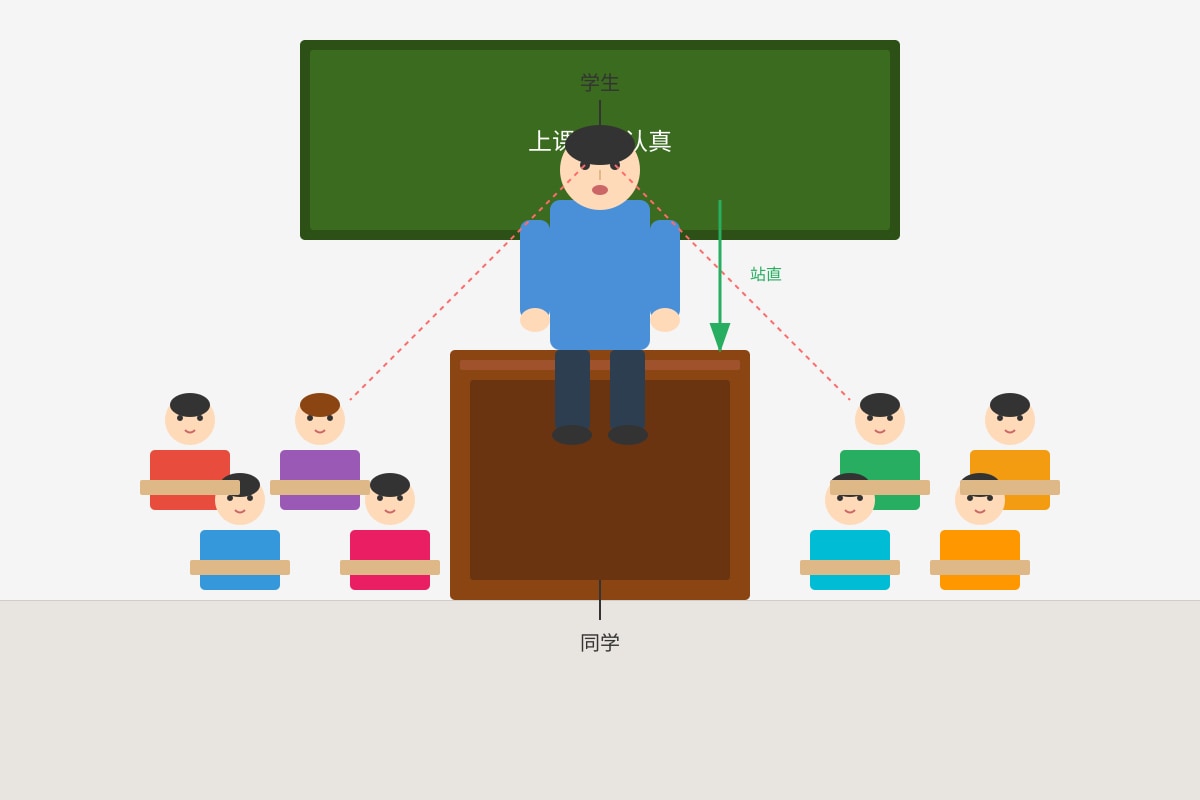
- Teaching note: Expected visual: Student at podium with upright posture, making eye contact with classmates. The correct answer identifies positive speaking behaviors: appropriate volume ("大声说话") and audience engagement ("看着观众"). Options A, C, D describe poor posture or avoidance behaviors.
8. B 事情发展
- Marking: 1 mark for correct answer.
- Teaching note: "事情发展的顺序" means the sequence of events/chronological order. Retelling requires temporal logic: beginning → middle → end. "喜欢" (preference), "字母" (alphabetical), and "长短" (length) are not standard organizational principles for narrative retelling.
9. A 描述
- Marking: 1 mark for correct answer.
- Teaching note: "描述" means to describe. "添油加醋地描述" is a set phrase meaning to describe with vivid/embellished details. "删除" (delete), "忘记" (forget), and "跳过" (skip) contradict the context of making the story interesting. Vivid description enhances storytelling.
10. B 介绍
- Marking: 1 mark for correct answer.
- Teaching note: "介绍" means to introduce. When someone visits from elsewhere, we introduce local features. "询问" (ask—wrong direction), "批评" (criticize—inappropriate), and "命令" (command—rude) do not fit the hospitable context. We "介绍" our culture and attractions to guests.
Section C: 词语搭配与填空 [10 marks]
11. 小声
- Marking: 1 mark for correct answer.
- Teaching note: The consequence "后面的同学听不见" (classmates behind can't hear) directly indicates insufficient volume. "小声" (soft/quiet voice) is the problem. Contrast with "大声" (loud) which would solve this problem.
12. 自信
- Marking: 1 mark for correct answer.
- Teaching note: The contrast "但是" (but) and "一点也不紧张" (not nervous at all) signal confidence despite inexperience. "自信" means self-confident. Other words like 清楚 or 小声 don't match the emotional state described.
13. 手势
- Marking: 1 mark for correct answer.
- Teaching note: "适当的手势" (appropriate gestures) provides visual reinforcement that helps audiences follow and understand spoken content. Gestures create a second communication channel that supports verbal messages. Compare with 表情 (17) which adds emotional flavor, and 停顿 (18) which creates processing time.
14. 清楚
- Marking: 1 mark for correct answer.
- Teaching note: "清楚地叫出" — at age three, clear articulation of family members' names shows developing pronunciation. "清楚" (clear) modifies the verb phrase, indicating intelligible speech production.
15. 重点
- Marking: 1 mark for correct answer.
- Teaching note: "抓住重点" (grasp the main points) is a standard comprehension strategy. Retelling requires selecting essential information, not exhaustive detail. This teaches summarization and discernment in oral reproduction.
16. 开头
- Marking: 1 mark for correct answer.
- Teaching note: "一个好的演讲开头" (a good speech opening) sets audience attention. The beginning of a speech must engage listeners immediately. Other parts like middle or conclusion serve different functions, but "开头" specifically addresses attention-grabbing.
17. 表情
- Marking: 1 mark for correct answer.
- Teaching note: Facial expressions ("表情") add emotional dimension to storytelling. Combined with gestures (question 13), they make narration "生动有趣" (vivid and interesting). Expression conveys feelings that words alone may not fully communicate.
18. 停顿
- Marking: 1 mark for correct answer.
- Teaching note: Pauses ("停顿") allow audiences mental processing time. The phrase "让观众有时间消化信息" (let audience time to digest information) explicitly defines the function of strategic pausing. This is advanced oral fluency technique.
19. 小声 and 20. 清楚 (or vice versa: 清楚 and 小声)
- Marking: 1 mark each, 2 marks total.
- Teaching note: The context describes nervousness undermining performance: "说话声音小声" (voice became soft/quiet) and "讲得不够清楚" (not clear enough). These are common anxiety manifestations. The contrast with preparation ("准备得很充分") shows how emotion affects delivery. Either order accepted if both words used correctly; standard order: 19. 小声, 20. 清楚.
Section D: 问答与口语表达 [20 marks]
16. 你最喜欢的一本书是什么?请用两三句话介绍这本书的内容。 [4 marks]
Sample answer framework:
- State book title clearly (1 mark)
- Mention author or type (optional, enhancer)
- Summarize main character/situation (1 mark)
- Describe key event or theme (1 mark)
- Give personal reason for liking it (1 mark)
Example: 我最喜欢的一本书是《夏洛的网》。这本书讲了一只小猪威尔伯和蜘蛛夏洛的友谊故事。夏洛用自己的丝在蛛网上写字,帮助威尔伯不被杀掉。这个故事让我明白了真正的朋友会在困难的时候互相帮助。
Marking descriptors:
| Component | Marks |
|---|---|
| Book title stated | 1 |
| Basic content summary (character/setting) | 1 |
| Key event or plot point | 1 |
| Personal response or theme understanding | 1 |
Teaching note: This question assesses summarization ability—condensing a book into 2-3 sentences requires identifying core elements. Students should demonstrate ability to distinguish main plot from minor details. Accept any appropriate book; content accuracy less important than structural completeness and clear expression.
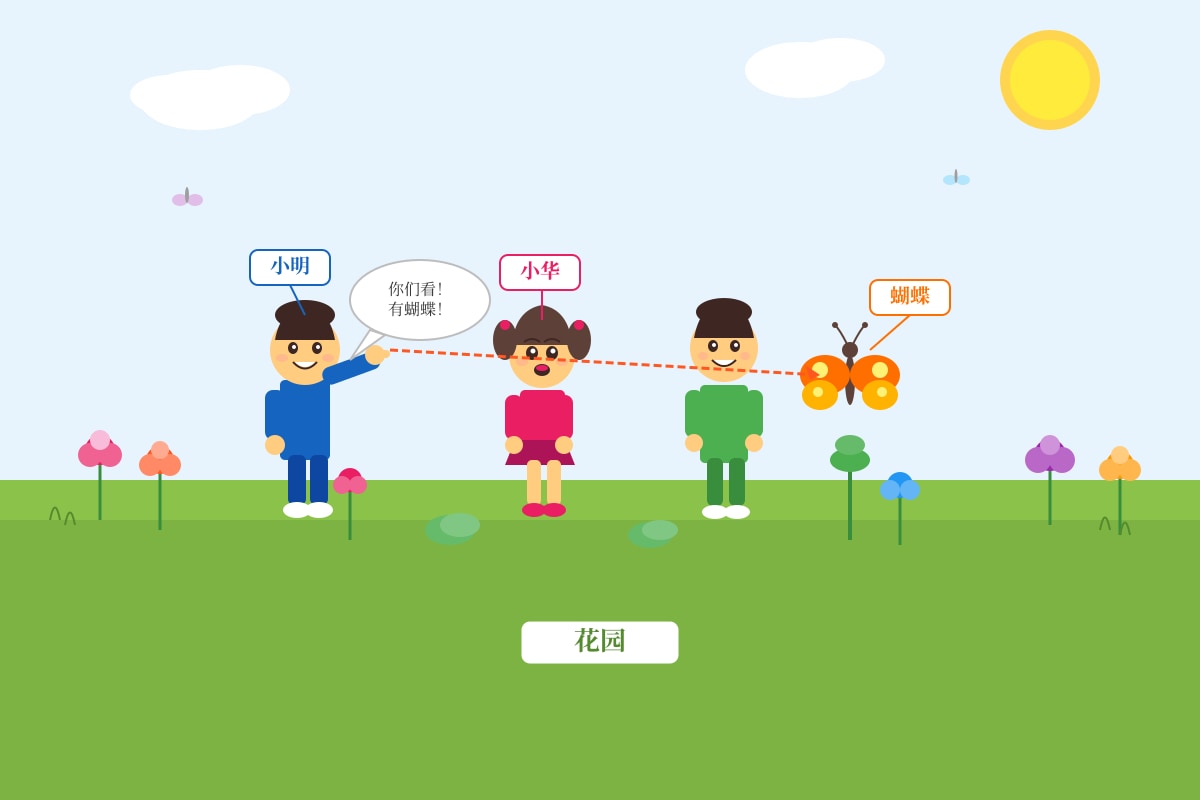
17. 看图描述:说说图中的小朋友在做什么,他们看起来心情怎么样。 [4 marks]
Sample answer framework:
- Identify setting and activity (1 mark): children in garden, observing butterfly
- Describe specific actions using speaking vocabulary (1 mark): pointing, talking, describing, sharing
- Identify emotional expressions (1 mark): excited, happy, curious, enthusiastic
- Add interpretive detail about interaction (1 mark): friends listening, shared interest, taking turns speaking
Example: 图中有三个小朋友在花园里。一个小男孩指着花上的蝴蝶,正在向他的朋友们介绍。另外两个小朋友专心地看着蝴蝶,听他说话。他们看起来都很兴奋和好奇,脸上带着开心的笑容。
Marking descriptors:
| Component | Marks |
|---|---|
| Setting and activity identified | 1 |
| Specific actions described with speaking vocabulary | 1 |
| Emotional state identified | 1 |
| Interaction detail or interpretation added | 1 |
Teaching note: This question assesses observational description and emotional inference. Students must connect visual information to oral communication concepts (introducing, describing, sharing with audience). The figure shows positive speaking behaviors: active gesturing, engaged listeners, shared attention—qualities to reinforce.
18. 请你复述一件在学校发生的有趣的事。按照时间顺序,说清楚:什么时候、在哪里、发生了什么事、你的感受。 [6 marks]
Sample answer framework:
- Time specified (1 mark): specific time reference (e.g., "上个星期五的体育课上")
- Location specified (1 mark): where at school (e.g., "在操场上", "在科学实验室")
- Event sequence clear (2 marks): beginning → middle → end, with transition words
- Somthing happened clearly described (1 mark): specific incident with enough detail
- Personal feeling expressed (1 mark): emotional response with reason
Example: 上个星期二的手工课上,在美术教室里,发生了一件有趣的事。老师让我们用废纸做环保手工,我和同桌合作做了一辆小汽车。我们开始用纸箱做车身,可是轮子总是掉下来。后来我们发现用瓶盖做轮子,再用牙签固定,小车就能跑了。看到我们的小汽车在桌上开动,我感到非常自豪和开心。
Marking descriptors:
| Component | Marks |
|---|---|
| Time clearly stated | 1 |
| Location clearly stated | 1 |
| Event sequence with transitions (beginning-middle-end) | 2 |
| Specific incident described with sufficient detail | 1 |
| Personal feeling with elaboration | 1 |
Teaching note: This is the most demanding question, assessing integrated narrative skills. "按照时间顺序" (in chronological order) requires explicit temporal markers: "首先/一开始" (first), "然后/接着" (then), "最后/后来" (finally). The 6-mark weighting reflects multiple competencies: temporal sequencing, spatial orientation, event narration, and emotional articulation. Accept any plausible school event; focus on structural completeness and fluency.
19. 你的好朋友要参加班上的"小小演讲家"比赛,他很紧张。请给他两条建议,帮助他准备比赛。 [4 marks]
Sample answer framework:
- Suggestion 1: Preparation/practice-focused (2 marks)
- Specific actionable advice (1 mark)
- Brief rationale or implementation detail (1 mark)
- Suggestion 2: Delivery/mental approach-focused (2 marks)
- Specific actionable advice (1 mark)
- Brief rationale or implementation detail (1 mark)
Example: 建议一:在比赛前,你可以每天对着镜子练习演讲,看看自己的表情和手势。这样你就能发现自己的问题,及时改正。
建议二:上台前深呼吸三次,告诉自己"我准备得很好"。这样可以让你放松下来,不那么紧张。
Marking descriptors:
| Component | Marks |
|---|---|
| Suggestion 1: specific and preparation-relevant | 1 |
| Suggestion 1: rationale or implementation included | 1 |
| Suggestion 2: specific and delivery/mentally-relevant | 1 |
| Suggestion 2: rationale or implementation included | 1 |
Teaching note: Accept any relevant, actionable advice. Common strong answers include: practice multiple times (练习多遍), write cue cards (写重点卡片), record yourself (录下来听), breathe deeply (深呼吸), imagine audience as friends (把观众当成朋友), start with a smile (先微笑). Deduct 1 mark per suggestion if too vague (e.g., just "不要紧张" without method) or if advice duplicates within single category.
20. 请解释为什么其中一条建议有用,并说说上台演讲时还要注意什么。 [2 marks]
Sample answer framework:
- Explain why one suggestion works (1 mark): connect action to outcome with causal logic
- Additional consideration for actual speaking (1 mark): distinct from suggestions in 19, focused on delivery moment
Example: 对着镜子练习很有用,因为你可以看到自己的样子,调整表情和手势,让自己看起来更自信。上台演讲时,还要注意看着观众的眼睛,不要一直低头看稿子。
Marking descriptors:
| Component | Marks |
|---|---|
| Causal explanation of suggestion effectiveness | 1 |
| Additional on-stage consideration distinct from preparation | 1 |
Teaching note: This follow-up requires meta-cognitive reflection—understanding why techniques work, not just listing them. The second part must address on-stage moment (not preparation), such as: eye contact (眼神接触), appropriate speed (速度适中), clear articulation (发音清楚), standing posture (站姿端正), using pauses (适当停顿). Deduct if student merely repeats suggestion from 19 without explanation, or if additional point is also preparation-focused.
End of Answer Key
Total: 40 marks