AI Generated Exam Paper
Primary 3 Chinese Practice Paper 2
Free P3 Chinese Practice Paper 2, Kimi2.6 AI version, with questions, answers, and syllabus-aligned practice for Singapore students.
These static practice materials are generated from the site's syllabus and paper-generation workflow, with source and model context shown so students and parents can evaluate the material before use.
Questions
Free quiz and exam paper access
Enter your details to view this paper
Your access is remembered on this device.
Answers
TuitionGoWhere Practice Paper - Chinese Primary 3 (Answers)
Version: 2 of 5 | Total Marks: 60
Section A: Character Recognition (辨认汉字) — Answers
1. (1) 饭 ✓
Marks: 2
Explanation: "煮饭" (zhǔ fàn) means "to cook rice/a meal." The other characters do not form correct words: 板 (bǎn = board), 返 (fǎn = return), 贩 (fàn = vendor).
Common mistake: Students may confuse 饭 (food, rice) with 返 because they share a similar sound, but 返 means "to return" and does not fit the context of cooking.
2. (1) 收 ✓
Marks: 2
Explanation: "收拾" (shōu shí) means "to tidy up." The sentence describes cleaning a room. 守 (shǒu = guard), 手 (shǒu = hand), and 首 (shǒu = first/head) do not form the correct compound word.
Teaching note: The compound 收拾 is a common P3 vocabulary item. Students should recognize that 收 combines with 拾 to mean "arrange and clean up."
3. (3) 励 ✓
Marks: 2
Explanation: "鼓励" (gǔ lì) means "to encourage." The sentence describes a teacher encouraging students to study hard. 厉 (lì = strict), 历 (lì = calendar/history), and 利 (lì = benefit/profit) are different characters with the same pronunciation.
Marking note: Full marks only if character (3) is selected. Students who write the character must write 励 correctly with the 力 radical on the right.
4. (4) 彩 ✓
Marks: 2
Explanation: "彩色" (cǎi sè) means "colorful." The sentence describes many-colored flowers in the park. 郝 (Hǎo = surname), 赫 (hè = illustrious), and 赤 (chì = red) do not fit.
Common mistake: Students may select 赤 thinking it means "red" for flowers, but 彩色 is the correct word for "many-colored/colorful."
5. (3) 绊 ✓
Marks: 2
Explanation: "绊了一跤" (bàn le yí jiào) means "to trip and fall." The radical 纟(silk/thread) relates to entanglement. 拌 (bàn = mix), 伴 (bàn = companion), and 判 (pàn = judge) have different meanings.
Teaching note: The action of tripping involves the foot being caught, and 绊 implies something entangling or obstructing the foot.
6. (1) 阅 ✓
Marks: 2
Explanation: "阅读" (yuè dú) means "to read." The sentence describes reading newspapers. 闻 (wén = hear/smell), 问 (wèn = ask), and 闷 (mèn = bored/suffocating) do not form the correct word.
Common mistake: 阅 and 闻 both relate to receiving information, but 阅 specifically means "to read visually" while 闻 means "to hear."
Section B: Vocabulary in Context (词语运用) — Answers
7. 兴奋 ✓
Marks: 2
Explanation: "兴奋" (xīng fèn) means "excited, thrilled." For a school sports day, students typically feel excited and enthusiastic.
- 高兴 (gāo xìng = happy) — too mild for the special occasion
- 紧张 (jǐn zhāng = nervous) — suggests anxiety, not the positive emotion expected
- 害怕 (hài pà = scared) — completely wrong context
Teaching note: 兴奋 conveys high energy and anticipation suitable for special events. Students should recognize that context determines the intensity of emotion.
8. 帮助 ✓
Marks: 2
Explanation: "帮助" (bāng zhù) means "to help, assist." It is the standard verb for assisting someone, especially an elderly person.
- 帮忙 (bāng máng = to help out) — more casual, often used for doing favors
- 扶手 (fú shǒu = handrail) — a noun, not a verb
- 扶助 (fú zhù = to support/assist, more formal) — acceptable but less common in P3 context
Marking note: 帮助 is the expected answer. 扶助 may be accepted with 1 mark if student explains context appropriately.
9. (1) 吃 ✓
Marks: 2
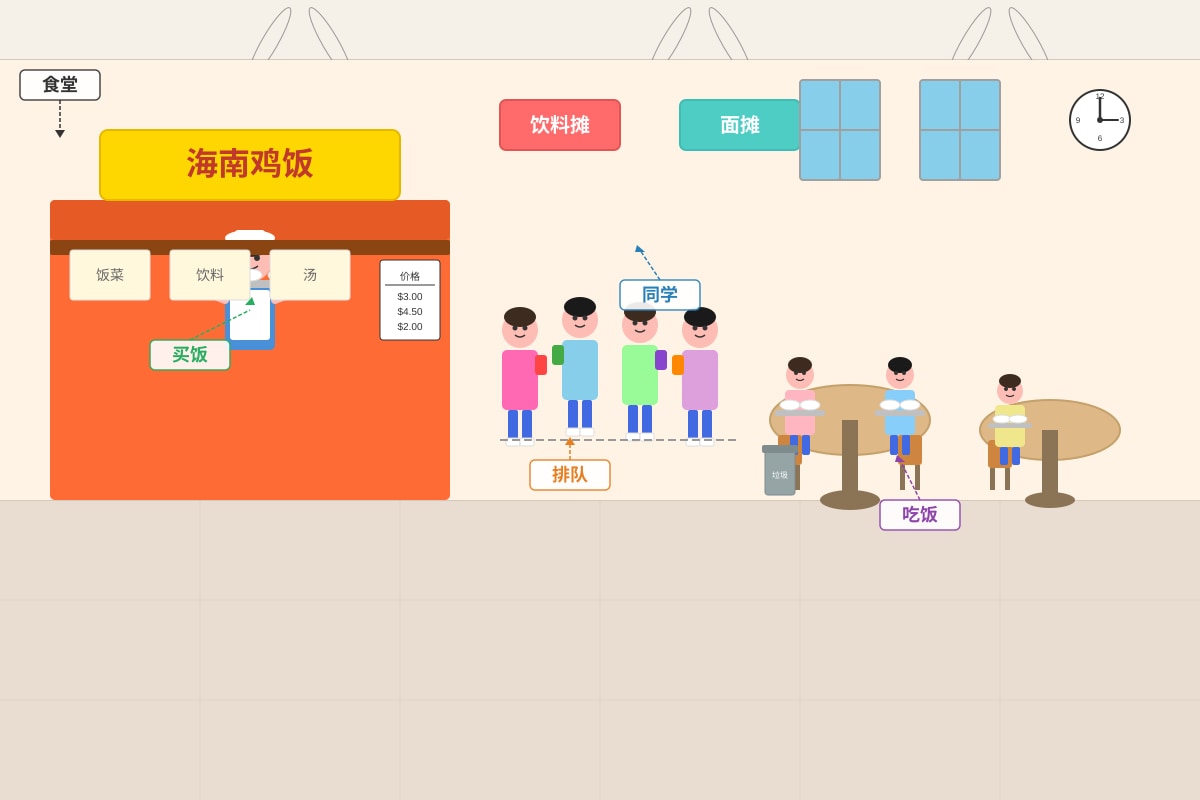
Explanation: The image shows students in a canteen. While they are also buying food, the most general and primary activity is 吃午餐 (eating lunch). The question asks what students are doing, and eating is the main completed action.
Visual reference: Image Q9-fig1 depicts students at tables and queuing — the eating action is most clearly represented.
10. (3) 秩序 ✓
Marks: 2
Explanation: "秩序" (zhì xù) means "order, sequence." "有秩序地排队" means "queuing in an orderly manner" — the standard Singapore school virtue of orderly queuing.
- 办法 (bàn fǎ = method) — appears twice as distractors, testing attention
- 注意 (zhù yì = attention) — does not fit grammatically
Teaching note: 秩序 is a common P3 social studies and civics vocabulary item related to school values.
11. (2) 可口 ✓
Marks: 2
Explanation: "可口" (kě kǒu) means " delicious, tasty." It describes food that looks appetizing.
- 可怕 (kě pà = scary) — wrong emotional tone
- 难过 (nán guò = sad) — applies to feelings, not food
- 辛苦 (xīn kǔ = hard/tiring) — applies to labor, not food appearance
Common mistake: Students may not recognize 可口 as they learn 好吃 more commonly. Both mean "tasty," but 可口 is more formal.
12. 锻炼 ✓
Marks: 2
Explanation: "锻炼" (duàn liàn) means "to exercise, work out." It specifically refers to physical exercise for health.
- 训练 (xùn liàn = training) — implies structured program for skill/sport
- 练习 (liàn xí = practice) — general practice, not specifically physical
- 磨练 (mó liàn = temper/toughen) — metaphorical hardship, too abstract for P3
Teaching note: 锻炼 is the standard collocation for morning exercises in parks, popular among senior citizens in Singapore.
13. 精彩 ✓
Marks: 2
Explanation: "精彩" (jīng cǎi) means "wonderful, brilliant, splendid." It describes performances, stories, and events that are impressive.
- 紧张 (jǐn zhāng = tense) — could describe plot but negative connotation
- 难过 (nán guò = sad) — emotional response, not plot quality
- 着急 (zháo jí = anxious) — applies to persons, not narratives
Teaching note: 精彩 is commonly used for shows, performances, and stories. Students should associate it with positive, engaging experiences.
Section C: Reading Comprehension (阅读理解) — Answers
14. 奶奶的花园在哪里?
Marks: 3
Answer: 奶奶住在宏茂桥的一座组屋里。她的家门口有一个小花园。
(or: 宏茂桥的一座组屋家门口。)
Marking breakdown:
- 1 mark: 宏茂桥 (location name)
- 1 mark: 组屋 (housing type)
- 1 mark: 家门口 (specific location of garden)
Teaching note: Students must quote from the text or paraphrase accurately. The full sentence from the text provides complete evidence. "宏茂桥" should be recognized as an actual Singapore neighborhood (Ang Mo Kio).
15. 短文中提到的三种植物:
Marks: 3 (1 mark each)
Answer:
(1) 九重葛 (jiǔ chóng gě = bougainvillea)
(2) 兰花 (lán huā = orchid)
(3) 番茄 (fān qié = tomato)
(or: 小番茄树)
Teaching note: Students may write 花 for all three; accept only if clearly distinguished. 九重葛 may also be called 三角梅 but the text uses 九重葛, so prefer text-based answer.
16. 九重葛在新加坡常见的原因:
Marks: 4 (2 marks each)
Answer:
(1) 因为它喜欢阳光 (it likes sunlight)
(2) 而且不需要太多水,很容易照顾 (and doesn't need much water, easy to care for)
Marking breakdown:
- 2 marks: Likes sunlight / 喜欢阳光
- 2 marks: Doesn't need much water / easy to care for / 不需要太多水 / 很容易照顾
Teaching note: Both reasons must come from text. Students may paraphrase but must preserve both environmental factors: Singapore's sunny climate and water conservation (relevant to Singapore's national water-saving messages).
17. 奶奶用什么种兰花?种兰花要注意什么?
Marks: 4 (2 marks each)
Answer:
- 用什么种:特别的树皮 (special bark)
- 要注意什么:不能太湿,也不能太干,要刚刚好 (not too wet, not too dry, just right / 刚刚好)
Marking breakdown:
- 2 marks: 特别的树皮 (material) — must include "特别的" as text specifies; "树皮" alone = 1 mark
- 2 marks: 水分控制 / 不能太湿也不能太干 / 刚刚好
Teaching note: This tests attention to specific detail. The modifier 特别的 indicates this is not ordinary soil. The "just right" concept (刚刚好) is important for understanding moderation.
18. "每次看到小番茄从绿色慢慢变成红色,我就觉得特别神奇。"
Marks: 4
Answer: 这句话说明了作者对植物生长变化感到惊奇/好奇/很感兴趣。
(Or in more detail): 说明了作者仔细观察了小番茄的生长过程,对颜色从绿变红的变化觉得很有趣,很喜欢照顾植物。
Marking breakdown:
- 2 marks: 感到惊奇/神奇/好奇/有趣 (emotional response)
- 2 marks: 观察到番茄的生长变化/颜色变化 (observation detail)
Teaching note: Students should identify both the factual observation (color change) and the emotional response (wonder/amazement). This demonstrates reading at literal and inferential levels.
19. "种瓜得瓜,种豆得豆"的意思和例子
Marks: 8
Meaning (4 marks):
- 2 marks: 字面意思 —种什么就会收获什么 / 你付出什么努力,就会得到什么样的结果
- 2 marks: 引申意思 — 只要努力工作或学习,就会有好的收获和成果 / 因果报应
Example (4 marks):
- 2 marks: 具体的生活例子(如:每天练习钢琴,后来学会了弹奏一首曲子;每天复习功课,考试成绩进步了)
- 2 marks: 例子与道理之间的联系说明清楚
Exemplar answer:
意思:这句话的字面意思是种瓜就会收获瓜,种豆就会收获豆。它的意思是如果我们努力去做一件事,就会有好的结果。
例子:我每天放学后都认真做数学练习,遇到不懂的题目就问老师。虽然一开始我觉得很难,但是经过一个月的努力,我的数学成绩从六十分进步到了八十五分。这就是"种瓜得瓜,种豆得豆"——努力练习就有好的成绩。
Common mistakes to flag:
- Giving only literal meaning without interpretation (-2 marks)
- Example unrelated to effort-result relationship (-2 marks)
- Example too vague without specifics (-1 mark)
20. 作者学到什么 + 个人经历
Marks: 8
Author's learning (4 marks):
- 2 marks: 学到很多关于植物的知识 (knowledge about plants)
- 2 marks: 更加懂得珍惜食物 (appreciating food more / understanding food comes from hard work)
Personal experience (4 marks):
- 2 marks: 具体的个人经历(如:自己种植物、做饭、帮忙家务、学习某项技能等)
- 2 marks: 感受和体会与作者的经历有联系,表达真实具体
Exemplar answer:
作者学到:作者学到了很多关于植物的知识,比如九重葛喜欢阳光,兰花要用树皮种。他也更加懂得珍惜食物,因为他知道种食物需要花时间照顾。
我的经历:去年,我在学校的种植计划里种了一棵小薄荷。我每天都给它浇水,观察它有没有长大。两个月后,薄荷长得很高,妈妈用它来做了薄荷水。我觉得很高兴,因为我明白了自己努力照顾的东西会有收获,就像作者说的"种瓜得瓜,种豆得豆"。
Marking descriptors:
| Score | Criteria |
|---|---|
| 4 | Specific, relevant personal experience with clear connection to text themes |
| 3 | Good experience but connection to text less explicit |
| 2 | Vague experience or weak connection |
| 1 | Minimal content, largely off-topic |
| 0 | No response or completely irrelevant |
Summary Mark Scheme
| Section | Questions | Marks |
|---|---|---|
| A | 1-6 | 12 |
| B | 7-13 | 14 |
| C | 14-20 | 34 |
| Total | 20 questions | 60 |
Duration check: 50 minutes allows approximately:
- Section A: 2 minutes per question × 6 = 12 min
- Section B: 2 minutes per question × 7 = 14 min
- Section C: Reading + writing = 3-4 minutes per question × 7 ≈ 24 min
- Total: 50 minutes with buffer for checking
Visual Reference for Marking
Image Q9-fig1 expected content: Singapore school canteen with students queuing and eating. Key elements: food stall, queue, tables with students, ceiling fans, colorful signboards. Students should identify eating (Q9), orderly queuing (Q10), and appetizing food (Q11) from this context.