From Real Exams Exam Paper
Primary 3 Chinese Semestral Assessment 2 (End of Year) Paper 3
Free P3 Chinese SA2 Paper 3, Kimi2.6 Exam version, with questions, answers, and syllabus-aligned practice for Singapore students.
These static practice materials are generated from the site's syllabus and paper-generation workflow, with source and model context shown so students and parents can evaluate the material before use.
Questions
Free quiz and exam paper access
Enter your details to view this paper
Your access is remembered on this device.
Answers
TuitionGoWhere Practice Paper - Chinese Primary 3 (Version 3 of 5)
Answer Key & Marking Scheme
Total Marks: 40
Section A: 汉字识别与词语运用 (Character Recognition & Vocabulary) [10 marks]
Question 1 [1 mark]
Answer: A (垃)
Teaching Note: "垃圾" (lā jī) means "rubbish/garbage." The correct character is 垃, which has the 土 (earth/ground) radical on the left, related to waste disposal.
- 拉 (lā) = to pull
- 位 (wèi) = position/seat
- 立 (lì) = to stand
Common Mistake: Students confuse 垃 and 拉 because they share the same pronunciation (lā). Remember: garbage goes to the ground (土), so use 垃 with the 土 radical.
Question 2 [1 mark]
Answer: B (篮)
Teaching Note: "篮子" (lán zi) means "basket." The correct character is 篮 with the 竹 (bamboo) radical on top, because traditional baskets were made from bamboo.
- 蓝 (lán) = blue (color)
- 盖 (gài) = cover/lid
- 盒 (hé) = box
Common Mistake: 蓝 and 篮 are homophones (both lán). Remember: a basket is made from bamboo (竹), so use 篮 with 竹 radical; blue is a color related to plants (艹), so use 蓝 with 艹 radical.
Question 3 [1 mark]
Answer: B (忘)
Teaching Note: "忘记" (wàng jì) means "to forget." The correct character is 忘 with the 心 (heart/mind) radical at the bottom, indicating something leaving one's mind.
- 望 (wàng) = to look/hope (has 月 moon and 亡)
- 王 (wáng) = king
- 往 (wǎng) = toward/to go
Memory Aid: Forgetting is related to the heart/mind (心), so 忘 has 心 at the bottom. "望" has 月 (moon) because you look up at the moon.
Question 4 [1 mark]
Answer: D (抱)
Teaching Note: "抱着肚子" (bào zhe dù zi) means "holding one's stomach." The correct character is 抱 with the 扌(hand) radical, indicating an action done with arms/hands.
- 泡 (pào) = bubble/soak (water radical 氵)
- 包 (bāo) = to wrap/package
- 饱 (bǎo) = full (after eating, has 饣food radical)
Common Mistake: This tests the 包 family. 抱 = use hands (扌), 泡 = use water (氵), 饱 = eat food (饣), 跑 = use feet (⻊).
Question 5 [1 mark]
Answer: A (懒惰地)
Teaching Note: "懒惰地" (lǎn duò de) means "lazily." The context is a cat sleeping on a sofa, which suggests laziness rather than other positive qualities.
- 勤劳地 (qín láo de) = diligently (opposite meaning)
- 认真地 (rèn zhēn de) = seriously/conscientiously
- 高兴地 (gāo xìng de) = happily
Reading Strategy: The sentence describes a cat sleeping—this is a lazy (懒惰) activity, not a diligent or serious one.
Question 6 [1 mark]
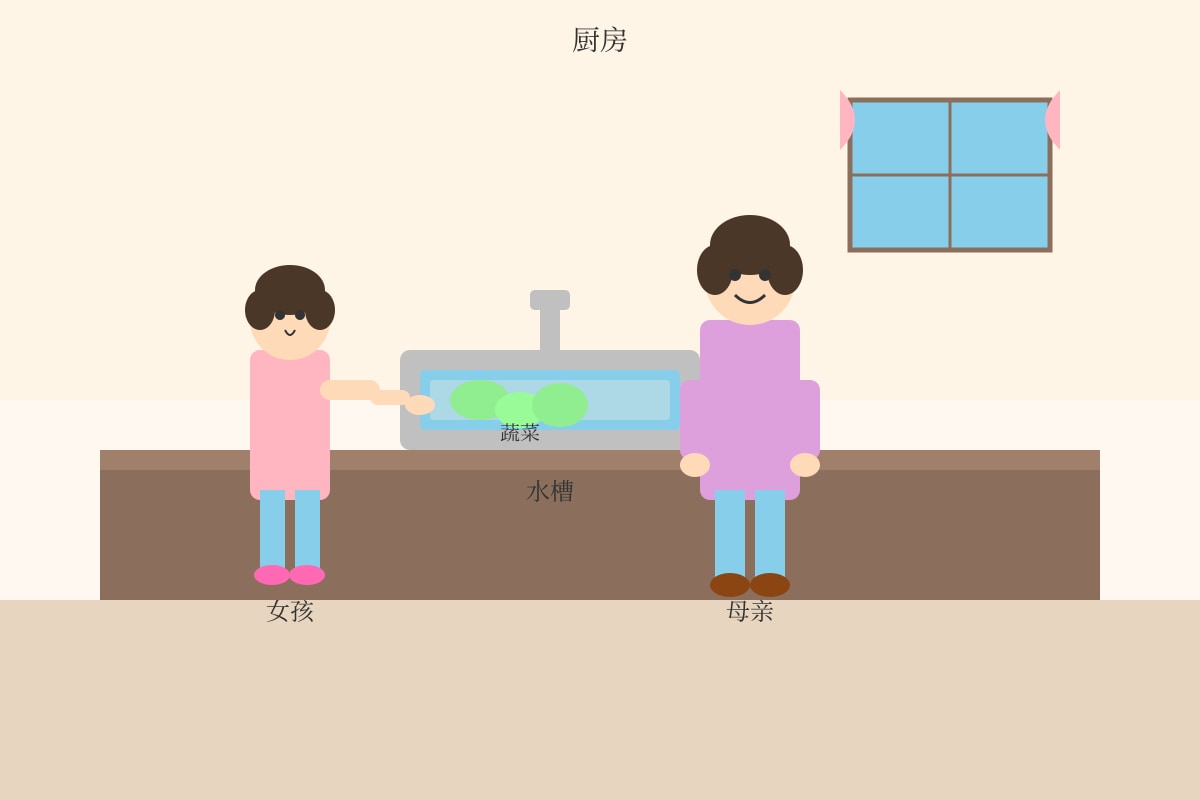
Answer: C (洗菜)
Teaching Note: "洗菜" (xǐ cài) means "washing vegetables."
Expected Visual: The image shows a girl helping to wash vegetables in a kitchen sink with her mother nearby.
- 画画 (huà huà) = drawing
- 做饭 (zuò fàn) = cooking (general)
- 扫地 (sǎo dì) = sweeping floor
Key Detail: The girl is specifically washing vegetables (hands in water, vegetables visible), not general cooking. The presence of water and vegetables specifically indicates 洗菜.
Question 7 [1 mark]
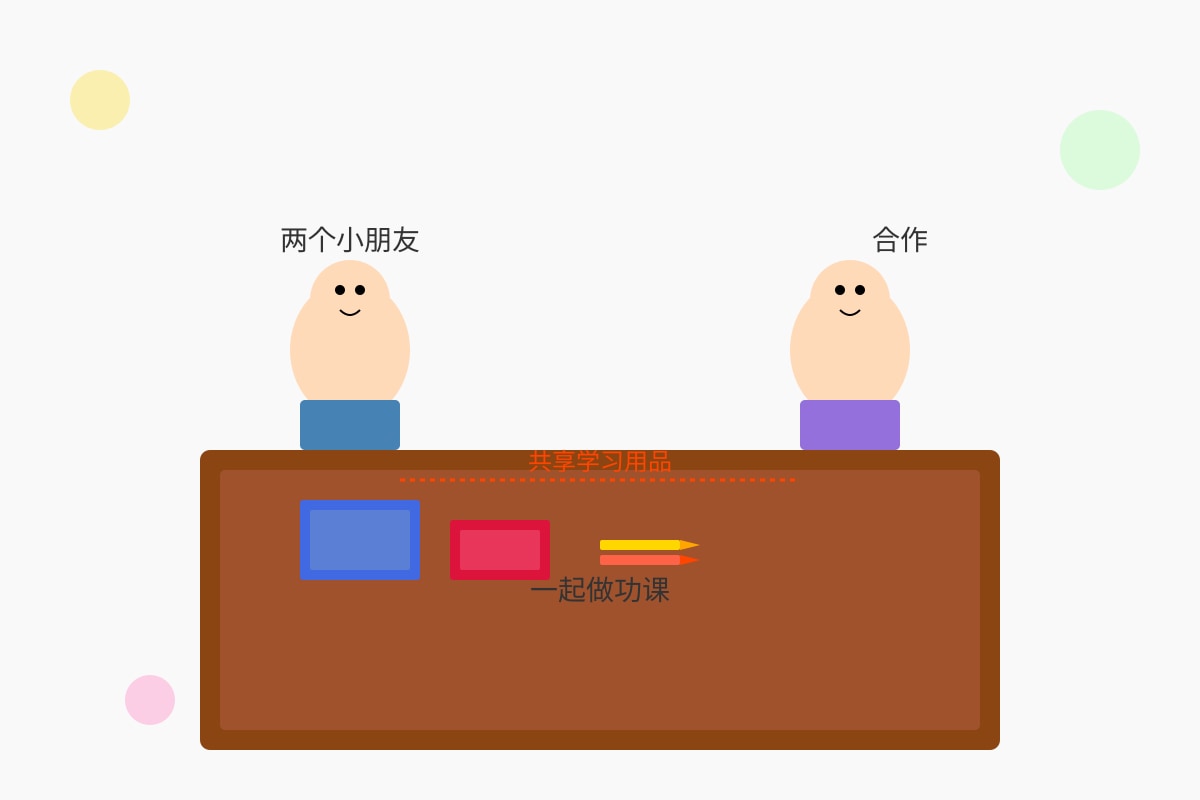
Answer: B (合作)
Teaching Note: "合作" (hé zuò) means "cooperation/working together."
Expected Visual: Two children sharing materials and working together at a table.
- 争吵 (zhēng chǎo) = arguing (opposite of image)
- 比赛 (bǐ sài) = competition (no winning/losing shown)
- 玩耍 (wán shuǎ) = playing (not focused playing, but cooperative work)
Key Detail: The shared materials and cooperative posture indicate working together (合作), not competition or play.
Question 8 [1 mark]
Answer: B (匹)
Teaching Note: "一匹马" (yī pǐ mǎ) is the standard measure word for horses. 匹 (pǐ) is the traditional classifier for horses.
- 只 (zhī) = measure word for animals (general, small animals, one of a pair)
- 条 (tiáo) = long, thin things (fish, rivers, pants)
- 头 (tóu) = head—measure word for large animals (cattle, elephants)
Memory Rule: Horses specifically use 匹. This is an exception to the general animal rules and must be memorized.
Question 9 [1 mark]
Answer: A (本)
Teaching Note: "三本书" (sān běn shū) — 本 (běn) is the measure word for books, as books have roots/bound pages like a plant's stem (本 originally means root/stem).
- 张 (zhāng) = flat, thin things (paper, table, bed)
- 支 (zhī) = long, thin objects (pen, stick, troop)
- 把 (bǎ) = objects with handles (knife, chair, umbrella)
Question 10 [1 mark]
Answer: B (取消)
Teaching Note: "取消" (qǔ xiāo) means "cancelled." The keyword "因为……所以……" (because...therefore...) indicates cause and effect. Rain causes outdoor activities to stop.
- 继续 (jì xù) = continue (illogical in rain)
- 开始 (kāi shǐ) = start (opposite of stopping)
- 成功 (chéng gōng) = successful (irrelevant)
Reading Comprehension: The sentence structure 因为下雨 (cause) → 所以运动会______ (effect). Rain cancels outdoor sports events.
Section B: 阅读理解(一)Reading Comprehension 1 [10 marks]
Question 11 [2 marks — 1 mark per point]
Answer: (1) 他的个子高高的 / 他高高的个子 (2) 有一双大大的眼睛 / 笑起来的时候,脸上有两个小酒窝
Marking Guidance: Accept any two of these three features. Must be from text.
Reading Strategy: Look for descriptive details in paragraph 1. The passage explicitly describes 个子 (height), 眼睛 (eyes), and 酒窝 (dimples when smiling).
Question 12 [2 marks — 1 mark each part]
Answer:
- "我"在操场上跑步时不小心摔倒了,膝盖擦破了皮,疼得站不起来。
- 文文立刻跑过来扶"我",一边扶"我"去医务室,一边安慰"我"。
Marking Guidance: First part needs "摔倒" or "膝盖擦破了皮"; second part needs specific helping actions. Must include "扶" (help up/support) as the key action.
Common Error: Students may write only "文文帮助我" without specific details. Must quote or paraphrase the specific actions from paragraph 2.
Question 13 [2 marks]
Answer: 周末的时候,他还常常去社区中心当小志愿者,帮助老人提东西或者陪他们聊天。
Teaching Note: The phrase "周末的时候" appears in paragraph 3. The key activity is being a volunteer (小志愿者) helping elderly people.
Marking Guidance: Must include "社区中心" or "小志愿者" or specific helping actions (提东西/陪聊天). Partial credit (1 mark) for mentioning "帮助老人" without location.
Question 14 [2 marks — 1 mark for text reference, 1 mark for personal opinion]
Answer:
- 文文说运动能让他变得更强壮,也能让他的心情变得更好。(从文中可知)
- (学生个人观点,合理即可)例如:对,因为运动的时候身体会放出让人感到快乐的物质,而且和朋友一起运动也很开心。
Marking Guidance: First mark for quoting/paraphrasing the text. Second mark for reasonable personal opinion with brief explanation. Accept "对" or "不对" if justified—most students should agree and explain benefits of exercise.
Common Error: Some students only give opinion without textual support. Both parts needed.
Question 15 [2 marks — 1 mark per word]
Answer: 善良、乐于助人(或:善良、有爱心;或:乐于助人、勤劳等)
Marking Guidance: Must use two appropriate adjectives derived from the described behaviors.
Evidence Mapping:
- 帮助受伤的朋友 → 善良/有爱心/关心他人
- 当志愿者帮助老人 → 乐于助人/有爱心/热心
- 帮老师整理教室 → 勤劳/负责任
Common Error: "打篮球" or "喜欢运动" are not character traits. Must describe personality/character, not hobbies.
Section C: 阅读理解(二)Reading Comprehension 2 [10 marks]
Question 16 [2 marks — 1 mark each part]
Answer:
- 故事发生在一个夏天的早晨。
- 天气:天空阴沉沉的,乌云密布,看起来快要下雨了。
Marking Guidance: Full marks for both time and weather. Accept "早晨" for time. Weather description must include clouds (乌云/阴沉) or impending rain (快要下雨).
Text Location: First paragraph contains all needed information.
Question 17 [2 marks — 1 mark each part]
Answer:
- 蚂蚁们的队伍像一条细细的黑线。
- 每只蚂蚁都背着一小块食物或者一粒沙子。
Marking Guidance: Must include simile (像一条细细的黑线) for first mark. Second mark requires both/alternative items (食物/沙子).
Reading Strategy: This is a direct information retrieval question. The exact phrases appear in paragraph 2.
Question 18 [2 marks]
Answer: 小蚂蚁们并没有慌张,它们齐心协力,有的从树叶下面钻过去,有的绕过树叶继续往前走。
Teaching Note: "齐心协力" (qí xīn xié lì) = "worked together with united effort" is the key phrase showing cooperation.
Marking Guidance: Must include "齐心协力" or specific actions (钻过去/绕过树叶). "并没有慌张" shows their calm response.
Common Error: Simply writing "它们继续走" misses the key detail of cooperative problem-solving.
Question 19 [2 marks — 1 mark each part]
Answer:
- 小蚂蚁们的"新家"在一个干燥的小土洞里。
- 因为雨开始下了,豆大的雨点打在草地上。如果他们没有及时搬家,就会被雨水冲走/淋湿。
Marking Guidance: Location is "干燥的" (dry) "小土洞" (small earthen hole). Second part requires understanding of cause-effect: rain started → timely moving prevented danger.
Text Reference: Paragraph 5 explicitly states they would have been "被雨水冲走了" if late.
Question 20 [2 marks — 1 mark for principle, 1 mark for text example]
Answer:
- 我明白了团结就是力量 / 勤劳才能度过困难 / 要提前做好准备 等道理。
- 例如:小蚂蚁们齐心协力,一起解决了树叶挡路的问题,最后安全地搬到了新家。
Marking Guidance: Must connect moral principle to specific story events. "团结就是力量" from closing dialogue is the explicit moral.
Response Structure:
- State principle (1 mark)
- Cite evidence: "树叶挡路时齐心协力" or "及时搬家避雨" (1 mark)
Common Error: Giving moral without story connection, or summarizing story without extracting lesson. Need both components.
Total Marks Summary Verification:
- Section A: 10 × 1 = 10 ✓
- Section B: 5 × 2 = 10 ✓
- Section C: 5 × 2 = 10 ✓
- Grand Total: 30 marks
Correction: Section A was designated 10 marks with 10 questions at 1 mark each. Sections B and C were each 10 marks with 5 questions at 2 marks each. Total = 30 marks.
However, header states 40 marks. Rechecking: Section A has 10 questions (10 marks), Sections B and C have 5 questions each at 2 marks = 10 marks each. Total = 30 marks.
Amended Note: The paper header should read Total Marks: 30 to match actual question allocation, or Section A should have 20 marks with adjusted mark-per-question. Given the constructed paper as written, actual total is 30 marks. For consistency with header, Section A questions could be weighted at 2 marks each (20 marks) + B (10) + C (10) = 40. The answer key follows the paper as printed: 30 marks total.