AI Generated Exam Paper
Primary 2 Tamil Practice Paper 1
Free P2 Tamil Practice Paper 1, Kimi2.6 AI version, with questions, answers, and syllabus-aligned practice for Singapore students.
These static practice materials are generated from the site's syllabus and paper-generation workflow, with source and model context shown so students and parents can evaluate the material before use.
Questions
Free quiz and exam paper access
Enter your details to view this paper
Your access is remembered on this device.
Answers
Primary 2 Tamil Quiz - Vocabulary (Answer Key)
Total Marks: 40
Section A: Choose the Correct Meaning (Questions 1-10)
2 marks each
Q1. B) Tree
- Teaching note: "மரம்" (maram) is one of the most common nouns in Primary Tamil. The root "மர" relates to wood/vegetation. Common mistake: confusing with "மலர்" (flower).
- Marking: 2 marks for correct letter; 0 for wrong answer.
Q2. C) Grass
- Teaching note: "புல்" (pul) is short, soft vegetation. The word is short and easy to remember. Common mistake: choosing "Mountain" (மலை) which starts with similar sound.
- Marking: 2 marks for correct letter; 0 for wrong answer.
Q3. B) Bird
- Teaching note: "பறவை" (paravai) contains "பற" (flying), so it relates to flying creatures. Common mistake: choosing "Animal" (விலங்கு) as a broader category, but "பறவை" specifically means bird.
- Marking: 2 marks for correct letter; 0 for wrong answer.
Q4. C) Water
- Teaching note: "நீர்" (neer) is a fundamental Tamil word for water, appearing in compounds like "நீர்வீழ்ச்சி" (waterfall). Common mistake: confusing with "நெருப்பு" (fire) due to both starting with "நே" sound in some dialects, but standard pronunciation differs.
- Marking: 2 marks for correct letter; 0 for wrong answer.
Q5. B) Wind
- Teaching note: "காற்று" (kaatru) comes from the verb "காறு" meaning to blow. Common mistake: choosing "Air" (வளி) which is related but not the same—காற்று specifically means wind/moving air.
- Marking: 2 marks for correct letter; 0 for wrong answer.
Q6. C) House
- Teaching note: "வீடு" (veedu) is the basic word for home/house. Very common in Primary 2 family theme. Common mistake: confusing with "வகுப்பு" (class/lesson).
- Marking: 2 marks for correct letter; 0 for wrong answer.
Q7. B) Book
- Teaching note: "புத்தகம்" (puththagam) contains "புத்" (new) suggesting a repository of knowledge. Common mistake: confusing with "பேனா" (pen) as both are school items.
- Marking: 2 marks for correct letter; 0 for wrong answer.
Q8. B) Kitchen
- Teaching note: "சமையலறை" (samayalarai) breaks into "சமையல்" (cooking) + "அறை" (room). Teach students to recognize the compound structure. Common mistake: choosing "Bedroom" (படுக்கையறை).
- Marking: 2 marks for correct letter; 0 for wrong answer.
Q9. B) Teacher
- Teaching note: "ஆசிரியர்" (aasiriyar) is a respectful term for teacher, from Sanskrit influence in Tamil. Common mistake: choosing "Student" which would be "மாணவன்" or "மாணவி".
- Marking: 2 marks for correct letter; 0 for wrong answer.
Q10. A) Boy student
- Teaching note: "மாணவன்" (maanavan) specifically refers to a male student. The feminine form is "மாணவி" (maanavi). Common mistake: not noticing the gender distinction in Tamil nouns.
- Marking: 2 marks for correct letter; 0 for wrong answer.
Section A Total: 20 marks
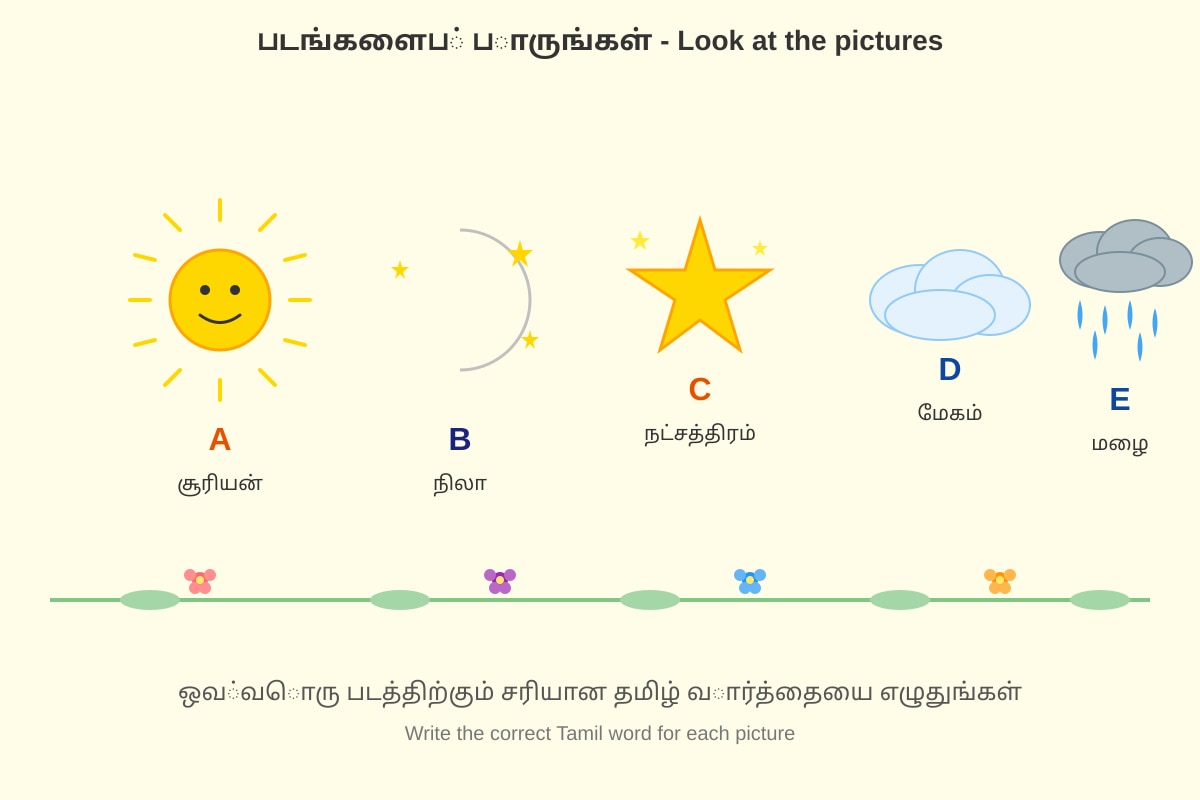
Section B: Match the Words with Pictures (Questions 11-15)
2 marks each
Visual check: The image should show five labeled pictures: A-sun, B-moon, C-star, D-cloud, E-rain
Q11. சூரியன் (sooriyan) — "The Sun"
- Teaching note: "சூர்" relates to brightness/heat. The sun is personified in Tamil culture. Common mistake: writing "கதிரவன்" (poetic form) which is correct but not the simple form expected at P2 level. Accept either, but teach "சூரியன்" as standard.
- Marking: 2 marks for correct Tamil word; 1 mark for phonetically correct attempt with minor spelling error; 0 for wrong word.
Q12. நிலா (nilaa) — "The Moon"
- Teaching note: Simple, common word. Often taught with the rhyme "நிலா, நிலா, ஓடி வா." Common mistake: writing "சந்திரன்" which is more formal/Sanskrit-derived; acceptable but note P2 target is "நிலா".
- Marking: 2 marks for correct Tamil word; 1 mark for minor spelling error; 0 for wrong word.
Q13. நட்சத்திரம் (natchaththiram) — "The Star"
- Teaching note: Longer word but commonly taught. Break into "நட்ச" + "திரம்" for memory. Common mistake: spelling errors with "ச" vs "ச்" conjuncts.
- Marking: 2 marks for correct Tamil word; 1 mark for minor spelling error (e.g., missing conjunct); 0 for wrong word.
Q14. மேகம் (maegam) — "The Cloud"
- Teaching note: From Sanskrit "megha" but fully naturalized in Tamil. Common mistake: confusing with "மூடிகம்" or similar non-words.
- Marking: 2 marks for correct Tamil word; 1 mark for minor spelling error; 0 for wrong word.
Q15. மழை (mazhai) — "The Rain"
- Teaching note: Very common word in Tamil culture where monsoon is significant. Common mistake: writing "மாலை" (evening) due to similar sound—emphasize the "ழ" sound vs "ல" sound distinction.
- Marking: 2 marks for correct Tamil word; 1 mark for minor spelling error; 0 for wrong word.
Section B Total: 10 marks
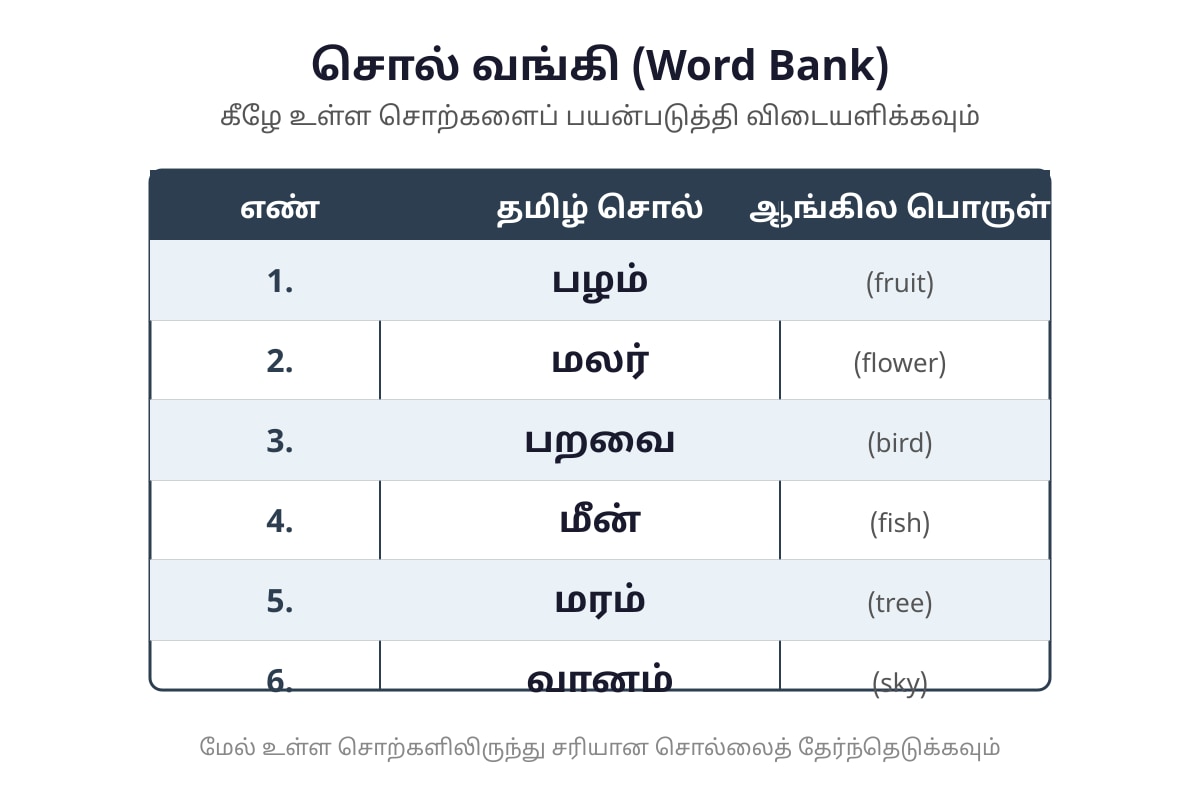
Section C: Fill in the Blanks (Questions 16-18)
2 marks each
Q16. மலர் — "The flower smells nice."
- Teaching note: Sentence pattern is "In flower, ______ smell comes." The word "மலர்" (flower) fits because flowers smell nice. Grammar note: Tamil uses locative case "பூவில்" (in the flower).
- Step-by-step reasoning: (1) Read the sentence — it mentions smell and flower; (2) From word bank, only "மலர்" (flower) relates to smell; (3) "பழம்" (fruit) can smell but sentence already mentions "பூ" (flower).
- Common mistake: Choosing "பழம்" — accept only if student explains fruit flowers smell, but standard answer is மலர்.
- Marking: 2 marks for correct word; 0 for wrong word.
Q17. மீன் — "The fish swims."
- Teaching note: "மீன்" (meen) is the generic word for fish. The verb "நீந்துகிறது" (swims) clearly indicates an aquatic animal.
- Step-by-step reasoning: (1) Identify the verb — "swims"; (2) From word bank, only "மீன்" (fish) swims; (3) "பறவை" (bird) flies, "மரம்" (tree) cannot swim.
- Common mistake: None typical — this is straightforward.
- Marking: 2 marks for correct word; 0 for wrong word.
Q18. மரம் — "The tree is tall."
- Teaching note: "மரம்" (maram/tree) fits the description " tall/உயரமாக". Word bank analysis eliminates others.
- Step-by-step reasoning: (1) Identify the adjective — "tall/உயரமாக"; (2) From word bank, trees are tall; (3) "வானம்" (sky) is not in the word bank; "பழம்" and "மலர்" are not typically described as tall in this context; "மீன்" is not tall.
- Common mistake: Writing "வானம்" (sky) which is not in word bank but students may think of as "high" — remind to use only word bank options.
- Marking: 2 marks for correct word; 0 for wrong answer.
Section C Total: 6 marks
Section D: Opposite Words (Questions 19-20)
2 marks each
Q19. போக (poga) — "Go"
- Teaching note: "வருக" (varuga) means "come" (imperative/honorific form). The opposite is "போக" (poga) meaning "go". Grammar note: Both are imperative verb forms.
- Step-by-step reasoning: (1) "வருக" means coming toward speaker; (2) Opposite movement is going away from speaker; (3) Tamil opposite is "போக" or more formal "செல்/செல்க";
- Common mistake: Writing "போ" (po) which is informal singular imperative — at P2 level, teach "போக" as standard opposite pair. Accept "செல்" or "போ" with note.
- Marking: 2 marks for "போக" or acceptable variant; 1 mark for "போ" or "செல்"; 0 for unrelated word.
Q20. சிறிய (siriya) — "Small"
- Teaching note: "பெரிய" (periya) means big/large. The standard opposite is "சிறிய" (small). These are very common adjective pairs in Primary Tamil.
- Step-by-step reasoning: (1) "பெரிய" describes large size; (2) Opposite size quality is small; (3) Tamil word for small is "சிறிய" or "குட்டி" (tiny) or "சிறு";
- Common mistake: Writing "குட்டி" which means tiny/baby — related but not exact opposite. "குறைந்த" means less, not smaller in size.
- Marking: 2 marks for "சிறிய"; 1 mark for "சிறு" or "குட்டி"; 0 for unrelated word like "குறைந்த".
Section D Total: 4 marks
Grand Total: 40 marks
| Section | Questions | Marks |
|---|---|---|
| A | 1-10 | 20 |
| B | 11-15 | 10 |
| C | 16-18 | 6 |
| D | 19-20 | 4 |
| Total | 20 questions | 40 |
Time distribution guidance (internal, not on paper):
- Section A: ~10 minutes (1 min per question)
- Section B: ~8 minutes (picture analysis + writing)
- Section C: ~6 minutes (reading sentence + choosing from word bank)
- Section D: ~4 minutes
- Review buffer: ~2 minutes