AI Generated Quiz
Primary 2 Mathematics Shapes Quiz
Free P2 Maths Shapes quiz, Kimi2.6 AI version, with questions, answers, and syllabus-aligned practice for Singapore students.
These static practice materials are generated from the site's syllabus and paper-generation workflow, with source and model context shown so students and parents can evaluate the material before use.
Questions

Free quiz and exam paper access
Enter your details to view this paper
Your access is remembered on this device.
Answers
Primary 2 Mathematics Quiz - Shapes (Answer Key)
Version: 1 of 5 (Syllabus-Aligned Generated Content)
Note: This content is syllabus-aligned practice material. No past-year exam papers were available for this topic at this level; questions were generated from interpreted MOE syllabus outcomes and pedagogical patterns suitable for Primary 2.
Section A: Multiple Choice
1. Which of the following is a cube?
Answer: B) A dice
Explanation (1 mark): A cube is a 3D shape with 6 square faces, 12 edges, and 8 vertices. All faces are the same size. A dice (singular of dice) is the classic example of a cube shape in everyday life.
- A ball is a sphere — completely round with no flat faces.
- A cereal box is a cuboid — the faces are rectangles, not all squares.
- A drinking straw is a cylinder — it has circular ends and a curved surface.
Common mistake: Students often confuse "cube" and "cuboid" because both are box-shaped. Remember: a cube has all square faces, while a cuboid has rectangular faces (which may include some squares, but not all six faces must be squares).
2. How many flat faces does a cylinder have?
Answer: C) 2
Explanation (1 mark): A cylinder has 2 flat faces (the circular top and bottom) and 1 curved surface (the side that wraps around).
Think of a soup can: the metal lid and the metal base are both flat circles. The label that wraps around is the curved surface. The flat faces are circular in shape.
Common mistake: Some students think a cylinder has 3 faces by counting the curved surface. In Primary 2, we distinguish between flat faces and curved surfaces. A cylinder has 2 flat faces + 1 curved surface = 3 surfaces total, but only 2 flat faces.
3. Which shape has only one curved surface and no flat faces?
Answer: B) Sphere
Explanation (1 mark): A sphere is the only common 3D shape with no flat faces at all — not even one. It has one continuous curved surface all the way around.
- A cone has 1 flat face (the circular base) and 1 curved surface.
- A cylinder has 2 flat faces and 1 curved surface.
- A cube has 6 flat faces and no curved surfaces.
Think of a ball: you cannot find any flat part on it no matter where you look or how you place it.
4. A cuboid has how many edges?
Answer: D) 12
Explanation (1 mark): A cuboid has 12 edges.
An edge is where two flat faces meet — it's a straight line. If you look at a box-shaped object (like a book or shoebox), you can count:
- 4 edges on the top
- 4 edges on the bottom
- 4 edges going up and down (vertical)
That's 4 + 4 + 4 = 12 edges total.
This is the same number of edges as a cube! Both cubes and cuboids are types of rectangular prisms, and they share this property.
5. Which 3D shape is most like a tent?
Answer: C) Cone (accept pyramid/cone with explanation)
Explanation (1 mark): A tent is most like a cone or pyramid shape because it has a pointed top and a flat base that sits on the ground.
The best answer is cone because many simple tents come to a single point at the top (the apex), similar to a cone's single vertex. However, some tents have a ridge line and are more like a triangular prism or pyramid.
In Primary 2, we focus on the key features: a tent has a flat base (sits on ground) and sloping sides that meet at a point or edge at the top — this distinguishes it from a cylinder, sphere, or regular box shape.
Section B: Fill in the Blanks and Short Answers
6. A square pyramid has ____ vertices.
Answer: 5
Marking (1 mark): Award 1 mark for correct answer.
Explanation: A square pyramid has:
- 4 vertices where the triangular faces meet at the top point (apex)
- 4 vertices around the square base
- But wait — the top apex is 1 vertex, and the square base has 4 corners...
Let me recount properly: A square pyramid has 5 vertices total:
- 4 vertices at the corners of the square base
- 1 vertex at the apex (the top point where all triangles meet)
Marking note: If student writes "4," they may have counted only the base. If "8," they may have confused with edges. Accept "5" only.
7. Name this shape: "It has 6 flat faces. Each face is a square. It has 12 edges and 8 vertices."
Answer: Cube
Marking (1 mark): Award 1 mark for correct identification.
Explanation: This description perfectly matches a cube. Let's verify each clue:
- "6 flat faces" ✓ (top, bottom, left, right, front, back)
- "Each face is a square" ✓ (this is the key — a cuboid has 6 faces but they're rectangles)
- "12 edges" ✓ (4 on top, 4 on bottom, 4 vertical)
- "8 vertices" ✓ (4 corners on top, 4 corners on bottom)
The key distinguishing feature from a cuboid is that all faces are squares (same size, same shape).
8. Complete the table.
| Property | Cube | Cuboid |
|---|---|---|
| Number of flat faces | 6 | 6 |
Answer: 6, 6
Marking (2 marks): Award 1 mark for each correct answer.
Explanation: Both a cube and a cuboid have exactly 6 flat faces. This is what makes them both prisms with rectangular cross-sections.
- Cube: 6 faces, all of which are squares (special rectangles where length = width)
- Cuboid: 6 faces, which are rectangles (opposite faces are identical)
The number of faces is the same (6), but the shape of those faces differs. A cube is actually a special type of cuboid where all edges are equal length, making all faces squares.
9. A cone has ____ flat face(s) and ____ curved surface(s).
Answer: 1, 1 (or "one, one")
Marking (2 marks): Award 1 mark for each correct answer.
Explanation: A cone has:
- 1 flat face: the circular base (like a circle cut out of paper sitting on the table)
- 1 curved surface: the part that wraps around from the base up to the pointy top (apex)
Think of an ice cream cone: the pointy part you hold is all one continuous curved surface. The flat circle at the top (where the ice cream sits) is the flat face. Actually — careful! The ice cream sits on top, so the "base" of the cone is really a flat circular face.
Common everyday example: A party hat or a traffic cone. The cone sits on its circular base (flat face), and the rest curves up to a point.
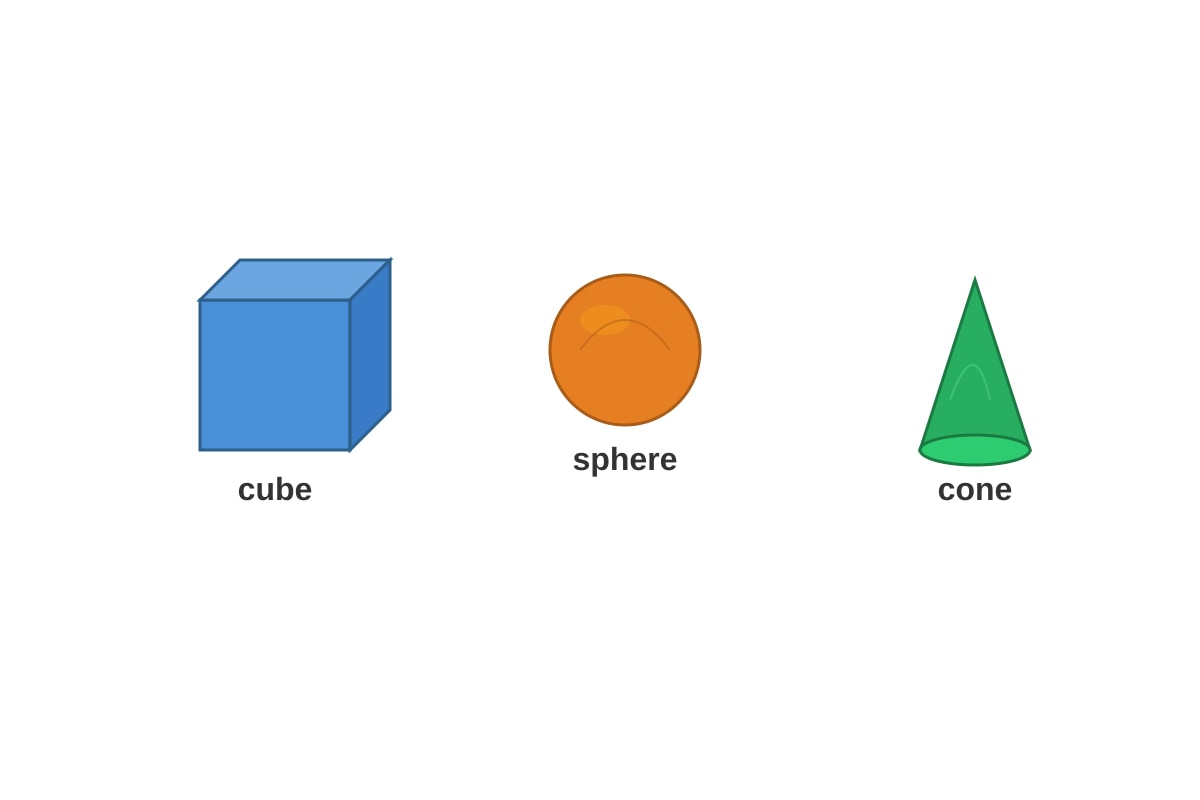
10. Look at the shapes.
(a) Which shape can roll in all directions?
Answer: Sphere (or "B" if referring to labeled diagram)
Marking (1 mark): Award 1 mark for correct identification.
Explanation: A sphere can roll in all directions because it has no flat faces and no edges. It is perfectly round like a ball.
A cube cannot roll — it has flat faces and would just slide or tumble. A cone can roll in a circle around its point, but not in all directions freely.
(b) Which shape can stack easily on a flat table?
Answer: Cube (or "A" if referring to labeled diagram)
Marking (1 mark): Award 1 mark for correct identification.
Explanation: A cube can stack easily because it has flat faces that sit flush against each other. You can pile cubes on top of each other and they stay stable.
A sphere is the worst for stacking — it rolls away! A cone can sit on its base, but the pointy top makes it hard to stack another shape on top.
11. I am a 3D shape. I have 2 flat faces that are circles. I have 1 curved surface. I can roll.
Answer: Cylinder
Marking (2 marks): Award 2 marks for correct answer. Award 1 mark if student identifies as "circle" (2D confusion) but shows partial understanding.
Explanation: Let's check against the clues:
- "2 flat faces that are circles" ✓ — the top and bottom of a cylinder are circles
- "1 curved surface" ✓ — the side that wraps around
- "I can roll" ✓ — cylinders roll on their curved surface (think of a rolling pin or can rolling down a slope)
This is the definition of a cylinder. Don't confuse with a cone (only 1 circular face) or a sphere (no flat faces at all).
Teaching note: Students often confuse "circle" (the 2D shape) with "cylinder" (the 3D shape). Emphasize that flat circular faces are parts of a 3D cylinder.
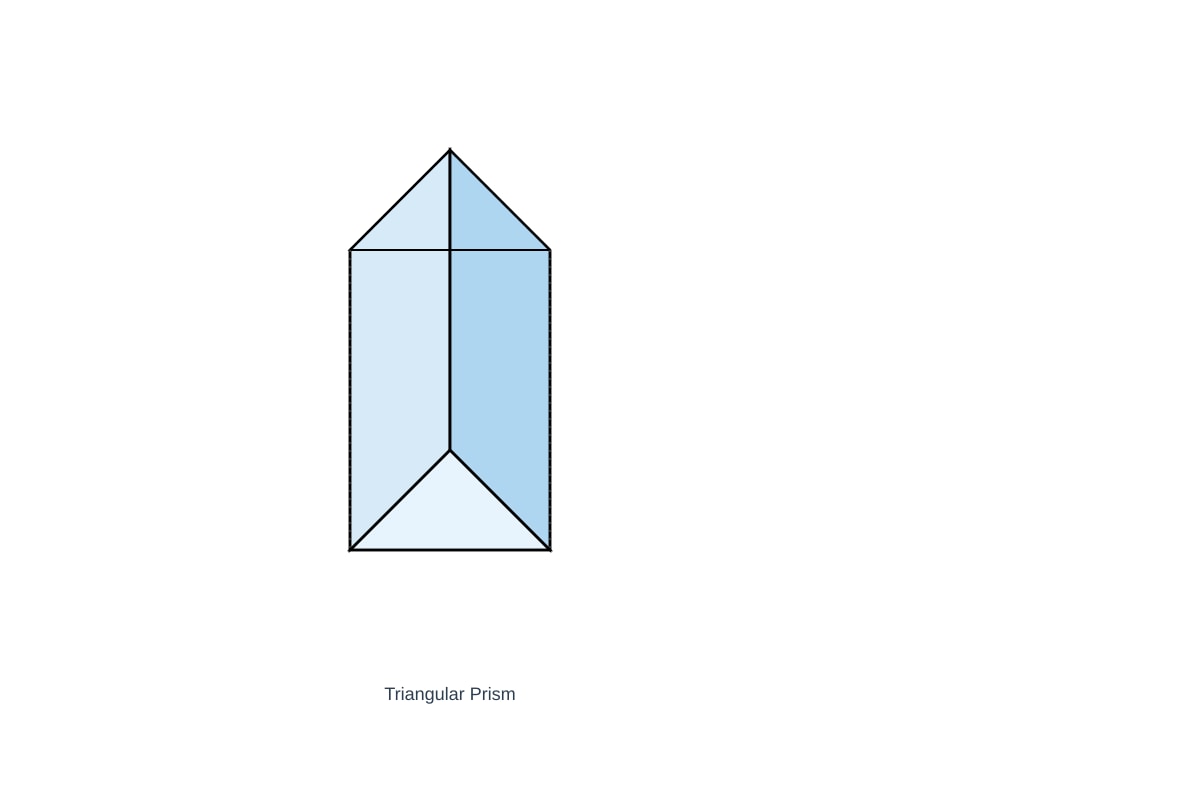
12. Look at the object.
(a) Name this 3D shape.
Answer: Triangular prism
Marking (1 mark): Award 1 mark for correct name. Accept "prism" with explanation.
Explanation: A triangular prism has:
- 2 triangular faces (the "ends" or bases) — these are parallel and identical
- 3 rectangular faces connecting them
The name tells us: "triangular" = the shape of the base (triangle), "prism" = the shape keeps the same cross-section all the way through.
(b) How many faces does this shape have?
Answer: 5
Marking (1 mark): Award 1 mark for correct answer.
Explanation: Counting the faces of a triangular prism:
- 2 triangular faces (front and back)
- 3 rectangular faces (connecting the corresponding sides of the triangles)
2 + 3 = 5 faces total
This is fewer than a cube or cuboid (which have 6 faces) because a triangle has 3 sides, not 4.
13. Rectangular prism with dimensions 5 cm × 3 cm × 2 cm.
(a) How many faces are rectangles?
Answer: 6
Marking (1 mark): Award 1 mark for correct answer.
Explanation: A rectangular prism (cuboid) always has 6 faces, and all 6 faces are rectangles.
Even if some faces happen to be squares (for example, if two dimensions were equal), we still call it a rectangular prism and count all 6 faces. In this case, 5, 3, and 2 are all different, so we get three pairs of differently-sized rectangles:
- Two faces: 5 cm × 3 cm
- Two faces: 5 cm × 2 cm
- Two faces: 3 cm × 2 cm
(b) How many faces are identical (same size and shape)?
Answer: 3 pairs or faces come in 3 pairs of identical faces or each face has one identical partner (accept 6 with explanation that they are in pairs)
Marking (1 mark): Award 1 mark for clear understanding of "identical pairs." Accept "3 pairs" or explanation that faces match in pairs. Accept "0" if student says "no faces are all identical to each other" with valid reasoning.
Explanation: In a cuboid with three different dimensions (5, 3, 2), the faces form 3 pairs of identical faces:
- Front = Back (both 5 × 3)
- Top = Bottom (both 5 × 2)
- Left side = Right side (both 3 × 2)
So there are 3 pairs of identical faces, but no single face size appears more than twice. If the answer given is "2" or "3 pairs," this shows understanding. The answer "6" would be incorrect unless qualified.
14. Look at the shapes in the box.
(a) Write down the letters of all shapes that can roll.
Answer: The letters corresponding to: spheres and cylinders (exact letters depend on random placement; in a typical arrangement with A=cube, B=sphere, C=cylinder, D=cube, E=sphere, F=cylinder, G=cone, H=pyramid: answer would be B, C, E, F — spheres and cylinders roll; cones roll in circles)
Expected answer based on typical labeling: Letters for spheres, cylinders, and cone if considering rolling motion.
Marking (2 marks): Award 2 marks for all correct letters. Award 1 mark for most correct with one omission.
Explanation: Shapes that can roll have at least one curved surface:
- Spheres roll in all directions (completely curved)
- Cylinders roll along their curved surface (like a rolling pin)
- Cones roll in a circular path around their point (less freely, but can roll)
Shapes with only flat faces cannot roll: cubes, cuboids, pyramids, prisms.
(b) Write down the letters of all shapes with only flat faces (no curved surfaces).
Answer: Letters corresponding to: cubes, pyramid (in typical arrangement: A, D, H)
Marking (2 marks): Award 2 marks for all correct. Award 1 mark for most correct with minor error.
Explanation: Shapes with only flat faces and no curved surfaces:
- Cubes — 6 flat square faces
- Cuboids — 6 flat rectangular faces
- Pyramids — 1 flat base + triangular flat faces meeting at apex
- Prisms — 2 flat bases + rectangular flat faces
Shapes to exclude: spheres (curved), cylinders (curved surface), cones (curved surface).
15. Complete: A sphere has ____ faces, ____ edges, and ____ vertices.
Answer: 0, 0, 0 (or "zero, zero, zero")
Marking (3 marks): Award 1 mark for each correct answer.
Explanation: A sphere is special among our common 3D shapes:
| Feature | Sphere | Why? |
|---|---|---|
| Faces | 0 | No flat surfaces at all — completely round |
| Edges | 0 | No straight lines where faces meet |
| Vertices | 0 | No corners or points |
This makes the sphere the simplest 3D shape in terms of these features, but hardest to draw! It's unlike any other common shape we study.
Common mistake: Students sometimes want to say a sphere has "1 curved face." In strict Primary 2 terminology, a face is specifically a flat surface. The sphere's outer boundary is called a surface, not a face. The sphere has 1 curved surface but 0 faces.
Section C: Problem Solving and Application
16. Ravi's tower
(a) Which shape should he put at the bottom? Explain why.
Answer: A cube or cylinder (flat base shapes), with explanation about flat, stable base.
Marking (2 marks):
- 1 mark: Identifies shape with flat base (cube, cuboid, cylinder sitting on flat face, or pyramid on its base)
- 1 mark: Explanation mentioning "flat face," "stable," "won't roll," or similar concept
Explanation: For a stable tower, the bottom shape needs:
- A flat face to sit firmly on the table
- To not roll away
The cube is ideal because it has 6 flat faces, any of which can be the base. It's very stable.
A cylinder could work if placed on one of its circular flat faces, but it could also be placed on its curved surface and roll — less ideal.
A sphere is the worst choice — it will roll away immediately!
(b) Can he put a sphere in the middle? Explain.
Answer: No (or "Yes, but it's very hard/unsafe"), with explanation.
Marking (2 marks):
- 1 mark: Correct judgment (No / difficult)
- 1 mark: Explanation about rolling, no flat faces, instability
Explanation: No, a sphere cannot be put in the middle of a stable tower.
A sphere has:
- No flat faces — nothing for the shape above to sit on
- It will roll in any direction — the tower would collapse
Even if you tried to balance another shape on top of a sphere, the sphere would roll out from under it. The only way would be to somehow hold the sphere in place (like a groove or glue), but for normal stacking, a sphere doesn't work.
Alternative acceptable answer: A student might creatively suggest "Yes, if wedges or supports hold it" — this shows advanced thinking and should be rewarded if explained well.
17. Mrs. Tan's box
(a) Spherical box or cuboid box?
Answer: Cuboid box
Marking (2 marks):
- 1 mark: Correct choice
- 1 mark: Explanation about flat surfaces, fitting rectangular books, space efficiency
Explanation: A cuboid box is correct because:
- Books are flat and rectangular — they match the flat faces of a cuboid
- A cuboid box can be packed efficiently with no wasted space
- Books can be stacked neatly in rows
A spherical box would be terrible:
- Books would slide around the curved interior
- Lots of wasted space near the top and bottom
- Impossible to stack books flat
Real-world connection: All book boxes, moving boxes, and storage containers are cuboid-shaped for this reason!
(b) How many flat faces does this cube box have?
Answer: 6
Marking (1 mark): Award 1 mark for correct answer.
Explanation: This is a straightforward recall question. All cubes have 6 flat faces regardless of their size. The 10 cm edge length is extra information to test whether students can identify the relevant fact.
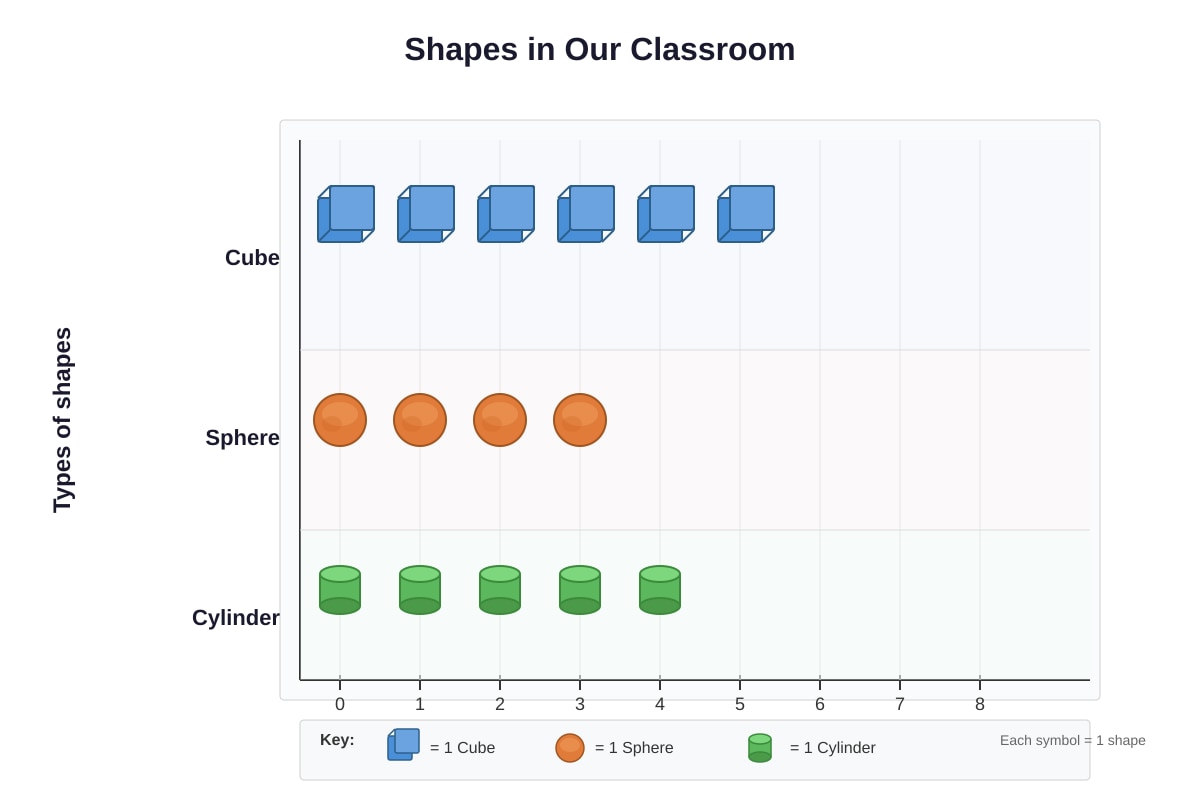
18. Picture graph
(a) How many cubes?
Answer: 6
Marking (1 mark): Award 1 mark.
Explanation: Count the cube symbols in the pictograph. Each symbol = 1 cube. If there are 6 cube symbols drawn, the answer is 6.
(b) How many more cylinders than spheres?
Working:
Cylinders = 5
Spheres = 4
5 − 4 = 1
Answer: 1
Marking (2 marks):
- 1 mark: Correct subtraction method shown or implied
- 1 mark: Correct answer with unit ("1 more")
Explanation: This is a comparison problem requiring subtraction. We need to find:
- How many cylinders? → read from graph = 5
- How many spheres? → read from graph = 4
- Difference: 5 − 4 = 1
The question asks "how many more" — this always signals subtraction (or counting up). We're comparing two quantities to find the gap between them.
(c) Total number of shapes
Working:
Cubes = 6
Spheres = 4
Cylinders = 5
Total = 6 + 4 + 5 = 15
Answer: 15
Marking (2 marks):
- 1 mark: Correct addition of all three values
- 1 mark: Correct final answer
Explanation: "Total" means we add everything together. This tests whether students understand the word "total" and can extract three values from a pictograph before computing.
Students must read all three rows correctly and then perform: 6 + 4 + 5. The addition can be done in any order:
- 6 + 4 = 10, then 10 + 5 = 15
- Or 4 + 5 = 9, then 6 + 9 = 15
19. Shape puzzle
(a) What shape am I?
Answer: Cuboid (or "rectangular prism")
Marking (2 marks): Award 2 marks for correct answer. Award 1 mark if student says "cube" with reasoning about 6 faces and 8 vertices, noting that a cube is a special cuboid.
Explanation: Let's check the clues:
- "More than 5 faces" → 6 faces (eliminates pyramid with 5, triangular prism with 5)
- "All faces are flat" → no curved surfaces (eliminates cylinder, cone, sphere)
- "Exactly 8 vertices" → matches cuboid/cube
With 6 flat faces and 8 vertices, this is a cuboid (or cube, which is a special type of cuboid).
Why not a hexagonal prism? That has 8 faces (2 hexagons + 6 rectangles), which violates "more than 5" but is more than 6 — however, Primary 2 syllabus focuses on basic shapes, and hexagonal prisms are not standard. The expected answer from Primary 2 curriculum is cuboid.
Why not a pentagonal pyramid? A square pyramid has 5 faces, so a pentagonal pyramid has 6 faces (1 pentagon + 5 triangles) — but it has 6 vertices (5 on base + 1 apex), not 8.
So cuboid is the unique correct answer in the Primary 2 context.
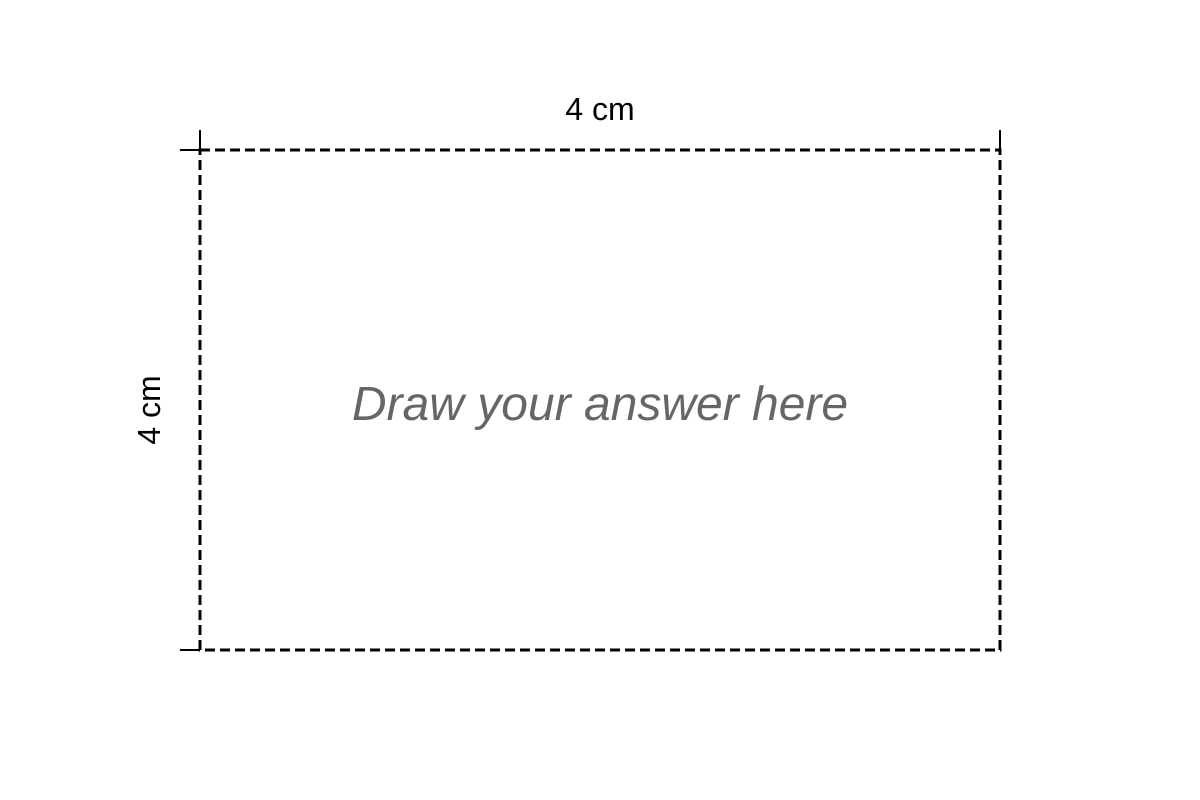
(b) Draw the shape of one face
Expected drawing: A rectangle (or square, since a cube is a special cuboid)
Marking (1 mark): Award 1 mark for a clear rectangle or square. Accept if student draws a rectangle with roughly 90° corners.
Explanation: Every face of a cuboid is a rectangle (including the special case where some faces are squares). The drawing should show:
- 4 straight sides
- 4 corners that look roughly like right angles (90°)
- Opposite sides appearing roughly equal
No need for perfect measurement — the shape recognition is what matters.
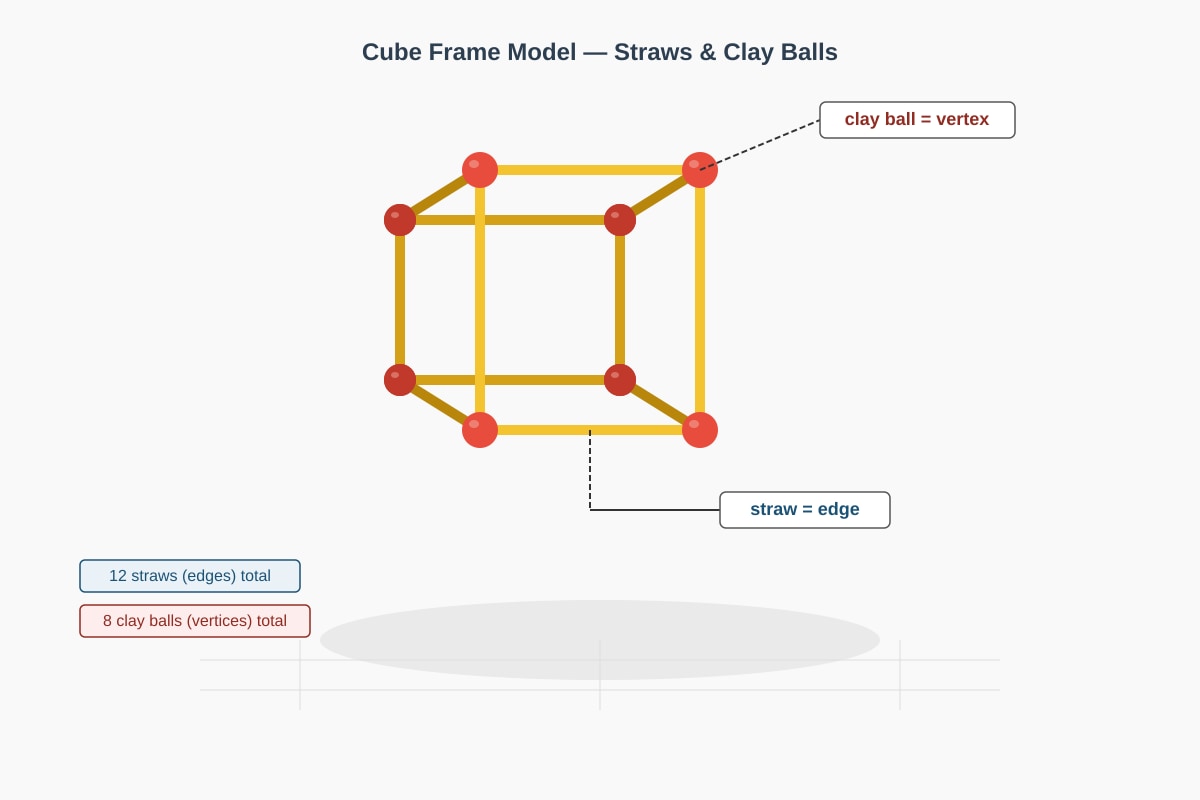
20. Challenge Question — straws and clay balls
(a) How many straws for a cube?
Answer: 12
Marking (2 marks): Award 2 marks for correct answer.
Explanation: In this model, straws = edges. A cube has 12 edges:
- 4 edges on the top face
- 4 edges on the bottom face
- 4 edges connecting top to bottom (vertical)
4 + 4 + 4 = 12 straws
This is a concrete way to understand what "edge" means — it's the "stick" part where two faces meet, or in this model, where two clay balls (vertices) are connected.
(b) How many clay balls for a cube?
Answer: 8
Marking (2 marks): Award 2 marks for correct answer.
Explanation: Clay balls = vertices (corners). A cube has 8 vertices:
- 4 corners on the top face
- 4 corners on the bottom face
4 + 4 = 8 clay balls
(c) Lily has 9 straws and 6 clay balls. What square-based shape can she make?
Answer: Square-based pyramid (or "pyramid with square base")
Marking (3 marks):
- 1 mark: Identifies correct shape (square pyramid or similar pyramid)
- 1 mark: Checks straws needed: 8 edges (4 base + 4 sides) ≤ 9 available ✓
- 1 mark: Checks clay balls needed: 5 vertices (4 base corners + 1 apex) ≤ 6 available ✓
Explanation: Let's check what shapes might work:
Square pyramid:
- Base: square (4 edges, 4 vertices)
- Sides: 4 triangles meeting at apex (4 edges from base corners to apex, 1 apex vertex)
- Total: 8 edges (straws) and 5 vertices (clay balls)
Check against Lily's supplies: 8 straws needed ≤ 9 available ✓, 5 clay balls needed ≤ 6 available ✓
A cube? Needs 12 straws — Lily only has 9. ✗
A triangular prism? Needs 9 edges (2 triangles = 6 edges? No — triangular prism has 9 edges: 3 + 3 + 3). But needs 6 vertices. Let's check: 9 straws = exactly enough, 6 clay balls = exactly enough!
Wait — triangular prism also works with exactly 9 straws and 6 clay balls!
However, the question specifies "square base" — so we need a shape with a square as its base. The square pyramid is the correct answer matching all constraints.
Marking note: If a student correctly identifies that a triangular prism uses exactly 9 straws and 6 clay balls but misses "square base," award 1 mark for the mathematical check but note the reading error. Full marks only for square-based answer.
END OF ANSWER KEY
This answer key provides teaching explanations suitable for students new to 3D shapes. Common misconceptions are flagged to help tutors and students understand underlying concepts.