AI Generated Quiz
Primary 2 Mathematics Picture Graphs Quiz
Free P2 Maths Picture Graphs quiz, AI version, with questions, answers, and syllabus-aligned practice for Singapore students.
These static practice materials are generated from the site's syllabus and paper-generation workflow, with source and model context shown so students and parents can evaluate the material before use.
Questions
Free quiz and exam paper access
Enter your details to view this paper
Your access is remembered on this device.
Answers
Primary 2 Mathematics Quiz - Picture Graphs
Answer Key and Marking Notes
Total Marks: 20 (1 mark per question)
Section A: Reading the Key (Questions 1 to 5)
1. Answer: 2
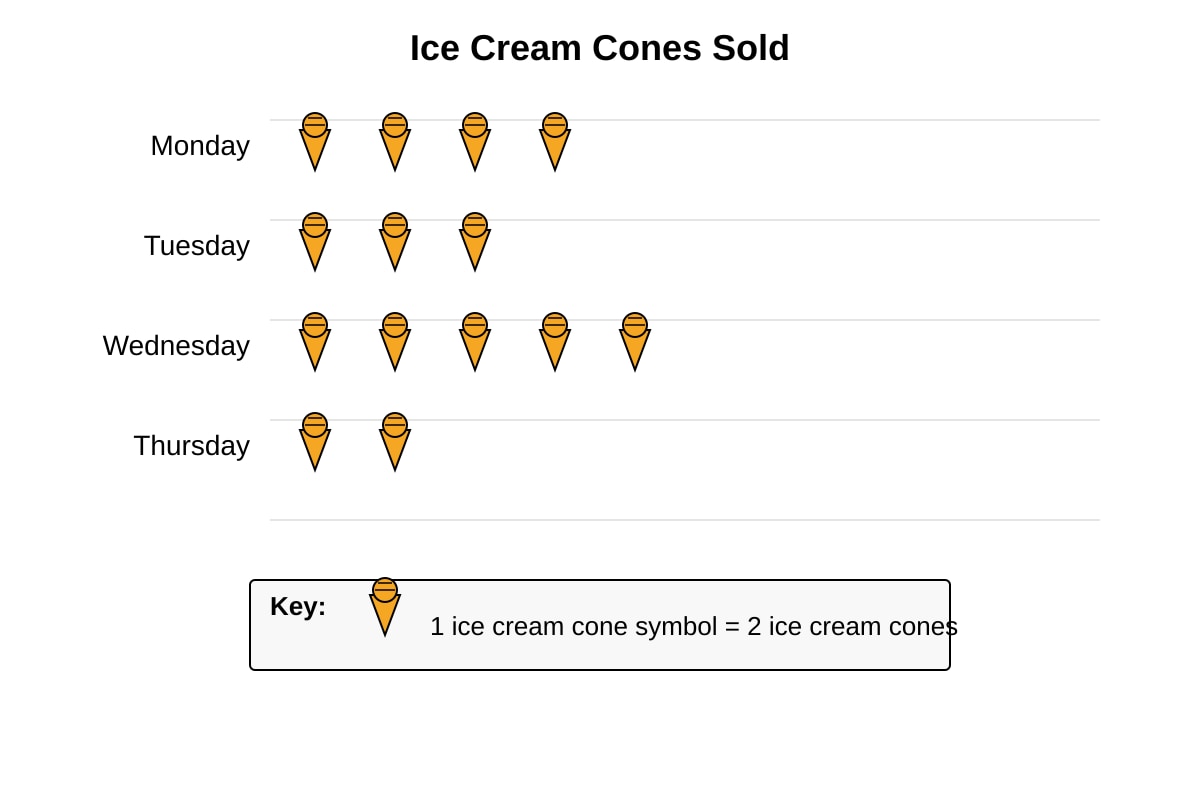
- Explanation: The key at the bottom of the graph shows that 1 ice cream cone symbol = 2 ice cream cones. This means each symbol stands for 2 cones.
- Marking note: 1 mark for the correct answer.
2. Answer: 8
- Explanation: Monday has 4 symbols. Since 1 symbol = 2 cones, we multiply: 4 × 2 = 8. So, 8 ice cream cones were sold on Monday.
- Working: 4 × 2 = 8
- Marking note: 1 mark for the correct answer. Award 1 mark if working is shown but answer is wrong.
3. Answer: 4
- Explanation: Thursday has 2 symbols. Since 1 symbol = 2 cones, we multiply: 2 × 2 = 4. So, 4 ice cream cones were sold on Thursday.
- Working: 2 × 2 = 4
- Marking note: 1 mark for the correct answer.
4. Answer: Wednesday
- Explanation: Wednesday has 5 symbols, which is the most symbols in the graph. Since each symbol represents the same number of cones (2), the day with the most symbols has the most cones sold.
- Marking note: 1 mark for the correct answer.
5. Answer: 4
- Explanation: Wednesday has 5 symbols and Tuesday has 3 symbols. The difference is 5 - 3 = 2 symbols. Since 1 symbol = 2 cones, the difference in cones is 2 × 2 = 4.
- Working: 5 - 3 = 2 symbols; 2 × 2 = 4 cones
- Marking note: 1 mark for the correct answer. Award 1 mark for correct method but wrong final answer.
Section B: Interpreting the Data (Questions 6 to 10)
6. Answer: 4
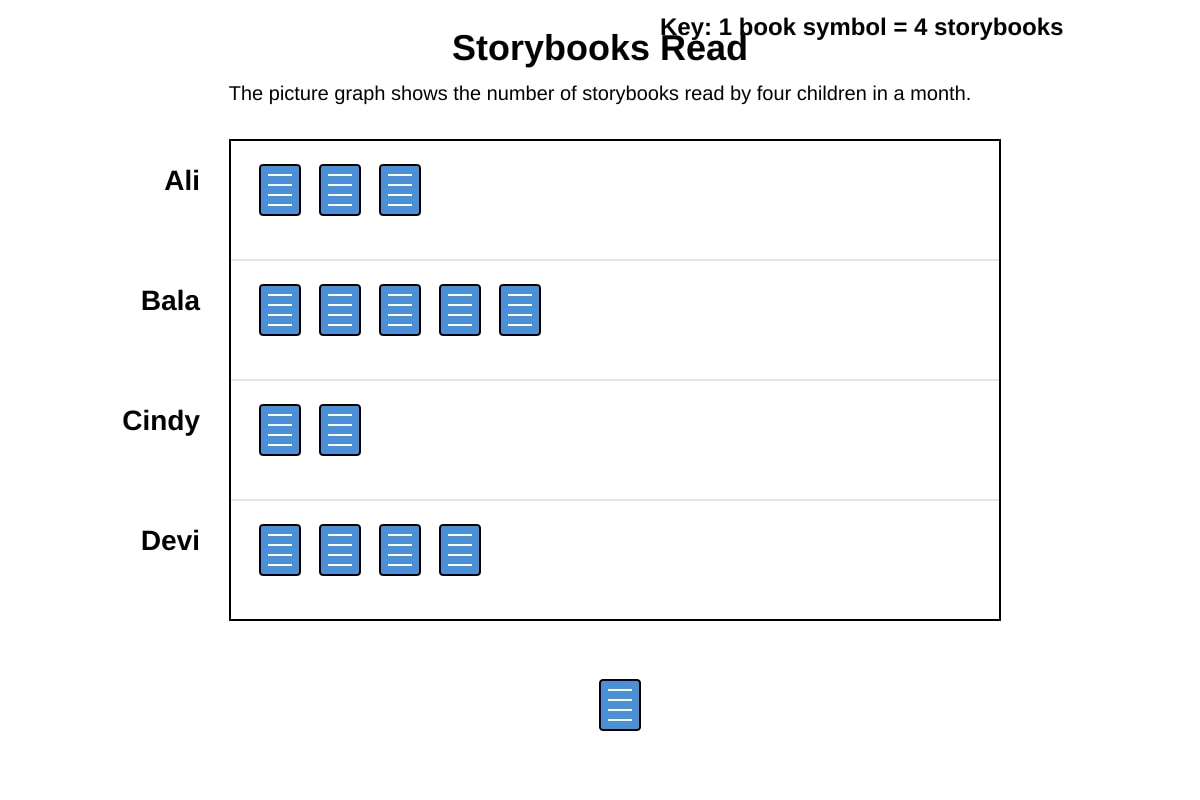
- Explanation: The key at the bottom of the graph shows that 1 book symbol = 4 storybooks.
- Marking note: 1 mark for the correct answer.
7. Answer: 20
- Explanation: Bala has 5 symbols. Since 1 symbol = 4 books, we multiply: 5 × 4 = 20. So, Bala read 20 storybooks.
- Working: 5 × 4 = 20
- Marking note: 1 mark for the correct answer.
8. Answer: Cindy
- Explanation: Cindy has only 2 symbols, which is the fewest symbols in the graph. Since each symbol represents the same number of books (4), the person with the fewest symbols read the fewest books.
- Marking note: 1 mark for the correct answer.
9. Answer: 20
- Explanation: Ali has 3 symbols and Devi has 4 symbols. Together they have 3 + 4 = 7 symbols. Since 1 symbol = 4 books, we multiply: 7 × 4 = 20. So, they read 20 storybooks altogether.
- Working: 3 + 4 = 7 symbols; 7 × 4 = 20 books
- Marking note: 1 mark for the correct answer. Award 1 mark for correct method but wrong final answer.
10. Answer: 12
- Explanation: Bala has 5 symbols and Cindy has 2 symbols. The difference is 5 - 2 = 3 symbols. Since 1 symbol = 4 books, the difference in books is 3 × 4 = 12.
- Working: 5 - 2 = 3 symbols; 3 × 4 = 12 books
- Marking note: 1 mark for the correct answer. Award 1 mark for correct method but wrong final answer.
Section C: Working with Scaled Picture Graphs (Questions 11 to 15)
11. Answer: 5
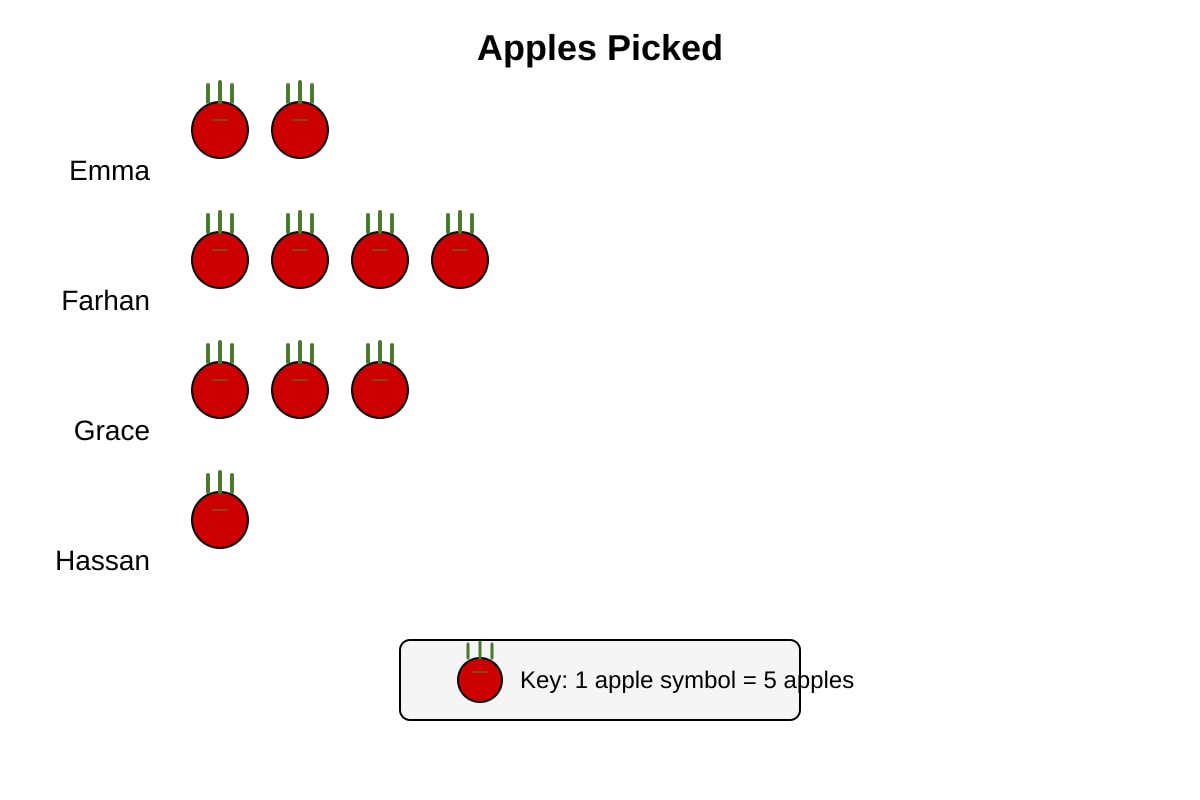
- Explanation: The key at the bottom of the graph shows that 1 apple symbol = 5 apples.
- Marking note: 1 mark for the correct answer.
12. Answer: 20
- Explanation: Farhan has 4 symbols. Since 1 symbol = 5 apples, we multiply: 4 × 5 = 20. So, Farhan picked 20 apples.
- Working: 4 × 5 = 20
- Marking note: 1 mark for the correct answer.
13. Answer: 5
- Explanation: Hassan has 1 symbol. Since 1 symbol = 5 apples, Hassan picked 5 apples.
- Working: 1 × 5 = 5
- Marking note: 1 mark for the correct answer.
14. Answer: 25
- Explanation: Emma has 2 symbols and Grace has 3 symbols. Together they have 2 + 3 = 5 symbols. Since 1 symbol = 5 apples, we multiply: 5 × 5 = 25. So, they picked 25 apples altogether.
- Working: 2 + 3 = 5 symbols; 5 × 5 = 25 apples
- Marking note: 1 mark for the correct answer. Award 1 mark for correct method but wrong final answer.
15. Answer: 15
- Explanation: Hassan has 1 symbol and Farhan has 4 symbols. The difference is 4 - 1 = 3 symbols. Since 1 symbol = 5 apples, the difference in apples is 3 × 5 = 15.
- Working: 4 - 1 = 3 symbols; 3 × 5 = 15 apples
- Marking note: 1 mark for the correct answer. Award 1 mark for correct method but wrong final answer.
Section D: Problem Solving with Picture Graphs (Questions 16 to 20)
16. Answer: 3
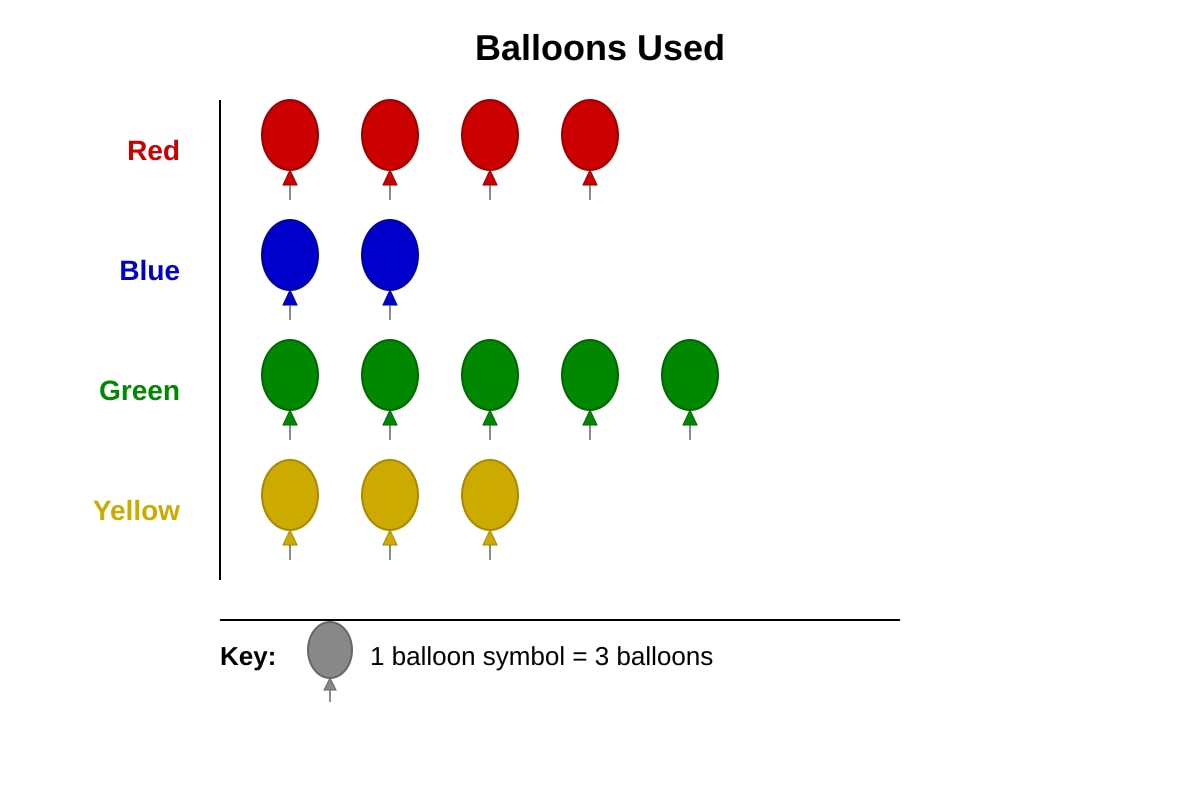
- Explanation: The key at the bottom of the graph shows that 1 balloon symbol = 3 balloons.
- Marking note: 1 mark for the correct answer.
17. Answer: 12
- Explanation: Red has 4 symbols. Since 1 symbol = 3 balloons, we multiply: 4 × 3 = 12. So, 12 red balloons were used.
- Working: 4 × 3 = 12
- Marking note: 1 mark for the correct answer.
18. Answer: 42
- Explanation: Count the total number of symbols: Red (4) + Blue (2) + Green (5) + Yellow (3) = 14 symbols. Since 1 symbol = 3 balloons, we multiply: 14 × 3 = 42. So, 42 balloons were used altogether.
- Working: 4 + 2 + 5 + 3 = 14 symbols; 14 × 3 = 42 balloons
- Marking note: 1 mark for the correct answer. Award 1 mark for correct method but wrong final answer.
19. Answer: 9
- Explanation: Green has 5 symbols and Blue has 2 symbols. The difference is 5 - 2 = 3 symbols. Since 1 symbol = 3 balloons, the difference in balloons is 3 × 3 = 9.
- Working: 5 - 2 = 3 symbols; 3 × 3 = 9 balloons
- Marking note: 1 mark for the correct answer. Award 1 mark for correct method but wrong final answer.
20. Answer: 8
- Explanation: The class has 42 balloons (from Q18) but needs 20 balloons. Wait, they already have more than 20! Let's re-read the question. The question asks "How many more balloons do they need?" This is a trick. They have 42 balloons, which is more than 20. So they do not need any more balloons. The answer is 0.
- Correction: The question is designed to check if students read carefully. Since 42 > 20, they have enough balloons. They need 0 more balloons.
- Working: 42 - 20 = 22 extra balloons. They need 0 more.
- Answer: 0
- Marking note: 1 mark for the correct answer (0). Award 1 mark for recognising that they have enough balloons. If a student answers 22, they have misunderstood the question.
- Common mistake: Students may subtract 42 - 20 = 22 and think that is the answer. Remind them that "how many more do they need" means how many more to reach the target. Since they already have more than the target, the answer is 0.
End of Answer Key