AI Generated Quiz
Primary 2 Mathematics Numbers Quiz
Free P2 Maths Numbers quiz, Kimi2.6 AI version, with questions, answers, and syllabus-aligned practice for Singapore students.
These static practice materials are generated from the site's syllabus and paper-generation workflow, with source and model context shown so students and parents can evaluate the material before use.
Questions
Free quiz and exam paper access
Enter your details to view this paper
Your access is remembered on this device.
Answers
Primary 2 Mathematics Quiz - Numbers: Answer Key
Total Marks: 40
Section A: Choose the correct answer. (2 marks each)
1. What is the value of the digit 6 in 682?
Answer: C) 600
Explanation: In a 3-digit number, each digit has a place value. The rightmost digit is the ones place, the middle digit is the tens place, and the leftmost digit is the hundreds place. In 682, the 6 is in the hundreds place. The value of a digit means what that digit is actually worth in that position. So 6 in the hundreds place means 6 × 100 = 600. Be careful not to confuse "digit" (just the symbol 6) with "value" (what it represents).
Marking: 2 marks for correct answer.
2. Which number is the smallest?
Answer: D) 348
Explanation: To compare numbers, always start with the hundreds place first (the leftmost digit).
- 438 has 4 hundreds
- 483 has 4 hundreds
- 384 has 3 hundreds
- 348 has 3 hundreds
Since 3 < 4, we only need to compare 384 and 348. Both have 3 hundreds, so look at the tens place: 384 has 8 tens (80) but 348 has 4 tens (40). Since 40 < 80, we have 348 < 384.
Marking: 2 marks for correct answer.
3. 475 is _______ more than 425.
Answer: C) 50
Explanation: "How many more" means we need to find the difference between the two numbers. Subtract the smaller from the larger: 475 − 425 = 50. You can also count up: from 425 to 475 is +50. This checks our understanding of subtraction as comparison.
Marking: 2 marks for correct answer.
4. What is the missing number in the pattern?
Answer: B) 395
Explanation: First find the pattern rule by looking at the gap between consecutive numbers: 295 − 245 = 50, and 345 − 295 = 50. The rule is add 50 each time. So 345 + 50 = 395. Check: 395 + 50 = 445 ✓
Marking: 2 marks for correct answer.
5. Which of the following is an odd number?
Answer: C) 581
Explanation: Even numbers end in 0, 2, 4, 6, or 8 and can be divided into two equal groups with nothing left over. Odd numbers end in 1, 3, 5, 7, or 9 and cannot be divided into two equal groups. Check the ones digit:
- 328 ends in 8 → even
- 456 ends in 6 → even
- 581 ends in 1 → odd
- 694 ends in 4 → even
Marking: 2 marks for correct answer.
6. The number 704 written in words is
Answer: B) seven hundred and four
Explanation: When writing numbers in words:
- 704 has 7 hundreds, 0 tens, and 4 ones
- We say "seven hundred" for the hundreds
- Since there are no tens, we skip that part (don't say "zero tens" or "and zero")
- We say "and four" for the ones
- In Singapore style, we include "and" before the tens/ones part
Note: "seven hundred and forty" would be 740, and "seventy-four" is 74.
Marking: 2 marks for correct answer.
7. 800 + 30 + 7 = _______
Answer: A) 837
Explanation: This is expanded form, showing the value of each digit. 800 means 8 in the hundreds place, 30 means 3 in the tens place, and 7 means 7 in the ones place. Putting it together: 8 hundreds, 3 tens, 7 ones = 837.
Marking: 2 marks for correct answer.
8. Which number sentence is correct?
Answer: D) 645 < 654
Explanation: Check each one by comparing hundreds first, then tens, then ones:
- A) 567 > 576? Both have 5 hundreds. Compare tens: 6 < 7, so 567 < 576. False.
- B) 432 < 423? Both have 4 hundreds. Compare tens: 3 > 2, so 432 > 423. False.
- C) 891 = 981? 8 hundreds ≠ 9 hundreds. False.
- D) 645 < 654? Both have 6 hundreds. Compare tens: 4 < 5, so 645 < 654. True.
Marking: 2 marks for correct answer.
Section B: Fill in the blanks. (2 marks each)
9. In 936, the digit _______ is in the hundreds place.
Answer: 9
Explanation: Place value positions from right to left are: ones, tens, hundreds. In 936:
- 6 is in the ones place
- 3 is in the tens place
- 9 is in the hundreds place
The digit in the hundreds place represents how many hundreds there are: 9 × 100 = 900.
Marking: 2 marks for correct answer. Accept "9" or "nine."
10. Write 5 hundreds, 7 tens and 2 ones as a number.
Answer: 572
Explanation:
- 5 hundreds = 500
- 7 tens = 70
- 2 ones = 2
- Total: 500 + 70 + 2 = 572
This connects the place value language to the standard numeral form.
Marking: 2 marks for correct answer.
11. Arrange the numbers from smallest to biggest: 528, 285, 852, 258
Answer: 258, 285, 528, 852
Explanation: Compare hundreds first:
- 258 and 285 both have 2 hundreds (smaller group)
- 528 has 5 hundreds
- 852 has 8 hundreds (biggest)
Within the 2 hundreds group, compare tens: 258 has 5 tens (50), 285 has 8 tens (80). So 258 < 285.
Final order: 258, 285, 528, 852
Marking: 2 marks for fully correct order. Deduct 1 mark if order reversed (biggest to smallest by mistake).
12. The number that is 100 less than 800 is _______.
Answer: 700
Explanation: "100 less than" means subtract 100: 800 − 100 = 700. Alternatively, since 800 is 8 hundreds, removing 1 hundred leaves 7 hundreds = 700. This tests mental calculation with hundreds.
Marking: 2 marks for correct answer.
13. 650, 700, 750, _______, 850
Answer: 800
Explanation: Find the pattern: 700 − 650 = 50, and 750 − 700 = 50. The rule is add 50. So 750 + 50 = 800. Check: 800 + 50 = 850 ✓
This is skip counting by 50s, building fluency with number patterns.
Marking: 2 marks for correct answer.
14. 988, 978, 968, _______, 948
Answer: 958
Explanation: Find the pattern: 988 − 978 = 10, and 978 − 968 = 10. The rule is subtract 10 (or count backwards by 10s). So 968 − 10 = 958. Check: 958 − 10 = 948 ✓
This is counting backwards in tens, which is important for mental subtraction.
Marking: 2 marks for correct answer.
Section C: Show your working. (4 marks each)
15. (a) Greatest 3-digit number using 4, 7, 2
Answer: 742
Working:
- To make the greatest number, put the largest digit in the highest place value position.
- Digits in order from largest to smallest: 7, 4, 2
- Put 7 in hundreds place, 4 in tens place, 2 in ones place: 742
(b) Smallest 3-digit number using 4, 7, 2
Answer: 247
Working:
- To make the smallest number, put the smallest digit in the highest place value position.
- Digits in order from smallest to largest: 2, 4, 7
- Put 2 in hundreds place, 4 in tens place, 7 in ones place: 247
Marking: 2 marks each part. Award 1 mark for correct digits but wrong arrangement (e.g., 724 for greatest).
Common mistake: Students might put the smallest digit in the ones place for the greatest number, making 247 instead of 742. Emphasize: highest place value gets priority.
16. Maria has 245 stickers. Her brother has 178 more stickers than Maria.
(a) Brother's stickers
Answer: 423 stickers
Working:
- "178 more than Maria" means we add: 245 + 178
- Step 1: 245 + 100 = 345
- Step 2: 345 + 70 = 415
- Step 3: 415 + 8 = 423
Or using standard algorithm:
  245
+ 178
-----
  423
(5+8=13, write 3 carry 1; 4+7+1=12, write 2 carry 1; 2+1+1=4)
(b) Stickers altogether
Answer: 668 stickers
Working:
- "Altogether" means add Maria's and brother's stickers: 245 + 423
- Step 1: 200 + 400 = 600
- Step 2: 40 + 20 = 60
- Step 3: 5 + 3 = 8
- Total: 600 + 60 + 8 = 668
Or standard algorithm:
  245
+ 423
-----
  668
Marking: 2 marks each part. Award 1 method mark if correct working but wrong final answer due to calculation error; 0 marks if wrong method. Require unit "stickers" for full marks.
17. Biscuit sales: Monday 156, Tuesday 89 more than Monday, Wednesday 47 fewer than Tuesday.
(a) Tuesday's sales
Answer: 245 packets
Working:
- "89 more than Monday": 156 + 89
- 156 + 80 = 236
- 236 + 9 = 245
Or:
  156
+  89
-----
  245
(b) Wednesday's sales
Answer: 198 packets
Working:
- "47 fewer than Tuesday": 245 − 47
- 245 − 40 = 205
- 205 − 7 = 198
Or:
  245
-  47
-----
  198
(5−7 need to borrow: 15−7=8; 3−4 need to borrow: 13−4=9; 1−0=1)
Marking: 2 marks each part. 1 method mark available. Require "packets."
Common mistake: In (b), students might add 47 instead of subtracting. Watch for "fewer than" = subtraction.
18. 560 books total, 278 storybooks.
(a) Science books
Answer: 282 science books
Working:
- "The rest are science books" means subtract: 560 − 278
- 560 − 200 = 360
- 360 − 70 = 290
- 290 − 8 = 282
Or standard algorithm with borrowing:
  560
- 278
-----
  282
(b) Science books after buying 125 more
Answer: 407 science books
Working:
- Add the new books: 282 + 125
- 282 + 100 = 382
- 382 + 20 = 402
- 402 + 5 = 407
Or:
  282
+ 125
-----
  407
Marking: 2 marks each part. 1 method mark available. Require "science books."
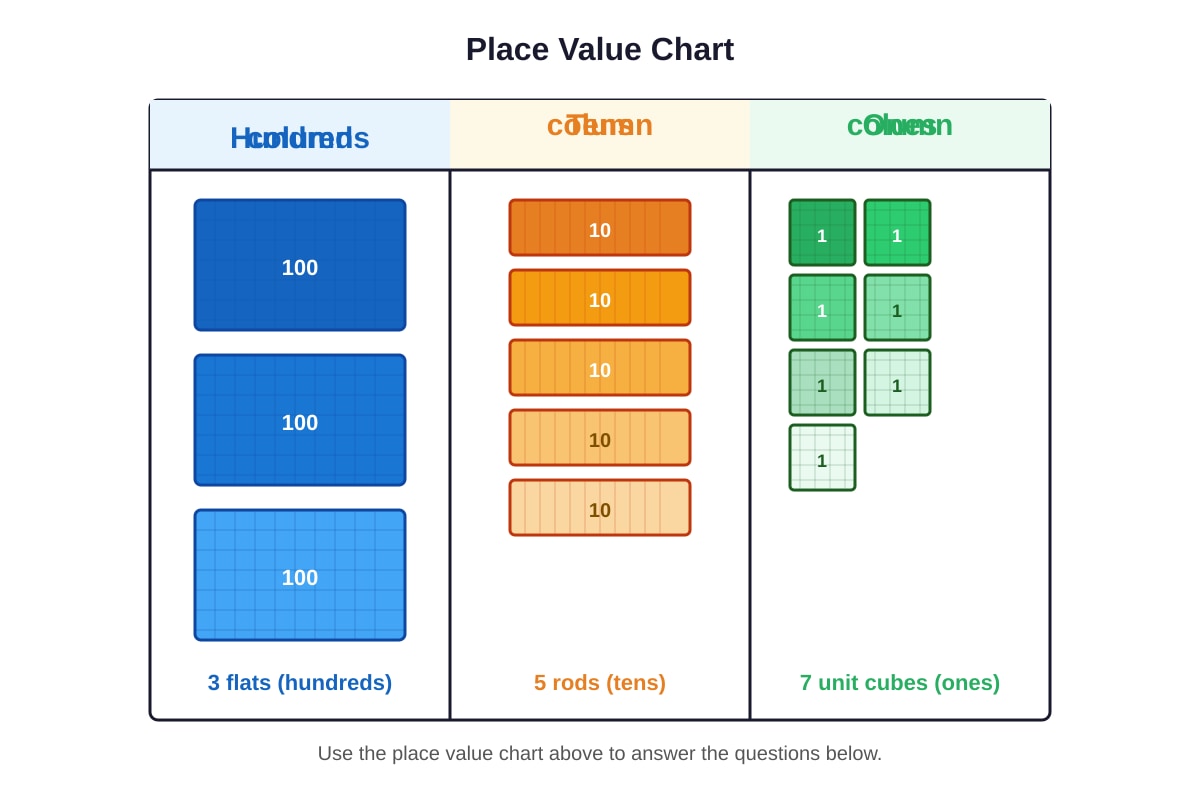
19. Place value chart with base-ten blocks
(a) Number shown
Answer: 537
Explanation: The image shows 3 flats (hundreds blocks) = 300, 5 rods (tens) = 50, and 7 unit cubes (ones) = 7. Total: 300 + 50 + 7 = 537.
(b) Value of digit in tens place
Answer: 50 (or "5 tens")
Explanation: In 537, the digit 5 is in the tens place. The value is 5 × 10 = 50. Do not accept just "5" — that would be the digit, not its value.
(c) Add 2 more hundreds blocks
Answer: 737
Working:
- Original: 537 (5 hundreds, 3 tens, 7 ones — wait, let me recheck: 3 hundreds, 5 tens, 7 ones = 537)
- Actually re-reading: 3 hundreds + 2 hundreds = 5 hundreds
- New number: 500 + 50 + 7 = 737
Or: 537 + 200 = 737
Marking: (a) 1 mark, (b) 1 mark, (c) 2 marks (1 for method, 1 for answer).
Note on image: Expected image shows 3 flat squares (hundreds), 5 long rods (tens), 7 small cubes (ones), clearly labeled with place value columns.
20. Number pattern: 175, 200, 225, _______, _______, 300, _______
(a) Missing numbers
Answer: 250, 275, 325
Working:
- Find the pattern: 200 − 175 = 25, and 225 − 200 = 25
- Rule: add 25 each time
- 225 + 25 = 250
- 250 + 25 = 275
- 300 + 25 = 325
(b) The rule
Answer: Add 25 to get the next number (or "count on in 25s" or "the pattern increases by 25 each time")
(c) Is 375 in this pattern?
Answer: Yes, 375 is in this pattern.
Explanation: Continue the pattern from 325: 325 + 25 = 350, 350 + 25 = 375. Since we keep adding 25 and reach 375 exactly, it is in the pattern. Alternatively: (375 − 175) = 200, and 200 ÷ 25 = 8, which is a whole number, so 375 is the 9th term.
Common wrong answer: "No" — students might stop at 325 and not continue, or think 300 is the end.
Marking: (a) 2 marks (deduct 1 for each error, minimum 0), (b) 1 mark, (c) 1 mark. For (c), must explain clearly to get the mark — answer only "yes" or "no" gets 0.
END OF ANSWER KEY