AI Generated Quiz
Primary 2 Mathematics Length Mass Volume Quiz
Free P2 Maths Length Mass Volume quiz, AI version, with questions, answers, and syllabus-aligned practice for Singapore students.
These static practice materials are generated from the site's syllabus and paper-generation workflow, with source and model context shown so students and parents can evaluate the material before use.
Questions
Free quiz and exam paper access
Enter your details to view this paper
Your access is remembered on this device.
Answers
Primary 2 Mathematics Quiz - Length Mass Volume: Answer Key
Total Marks: 20
Section A: Choosing the Right Unit (Questions 1 to 5)
(1 mark each)
1. (B) metres (m)
- Explanation: A classroom is a large space. We measure long distances in metres (m). Grams (g) and kilograms (kg) are for mass, and litres (ℓ) are for volume.
- Marking: 1 mark for correct answer.
2. (C) kilograms (kg)
- Explanation: A bag of rice is heavy. We measure the mass of heavy objects in kilograms (kg). Grams (g) are for lighter objects. Metres (m) are for length, and litres (ℓ) are for volume.
- Marking: 1 mark for correct answer.
3. (B) litres (ℓ)
- Explanation: A fish tank holds water. We measure the volume of liquids in litres (ℓ). Metres (m) are for length, and grams (g) and kilograms (kg) are for mass.
- Marking: 1 mark for correct answer.
4. (D) grams (g)
- Explanation: A paperclip is very light. We measure the mass of light objects in grams (g). Kilograms (kg) are for heavier objects. Metres (m) are for length, and litres (ℓ) are for volume.
- Marking: 1 mark for correct answer.
5. (C) metres (m)
- Explanation: A pencil is a long, thin object. We measure length in metres (m). Litres (ℓ) are for volume, and kilograms (kg) and grams (g) are for mass.
- Marking: 1 mark for correct answer.
Section B: Comparing and Ordering (Questions 6 to 10)
(1 mark each)
6. 5 m
- Explanation: Both measurements are in metres. 5 is greater than 3, so 5 m is longer than 3 m.
- Marking: 1 mark for circling 5 m.
7. 2 kg
- Explanation: Kilograms (kg) are much heavier than grams (g). 2 kg is the same as 2000 g, which is much heavier than 2 g.
- Marking: 1 mark for circling 2 kg.
8. 4 ℓ
- Explanation: Both measurements are in litres. 4 is greater than 1, so 4 ℓ is a greater volume than 1 ℓ.
- Marking: 1 mark for circling 4 ℓ.
9. 2 m, 5 m, 8 m
- Explanation: To arrange from shortest to longest, we look at the numbers. 2 is the smallest, then 5, then 8 is the largest.
- Marking: 1 mark for correct order.
10. 7 kg, 3 kg, 1 kg
- Explanation: To arrange from heaviest to lightest, we look at the numbers. 7 is the largest, then 3, then 1 is the smallest.
- Marking: 1 mark for correct order.
Section C: Reading Measurements (Questions 11 to 15)
(2 marks each)
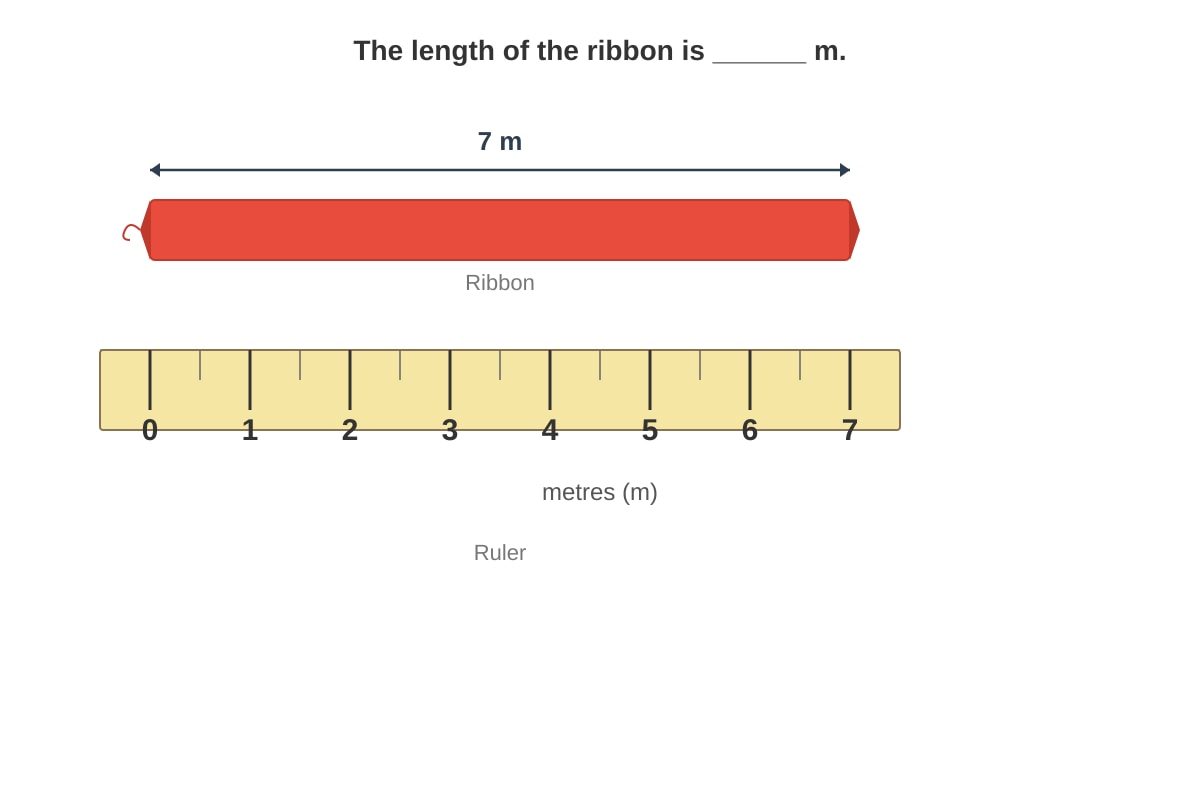
11. 7 m
- Explanation: The ribbon starts at 0 and ends at 7 on the ruler. The length is the difference between the end and the start: 7 - 0 = 7. So the ribbon is 7 m long.
- Marking: 1 mark for correct number, 1 mark for correct unit (m).
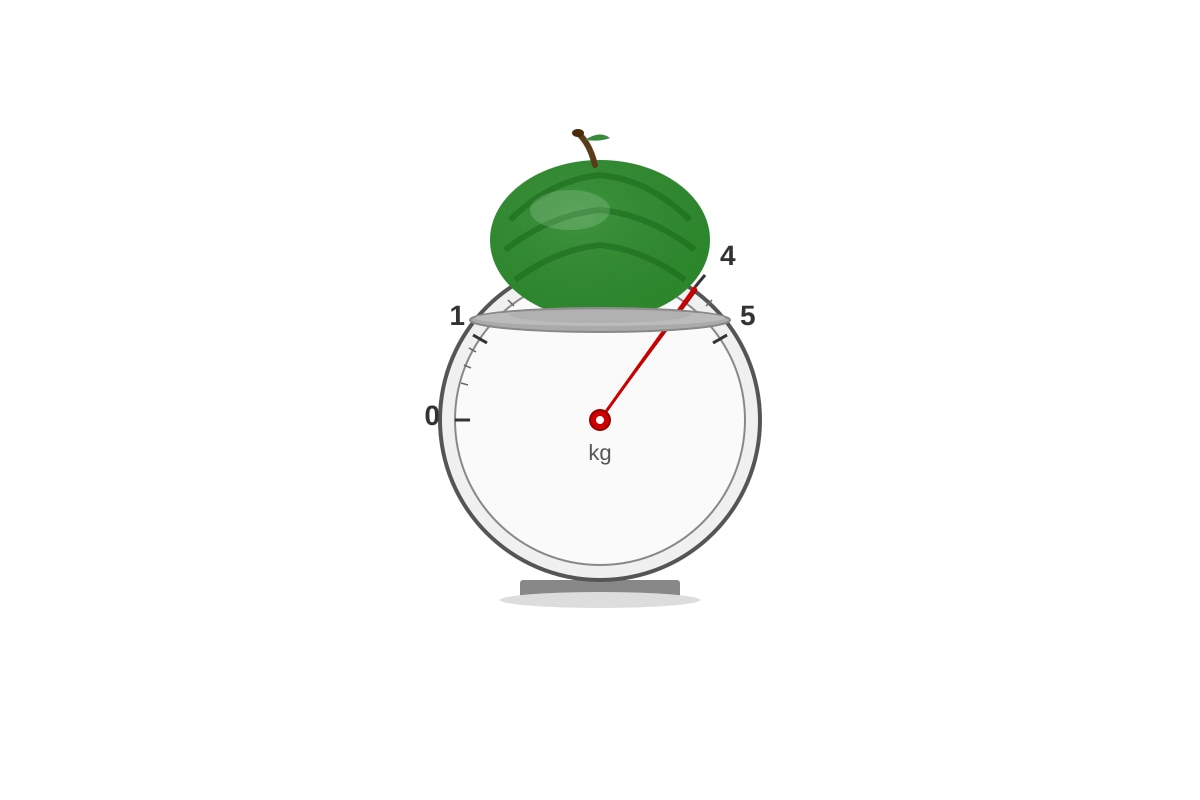
12. 4 kg
- Explanation: The needle on the scale points to 4. The scale is marked in kilograms (kg). So the watermelon has a mass of 4 kg.
- Marking: 1 mark for correct number, 1 mark for correct unit (kg).
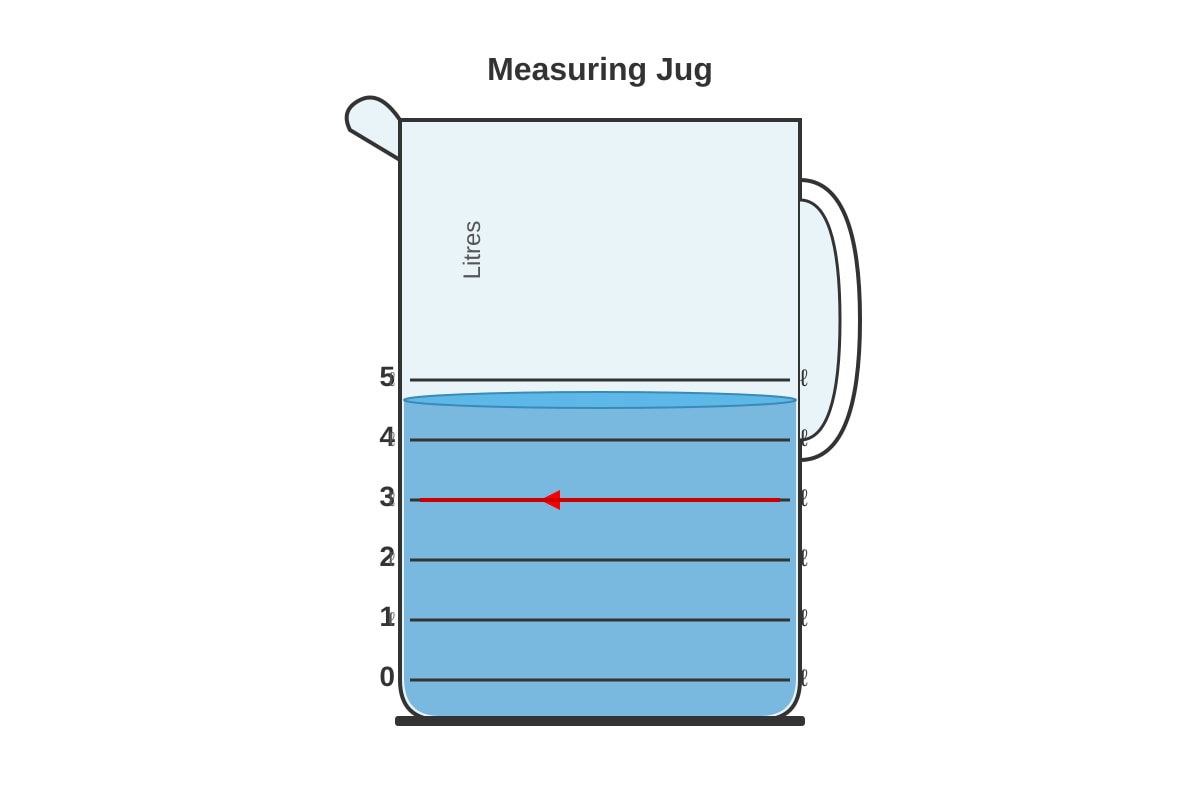
13. 3 ℓ
- Explanation: The water in the jug reaches the 3 ℓ mark. The jug is marked in litres (ℓ). So the volume of water is 3 ℓ.
- Marking: 1 mark for correct number, 1 mark for correct unit (ℓ).
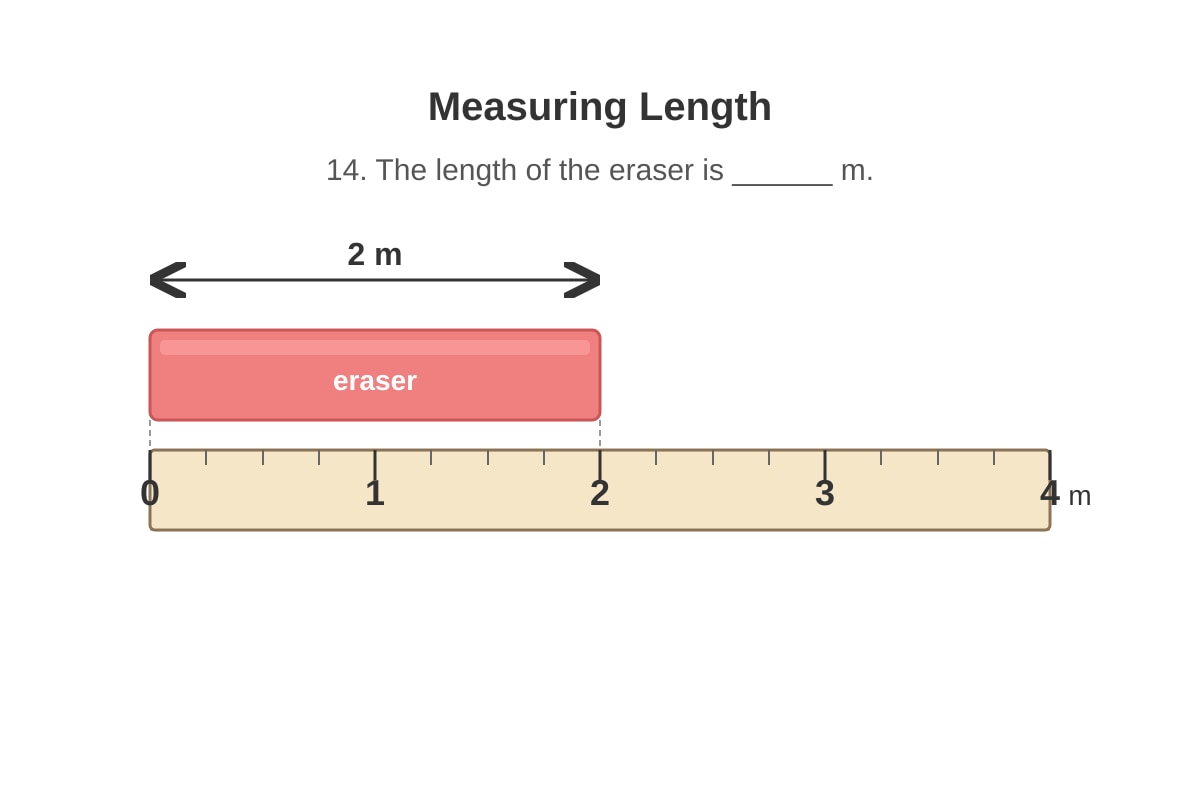
14. 2 m
- Explanation: The eraser starts at 0 and ends at 2 on the ruler. The length is the difference between the end and the start: 2 - 0 = 2. So the eraser is 2 m long.
- Marking: 1 mark for correct number, 1 mark for correct unit (m).
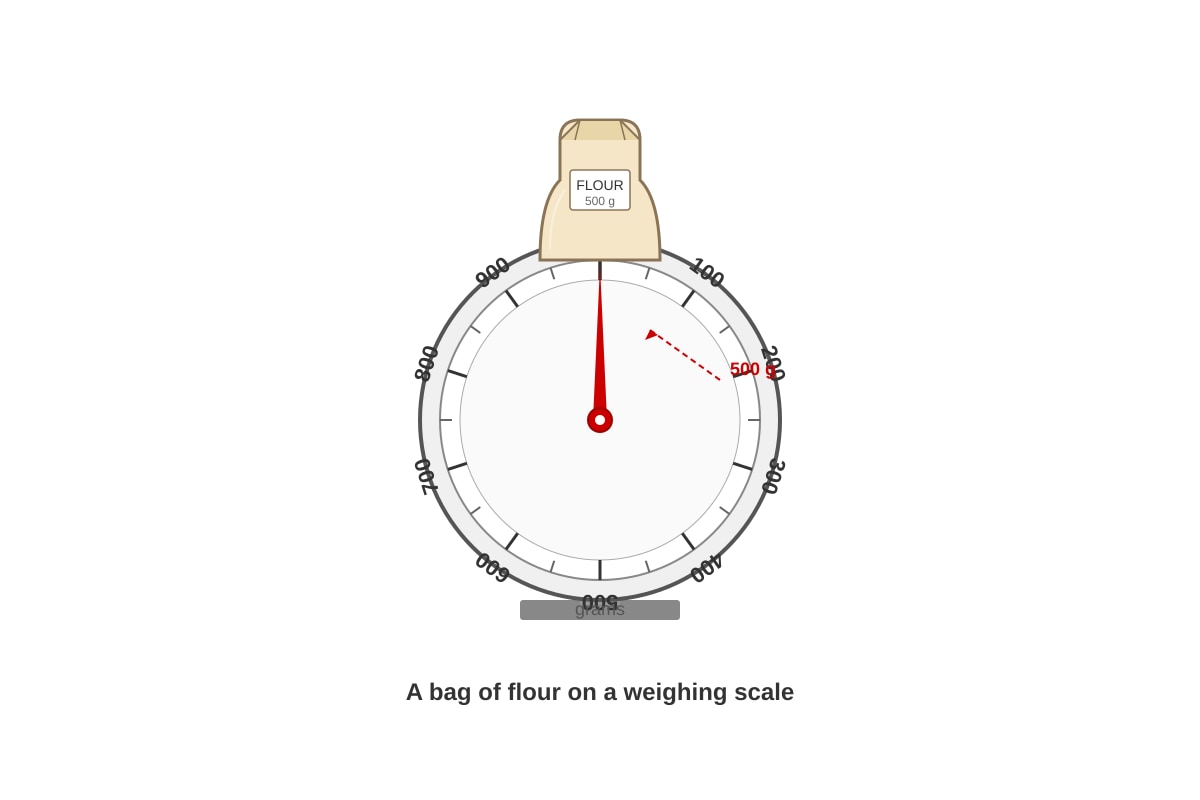
15. 500 g
- Explanation: The needle on the scale points to 500. The scale is marked in grams (g). So the bag of flour has a mass of 500 g.
- Marking: 1 mark for correct number, 1 mark for correct unit (g).
Section D: Word Problems (Questions 16 to 20)
(2 marks each)
16. Total length = 9 m + 6 m = 15 m
- Explanation: "Total length" means we add the two lengths together. 9 + 6 = 15. The unit is metres (m).
- Working: 9 + 6 = 15
- Answer: 15 m
- Marking: 1 mark for correct working, 1 mark for correct answer with unit.
17. Difference in mass = 5 kg - 2 kg = 3 kg
- Explanation: "How much heavier" means we find the difference. We subtract the smaller mass from the larger mass. 5 - 2 = 3. The unit is kilograms (kg).
- Working: 5 - 2 = 3
- Answer: 3 kg
- Marking: 1 mark for correct working, 1 mark for correct answer with unit.
18. Total volume = 2 ℓ + 5 ℓ = 7 ℓ
- Explanation: "Total volume" means we add the two volumes together. 2 + 5 = 7. The unit is litres (ℓ).
- Working: 2 + 5 = 7
- Answer: 7 ℓ
- Marking: 1 mark for correct working, 1 mark for correct answer with unit.
19. Remaining length = 8 m - 3 m = 5 m
- Explanation: "Cuts off" means we subtract. We take away the cut piece from the original length. 8 - 3 = 5. The unit is metres (m).
- Working: 8 - 3 = 5
- Answer: 5 m
- Marking: 1 mark for correct working, 1 mark for correct answer with unit.
20. Total mass = 4 kg + 3 kg = 7 kg
- Explanation: "Total mass" means we add the two masses together. 4 + 3 = 7. The unit is kilograms (kg).
- Working: 4 + 3 = 7
- Answer: 7 kg
- Marking: 1 mark for correct working, 1 mark for correct answer with unit.