AI Generated Quiz
Primary 2 Mathematics Addition Subtraction Quiz
Free P2 Maths Addition Subtraction quiz, Kimi2.6 AI version, with questions, answers, and syllabus-aligned practice for Singapore students.
These static practice materials are generated from the site's syllabus and paper-generation workflow, with source and model context shown so students and parents can evaluate the material before use.
Questions
Free quiz and exam paper access
Enter your details to view this paper
Your access is remembered on this device.
Answers
Primary 2 Mathematics Quiz - Addition Subtraction (Answer Key)
Total Marks: 40 marks
Section A: Simple Calculations
Question 1 (2 marks)
Find the sum of 245 and 324.
Working:
-
Line up the digits by place value (hundreds, tens, ones)
-
Add the ones: 5 + 4 = 9
-
Add the tens: 4 + 2 = 6
-
Add the hundreds: 2 + 3 = 5
245
- 324
569
Answer: 569
Key concept: "Sum" means the result of addition. Always add from right to left (ones first), regrouping when needed. In this case, no regrouping is needed.
Question 2 (2 marks)
Subtract 156 from 482.
Working:
-
"Subtract 156 from 482" means 482 – 156
-
Subtract ones: 2 – 6 (cannot do, so regroup) → 12 – 6 = 6
-
Subtract tens: 7 (after regrouping) – 5 = 2
-
Subtract hundreds: 4 – 1 = 3
482
-
156
326
Answer: 326
Common mistake: Some students write 156 – 482 instead. "Subtract A from B" always means B – A. The word "from" tells you which number to start with.
Question 3 (2 marks)
What is 350 + 275?
Working:
-
Add ones: 0 + 5 = 5
-
Add tens: 5 + 7 = 12 (write 2, carry 1 to hundreds)
-
Add hundreds: 3 + 2 + 1 (carried) = 6
350
- 275
625
Answer: 625
Key concept: When the tens add to 10 or more, we regroup (carry) to the hundreds place. 5 tens + 7 tens = 12 tens = 1 hundred and 2 tens.
Question 4 (2 marks)
673 – 289 = ?
Working:
-
Ones: 3 – 9 (cannot do, regroup) → 13 – 9 = 4
-
Tens: 6 (after regrouping) – 8 (cannot do, regroup from hundreds) → 16 – 8 = 8
-
Hundreds: 5 (after regrouping) – 2 = 3
673
-
289
384
Answer: 384
Regrouping twice: This question needs regrouping in both the ones and tens places. Be careful to track which digits change after each regrouping step.
Question 5 (2 marks)
Calculate 508 + 196.
Working:
-
Ones: 8 + 6 = 14 (write 4, carry 1)
-
Tens: 0 + 9 + 1 (carried) = 10 (write 0, carry 1)
-
Hundreds: 5 + 1 + 1 (carried) = 7
508
- 196
704
Answer: 704
Note: The tens add to exactly 10, so we write 0 in the tens place and carry 1. The answer has 0 in the tens place, which is correct.
Section B: Word Problems
Question 6 (2 marks)
Mei Ling has 156 stickers. Her brother gives her 78 more stickers. How many stickers does she have now?
Working:
-
"Gives her more" means addition
-
156 + 78 = ?
156
- 78
234
Answer: 234 stickers
Method: Identify the operation by looking for clue words. "More" and "gives her" both suggest adding to what she already has. Her original amount increases.
Question 7 (2 marks)
A baker made 245 muffins in the morning. He sold 138 muffins. How many muffins are left?
Working:
-
"Sold" means take away, so we subtract
-
245 – 138 = ?
245
-
138
107
Answer: 107 muffins
Key concept: "How many left?" tells us to subtract. The original amount minus the amount sold gives what remains. Check: 107 + 138 = 245 ✓
Question 8 (2 marks)
There are 407 books in the library. 159 books are borrowed. How many books are still in the library?
Working:
-
"Still in the library" means what remains after borrowing
-
407 – 159 = ?
407
-
159
248
Answer: 248 books
Regrouping with zero: We need to regroup from the tens place, but there are 0 tens. So we first regroup from hundreds (4 hundreds → 3 hundreds and 10 tens), then from tens (10 tens → 9 tens and 10 ones). This is a common tricky case.
Question 9 (2 marks)
Rajesh saved 267 in February. How much did he save altogether?
Working:
-
"Altogether" means add both amounts
-
267 = ?
185
- 267
452
Answer: $452
Key concept: When combining two or more amounts, we always add. "Altogether" is a strong clue word for addition in word problems.
Question 10 (2 marks)
A school has 520 pupils. 186 are girls. How many boys are there?
Working:
-
Total pupils = girls + boys
-
So boys = total – girls
-
520 – 186 = ?
520
-
186
334
Answer: 334 boys
Method: The total group is made of two parts (girls and boys). If we know the total and one part, we subtract to find the other part. Check: 334 + 186 = 520 ✓
Question 11 (2 marks)
Mrs Tan bought 300 eggs. She used 145 eggs for baking. How many eggs does she have left?
Working:
-
300 – 145 = ?
300
-
145
155
Answer: 155 eggs
Note: With 300, we need to regroup twice (from 3 hundreds → 2 hundreds, 10 tens → 9 tens, 10 ones). Many students forget the second regrouping step.
Question 12 (2 marks)
Ahmad has 238 marbles. He gives 95 marbles to his friend. He buys 67 more marbles. How many marbles does Ahmad have in the end?
Working:
-
Two-step problem: first subtract, then add
-
Step 1: 238 – 95 = 143 (after giving away)
-
Step 2: 143 + 67 = 210 (after buying more)
238 143
-
95 + 67
143 210
Answer: 210 marbles
Common mistake: Some students add both numbers (95 + 67) or subtract both. Read carefully: "gives 95 away" means minus, "buys 67 more" means plus. The order matters too—he gives away first, then buys.
Section C: Fill in the Blanks and Patterns
Question 13 (2 marks)
Complete the following. 450 + _____ = 700
Working:
- To find the missing number, subtract: 700 – 450
- 700 – 450 = 250
Answer: 250
Key concept: In addition, if you know the total and one part, subtract to find the missing part. This uses the inverse relationship: addition and subtraction undo each other.
Question 14 (2 marks)
_____ – 168 = 425. What is the missing number?
Working:
-
To find the starting number, add: 425 + 168
-
425 + 168 = 593
425
- 168
593
Answer: 593
Method: The missing number is the whole (start). In subtraction: whole – part = other part. So whole = part + other part. We add the two given numbers.
Question 15 (2 marks)
Look at the pattern below. Fill in the missing numbers. 325, 400, 475, _____, _____, 700
Working:
- Find the difference between known terms: 400 – 325 = 75, and 475 – 400 = 75
- The pattern increases by 75 each time
- 475 + 75 = 550
- 550 + 75 = 625
- Check: 625 + 75 = 700 ✓
Answers: 550, 625 (1 mark each)
Key concept: A number pattern has a "rule." First find what changes between terms, then apply that rule. Always check your answers by continuing the pattern.
Question 16 (2 marks)
Fill in the blank with >, <, or =. 456 + 234 _____ 234 + 456
Working:
- Left side: 456 + 234 = 690
- Right side: 234 + 456 = 690
- Both sides equal 690
Answer: =
Key concept: This demonstrates the commutative property of addition: a + b = b + a. The order of numbers does not change the sum. Students can recognize this without calculating both sides fully.
Question 17 (2 marks)
Fill in the blank with >, <, or =. 800 – 350 _____ 800 – 450
Working:
- Left side: 800 – 350 = 450
- Right side: 800 – 450 = 350
- 450 > 350
Answer: >
Key concept: When you subtract from the same starting number, taking away a smaller number leaves more. 350 < 450, so 800 – 350 > 800 – 450. This helps build number sense without always calculating.
Section D: Problem Solving with Bar Models
Question 18 (2 marks)
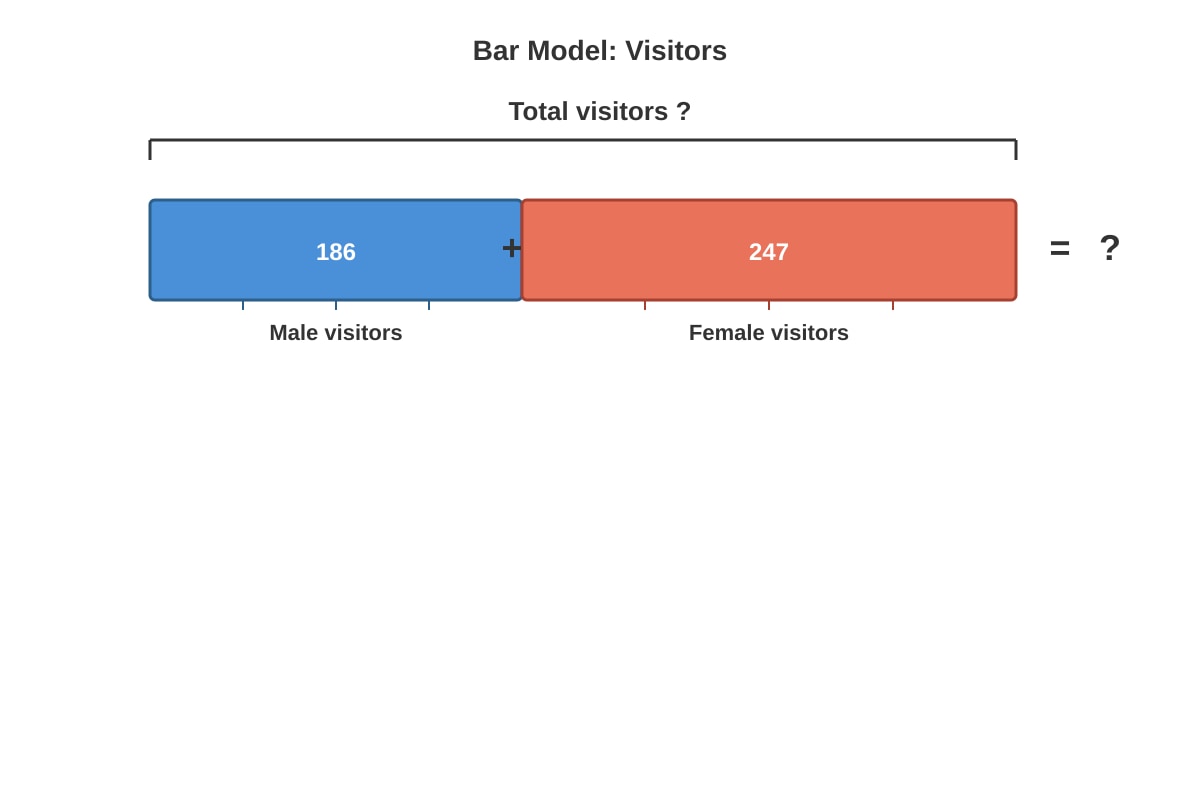
Bar model shows: Male visitors 186, Female visitors 247, Total visitors ?
Working:
-
Bar model shows two parts making a whole
-
Total = 186 + 247
186
- 247
433
Answer: 433 visitors
Bar model reading: The bracket across both bars shows we need to combine (add) the two parts. Bar models help visualize whether we need to add or subtract in a problem.
Question 19 (2 marks)
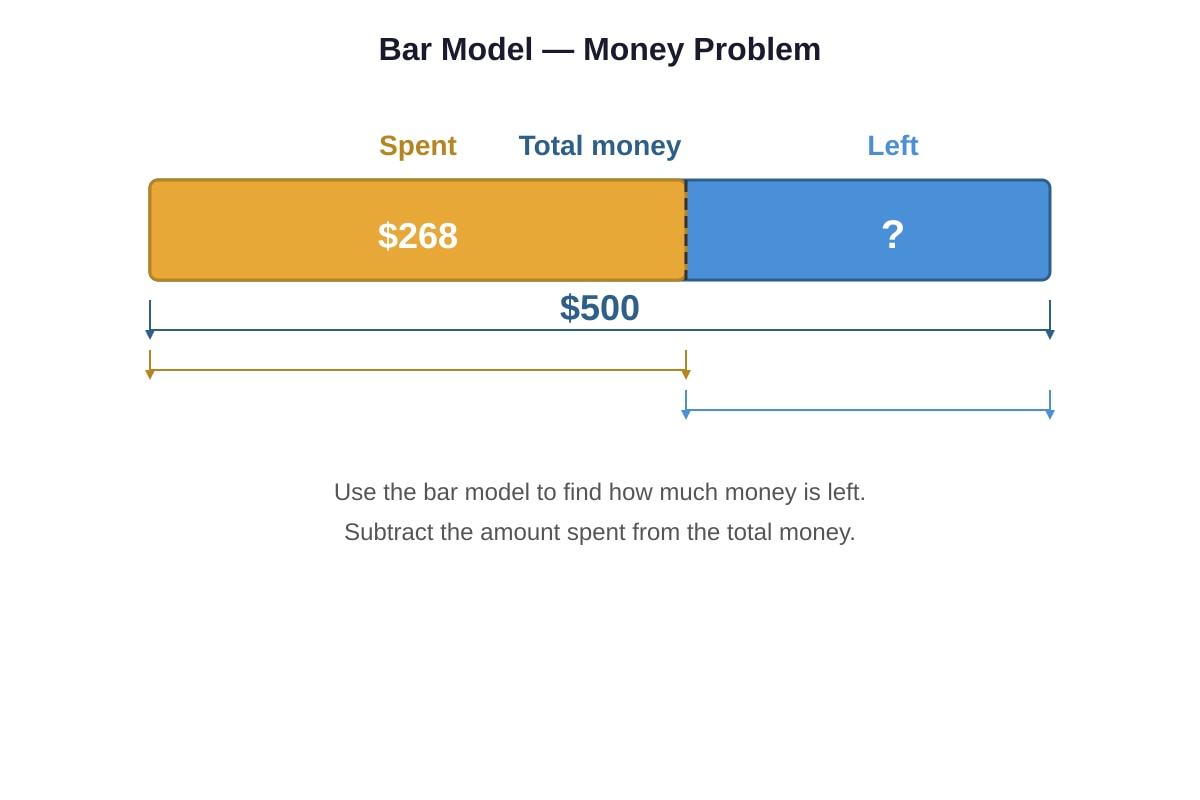
Bar model shows: Total money 268, Left ?
Working:
-
Bar model shows a whole with one part removed
-
Left = 500 – 268
500
-
268
232
Answer: $232
Bar model reading: When we know the total and one part, we subtract to find the remaining part. The "Left ?" label indicates this is the unknown remaining portion.
Question 20 (2 marks)
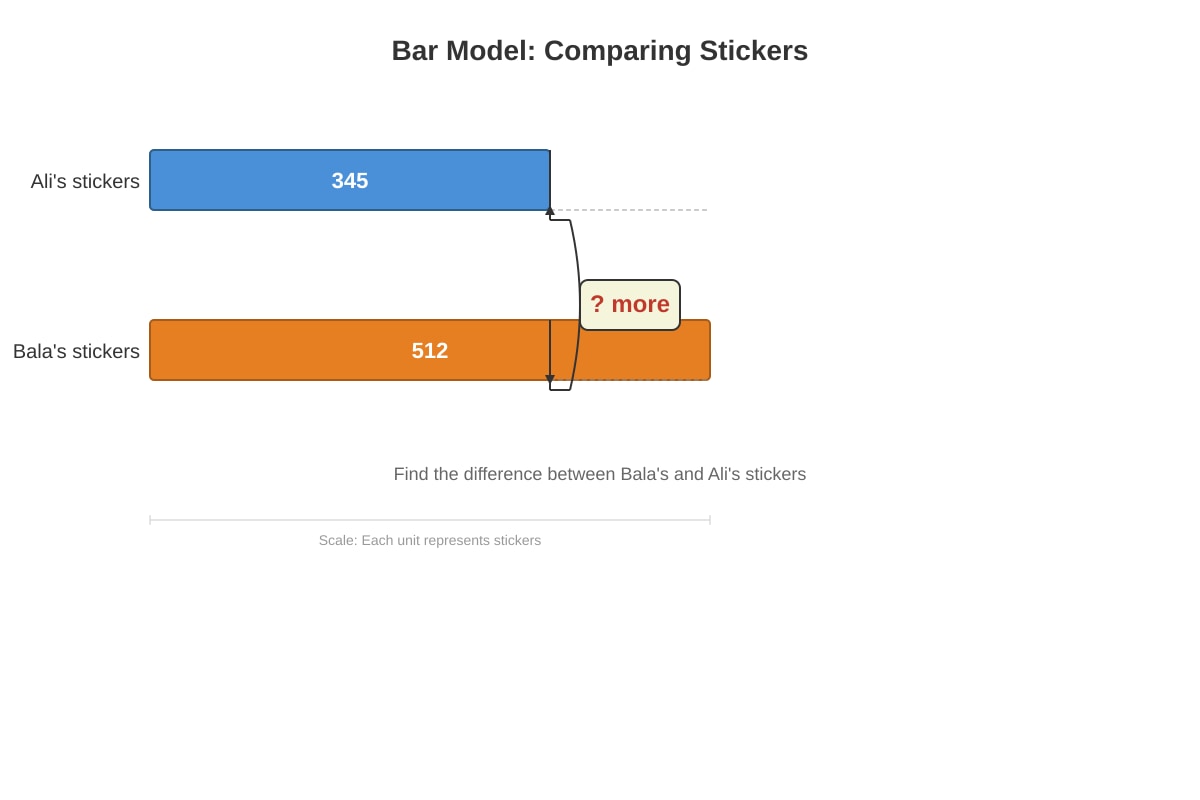
Bar model shows: Ali's stickers 345, Bala's stickers 512, ? more
Working:
-
The gap between the two bars shows the difference
-
Difference = 512 – 345
512
-
345
167
Answer: 167 more stickers
Bar model reading: The bracket showing the gap after the shorter bar asks "how much more?" This means we compare by subtracting the smaller from the larger. "More than" and "less than" problems use subtraction to find the difference.