AI Generated Exam Paper
Primary 2 Mathematics Practice Paper 5
Free P2 Maths Practice Paper 5, Kimi2.6 AI version, with questions, answers, and syllabus-aligned practice for Singapore students.
These static practice materials are generated from the site's syllabus and paper-generation workflow, with source and model context shown so students and parents can evaluate the material before use.
Questions
Free quiz and exam paper access
Enter your details to view this paper
Your access is remembered on this device.
Answers
TuitionGoWhere Practice Paper Answers - Mathematics Primary 2
Version 5 of 5
Section A: Short Answer Questions
1. [1 mark]
Answer: 629
Working/Explanation:
- 6 hundreds = 600
- 2 tens = 20
- 9 ones = 9
- 600 + 20 + 9 = 629
Teaching note: In place value, each position has a different value. Hundreds are worth 100 times more than ones.
2. [1 mark]
Answer: 40
Working/Explanation:
- The digit 4 is in the tens place
- Value = 4 × 10 = 40
Common mistake: Writing "4" instead of "40" — this gives the digit, not its value.
3. [1 mark]
Answer: 380, 408, 418, 803
Working/Explanation:
- Compare hundreds first: 380 and 408, 418 have smaller hundreds digits
- 380 has 3 hundreds; 408 and 418 have 4 hundreds; 803 has 8 hundreds
- Between 408 and 418: both have 4 hundreds, but 08 < 18 in tens place
4. [1 mark]
Answer: 326
Working/Explanation:
- 50 more than 276 means 276 + 50
- 276 + 50 = 326
- Or: 2 hundreds + 7 tens + 6 ones + 5 tens = 2 hundreds + 12 tens + 6 ones = 326
5. [1 mark]
Answer: Even number
Working/Explanation:
- Even numbers end in 0, 2, 4, 6, or 8
- 438 ends in 8, so it is even
- Also: 438 = 2 × 219, so it can be divided equally into 2 groups
6. [1 mark]
Answer: 20
Working/Explanation:
- 625 = 600 + 20 + 5
- 625 – 600 – 5 = 20
- The digit 2 is in the tens place, so its value is 20
7. [1 mark]
Answer: 907
Working/Explanation:
- Nine hundred = 900
- Zero tens = 00 (we write 0 as a placeholder)
- Seven ones = 7
- 900 + 0 + 7 = 907
Common mistake: Writing 97 or 9007. The zero tens place must be filled.
8. [1 mark]
Answer: 275
Working/Explanation:
- Pattern: increasing by 10 each time (skip counting in tens)
- 245 + 10 = 255
- 255 + 10 = 265
- 265 + 10 = 275
- 275 + 10 = 285 ✓
9. [1 mark]
Answer: 567 < 576
Working/Explanation:
- Both have 5 hundreds — equal
- Compare tens: 6 tens vs 7 tens
- 6 < 7, so 567 < 576
10. [1 mark]
Answer: 170
Working/Explanation:
- Counting backward in tens: subtract 10 each time
- 180 – 10 = 170
11. [1 mark]
Answer: 731
Working/Explanation:
- To make the greatest number, put the largest digit in the highest place value
- Largest digit is 7 → hundreds place
- Next largest is 3 → tens place
- Smallest is 1 → ones place
- 731
12. [1 mark]
Answer: 436
Working/Explanation:
- 400 + 30 + 6 = 436
- 4 hundreds, 3 tens, 6 ones
13. [1 mark]
Answer: 490
Working/Explanation:
- 486 is between 480 and 490
- Look at the ones digit: 6
- 6 ≥ 5, so round up to 490
- (If ones digit were 0–4, we would round down)
14. [1 mark]
Answer: 16
Working/Explanation:
- Digits in 529: 5, 2, and 9
- Sum = 5 + 2 + 9 = 16
15. [1 mark]
Answer: 800
Working/Explanation:
- 100 less than 900 means 900 – 100
- 900 – 100 = 800
16. [1 mark]
Answer: 74
Working/Explanation:
- 740 = 74 tens + 0 ones (since 74 × 10 = 740)
- Or: 740 ÷ 10 = 74
Common mistake: Writing 4 (confusing tens digit with number of tens). The digit 4 is in tens place, but there are 74 tens in 740.
17. [1 mark]
Answer: 550
Working/Explanation:
- 1000 – 450 = 550
- Check: 550 + 450 = 1000 ✓
18. [1 mark]
Answer: six hundred and eight
Working/Explanation:
- 600 = six hundred
- 08 = eight (we say "and eight" not "zero eight")
- Zero tens place is silent in words
Common mistake: "Six hundred zero eight" — we don't say the zero.
19. [2 marks - 1 mark for correct identification, 1 mark for correct explanation]
Answer: 321
Explanation: 321 is the only number with 3 in the hundreds place. The other three numbers (312, 132, 123) all have different arrangements of digits but none have 3 in the hundreds place. Wait — let me re-check: 312 has 3 in hundreds, 132 has 1 in hundreds, 321 has 3 in hundreds, 123 has 1 in hundreds.
Corrected Answer: 321 (odd one out because it's the only number greater than 300, OR 312 because even number)
Better answer: 312 — it is the only even number (ends in 2). All others (321, 132, 123) are odd numbers.
Mark scheme: Any valid mathematical reason with correct identification: 2 marks. Valid reason but wrong identification: 1 mark.
20. [1 mark]
Answer: 750, 450
Working/Explanation:
- Pattern decreases by 100 each time (counting backward in hundreds)
- 850 – 100 = 750
- 750 – 100 = 650 ✓
- 650 – 100 = 550 ✓
- 550 – 100 = 450
Section A Total: 20 marks
Section B: Problem Solving
21. [Total: 3 marks]
(a) [1 mark]
Answer: 800 + 30 + 5
Explanation: 835 = 8 hundreds + 3 tens + 5 ones = 800 + 30 + 5
(b) [2 marks]
Working:
- Value of 8 in 835: 8 × 100 = 800
- Value of 5 in 835: 5 × 1 = 5
- Difference: 800 – 5 = 795
Answer: 795
Mark breakdown: 1 mark for correct values of 8 and 5; 1 mark for correct difference.
Teaching note: Always check which place the digit is in. The 8 is hundreds place (value 800), not 8. The 5 is ones place (value 5), not 50.
22. [Total: 3 marks]
(a) [1 mark]
Answer: 924, 492, 429, 294, 249
Working/Explanation:
- All have digits 2, 4, 9 in different arrangements
- Compare hundreds: 9 > 4 > 2
- For 4 hundreds: 492 > 429 (92 > 29 in tens)
- For 2 hundreds: 294 > 249 (94 > 49 in tens)
(b) [2 marks]
Working:
-
Smallest number: 249
-
Largest number: 924
-
Sum: 249 + 924
249 + 924 ----- 1173
Answer: 1173
Mark breakdown: 1 mark for identifying correct smallest and largest; 1 mark for correct addition with working.
23. [Total: 3 marks]
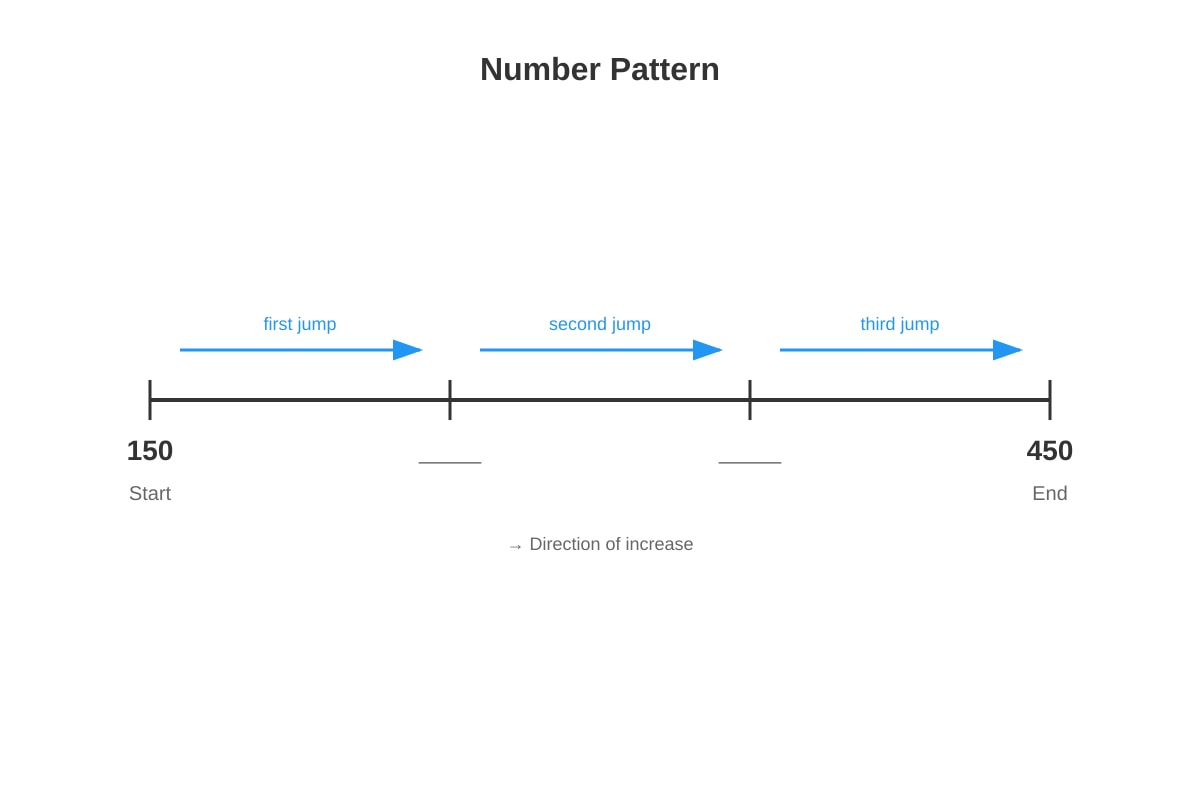
(a) [1 mark]
Answer: Counting forward in hundreds / Add 100 each time / Rule: +100
Expected visual from image placeholder: Number line from 150 to 450 with equal jumps: 150 → 250 → 350 → 450
(b) [2 marks]
Answer: 250, 350
Working/Explanation:
- 450 – 150 = 300 total distance
- 3 jumps cover 300, so each jump = 300 ÷ 3 = 100
- 150 + 100 = 250
- 250 + 100 = 350
- 350 + 100 = 450 ✓
Mark breakdown: 1 mark for each correct missing number.
24. [Total: 4 marks]
(a) [1 mark]
Answer: 742
Explanation: Put largest digit (7) in hundreds, next (4) in tens, smallest (2) in ones.
(b) [1 mark]
Answer: 247
Explanation: Put smallest digit (2) in hundreds, next (4) in tens, largest (7) in ones.
(c) [2 marks]
Working:
-
Greatest: 742
-
Smallest: 247
-
Difference: 742 – 247
742 - 247 ----- 495
-
2 < 7, so regroup: 12 – 7 = 5
-
3 (after regroup) < 4, so regroup again: 13 – 4 = 9
-
6 (after regroup) – 2 = 4
Answer: 495
Mark breakdown: 1 mark for correct subtraction setup; 1 mark for correct answer with working shown.
25. [Total: 5 marks]
(a) [2 marks]
Working:
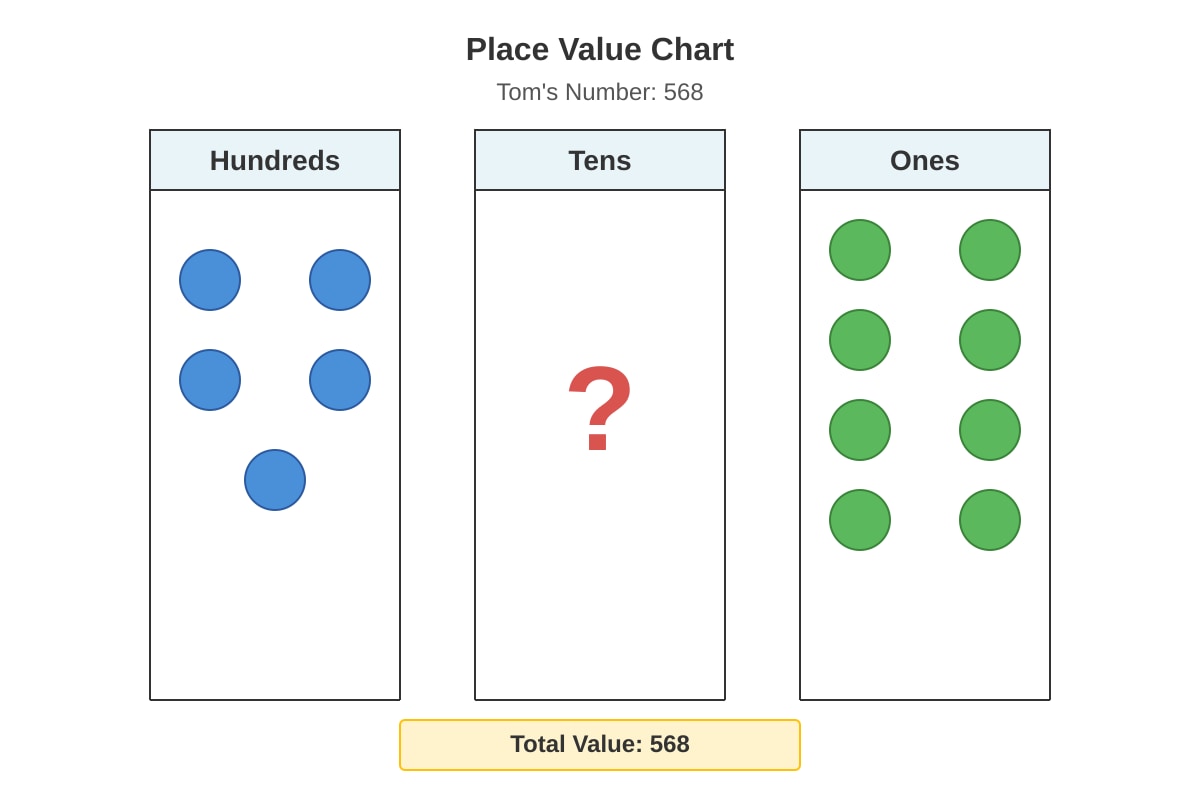
- Total value = 568
- 5 hundreds = 500
- 8 ones = 8
- Tens value = 568 – 500 – 8 = 60
- Number of tens counters = 60 ÷ 10 = 6
Or: 568 = 500 + 60 + 8, so tens digit is 6.
Answer: 6 counters
Mark breakdown: 1 mark for showing 60 is the tens value; 1 mark for identifying 6 counters.
Expected visual from image placeholder: Place value chart with 5 in hundreds, blank/? in tens, 8 in ones; total shown as 568.
(b) [1 mark]
Answer: 865
Explanation: Original number is 568. Swap hundreds (5) and ones (8): 865.
(c) [2 marks]
Working:
-
Original: 568
-
New number: 865
-
Difference: 865 – 568
865 - 568 ----- 297
-
5 < 8, regroup: 15 – 8 = 7
-
5 (after regroup) < 6, regroup again: 15 – 6 = 9
-
7 (after regroup) – 5 = 2
Answer: 297
Mark breakdown: 1 mark for correct subtraction setup with swapped number; 1 mark for correct answer with working.
Section B Total: 20 marks
Grand Total: 40 marks
Marking Summary
| Section | Marks Available | Focus Areas |
|---|---|---|
| A: Short Answer | 20 | Place value, number patterns, comparison, rounding, number properties |
| B: Problem Solving | 20 | Multi-step reasoning, place value understanding, number manipulation, working shown |
Expected performance indicators:
- 34–40 marks: Strong grasp of numbers to 1000
- 26–33 marks: Good understanding with some gaps in multi-step problems
- 18–25 marks: Developing; review place value and number patterns
- Below 18 marks: Significant gaps; revisit basic place value and number bonds to 1000