AI Generated Exam Paper
Primary 2 Mathematics Practice Paper 4
Free P2 Maths Practice Paper 4, Kimi2.6 AI version, with questions, answers, and syllabus-aligned practice for Singapore students.
These static practice materials are generated from the site's syllabus and paper-generation workflow, with source and model context shown so students and parents can evaluate the material before use.
Questions
Free quiz and exam paper access
Enter your details to view this paper
Your access is remembered on this device.
Answers
TuitionGoWhere Practice Paper — Answer Key
Subject: Mathematics | Level: Primary 2 | Version: 4 of 5
Total Marks: 50
Section A: Multiple Choice (10 marks)
| Question | Answer | Explanation |
|---|---|---|
| 1 | C) 600 | The digit 6 is in the hundreds place. In place value, each position has a value: hundreds = ×100, tens = ×10, ones = ×1. So 6 × 100 = 600. Common mistake: Choosing B (60) by confusing tens and hundreds place. |
| 2 | A) 309 | Compare hundreds first: all have 3, 3, 9, 9. Then compare tens: 0 < 9, so 309 and 390 are smaller than 903 and 930. Finally 0 < 9 in the ones place comparison of 309 vs 390. |
| 3 | B) 792 | Standard addition: 527 + 265. Ones: 7+5=12 (write 2, carry 1). Tens: 2+6+1=9. Hundreds: 5+2=7. Result: 792. |
| 4 | B) 600 | Pattern: counting up by 50s each time. 450 + 50 = 500, 500 + 50 = 550, 550 + 50 = 600, 600 + 50 = 650. ✓ |
| 5 | B) 687 | "200 more than" means add 200: 487 + 200 = 687. The hundreds digit increases by 2. |
| 6 | A) 453 | Subtraction with regrouping: 800 – 347. Ones: 0–7 needs regrouping → 10–7=3. Tens: 9–4=5 (after regrouping). Hundreds: 7–3=4. Result: 453. |
| 7 | B) 3 | In 935: 9 is hundreds, 3 is tens, 5 is ones. The tens place is the middle digit. |
| 8 | A) 278, 287, 728, 872 | Compare hundreds: 2, 2, 7, 8. So 278 and 287 come before 728 and 872. Compare 278 vs 287: 78 < 87. Compare 728 vs 872: 728 < 872. |
| 9 | C) 703 | "100 less than" means subtract 100: 803 – 100 = 703. The hundreds digit decreases by 1. |
| 10 | C) 600 + 20 + 4 | Expanded form shows each digit's value: 624 = 600 (6 hundreds) + 20 (2 tens) + 4 (4 ones). |
Section A Total: 10 marks
Section B: Short Answer (24 marks)
11. (a) 673 [1 mark]
- "Six hundred" = 600, "seventy-three" = 73. Together: 600 + 73 = 673.
11. (b) nine hundred and five [1 mark]
- 905: 9 hundreds, 0 tens, 5 ones. In words, we say "nine hundred and five." Note: "and" is used before the tens/ones part in Singapore style.
12. (a) 50 [1 mark]
- The digit 5 in 358 is in the tens place. Value = 5 × 10 = 50.
12. (b) 80 [1 mark]
- The digit 8 in 784 is in the tens place. Value = 8 × 10 = 80.
13. (a) < (or 456 < 465) [1 mark]
- Hundreds are equal (4 = 4). Compare tens: 5 < 6. So 456 < 465.
13. (b) = (or 803 = 800 + 3) [1 mark]
- 800 + 3 = 803. The expanded form matches the number exactly. This tests understanding that 803 = 800 + 0 + 3.
14. (a) 390, 395 [2 marks]
- Pattern: counting up by 5s. 385 + 5 = 390, 390 + 5 = 395.
- Marking: 1 mark for each correct number.
14. (b) 750, 700 [2 marks]
- Pattern: counting down by 50s. 800 – 50 = 750, 750 – 50 = 700.
- Marking: 1 mark for each correct number.
15. (a) 277 [1 mark]
- Mental method: 247 + 30 = 247 + 10 + 10 + 10 = 277. Or: add tens only: 24 tens + 3 tens = 27 tens, so 277.
15. (b) 258 [1 mark]
- Mental method: 658 – 400 = subtract 4 hundreds from 6 hundreds = 2 hundreds, with tens and ones unchanged. Result: 258.
16. 473 stickers [2 marks]
- Working: Sarah has 128 more than David.
345 + 128 = ?
Ones: 5 + 8 = 13 (write 3, carry 1)
Tens: 4 + 2 + 1 = 7
Hundreds: 3 + 1 = 4
Answer: 473 stickers - Marking: 1 mark for correct method, 1 mark for correct answer. Accept 345 + 128 shown even if arithmetic error (method mark).
17. 88 buns [3 marks]
- Working (Method 1 - total sold first):
Total sold = 267 + 145 = 412
Left = 500 – 412 = 88 - Working (Method 2 - step by step):
After morning: 500 – 267 = 233
After afternoon: 233 – 145 = 88 - Marking: 1 mark for finding total sold or first step, 1 mark for correct subtraction method, 1 mark for correct final answer.
18. 57 pencils [3 marks]
- Working:
Total pencils = 3 × 24 = 72 (or 24 + 24 + 24 = 72)
Left after giving away: 72 – 15 = 57 - Marking: 1 mark for finding total pencils (3 × 24), 1 mark for subtracting 15, 1 mark for correct final answer.
- Common error: Forgetting to multiply first (e.g., using 24 – 15 = 9). This gets 0 for first mark but may get method marks if subsequent steps follow logically.
Section B Total: 24 marks
Section C: Word Problems and Application (16 marks)
19. Place value chart question (visual-based)
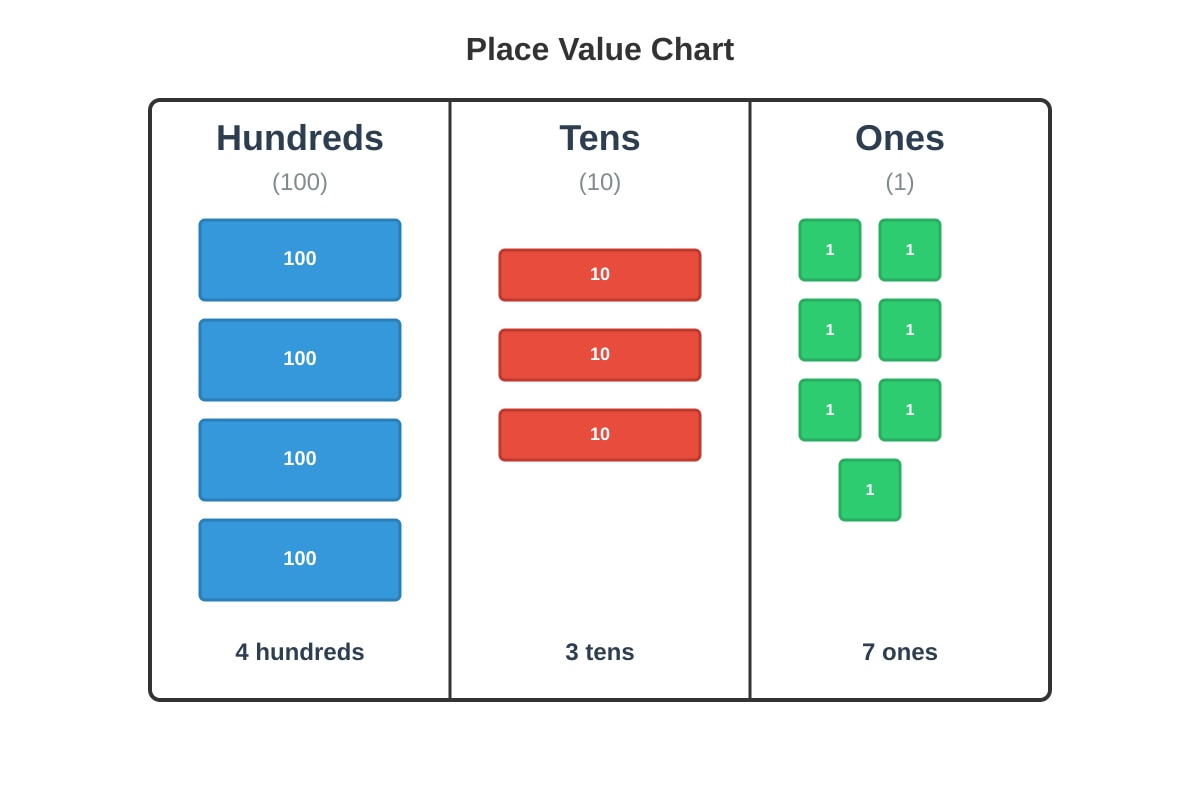
Visual reference: Place value chart shows 4 hundreds flats, 3 tens rods, 7 ones cubes. Expected number: 437.
(a) 437 [1 mark]
- 4 hundreds + 3 tens + 7 ones = 400 + 30 + 7 = 437.
(b) 537 [2 marks]
- Working: 100 more than 437 = 437 + 100 = 537.
- When we add 100, only the hundreds digit changes: 4 becomes 5.
- Marking: 1 mark for correct method (adding 100), 1 mark for correct answer.
(c) 743 [1 mark]
- To make the biggest number, put the largest digit (7) in the hundreds place, then next largest (4) in tens, smallest (3) in ones: 743.
(d) 347 [1 mark]
- To make the smallest number, put the smallest digit (3) in the hundreds place, then next smallest (4) in tens, largest (7) in ones: 347.
- Common error: 374 (forgetting to check tens vs ones ordering).
19. Total: 6 marks
20. Table-based problem
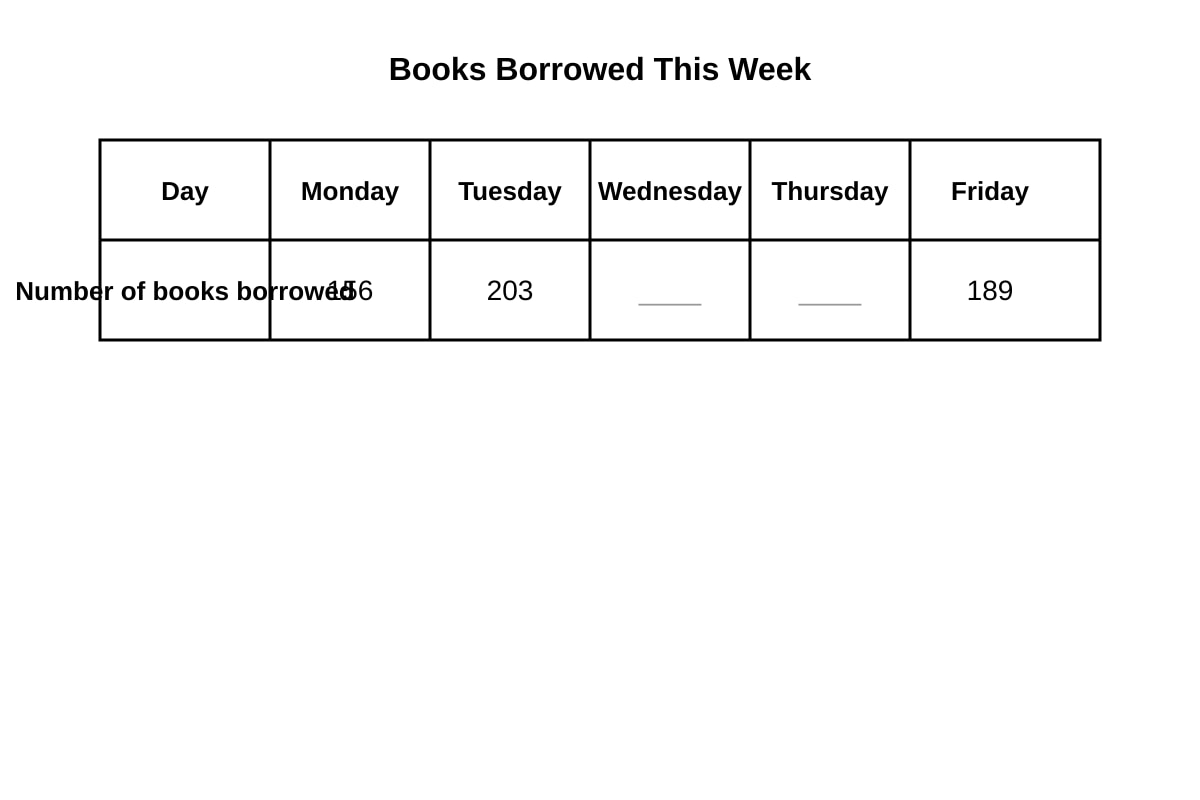
Visual reference: Table with Monday: 156, Tuesday: 203, Friday: 189. Wednesday and Thursday blank.
(a) 203 books [2 marks]
- Working: Wednesday = Monday + 47 = 156 + 47
156 + 47 = 156 + 40 + 7 = 196 + 7 = 203 - Marking: 1 mark for correct method (adding 47 to 156), 1 mark for correct answer.
- Note: Coincidentally equals Tuesday's value, but this is correct.
(b) 94 books [3 marks]
- Working:
Known total = 156 + 203 + 203 + 189 = 751
Thursday = 845 – 751 = 94 - Or:
Monday + Tuesday + Wednesday + Friday = 156 + 203 + 203 + 189 = 751
Thursday = 845 – 751 = 94 - Marking: 1 mark for summing known values correctly, 1 mark for subtracting from total, 1 mark for correct final answer.
- Accept alternative: 845 – 156 – 203 – 203 – 189 step-by-step.
(c) Tuesday [1 mark for correct day], with explanation [1 mark]
- Tuesday (or Wednesday — they tie at 203).
- Explanation mark: Must state comparison without calculation, e.g., "Tuesday has 2 hundreds while others have 1 hundred, and Wednesday equals Tuesday." Or "203 and 203 are the biggest because they both have 2 in the hundreds place while the others have 1."
- Must explicitly mention hundreds place comparison or digit 2 vs digit 1 to get explanation mark.
(d) 200 [1 mark]
- 203 to nearest ten: look at ones digit 3. Since 3 < 5, round down to 200.
- Rule: If ones digit is 0–4, round down. If 5–9, round up.
20. Total: 10 marks
Grand Total Verification
| Section | Marks |
|---|---|
| A (Questions 1–10) | 10 |
| B (Questions 11–18) | 24 |
| C (Questions 19–20) | 16 |
| Total | 50 |
Marking Summary & Common Issues
| Issue | Guidance |
|---|---|
| Reversed digits (e.g., 673 → 637) | Check place value understanding; suggest base-ten block practice |
| Expanded form errors | Reinforce: each digit × its place value, not just digits added |
| Subtraction regrouping errors | Practice "borrowing across zero" (e.g., 800 – 347) |
| "More than" vs "less than" | Encourage underlining key words; test with smaller numbers |
| Word problem setup | Ensure students write number sentence before calculating |
| Nearest ten rounding | Drill: "Look at the ones digit, 4 or less let it rest, 5 or more raise the score" |
Answer key aligns with 2021 MOE Primary Mathematics Syllabus (P1-P6). Generated for educational practice purposes.