AI Generated Exam Paper
Primary 2 Mathematics Practice Paper 3
Free P2 Maths Practice Paper 3, Kimi2.6 AI version, with questions, answers, and syllabus-aligned practice for Singapore students.
These static practice materials are generated from the site's syllabus and paper-generation workflow, with source and model context shown so students and parents can evaluate the material before use.
Questions
Free quiz and exam paper access
Enter your details to view this paper
Your access is remembered on this device.
Answers
TuitionGoWhere Practice Paper – Answer Key
Primary 2 Mathematics: Numbers (Version 3 of 5)
Total Marks: 50
Section A: Multiple Choice (10 marks)
| Question | Answer | Working / Explanation |
|---|---|---|
| 1 | (B) 80 | The digit 8 is in the tens place. In 482: 4 is hundreds (400), 8 is tens (80), 2 is ones (2). Value of 8 = 8 × 10 = 80. |
| 2 | (A) 309 | Compare hundreds digits first: 309 and 390 have 3 hundreds; 903 and 930 have 9 hundreds. Between 309 and 390: tens digits are 0 and 9, so 309 < 390. 309 is smallest. |
| 3 | (C) 390 | 350 + 40: 350 + 40 = 300 + 50 + 40 = 300 + 90 = 390. Or: 35 tens + 4 tens = 39 tens = 390. |
| 4 | (B) 613 | 648 − 35: Subtract ones: 8 − 5 = 3; subtract tens: 4 − 3 = 1; hundreds stay 6. Answer: 613. |
| 5 | (B) 350 | Even numbers end in 0, 2, 4, 6, or 8. 247 ends in 7 (odd), 350 ends in 0 (even), 555 ends in 5 (odd), 721 ends in 1 (odd). |
| 6 | (B) 700 | Pattern increases by 25 each time: 625 + 25 = 650; 650 + 25 = 675; 675 + 25 = 700; 700 + 25 = 725 ✓ |
| 7 | (B) 537 | 5 hundreds = 500; 3 tens = 30; 7 ones = 7. Total: 500 + 30 + 7 = 537. |
| 8 | (A) 298 | 200 + 90 + 8 = 200 + 90 = 290; 290 + 8 = 298. |
| 9 | (B) 799 | "Just before 800" means one less than 800. 800 − 1 = 799. |
| 10 | (A) 479 | For smallest 3-digit number, put smallest digit in hundreds place. But 4 is even, so check: 4 in hundreds, then 7 in tens, 9 in ones → 479 (odd ✓). Alternative 497 is larger. |
Section A Total: 10 marks
Section B: Short Answer (18 marks) + Question 20 (4 marks) = Extended section total as per mark allocation
Note: Questions 11–19 carry 18 marks; Question 20 carries 4 marks. Section B + C combined working below.
11. Write 567 in words. (1 mark)
Answer: Five hundred and sixty-seven
Teaching note: 5 in hundreds place → "five hundred", 6 in tens place → "sixty", 7 in ones place → "seven". We use "and" after "hundred" in Singapore convention.
12. Write six hundred and forty-three in numerals. (1 mark)
Answer: 643
Teaching note: "Six hundred" = 600, "forty" = 40, "three" = 3. Add: 600 + 40 + 3 = 643.
13. What is the greatest 3-digit number that can be formed using the digits 2, 6, and 9? (2 marks)
Answer: 962
Method (1 mark): To make the greatest number, put the largest digit in the hundreds place, the next largest in the tens place, and the smallest in the ones place.
Digits in order: 9 > 6 > 2
So: 9 in hundreds, 6 in tens, 2 in ones → 962 (1 mark)
Common mistake: Putting 269 (smallest number) or not using all digits.
14. Arrange 408, 384, 480, 438 from smallest to biggest. (2 marks)
Answer: 384, 408, 438, 480
Method: Compare hundreds digits first:
- 384 has 3 hundreds (smallest group)
- 408, 438, 480 have 4 hundreds
Among 408, 438, 480: compare tens digits: 0 < 3 < 8
Order: 384 → 408 → 438 → 480
Marking: All in correct order (2 marks). Three in correct position (1 mark).
15. Find the missing numbers: 195, 210, 225, ______, ______, 270 (2 marks)
Answer: 240, 255
Method (1 mark each): Find the pattern rule: 210 − 195 = 15; 225 − 210 = 15. Pattern adds 15 each time.
225 + 15 = 240
240 + 15 = 255
Check: 255 + 15 = 270 ✓
16. 245 boys + 318 girls = ? children (3 marks)
Answer: 563 children
Working:
  245
+ 318
-----
Step 1: Ones: 5 + 8 = 13, write 3, carry 1 to tens (1 mark) Step 2: Tens: 4 + 1 + 1 = 6, write 6 (1 mark) Step 3: Hundreds: 2 + 3 = 5, write 5 → 563 (1 mark)
17. 500 − 175 = ? stickers (3 marks)
Answer: 325 stickers
Working:
  500
- 175
-----
Step 1: Ones: 0 − 5, need to regroup. 500 becomes 490 + 10. 10 − 5 = 5 (1 mark) Step 2: Tens: 9 − 7 = 2 (after regrouping) (1 mark) Step 3: Hundreds: 4 − 1 = 3 → 325 (1 mark)
Common mistake: Writing 425 (forgetting to regroup hundreds to tens).
18. Peter has 56 more than John's 128 marbles. (3 marks)
Answer: 184 marbles
Working: "More than" means addition.
128 + 56:
Step 1: Ones: 8 + 6 = 14, write 4, carry 1 (1 mark) Step 2: Tens: 2 + 5 + 1 = 8, write 8 (1 mark) Step 3: Hundreds: 1 + 0 = 1 → 184 (1 mark)
19. 463 − 148 − 95 = ? chickens (4 marks)
Answer: 220 chickens
Working:
Method 1: Step by step Step 1: 463 − 148
  463
- 148
-----
Ones: 3 − 8, regroup: 13 − 8 = 5 Tens: 5 − 4 = 1 (after regrouping) Hundreds: 3 − 1 = 2 → 315 (2 marks for correct first subtraction)
Step 2: 315 − 95
  315
-  95
-----
Ones: 5 − 5 = 0 Tens: 1 − 9, regroup: 11 − 9 = 2 Hundreds: 2 − 0 = 2 → 220 (2 marks for correct second subtraction)
Marking alternative: 2 marks for complete correct method with one calculation error; 1 mark for correct operation choice only.
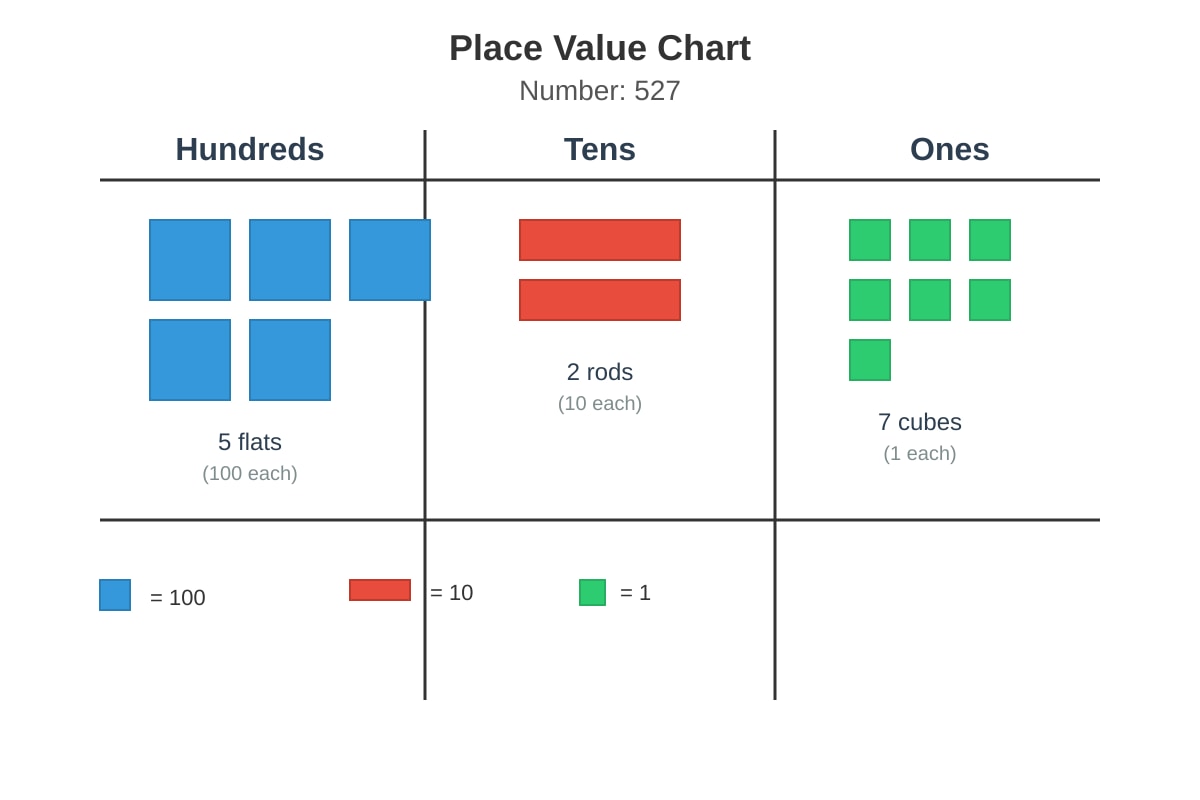
20. Place value chart showing 527 with base-10 blocks (4 marks total)
Expected visual from placeholder (Q20-fig1):
- Hundreds column: 5 flat squares (each = 100)
- Tens column: 2 long rods (each = 10)
- Ones column: 7 small cubes (each = 1)
- Total: 500 + 20 + 7 = 527
(a) What number is shown? (1 mark)
Answer: 527
(b) Value of digit in tens place? (1 mark)
Answer: 20 (or 2 tens)
Teaching note: The digit is 2, but its value is 2 × 10 = 20. Common error: answering "2" (confusing digit with value).
(c) Take away 3 tens, what is the new number? (2 marks)
Working: Original number: 527 3 tens = 30
527 − 30 = 497 (2 marks)
Or using place value: 5 hundreds, 2 tens, 7 ones → take 3 tens → need to regroup: 4 hundreds, 12 tens, 7 ones → 4 hundreds, 9 tens, 7 ones = 497
Marking: Correct method shown (1 mark), correct answer 497 (1 mark).
END OF ANSWER KEY
Total marks verification: 10 + 1 + 1 + 2 + 2 + 2 + 3 + 3 + 3 + 4 + 4 = 50 marks ✓