AI Generated Exam Paper
Primary 2 Mathematics Practice Paper 2
Free P2 Maths Practice Paper 2, Kimi2.6 AI version, with questions, answers, and syllabus-aligned practice for Singapore students.
These static practice materials are generated from the site's syllabus and paper-generation workflow, with source and model context shown so students and parents can evaluate the material before use.
Questions
Free quiz and exam paper access
Enter your details to view this paper
Your access is remembered on this device.
Answers
TuitionGoWhere Practice Paper - Mathematics Primary 2
Answer Key (Version 2 of 5)
Section A: Multiple Choice
| Question | Answer | Explanation |
|---|---|---|
| 1 | (3) | The digit 7 is in the hundreds place, so its value is 700. |
| 2 | (1) | Compare hundreds digits: all have 3 or 5. 356 and 365 have 3 hundreds. Compare tens: 356 has 5 tens, 365 has 6 tens. So 356 is smallest. |
| 3 | (2) | 450 + 30 = 480 (add the tens: 50 + 30 = 80, keep 4 hundreds). |
| 4 | (3) | The pattern increases by 50 each time: 200, 250, 300, 350, 400. |
| 5 | (2) | 689 + 100 = 789 (add 1 to the hundreds digit: 6 → 7). |
| 6 | (3) | 536 − 506 = 30 (subtract hundreds: 500 − 500 = 0; tens: 30 − 0 = 30; ones: 6 − 6 = 0). |
| 7 | (2) | 4 hundreds + 8 tens + 5 ones = 400 + 80 + 5 = 485. |
| 8 | (2) | 428 ends in 8, which is even. Even numbers end in 0, 2, 4, 6, or 8. |
| 9 | (1) | 1000 − 287: 1000 − 200 = 800; 800 − 80 = 720; 720 − 7 = 713. |
| 10 | (2) | The digit 6 is in the tens place, so its value is 60. |
Section A Total: 10 marks
Section B: Short Answer
11. Write 905 in words.
Answer: Nine hundred and five
Marking: [2 marks] — "Nine hundred" [1], "and five" [1]; accept "nine hundred five" for full marks
Teaching note: In Singapore, we say "nine hundred and five" or "nine hundred five". The 0 in the tens place means we say no tens, and the 5 in the ones place is "five".
12. Arrange 408, 480, 384, 438 from smallest to biggest.
Answer: 384, 408, 438, 480
Working:
- Compare hundreds: 384 has 3 hundreds, rest have 4 hundreds → 384 is smallest
- Compare remaining: 408, 438, 480 all have 4 hundreds
- Compare tens: 408 has 0 tens, 438 has 3 tens, 480 has 8 tens
- Order: 408 < 438 < 480
Marking: [2 marks] — correct order [2]; any single swap error [1]
Teaching note: Always compare from left to right: hundreds first, then tens, then ones. Don't be tricked by 480 having an 8—it's in the tens place, not the hundreds place!
13. Fill in: 625, 635, 645, ___, ___
Answer: 655, 665
Working: Pattern increases by 10 each time: 625 + 10 = 635, 635 + 10 = 645, 645 + 10 = 655, 655 + 10 = 665
Marking: [2 marks] — each correct answer [1]
Teaching note: Look at the ones digit—it stays at 5. Look at the tens digit: 2, 3, 4... so next is 5, then 6. The hundreds digit stays at 6.
14. 700 − ___ = 250. What is the missing number?
Answer: 450
Working: Missing number = 700 − 250 = 450
Check: 700 − 450 = 250 ✓
Marking: [2 marks]
Teaching note: To find "what was subtracted," subtract the answer from the original number. Think: 700 − 200 = 500, then 500 − 50 = 450.
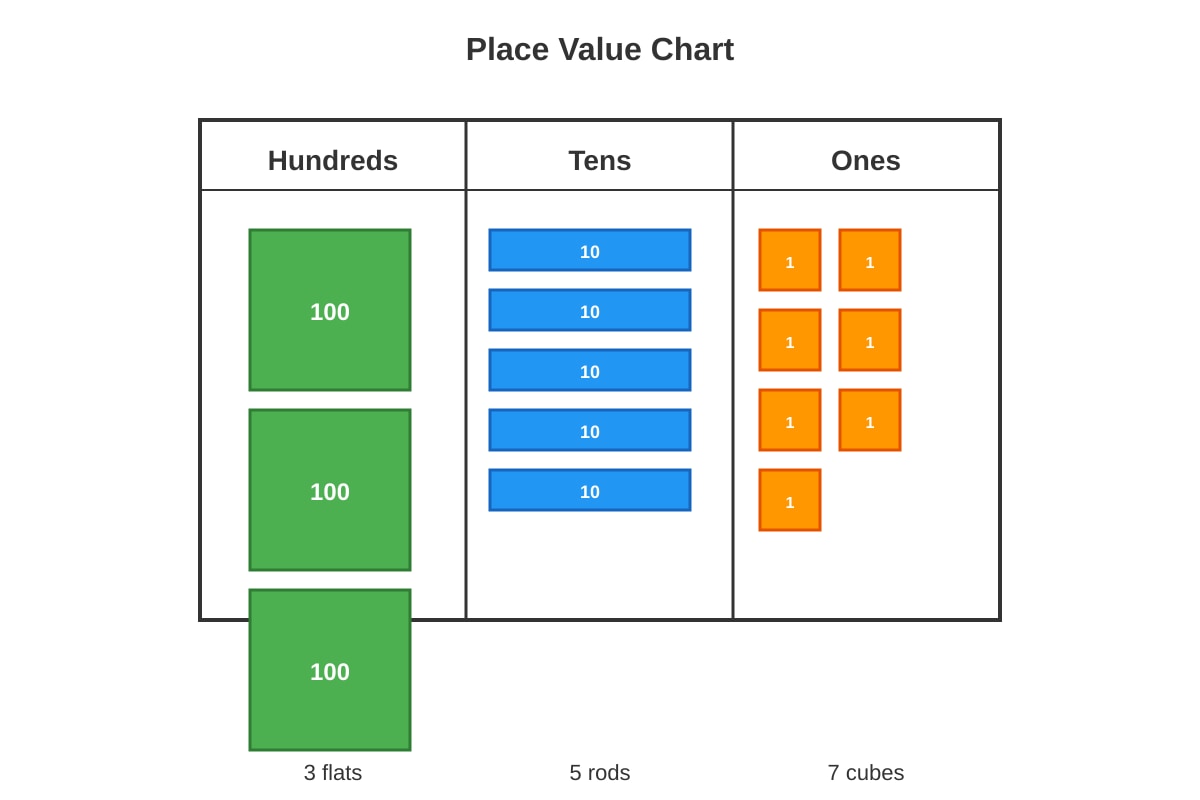
15. (a) What number is shown by the blocks?
Answer: 357
Working: 3 hundreds + 5 tens + 7 ones = 300 + 50 + 7 = 357
Marking: [2 marks]
Visual reference: The place value chart shows 3 hundred-flats (value 300), 5 ten-rods (value 50), and 7 one-cubes (value 7).
(b) What is 100 less than this number?
Answer: 257
Working: 357 − 100 = 257 (subtract 1 from the hundreds digit: 3 → 2)
Marking: [2 marks] — follow-through mark available if student uses their answer from (a) correctly
Teaching note: "100 less" means subtract 100, which changes only the hundreds digit. Keep the tens and ones digits the same.
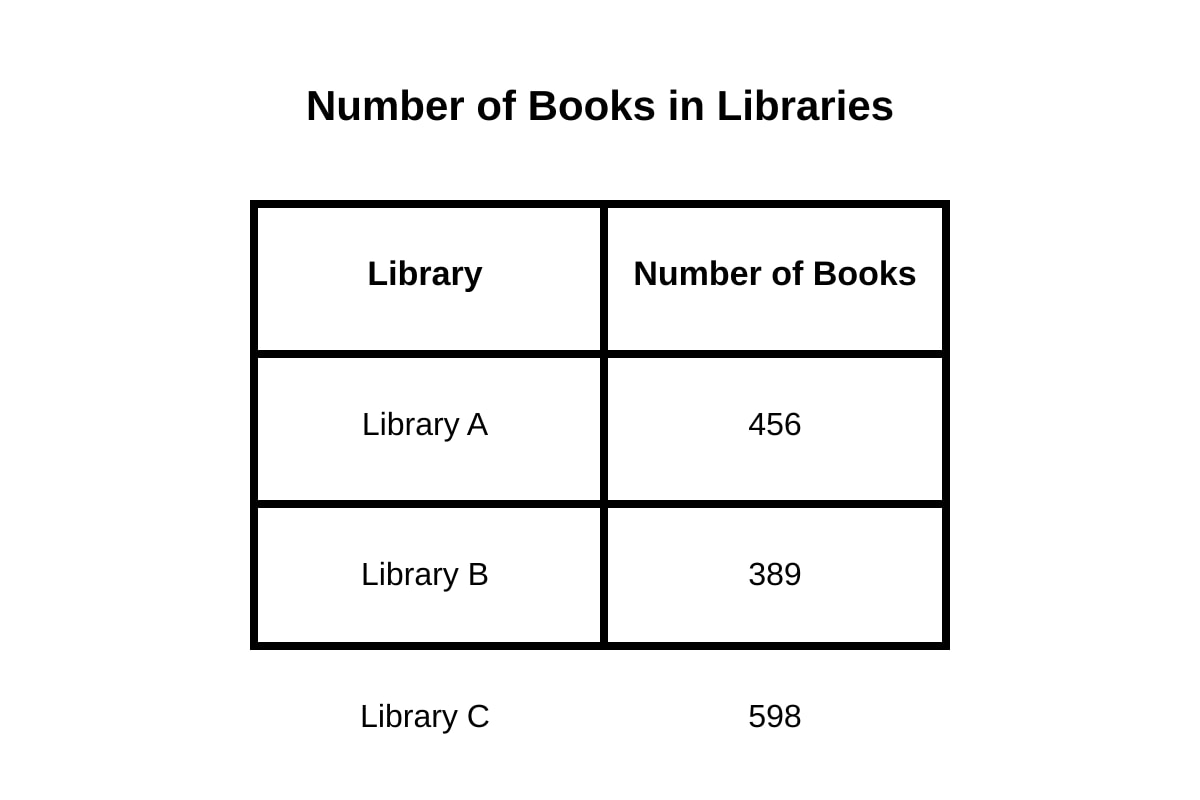
16. Library data table.
(a) Which library has the most books?
Answer: Library C
Marking: [1 mark]
Visual reference: Table shows Library A: 456, Library B: 389, Library C: 598. Compare: 598 > 456 > 389.
(b) How many books in Library A and Library B altogether?
Answer: 845 books
Working:
  456
+ 389
-----
  845
- Ones: 6 + 9 = 15, write 5, carry 1 ten
- Tens: 5 + 8 + 1 = 14, write 4, carry 1 hundred
- Hundreds: 4 + 3 + 1 = 8
Marking: [2 marks] — correct method [1], correct answer [1]
(c) How many more books does Library C have than Library B?
Answer: 209 more books
Working: 598 − 389 = 209
  598
- 389
-----
  209
- Ones: 8 − 9 (need to exchange), 18 − 9 = 9
- Tens: 8 (after exchange) − 8 = 0
- Hundreds: 5 − 3 = 2
Marking: [1 mark]
Teaching note: "How many more" means subtraction. Be careful with exchanging when the top digit is smaller than the bottom digit.
17. Jenny's stickers.
(a) How many stickers after her brother gives her more?
Answer: 721 stickers
Working: 485 + 236 = 721
  485
+ 236
-----
  721
- Ones: 5 + 6 = 11, write 1, carry 1 ten
- Tens: 8 + 3 + 1 = 12, write 2, carry 1 hundred
- Hundreds: 4 + 2 + 1 = 7
Marking: [2 marks]
(b) How many stickers in the end?
Answer: 571 stickers
Working: 721 − 150 = 571
  721
- 150
-----
  571
- Ones: 1 − 0 = 1
- Tens: 2 − 5 (need to exchange), 12 − 5 = 7
- Hundreds: 6 (after exchange) − 1 = 5
Marking: [2 marks]
Teaching note: This is a two-step problem. First add, then subtract. Check if your final answer makes sense—Jenny should have more than she started with (485 → 571), which she does!
18. Complete the pattern: 125, 150, 175, 200, ___, ___
Answer: 225, 250
Pattern rule: Add 25 each time / Count up in twenty-fives
Working:
- 150 − 125 = 25
- 175 − 150 = 25
- 200 − 175 = 25
- 200 + 25 = 225
- 225 + 25 = 250
Marking: [3 marks] — 225 [1], 250 [1], correct rule stated clearly [1]
Teaching note: Find the difference between consecutive terms to discover the pattern rule. This pattern uses skip counting by 25s, which is useful for money (4 quarters = $1).
Section C: Problem Solving
19. Tom's number cards: 7, 4, 2.
(a) Greatest 3-digit number.
Answer: 742
Method: To make the greatest number, put the largest digit (7) in the hundreds place, the next largest (4) in tens, and the smallest (2) in ones.
Marking: [2 marks]
(b) Smallest 3-digit number.
Answer: 247
Method: To make the smallest number, put the smallest non-zero digit (2) in the hundreds place, then 4 in tens, 7 in ones. Important: We cannot start with 0, but here our smallest digit is 2, so that's fine.
Marking: [2 marks] — deduct [1] if answer is 472 (confusing largest/smallest digits)
(c) Difference between greatest and smallest.
Answer: 495
Working:
  742
- 247
-----
  495
- Ones: 2 − 7 (exchange needed), 12 − 7 = 5
- Tens: 3 (after exchange) − 4 (need to exchange), 13 − 4 = 9
- Hundreds: 6 (after exchange) − 2 = 4
Marking: [3 marks] — correct method with exchanges shown [2], correct answer [1]
Common mistake: Forgetting to exchange or exchanging incorrectly. Always check: 247 + 495 should equal 742.
(d) Is the smallest number odd or even?
Answer: Odd. 247 ends in 7, and 7 is an odd digit. Numbers ending in 1, 3, 5, 7, or 9 are odd.
Marking: [1 mark] — must have correct answer with acceptable explanation
Teaching note: Even numbers can be split into two equal groups with none left over. 247 ÷ 2 = 123 remainder 1, so it's odd.
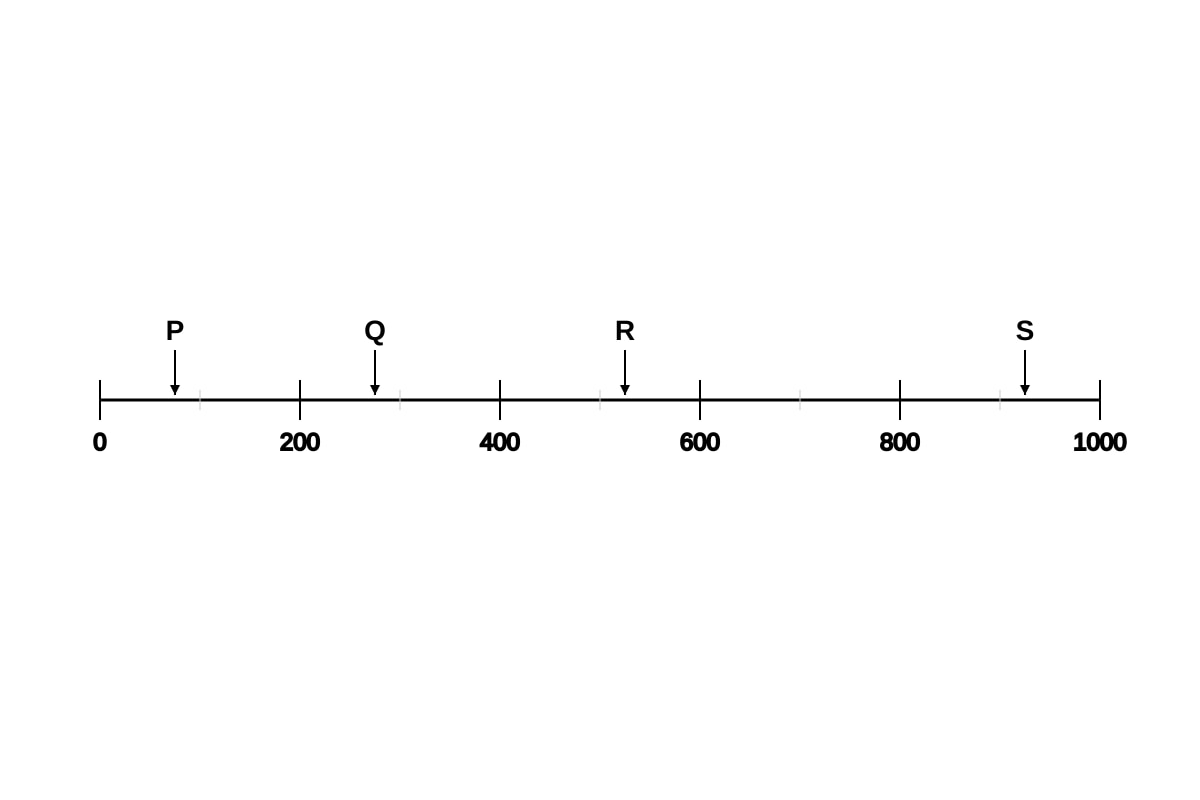
20. Number line with points P, Q, R, S.
(a) Write the number for each letter.
| Letter | Answer | Explanation |
|---|---|---|
| P | 150 | Halfway between 0 and 200 |
| Q | 350 | Halfway between 200 and 400 (or 200 + 150) |
| R | 550 | Halfway between 400 and 600 (or 400 + 150) |
| S | 950 | 50 before 1000, or 800 + 150 |
Marking: [4 marks] — each correct [1]
Visual reference: The number line shows intervals of 200. Each interval is divided by the arrow positions. P, Q, R are at midpoints (150 into each interval); S is 150 past 800.
(b) Which letter stands for the greatest number?
Answer: S
Marking: [1 mark]
(c) Difference between R and P.
Answer: 400
Working: 550 − 150 = 400
Or: R is 3 intervals from P (150 to 350 to 550 = 200 + 200 = 400... wait, let me check: 550 − 150 = 400). Actually from the number line: P at 150, R at 550. The distance is 550 − 150 = 400.
Marking: [2 marks] — method [1], answer [1]
(d) List letters for even numbers.
Answer: P (150) and R (550)
Working: 150 ends in 0 (even); 350 ends in 0 (even); 550 ends in 0 (even); 950 ends in 0 (even).
Wait—let me recheck: All four numbers end in 0, so ALL are even!
Corrected Answer: P, Q, R, S (all are even)
Working:
- 150 ends in 0 → even
- 350 ends in 0 → even
- 550 ends in 0 → even
- 950 ends in 0 → even
Marking: [1 mark] — all four letters correctly listed; deduct [1] for any omission
Teaching note: This is a trick question to check careful observation! All numbers ending in 0, 2, 4, 6, 8 are even. Don't just look at the first digit—always check the ones place.
Mark Summary
| Section | Marks |
|---|---|
| Section A (Questions 1–10) | 10 |
| Section B (Questions 11–18) | 24 |
| Section C (Questions 19–20) | 16 |
| Total | 50 |
Grade Boundaries (suggested):
- A*: 45–50
- A: 40–44
- B: 35–39
- C: 30–34
- D: 25–29
- Below 25: Needs reinforcement
Caveat: This practice paper is generated from LLM-inferred templates based on the 2021 Singapore Primary Mathematics syllabus. No past-year examination templates were available for this topic and level. Questions are designed to be syllabus-aligned and pedagogically useful, but are not derived from official examination sources.