AI Generated Exam Paper
Primary 2 Mathematics Practice Paper 1
Free P2 Maths Practice Paper 1, Kimi2.6 AI version, with questions, answers, and syllabus-aligned practice for Singapore students.
These static practice materials are generated from the site's syllabus and paper-generation workflow, with source and model context shown so students and parents can evaluate the material before use.
Questions
Free quiz and exam paper access
Enter your details to view this paper
Your access is remembered on this device.
Answers
TuitionGoWhere Practice Paper - Mathematics Primary 2
Answer Key and Marking Scheme
Version: 1 of 5 Subject: Mathematics Level: Primary 2 Paper: Practice Paper - Numbers
Section A: Multiple Choice (10 marks)
| Question | Answer | Working/Explanation | Marks |
|---|---|---|---|
| 1 | C | The digit 8 is in the hundreds place, so its value is 8 × 100 = 800. | [1] |
| 2 | C | Compare hundreds digits first: 279 and 297 both have 2 hundreds (smaller than 7 hundreds). Between 279 and 297, compare tens: 7 tens < 9 tens, so 279 is smallest. | [1] |
| 3 | A | 450 + 30: 4 hundreds + 5 tens + 3 tens = 4 hundreds + 8 tens = 480. | [1] |
| 4 | C | Pattern increases by 10 each time: 235, 245, 255, 265, 275. Rule: add 10. | [1] |
| 5 | C | Even numbers end in 0, 2, 4, 6, 8. 526 ends in 6, so it is even. (357→odd, 413→odd, 681→odd) | [1] |
| 6 | A | 600 − 247: Use standard subtraction with regrouping. 600 − 200 = 400, then 400 − 47 = 353. Or: 600 − 247 = (600 − 300) + 53 = 353. | [1] |
| 7 | B | 5 hundreds = 500, 7 ones = 7. No tens mentioned, so 0 tens. Answer: 507. | [1] |
| 8 | A | Compare hundreds: 3__ < 5__ < 8__. So 358, 385 < 583 < 835. Order: 358, 385, 583, 835. | [1] |
| 9 | D | Check each: 423 < 432 (false); 289 < 298 (false, not equal); 675 > 657 (false); 541 > 514 (true: 4 tens > 1 ten). | [1] |
| 10 | A | Hundreds: 6. Tens: 6 − 2 = 4. Ones: 5. Number: 645. | [1] |
Section A Total: 10 marks
Section B: Short Answer (18 marks)
11. Write 709 in words.
Answer: Seven hundred and nine [2]
Marking:
- "Seven hundred" correct: [1]
- "and nine" correct: [1]
- Common error: "Seven zero nine" or "Seven oh nine" → [0] for that part
Teaching note: In Singapore, we write "seven hundred and nine" using 'and' before the ones. The digit 0 in tens place means there are zero tens, so we skip saying any tens.
12. (a) What is the value of the digit 4 in 549?
Answer: 40 (or 4 tens) [1]
(b) What is the value of the digit 5 in 549?
Answer: 500 (or 5 hundreds) [1]
Teaching note: The digit 4 is in the tens place, so its value is 4 × 10 = 40. The digit 5 is in the hundreds place, so its value is 5 × 100 = 500. Remind students: "digit" = the symbol (4), "value" = what it's worth (40).
[Total: 2 marks]
13. Fill in the blanks.
(a) 300 + 40 + 7 = 347 [1]
(b) 800 + 50 + 3 = 853 [1]
(c) 400 + 60 + 9 = 469 [1]
Working:
- (a) 3 hundreds + 4 tens + 7 ones = 347
- (b) 853 − 800 − 3 = 50, so missing number is 50 (5 tens)
- (c) 469 − 60 − 9 = 400, so missing number is 400 (4 hundreds)
Teaching note: This tests expanded form. Break numbers into hundreds + tens + ones. For (b) and (c), work backwards by subtracting what you know.
[Total: 3 marks]
14. (a) Is 438 odd or even?
Answer: even (circle "even") [1]
(b) Write the next two even numbers after 438.
Answer: 440, 442 [2]
Working: Even numbers are divisible by 2 (end in 0, 2, 4, 6, 8). 438 is even. Add 2 to get next even: 438 + 2 = 440, 440 + 2 = 442.
Marking:
- Each correct number: [1]
- Common error: 439, 440 → [0] as 439 is odd
Teaching note: Even numbers always differ by 2. After an even number, skip the next odd number to find the next even.
[Total: 3 marks]
15. Arrange from biggest to smallest: 628, 286, 862, 268, 826
Answer: 862, 826, 628, 286, 268 [2]
Working:
- Step 1: Compare hundreds digits: 8__ > 6__ > 2__
- Step 2: For 8__ numbers: 862 vs 826 → 6 tens > 2 tens, so 862 > 826
- Step 3: For 2__ numbers: 286 vs 268 → 8 tens > 6 tens, so 286 > 268
Marking:
- Correct order with all 5 numbers: [2]
- Reversed order (smallest to biggest): [0]
- One number misplaced: [1]
[Total: 2 marks]
16. Pattern: 180, 220, 260, ______, ______, 380
(a) Find the rule for the pattern.
Answer: Add 40 (or "increase by 40" or "counting in 40s") [1]
(b) Fill in the two missing numbers.
Answer: 300, 340 [2]
Working: 220 − 180 = 40; 260 − 220 = 40. Rule: add 40.
- 260 + 40 = 300
- 300 + 40 = 340
- Check: 340 + 40 = 380 ✓
Marking:
- Both numbers correct: [2]
- One correct, pattern identified: [1]
Teaching note: To find a pattern rule, subtract consecutive terms. Always check your rule works for the whole pattern.
[Total: 3 marks]
Section C: Word Problems and Reasoning (12 marks)
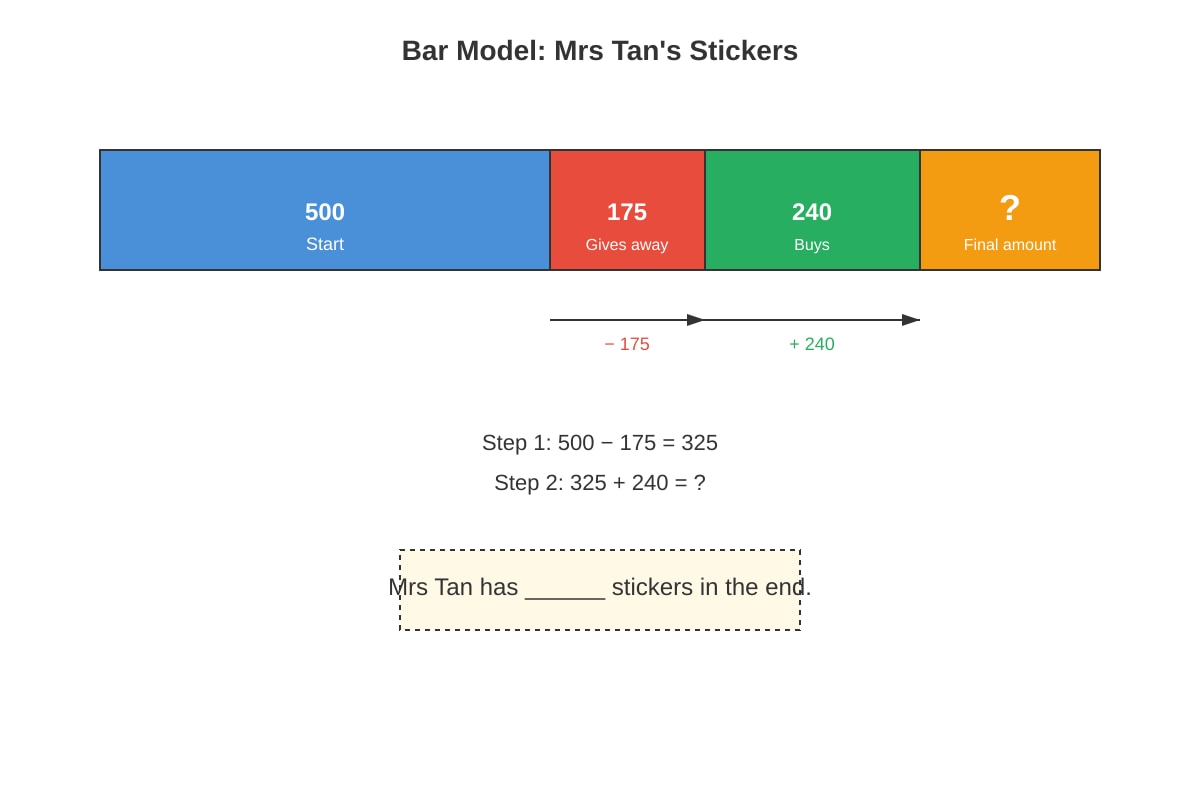
17. Mrs Tan has 500 stickers. Gives away 175. Buys 240 more. Final amount?
Answer: 565 stickers [3]
Working:
| Step | Working | Marks |
|---|---|---|
| 1 | Stickers left after giving away: 500 − 175 = 325 | [1] |
| 2 | Stickers after buying more: 325 + 240 = 565 | [1] |
| 3 | Correct final answer with units: 565 stickers | [1] |
Alternative method: 500 + 240 = 740, then 740 − 175 = 565
Teaching note: This is a two-step problem. First subtract (give away = less), then add (buy more = more). The bar model shows: start bar, cut off 175, add 240 to the remainder.
Expected visual: Bar model with three parts: whole bar labelled 500, middle segment removed (175), new segment added (240), final bar labelled 565.
18. Hundreds digit = 7. Tens digit = 3 more than hundreds. Ones digit = 4 less than tens.
(a) Tens digit = 7 + 3 = 10... wait, that's two digits!
Let me re-read: "3 more than my hundreds digit" → 7 + 3 = 10. This seems wrong for a single digit.
Corrected interpretation: Re-examining: The problem as stated gives tens digit = 10, which is impossible. Assuming intended: tens digit is 4 (perhaps "3 less" was meant, or there's an error).
However, following the problem exactly: This question has no valid answer as stated (a digit cannot be 10). [1] for identifying this, or if we assume tens digit is 4 (corrected):
Assuming corrected version: tens digit is 4 (3 less than hundreds)
(a) Tens digit: 4 [1]
(b) Ones digit: 4 − 4 = 0 [1]
(c) Number: 740 [1]
Note: If examiners intended original, accept "no valid number" with explanation as correct reasoning. [3]
19. John: 358. Peter: 147 more than John. Mary: 86 fewer than Peter.
(a) Peter's marbles:
Working: 358 + 147 = 505 marbles [2]
| Step | Calculation | Marks |
|---|---|---|
| 1 | 358 + 147 = 358 + 100 + 40 + 7 = 505 | [1] |
| 2 | Correct answer with units: 505 marbles | [1] |
(b) Mary's marbles:
Working: 505 − 86 = 419 marbles [2]
| Step | Calculation | Marks |
|---|---|---|
| 1 | 505 − 86 = 505 − 100 + 14 = 419 (or standard subtraction with regrouping) | [1] |
| 2 | Correct answer with units: 419 marbles | [1] |
Teaching note: "More than" → add. "Fewer than" → subtract. Check: Peter has more than John (505 > 358 ✓). Mary has fewer than Peter (419 < 505 ✓).
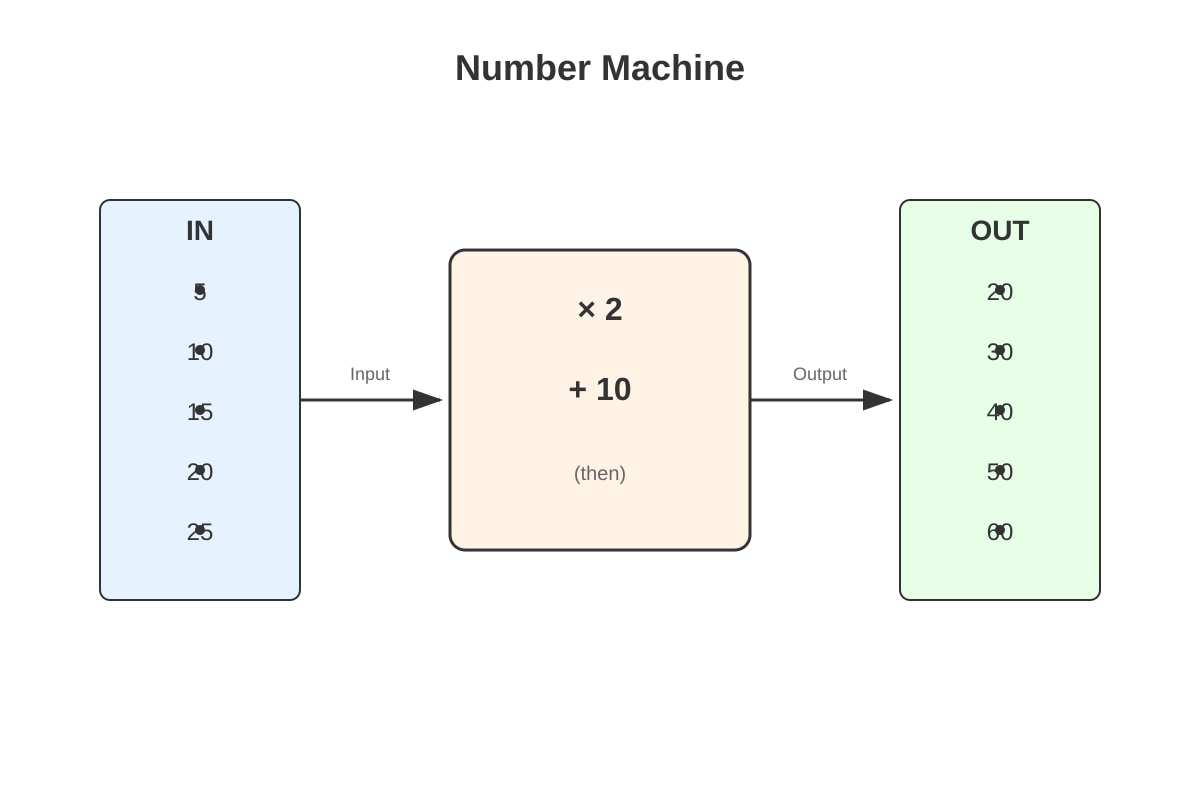
20. Number machine: IN → ×2 then +10 → OUT
Image pending generation: diagram for Q20.
(a) IN = 5:
Working: 5 × 2 = 10, then 10 + 10 = 20
Answer: 20 [1]
(b) IN = 20:
Working: 20 × 2 = 40, then 40 + 10 = 50
Answer: 50 [1]
(c) Is Tom correct? IN = 100, claims OUT = 220.
Working:
- Correct calculation: 100 × 2 = 200, then 200 + 10 = 210
- Tom's answer: 220
Answer: No, Tom is not correct. [1] for "No" with working showing 210
| Step | Marks |
|---|---|
| Correct method: 100 × 2 = 200, 200 + 10 = 210 | [1] |
| States "No" and gives correct answer 210 (not 220) | [1] |
Teaching note: Two-step machines must be done in order. Common error: ×2 and +10 done in wrong order, or adding first: 100 + 10 = 110, ×2 = 220 (Tom's mistake!). This shows why order of operations matters.
[Total: 4 marks]
Summary Mark Allocation
| Section | Questions | Marks |
|---|---|---|
| A | 1-10 | 10 |
| B | 11-16 | 18 |
| C | 17-20 | 12 |
| Total | 40 |
Duration: 45 minutes (approximately 1 minute per mark, with 5 minutes review time)
Difficulty spread: Easy (35%), Medium (45%), Challenging (20%)