AI Generated Quiz
Primary 2 Malay Language Use Quiz
Free P2 Malay Language Use quiz, AI version, with questions, answers, and syllabus-aligned practice for Singapore students.
These static practice materials are generated from the site's syllabus and paper-generation workflow, with source and model context shown so students and parents can evaluate the material before use.
Questions
Free quiz and exam paper access
Enter your details to view this paper
Your access is remembered on this device.
Answers
Primary 2 Malay Quiz - Language Use - ANSWER KEY
Total Marks: 20
Section A: Vocabulary (Questions 1-5)
1. Answer: B) memasak Marks: 1 Explanation: The sentence "Ibu sedang ______ nasi di dapur" means "Mother is ______ rice in the kitchen." The most suitable word is "memasak" (cooking). "Tidur" (sleep), "membaca" (read), and "menari" (dance) do not fit the context of cooking rice in the kitchen. Common Mistake: Students might choose "membaca" because it starts with 'me-', but reading does not involve rice in the kitchen.
2. Answer: C) Gembira Marks: 1 Explanation: The question asks, "What is your feeling when you receive a gift?" The most appropriate feeling is "gembira" (happy). "Sedih" (sad), "marah" (angry), and "takut" (afraid) are negative emotions that are not typically associated with receiving a gift. Teaching Note: This question tests vocabulary related to emotions (perasaan). Encourage students to think about how they feel when they get a present.
3. Answer: 1-B, 2-A, 3-C Marks: 1 Explanation:
- Doktor (Doctor) - Orang yang merawat pesakit (A person who treats patients) -> 1-B
- Sekolah (School) - Tempat belajar (A place to study) -> 2-A
- Bas (Bus) - Kenderaan awam (Public vehicle) -> 3-C Teaching Note: This question tests vocabulary matching. Students need to know the meaning of each word and find its correct definition.
4. Answer: A) panas Marks: 1 Explanation: The sentence says "Hari ini cuaca ______, tetapi semalam cuaca sejuk" meaning "Today the weather is ______, but yesterday the weather was cold." The word "tetapi" (but) shows a contrast. The opposite of "sejuk" (cold) is "panas" (hot). Teaching Note: This question tests antonyms (kata lawan). "Panas" is the opposite of "sejuk".
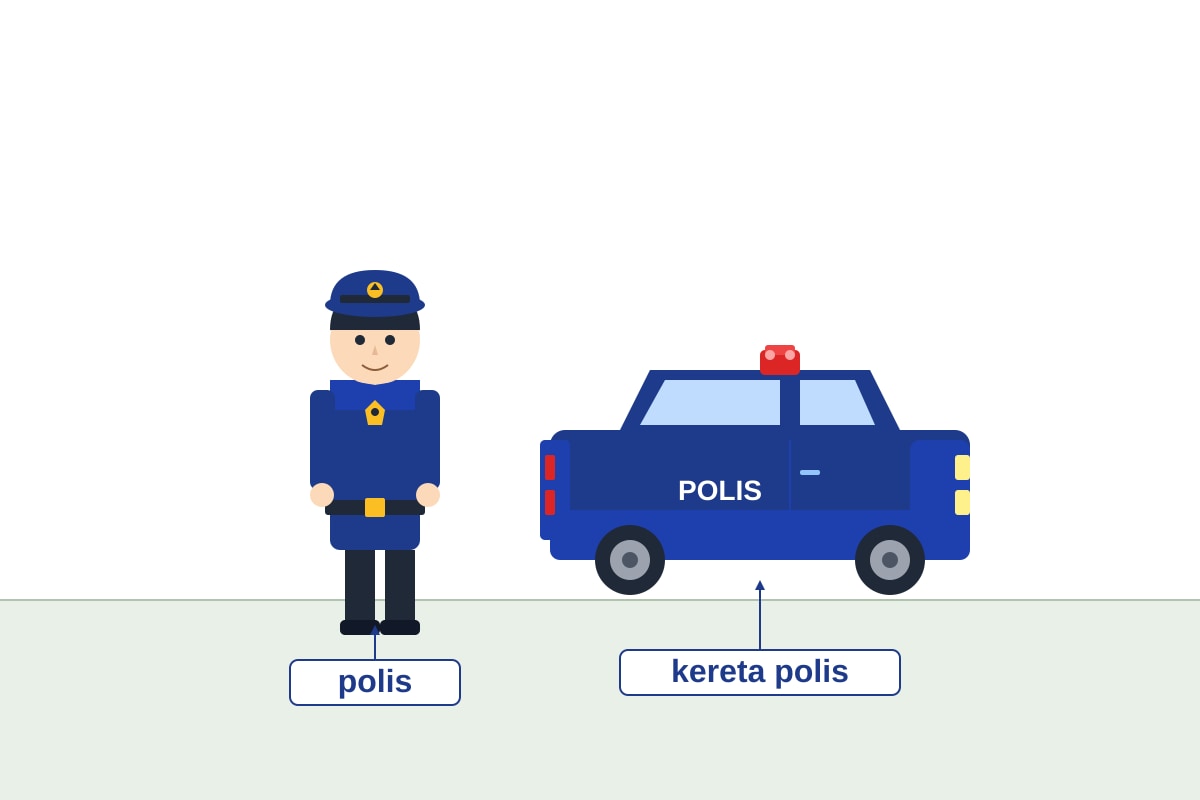
5. Answer: B) Polis Marks: 1 Explanation: The image shows a person in a police uniform standing next to a police car. This person is a "polis" (police officer). "Guru" (teacher), "petani" (farmer), and "nelayan" (fisherman) do not match the uniform and vehicle shown. Teaching Note: This question tests vocabulary related to occupations (pekerjaan). Students should identify the job based on visual clues like the uniform and car.
Section B: Grammar (Questions 6-10)
6. Answer: A) di Marks: 1 Explanation: The sentence "Kucing itu tidur ______ bawah meja" means "The cat is sleeping ______ the table." The preposition "di" is used to indicate a location or place. "Ke" (to) indicates direction, "dari" (from) indicates origin, and "dengan" (with) indicates accompaniment. Teaching Note: "Di" is used for locations. "Di bawah" means "under".
7. Answer: B) dan Marks: 1 Explanation: The sentence "Adik suka makan epal ______ anggur" means "Younger sibling likes to eat apples ______ grapes." The conjunction "dan" (and) is used to connect two similar items in a list. "Tetapi" (but) shows contrast, "atau" (or) shows a choice, and "kerana" (because) shows a reason. Teaching Note: "Dan" is used to add information. The sentence lists two fruits the sibling likes.
8. Answer: A) membaca Marks: 1 Explanation: The sentence "Ayah sedang ______ (baca) surat khabar" means "Father is ______ (read) the newspaper." The correct prefix for the root word "baca" (read) in this context is "me-" to form "membaca" (reading). The prefix "ber-" is not used with "baca" to mean "reading". Teaching Note: The prefix "me-" is used to form active verbs. "Membaca" is the correct active verb form for "read".
9. Answer: Ali suka bermain bola dan berenang. / Ali suka bermain bola dan Ali suka berenang. Marks: 1 Explanation: The two simple sentences are "Ali suka bermain bola" (Ali likes to play ball) and "Ali suka berenang" (Ali likes to swim). They can be combined using "dan" (and) to form a compound sentence. The most concise way is "Ali suka bermain bola dan berenang." Teaching Note: A compound sentence joins two related ideas. "Dan" is used to add information.
10. Answer: D) Bila Marks: 1 Explanation: The question is "______ kamu pergi ke perpustakaan semalam?" meaning "______ did you go to the library yesterday?" The word "semalam" (yesterday) indicates a time. Therefore, the correct question word is "Bila" (When). "Siapa" (Who) asks for a person, "Apa" (What) asks for a thing, and "Ke mana" (Where to) asks for a destination. Teaching Note: Question words (kata tanya) are used to ask for specific information. "Bila" is used to ask about time.
Section C: Sentence Construction (Questions 11-15)
11. Answer: Saya pergi ke pasar dengan emak. Marks: 1 Explanation: The words are "pergi" (go), "ke" (to), "Saya" (I), "pasar" (market), "dengan" (with), "emak" (mother). The correct sentence order is Subject (Saya) + Verb (pergi) + Preposition (ke) + Object (pasar) + Preposition (dengan) + Noun (emak). Teaching Note: In Malay, the basic sentence structure is Subject-Verb-Object. Prepositions like "ke" and "dengan" come before the noun they refer to.
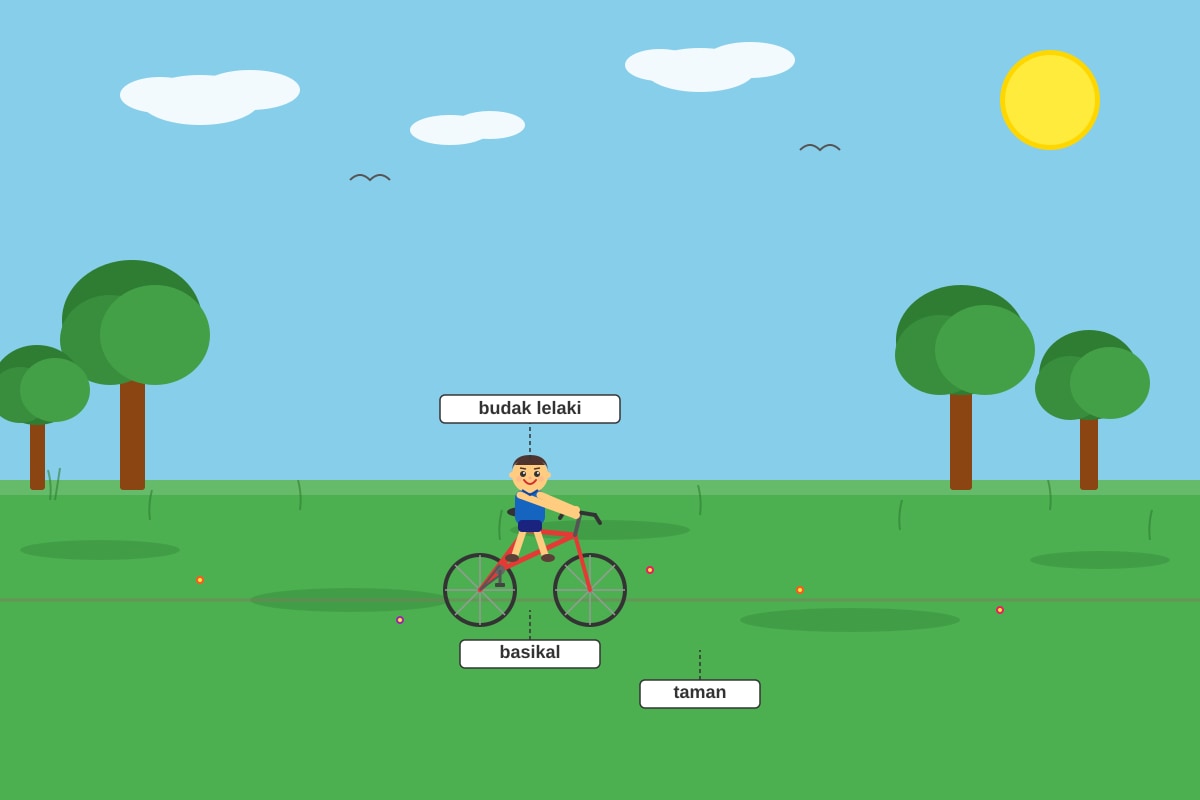
12. Answer: (Accept any reasonable sentence describing the picture, e.g.,)
- Seorang budak lelaki sedang menunggang basikal di taman.
- Budak itu berbasikal di taman.
- Dia gembira menunggang basikal di taman. Marks: 1 Explanation: The picture shows a boy riding a bicycle in a park. The sentence should include the subject (budak lelaki), the action (menunggang basikal/berbasikal), and the location (di taman). Teaching Note: Encourage students to write a complete sentence with a subject, verb, and object/location.
13. Answer: B) mengajar Marks: 1 Explanation: The sentence "Cikgu ______ murid-murid di dalam kelas" means "Teacher ______ students in the classroom." The most suitable word is "mengajar" (teaches). "Menyanyi" (sings), "berlari" (runs), and "tidur" (sleeps) are not typical actions of a teacher in a classroom. Teaching Note: This question tests vocabulary related to actions in a school setting.
14. Answer: Mereka pergi ke perpustakaan. Marks: 1 Explanation: "Ali dan Siti" is a plural subject (two people). The correct personal pronoun to replace "Ali dan Siti" is "Mereka" (They). Teaching Note: Personal pronouns (kata ganti nama diri) replace nouns. "Mereka" is used for a group of people.
15. Answer: A) Saya suka makan nasi lemak kerana sedap. Marks: 1 Explanation: The sentence means "I like to eat nasi lemak because it is delicious." The conjunction "kerana" (because) correctly shows the reason for liking the food. "Tetapi" (but) shows contrast, "dan" (and) adds information, and "atau" (or) shows a choice, none of which fit the meaning of the sentence. Teaching Note: "Kerana" is used to give a reason or cause.
Section D: Comprehension and Language Use (Questions 16-20)
16. Answer: B) Ke pantai Marks: 1 Explanation: The passage states, "Pada hari Ahad, keluarga Encik Ahmad pergi ke pantai." (On Sunday, Encik Ahmad's family went to the beach.) Teaching Note: This is a direct recall question. The answer is explicitly stated in the text.
17. Answer: B) Bermain pasir Marks: 1 Explanation: The passage states, "Adik-adik bermain pasir." (The younger siblings played with sand.) Teaching Note: This is a direct recall question. The answer is explicitly stated in the text.
18. Answer: C) Di bawah pokok Marks: 1 Explanation: The passage states, "Ibu dan Ayah duduk di bawah pokok." (Mother and Father sat under a tree.) Teaching Note: This is a direct recall question. The answer is explicitly stated in the text.
19. Answer: C) Gembira Marks: 1 Explanation: The passage states, "Mereka berasa sangat gembira." (They felt very happy.) Teaching Note: This is a direct recall question. The answer is explicitly stated in the text.
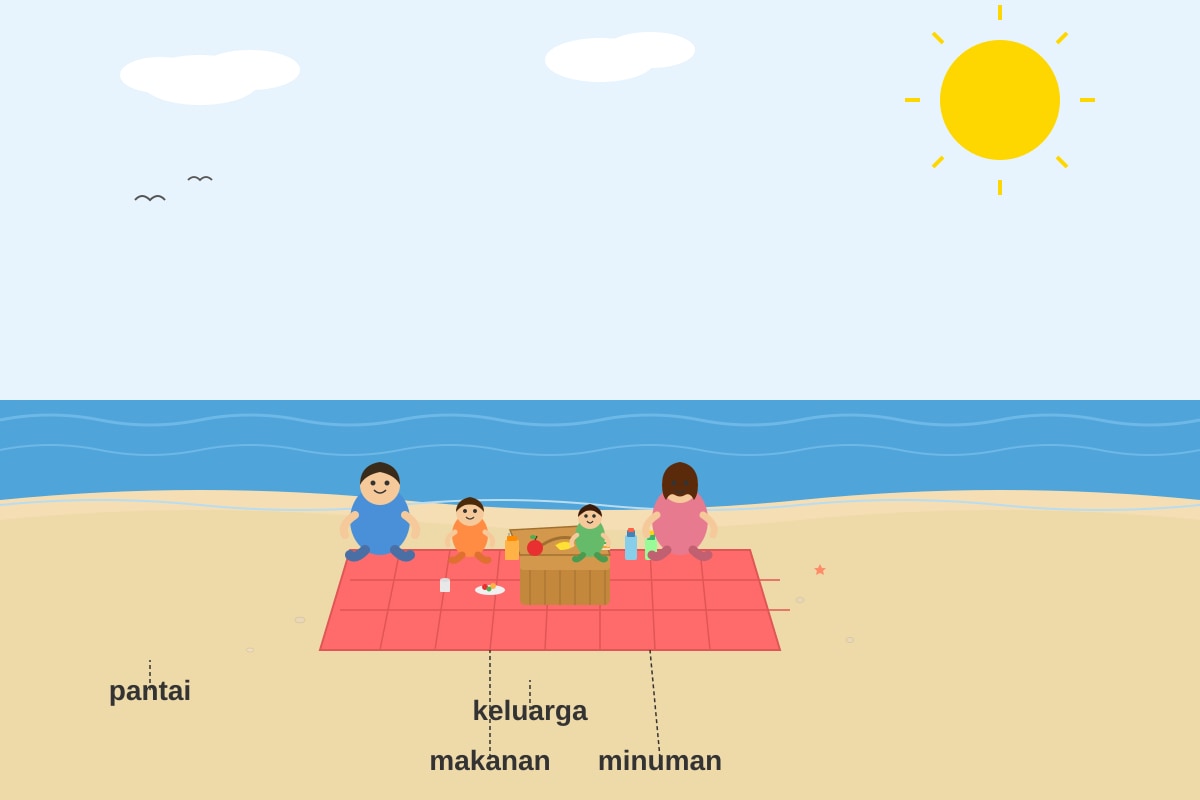
20. Answer: B) Keluarga itu sedang berkelah di pantai. Marks: 1 Explanation: The image shows a family having a picnic on the beach with a picnic basket, food, and drinks. The most suitable sentence is "Keluarga itu sedang berkelah di pantai" (The family is having a picnic at the beach). The other options describe different activities: swimming (berenang), sleeping (tidur), and running (berlari), which are not shown in the picture. Teaching Note: This question tests the ability to match a sentence to a visual stimulus. Students should look for key details in the picture (picnic basket, food, family sitting on a blanket) to choose the correct description.