AI Generated Exam Paper
Primary 2 Malay Practice Paper 4
Free P2 Malay Practice Paper 4, Kimi2.6 AI version, with questions, answers, and syllabus-aligned practice for Singapore students.
These static practice materials are generated from the site's syllabus and paper-generation workflow, with source and model context shown so students and parents can evaluate the material before use.
Questions
Free quiz and exam paper access
Enter your details to view this paper
Your access is remembered on this device.
Answers
TuitionGoWhere Practice Paper - Malay Primary 2
Answer Key and Marking Scheme
Version 4 of 5
Section A: Vocabulary and Word Meaning (10 marks)
| Question | Answer | Marks | Notes |
|---|---|---|---|
| 1 | B) to read | 1 | membaca = to read. Common confusion: menulis (to write) is option A. Emphasize the prefix mem- indicates action, and the root baca relates to reading. |
| 2 | C) school | 1 | sekolah = school. Cognate with English "school" from Portuguese/Dutch influence. Distractor perpustakaan (library) appears in Q10 to build connection. |
| 3 | B) wake up early | 1 | bangun = wake up/get up; pagi = morning. Compound phrase follows Malay syntax of verb + time expression. Common error: selecting "sleep early" (tidur awal) which is different concept. |
| 4 | C) good friend | 1 | kawan = friend; baik = good. Post-positive adjective structure (noun + adjective) is typical Malay grammar. Musuh = enemy, orang asing = stranger. |
| 5 | B) food | 1 | makan = to eat; makanan = food (nominalized with -an suffix). Distractor minuman = drinks from minum. Teach noun-forming pattern. |
| 6 | gambar | 1 | Context clue: melukis (to draw) requires an object that can be drawn. Gambar = picture/drawing. |
| 7 | hari | 1 | Hari Jumaat = Friday. Fixed expression for days of the week: Hari + day name. |
| 8 | minum | 1 | Minum = to drink; collocates with air (water). Sentence structure: suka + base verb (not conjugated in Malay). |
| 9 | laju | 1 | Laju = fast/rapid. Describes speed of vehicle. Adjective follows noun in Malay (kereta itu laju, not laju kereta). |
| 10 | buku | 1 | Context: membaca (reading) at perpustakaan (library) implies books. Builds semantic field of reading/books/library. |
Section A Total: 10 marks
Section B: Sentence Construction and Grammar (15 marks)
| Question | Answer | Marks | Notes |
|---|---|---|---|
| 11 | Saya pergi ke sekolah setiap hari. | 2 | Standard SVA (Subject-Verb-Agent/Location-Time) Malay sentence structure. Saya (I) = subject; pergi (go) = verb; ke sekolah (to school) = prepositional phrase; setiap hari (every day) = time expression. Marking: 1 mark for correct word order; 1 mark for correct spelling and use of ke. Common error: Omitting ke (pergi sekolah is colloquial but grammatically incomplete at this level). |
| 12 | Adik saya suka minum susu. / Saya suka minum susu, adik. (with comma if addressing) | 2 | Preferred: Adik saya suka minum susu. Subject adik saya (my younger sibling); suka (likes) + minum susu (drink milk) as verb phrase. Alternative acceptable with different meaning: Saya suka minum susu, adik. (I like to drink milk, younger sibling — vocative). Marking: 1 mark for grammatical structure; 1 mark for meaning coherence. Teach that Malay has flexible word order but standard is Subject-Verb-Object. |
| 13 | Bunga itu sangat cantik. | 2 | Bunga itu (that flower/the flower) as topic/subject; sangat cantik (very beautiful) as predicate. Demonstrative itu follows noun in Malay. Marking: 1 mark for correct positioning of itu; 1 mark for complete sentence structure. Common error: itu bunga cantik (mixed word order). |
| 14 | Saya makan tengahari bersama keluarga pada hari [sabtu/ahad/etc]. / Pada hari Ahad, saya makan tengahari bersama keluarga. | 2 | Standard time expression: makan tengahari ( lunch / eat midday meal); bersama keluarga (with family). Marking: 1 mark for correct phrase arrangement; 1 mark for grammatical completeness including preposition pada or bersama. Note: sama alone is colloquial; bersama is formal correct form. Accept pada or sentence-initial time phrase with comma. |
| 15 | Cikgu menulis di papan hitam yang baru. | 2 | Relative clause with yang (that/which) introduces description. Papan hitam (blackboard — compound noun); yang baru (new) as qualifier. Marking: 1 mark for correct yang usage; 1 mark for complete sentence with proper word order. Common error: Cikgu baru menulis... (changes meaning to "new teacher writes"). |
| 16 | nasi | 2½ | Nasi = cooked rice. Nasik is non-standard spelling/vulgar variant. Marking: 2½ marks for correct underlining. Deduct 2½ if nasik selected. Emphasize standard vs. colloquial spelling at P2 level to build proper orthographic habits. |
| 17 | sudah | 2½ | Sudah = already (completed action). Suda is non-standard colloquialism (common in casual speech, dialect). Marking: 2½ marks for correct underlining. Deduct 2½ if suda selected. Teach that final -h in sudah is pronounced but important for written form. |
Section B Total: 15 marks
Section C: Comprehension and Response (15 marks)
Question 18 (5 marks)
| Part | Answer | Marks | Notes |
|---|---|---|---|
| 18(a) | Pada hari Ahad / Ahad | 1 | Direct retrieval from first sentence. Accept with or without pada (on). |
| 18(b) | Ayah / Ayahnya / Bapanya | 1 | Direct retrieval: "Ayah memandu kereta dengan berhati-hati." |
| 18(c) | Buku cerita / Sebuah buku cerita | 1 | Direct retrieval: "Adik Ali membawa buku cerita." |
| 18(d) | Di bawah pokok yang besar / Mereka makan tengahari di bawah pokok yang besar | 2 | Marking: 1 mark for location di bawah pokok; 1 mark for complete phrase with descriptor yang besar. Must specify under the big tree — "under a tree" alone gets 1 mark. |
Question 19 (5 marks)
| Part | Answer | Marks | Notes |
|---|---|---|---|
| 19(a) | Any two from: pokok / bunga / burung (trees / flowers / birds) | 2 | 1 mark each for two correct items. Direct retrieval from "...melihat banyak pokok dan bunga. Ali suka melihat burung..." |
| 19(b) | Any plausible reason referencing enjoyment, family time, beautiful scenery, fun activities: e.g., Kerana mereka bersama keluarga dan menikmati masa yang indah / Kerana mereka suka melihat alam sekitar yang cantik / Kerana mereka berehat dan makan bersama dengan gembira | 3 | Marking descriptor: 1 mark for grammatical sentence; 1 mark for logical connection to passage; 1 mark for specific detail or elaboration. Require at least one specific element from text or reasonable inference (family togetherness, enjoyable outing, satisfying meal, beautiful nature). Vague "seronok" (fun) without elaboration gets maximum 2 marks. |
Question 20 (5 marks)
Marking Descriptors:
| Band | Marks | Description |
|---|---|---|
| Excellent | 5 | Two complete sentences with correct grammar, relevant Sunday family activity, specific details, and coherence. Proper use of bersama keluarga, time expression pada hari Ahad, and description of activity. |
| Good | 4 | Two sentences, mostly correct grammar, relevant activity, some detail. Minor spelling or word order errors that don't impede meaning. |
| Developing | 3 | Two sentences attempted, some grammatical issues, basic relevant content. May lack specificity or have noticeable errors. |
| Basic | 2 | One complete sentence or two fragmentary sentences. Limited relevance or frequent errors. |
| Minimal | 1 | Single phrase or severely limited response with minimal relevance to prompt. |
Exemplar answer:
Pada hari Ahad, saya suka pergi ke taman bersama keluarga saya. Kami bermain bola dan makan makanan sedap di bawah pokok. Saya sangat gembira kerana boleh bersama ibu bapa dan adik-beradik saya.
Teaching note: Guide students to include: (1) time marker pada hari Ahad; (2) family members bersama keluarga; (3) specific activity; (4) location if relevant; (5) feeling/reason. This builds narrative structure skills for P2 writing progression.
Section C Total: 15 marks
Section D: Picture Description and Writing (10 marks)
Question 21 (10 marks)
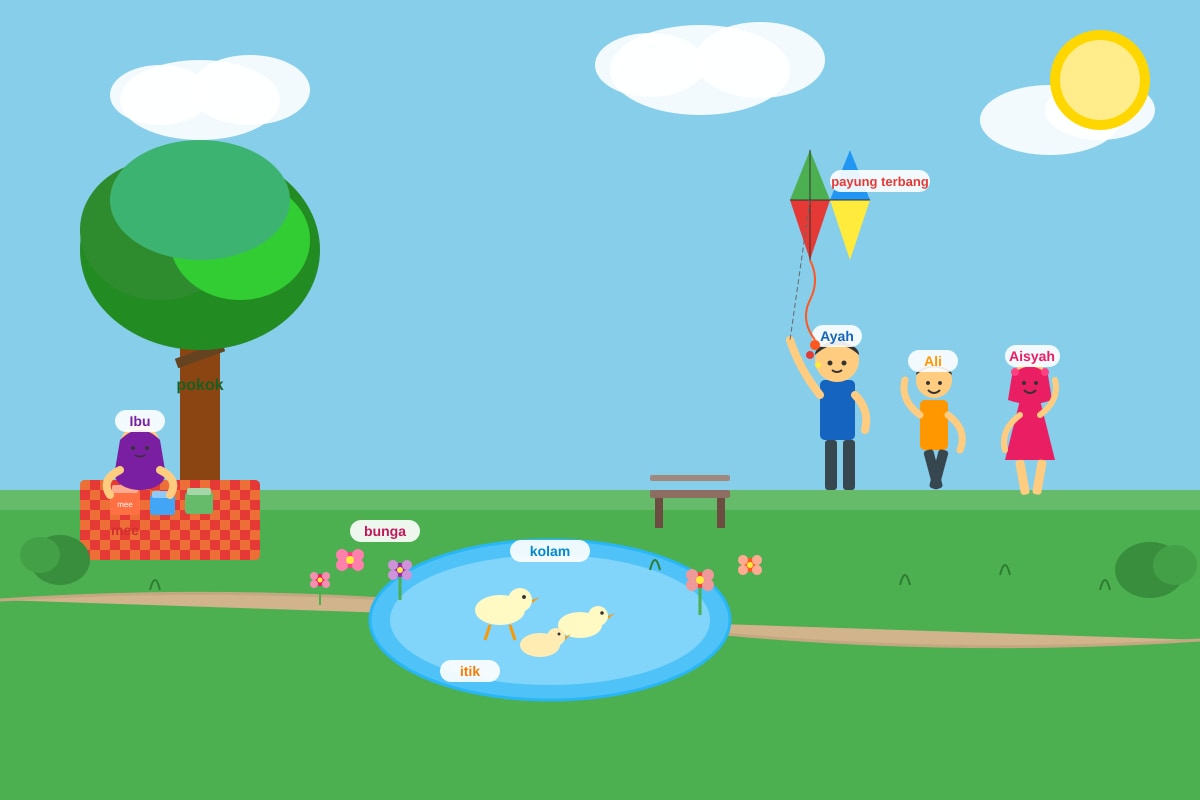
Generated diagram for Q21.
Marking Descriptors (10 marks):
| Criterion | Marks | Description |
|---|---|---|
| Content coverage | 4 | All four required elements addressed: who (family members), what (activities), where (park/nature setting), how they feel (happy/enjoyment) |
| 3 | Three elements well covered, one weak or missing | |
| 2 | Two elements well covered | |
| 1 | One element addressed | |
| 0 | No relevant content | |
| Grammar and structure | 3 | Correct sentence structures, appropriate P2-level vocabulary, proper word order, appropriate use of prepositions |
| 2 | Mostly correct with minor errors that don't impede meaning | |
| 1 | Frequent grammatical errors but some intelligible content | |
| 0 | Unintelligible or fragmentary | |
| Coherence and detail | 2 | Sentences flow logically, good use of connectors (dan, kerana, lalu), specific details from picture |
| 1 | Some logical connection but limited connectors or generic description | |
| 0 | Disconnected phrases or sentences | |
| Spelling and presentation | 1 | Generally accurate spelling, clear handwriting consideration (not assessed in digital but noted for conventions) |
| 0 | Frequent spelling errors that impede understanding |
Expected content points from image:
- Family members: Ayah, Ibu, Ali, Aisyah (or generic seorang budak lelaki dan seorang budak perempuan)
- Activities: memainkan layang-layang/payung terbang (flying kite), duduk di bawah pokok (sitting under tree), makan (eating)
- Setting: taman/rekreasi/taman awam (park), with natural elements pokok, bunga, kolam, itik
- Feelings: gembira, seronok, senang hati (happy, enjoying themselves)
Exemplar response (Band Excellent - 9-10 marks):
Gambar ini menunjukkan sebuah keluarga yang sedang bersiar-siar di taman. Ayah sedang memainkan layang-layang bersama Ali dan Aisyah. Ibu duduk di atas tikar di bawah pokok yang besar. Mereka membawa makanan untuk dimakan. Di kolam itu, ada beberapa ekor itik yang berenang. Anak-anak kelihatan sangat gembira kerana mereka dapat bermain bersama keluarga pada hari yang cerah.
Teaching notes for student learning:
- Encourage observation from left to right or foreground to background
- Use ini (this/introducing) and itu (that/distal) appropriately
- Include at least one sentence with kerana or sebab to explain why they feel happy
- Build from simple Saya nampak... (I see...) to more complex descriptive sentences
Section D Total: 10 marks
Paper Total: 50 marks
Time Alignment Check: Section A ~10 min, Section B ~18 min, Section C ~12 min, Section D ~10 min = 50 min; allows 5 min buffer in 45-min paper if student works efficiently. Adjusted downward for P2 novice writers who may need more thinking time per sentence.
Common Errors to Flag in Teaching:
- Confusing ke and di (direction vs. location)
- Omitting yang in relative clauses
- Wrong word order with demonstratives (itu bunga vs. bunga itu)
- Colloquial spellings (nasik, suda) becoming fossilized
- Direct translation from English word order