AI Generated Exam Paper
Primary 2 Malay Practice Paper 3
Free P2 Malay Practice Paper 3, Kimi2.6 AI version, with questions, answers, and syllabus-aligned practice for Singapore students.
These static practice materials are generated from the site's syllabus and paper-generation workflow, with source and model context shown so students and parents can evaluate the material before use.
Questions
Free quiz and exam paper access
Enter your details to view this paper
Your access is remembered on this device.
Answers
TuitionGoWhere Practice Paper - Malay Primary 2: Answer Key
Version: 3 of 5
Section A: Pilih Perkataan Yang Betul (Questions 1–8)
Question 1
Answer: C) gula-gula
Marks: 2
Explanation: The sentence says "Adik suka makan _________ yang manis" (My younger sibling likes to eat _________ that is sweet). All options are edible, but only gula-gula (sweets/candies) is characteristically sweet as a defining quality. Epal (apple) can be sweet or sour; nasi (rice) is not primarily sweet; sayur (vegetables) are typically not sweet. The clue "yang manis" (that is sweet) directly points to sweets/candy.
Question 2
Answer: B) ikan
Marks: 2
Explanation: The sentence says "Ibu membeli _________ di pasar pagi" (Mother bought _________ at the morning market). A pasar pagi (morning market) is a traditional market where fresh food, especially fish, meat, and vegetables, is sold. While buku (books), kasut (shoes), and baju (clothes) can be bought at markets, ikan (fish) is the most typical item associated with a morning market in Malaysian/Singapore cultural context.
Question 3
Answer: A) bola sepak
Marks: 2
Explanation: The sentence says "Abang saya pandai bermain _________" (My older brother is good at playing _________). The verb bermain (to play) is used for sports and games. Bola sepak (football/soccer) is a sport that one "plays." While piano involves "bermain" (to play an instrument), the more common collocation in Primary 2 context is sports. Kedai (shop) and pokok (tree) are not things one "plays."
Question 4
Answer: C) taman burung
Marks: 2
Explanation: The sentence says "Kami pergi ke _________ untuk melihat burung" (We went to _________ to see birds). The purpose clause "untuk melihat burung" (to see birds) clearly indicates the destination. A taman burung (bird park) is specifically designed for viewing birds. Hospital, sekolah (school), and stesen bas (bus station) are not places for bird-watching.
Question 5
Answer: B) papan hitam
Marks: 2
Explanation: The sentence says "Cikgu menulis di atas _________ dengan kapur" (Teacher writes on _________ with chalk). Kapur (chalk) is used to write on a papan hitam (blackboard). This is the classic teacher writing tool combination. One does not write with chalk on a meja (table), tingkap (window), or pintu (door).
Question 6
Answer: B) petang
Marks: 2
Explanation: The sentence says "Pada waktu _________, matahari terbenam" (At _________ time, the sun sets). The matahari terbenam (sunset) occurs in the petang (late afternoon/evening). Pagi (morning) is when the sun rises; malam (night) is after sunset; tengah hari (noon) is when the sun is highest.
Question 7
Answer: C) flat
Marks: 2
Explanation: The sentence says "Nenek saya tinggal di _________ yang tinggi" (My grandmother lives in a tall _________). The adjective tinggi (tall/high) describes a multi-story building. A flat (apartment building) is a tall residential structure. Sungai (river), jalan (road), and tasik (lake) are not described as "tall."
Question 8
Answer: A) air
Marks: 2
Explanation: The sentence says "Kucing itu minum _________ dari pinggan" (The cat drinks _________ from a plate). The verb minum (to drink) requires a liquid. Air (water) is the only liquid option. Nasi (rice), roti (bread), and daging (meat) are solids that one eats (makan), not drinks.
Section B: Padankan (Questions 9–14)
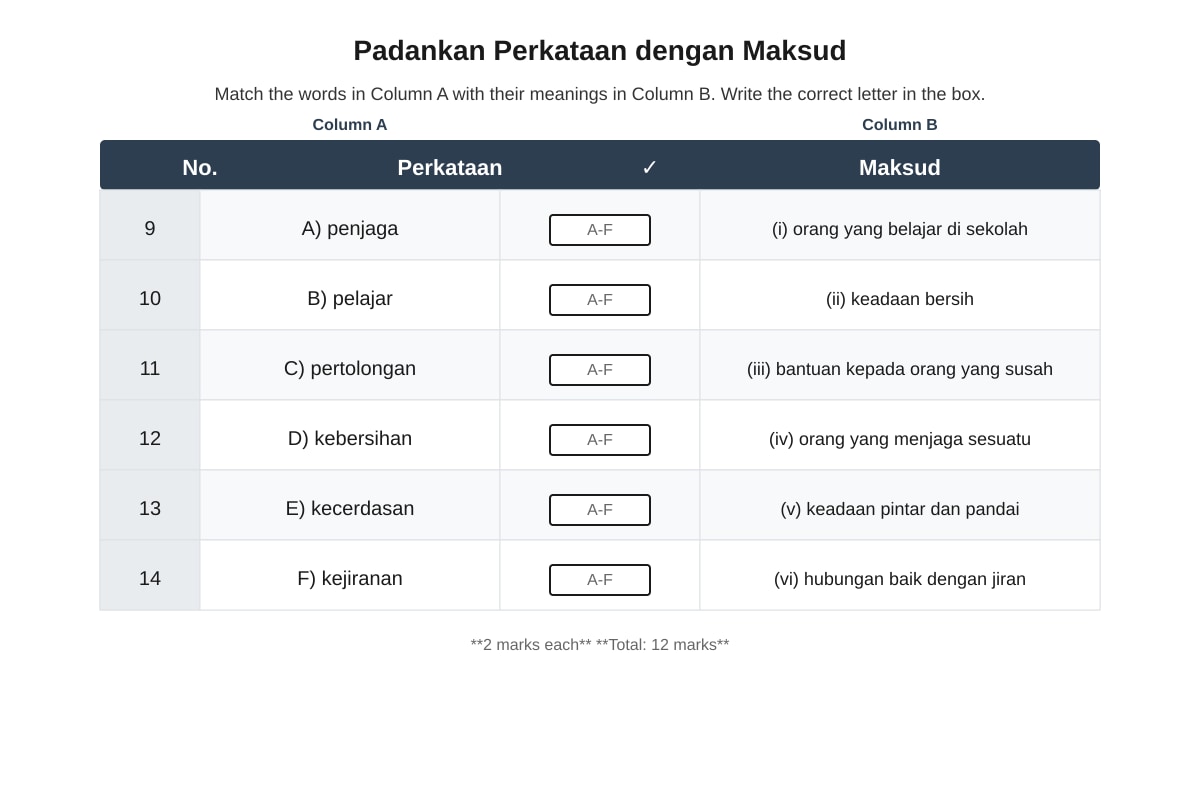
Visual reference: Answer key expects Table Q9-fig1 with words A–F matched to meanings (i)–(vi).
Question 9
Answer: A) penjaga → (iv) orang yang menjaga sesuatu
Marks: 2
Explanation: Penjaga breaks down into the root jaga (to guard/watch) with prefix pe- and suffix -an, making it "a person who guards/watches something." The meaning "(iv) orang yang menjaga sesuatu" directly matches this definition.
Question 10
Answer: B) pelajar → (i) orang yang belajar di sekolah
Marks: 2
Explanation: Pelajar comes from ajar (to teach/learn) with prefix pe-, meaning "one who learns" or "student." The meaning "(i) orang yang belajar di sekolah" (a person who studies at school) is the precise definition of a student.
Question 11
Answer: C) pertolongan → (iii) bantuan kepada orang yang susah
Marks: 2
Explanation: Pertolongan comes from tolong (help) with prefix per- and suffix -an, meaning "help/assistance." The meaning "(iii) bantuan kepada orang yang susah" (help given to someone in difficulty) captures the essence of assistance — providing help to those who need it.
Question 12
Answer: D) kebersihan → (ii) keadaan bersih
Marks: 2
Explanation: Kebersihan comes from bersih (clean) with prefix ke- and suffix -an, transforming the adjective into a noun meaning "cleanliness" or "state of being clean." The meaning "(ii) keadaan bersih" (the state of being clean) is the exact definition.
Question 13
Answer: E) kecerdasan → (v) keadaan pintar dan pandai
Marks: 2
Explanation: Kecerdasan comes from cerdas (clever/smart) with prefix ke- and suffix -an, meaning "intelligence" or "cleverness." The meaning "(v) keadaan pintar dan pandai" (the state of being smart and clever) accurately defines this abstract noun.
Question 14
Answer: F) kejiranan → (vi) hubungan baik dengan jiran
Marks: 2
Explanation: Kejiranan comes from jiran (neighbor) with prefix ke- and suffix -an, referring to "neighborhood" or "neighborhood relations." The meaning "(vi) hubungan baik dengan jiran" (good relationship with neighbors) captures the social aspect of neighborhood — positive community bonds with those living nearby.
Section C: Isikan Tempat Kosong (Questions 15–18)
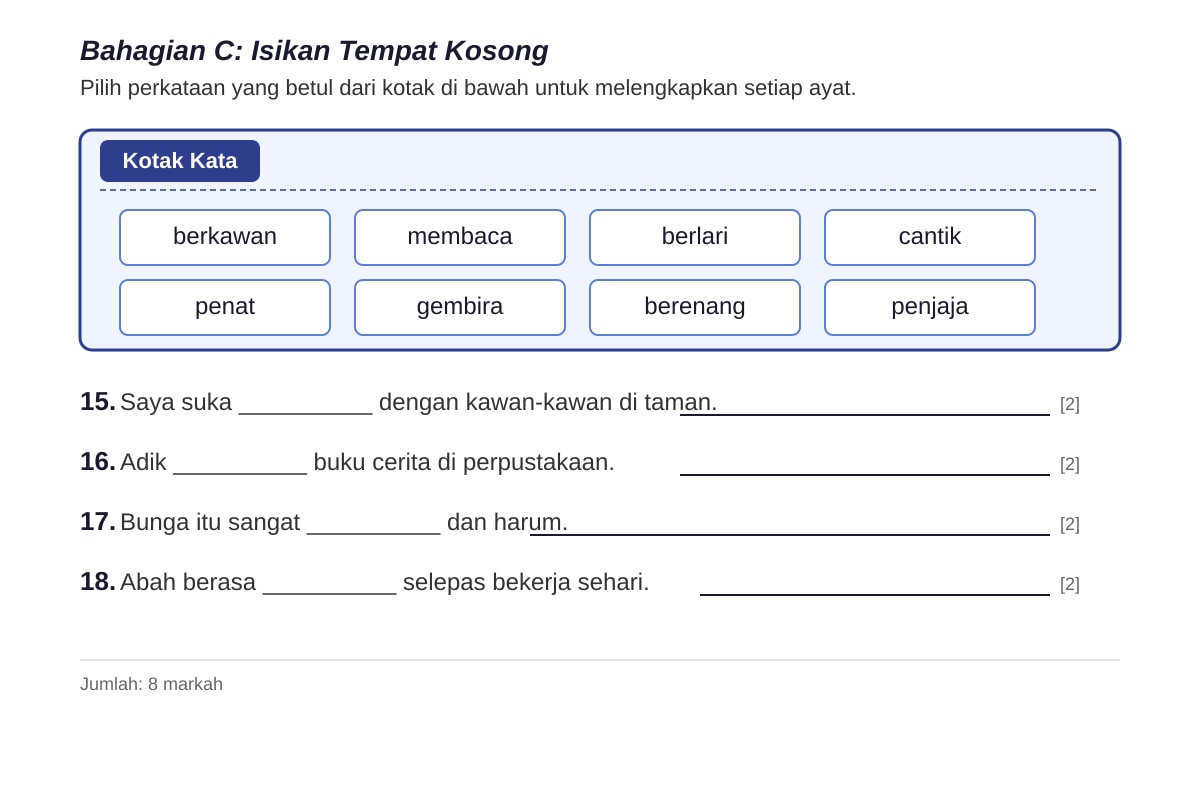
Visual reference: Answer key expects Word Box Q15-fig1 with words: berkawan, membaca, berlari, cantik, penat, gembira, berenang, penjaja.
Question 15
Answer: gembira
Marks: 2
Explanation: The sentence says "Siti sangat _________ kerana hari ini hari jadinya" (Siti is very _________ because today is her birthday). Birthdays are celebratory occasions, so gembira (happy/joyful) is the appropriate emotion. The context clue "hari jadinya" (her birthday) signals a positive emotional response.
Teaching note: "Gembira" describes a state of happiness. Other positive options like "cantik" (beautiful) don't fit grammatically with "kerana hari ini hari jadinya" — one isn't beautiful because it's one's birthday.
Question 16
Answer: berkawan
Marks: 2
Explanation: The sentence says "Ali dan Abu suka _________ di taman selepas sekolah" (Ali and Abu like to _________ at the park after school). Berkawan (to befriend/hang out with friends) requires plural subjects or companions. The two names "Ali dan Abu" indicate two people doing an activity together, making "berkawan" (spending time as friends) the logical choice.
Teaching note: "Berkawan" is from kawan (friend) with prefix ber-, indicating reciprocal action — two or more people being friends together. This differs from solitary activities like "membaca" (reading) or "berlari" (running) which don't require companions.
Question 17
Answer: penat
Marks: 2
Explanation: The sentence says "Kakak saya berasa _________ selepas bersukan sepanjang hari" (My older sister feels _________ after playing sports all day). The phrase "selepas bersukan sepanjang hari" (after playing sports all day) indicates physical exhaustion. Penat (tired/weary) is the physical state resulting from prolonged exertion.
Teaching note: "Berasa" (feels) requires an adjective describing a physical or emotional state. "Penat" describes physical tiredness from activity. Contrast with "gembira" which would be unlikely after tiring activity, or "cantik" which is not a feeling.
Question 18
Answer: penjaja
Marks: 2
Explanation: The sentence says "Encik Ahmad adalah seorang _________ yang menjual nasi lemak" (Encik Ahmad is a _________ who sells nasi lemak). Penjaja (hawker/vendor) specifically refers to someone who sells food or goods, typically in a market or street setting. The relative clause "yang menjual nasi lemak" confirms this is an occupation involving selling food.
Teaching note: "Penjaja" comes from jaja (to peddle/sell) with prefix pe-, forming the occupational noun "seller/hawker." This differs from general "penjaga" (guardian) — the specific activity of selling food defines the occupation. Nasi lemak is a traditional Malaysian/Singaporean breakfast dish commonly sold by hawkers.
Section D: Soalan Terbuka (Questions 19–20)
Question 19
Marks: 2 (1 mark per correct word with complete sentence)
Expected answers: Any two of the following (or other valid synonyms):
(i) gembira
Example sentence: Saya berasa gembira apabila menerima hadiah daripada ibu bapa saya.
(English: I feel happy when I receive gifts from my parents.)
(ii) suka cita / riang / riang gembira / senang hati
Example sentence: Kami suka cita kerana akan pergi bercuti ke pulau.
(English: We are joyful because we will go on holiday to an island.)
Marking descriptors:
- 1 mark: Correct vocabulary word identifying a happy feeling/emotion
- 1 mark: Complete, grammatically correct sentence using the word in context
Teaching note: "Perasaan gembira" (happy feelings) has many Malay synonyms. Primary 2 students should know gembira as the core term, and may extend to suka cita (joyful, more formal), riang (cheerful), or senang hati (content/glad). The sentence must show understanding by using the word in a situation that naturally evokes happiness.
Question 20
Marks: 2 (1 mark for correct meaning; 1 mark for correct sentence)
Maksud (Meaning):
Bermuafakat bermaksud bekerjasama atau bersetuju sesama sendiri demi mencapai sesuatu matlamat; bersatu hati dan pandangan dalam melakukan sesuatu.
(English: To cooperate or reach mutual agreement among ourselves to achieve a goal; to be united in heart and view in doing something.)
Example Ayat (Sentence):
Murid-murid dalam kelas 2A bermuafakat untuk membersihkan kelas selepas perhimpunan.
(English: The students in class 2A cooperated to clean the classroom after assembly.)
Marking descriptors:
- 1 mark: Meaning captures the core concept of cooperation, mutual agreement, or working together with shared purpose
- 1 mark: Sentence uses "bermuafakat" correctly with appropriate subject (plural or collective) and context requiring cooperation
Teaching note: Bermuafakat is a more advanced Primary 2 vocabulary item combining muafakat (consensus/agreement) with prefix ber- (reciprocal action). The word implies not just cooperation but mutual agreement — everyone involved shares the same purpose. Common mistake: using it with singular subjects (incorrect: Saya bermuafakat) — it requires multiple parties. Students should also recognize related words: muafakat (noun: consensus), permuafakatan (noun: the process of reaching agreement).
Total Marks Summary
| Section | Questions | Marks |
|---|---|---|
| A | 1–8 | 16 |
| B | 9–14 | 12 |
| C | 15–18 | 8 |
| D | 19–20 | 4 |
| Total | 40 |