AI Generated Exam Paper
Primary 2 Malay Practice Paper 2
Free P2 Malay Practice Paper 2, Kimi2.6 AI version, with questions, answers, and syllabus-aligned practice for Singapore students.
These static practice materials are generated from the site's syllabus and paper-generation workflow, with source and model context shown so students and parents can evaluate the material before use.
Questions
Free quiz and exam paper access
Enter your details to view this paper
Your access is remembered on this device.
Answers
TuitionGoWhere Practice Paper Answers - Malay Primary 2
Subject: Malay Language
Level: Primary 2
Paper: Practice Paper (Vocabulary Focus - Version 2 of 5)
Total Marks: 40
Section A: Pilih Perkataan yang Betul (Choose the Correct Word)
16 marks
Question 1 (2 marks)
Answer: A) Ali
Explanation: "Ali" is a person's name, which fits the sentence pattern "My name is ______. I am a Year 2 student." The other options are wrong: "besar" (big) describes size, "merah" (red) is a colour, and "berlari" (running) is a verb action. When introducing yourself, you need a name.
Common mistake: Some students might choose "besar" thinking it completes a different sentence pattern, but here the context clearly asks for a name.
Question 2 (2 marks)
Answer: B) sayur-sayuran
Explanation: The clue word "pasar pagi" (morning market) and "segar" (fresh) point to vegetables. "Sayur-sayuran" means vegetables. Books (buku), clothes (baju), and cars (kereta) are not typically described as "fresh" or commonly bought at morning markets for their freshness.
Vocabulary note: "Sayur-sayuran" is the plural form of "sayur" (vegetable), showing variety. The reduplication pattern is common in Malay for indicating plurality of items.
Question 3 (2 marks)
Answer: A) tidur
Explanation: "Tidur" means sleep. The clues are "di atas tilam" (on the mattress) and "selesa" (comfortable) — these describe sleeping. A cat drinking (minum) on a mattress would be unusual; cooking (masak) and writing (tulis) are impossible for a cat and don't match "comfortable."
Contextual reasoning: Animals sleeping in comfortable places is a common, relatable scenario for Primary 2 students.
Question 4 (2 marks)
Answer: B) bola sepak
Explanation: "Bola sepak" means football/soccer. The verb "bermain" (to play) needs a sport/game as its object. "Nasi" (rice) is food eaten, not played; "tidur" (sleep) is a verb itself, not an object; "baju" (clothes) is worn. The sentence structure "bermain [sport]" is the standard Malay pattern for playing games.
Cultural note: Football is extremely popular in Singapore and Malaysia, making this a familiar context.
Question 5 (2 marks)
Answer: C) rambutan
Explanation: "Rambutan" is a tropical fruit tree common in Singapore/Malaysia. The key clue is "berbunga" (flowering/bearing fruit) — only plants do this. "Makan" (eat), "jalan" (walk), and "lari" (run) are all verbs describing actions, not things that can flower. The sentence describes something growing in a yard.
Local knowledge: Rambutan trees are familiar to Singaporean students and commonly found in residential areas.
Question 6 (2 marks)
Answer: C) baju kurung
Explanation: "Baju kurung" is traditional Malay clothing for women and girls, often worn for dancing. The description "berwarna merah jambu" (pink coloured) describes clothing. A table (meja) or fan (kipas) or book (buku) would not typically be described as something one "dances with" in this context.
Cultural note: The baju kurung is an important traditional garment; recognizing it shows cultural vocabulary knowledge.
Question 7 (2 marks)
Answer: A) kereta
Explanation: "Kereta" means car. The verb "memandu" (to drive) specifically requires a vehicle as its object. "Makanan" (food), "kasut" (shoes), and "pokok" (tree/plant) cannot be driven. This tests the collocation — which words naturally go together in Malay.
Grammar point: "Memandu" (drive) + vehicle is a fixed verb-object combination.
Question 8 (2 marks)
Answer: B) huruf
Explanation: "Huruf" means letters (of the alphabet). The context is "mengajar kami cara menulis" (teaching us how to write) — writing instruction begins with learning letters. A table (meja), chair (kerusi), or house (rumah) have no connection to the skill of writing.
Educational context: Primary 2 students are still mastering correct letter formation, making this relevant.
Section B: Padankan Gambar dengan Perkataan (Match Pictures with Words)
12 marks
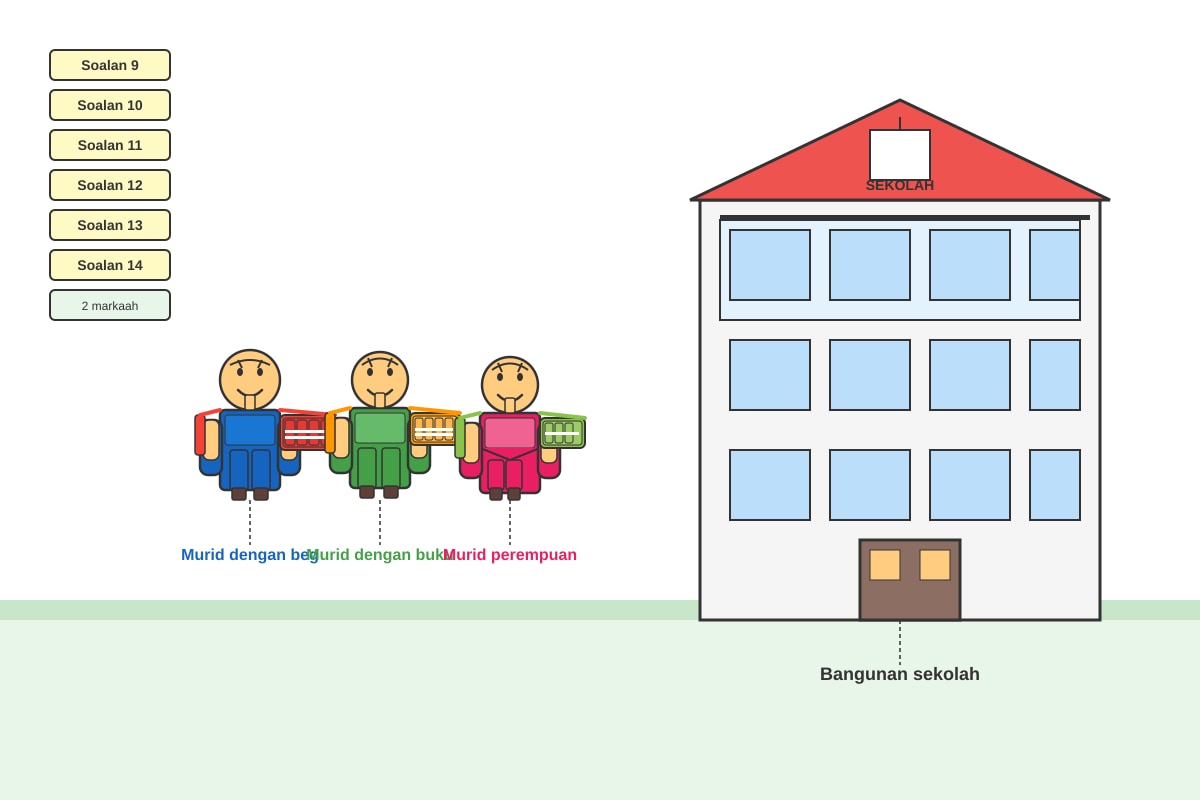
Question 9 (2 marks)
Answer: murid / pelajar / sekolah (accept any accurate vocabulary for the scene)
Expected visual features: Student in school uniform with backpack, school building, books — indicates education setting.
Teaching note: The image shows a student going to school. "Murid" (student/pupil) or "pelajar" (student) or "sekolah" (school) would all show comprehension. Full marks for any appropriate word that captures the main subject.
Marking guidance:
- 2 marks: Correct Malay word matching the image's main subject
- 1 mark: Related word but not the best fit (e.g., "buku" for books only, not the whole scene)
- 0 marks: Completely unrelated word
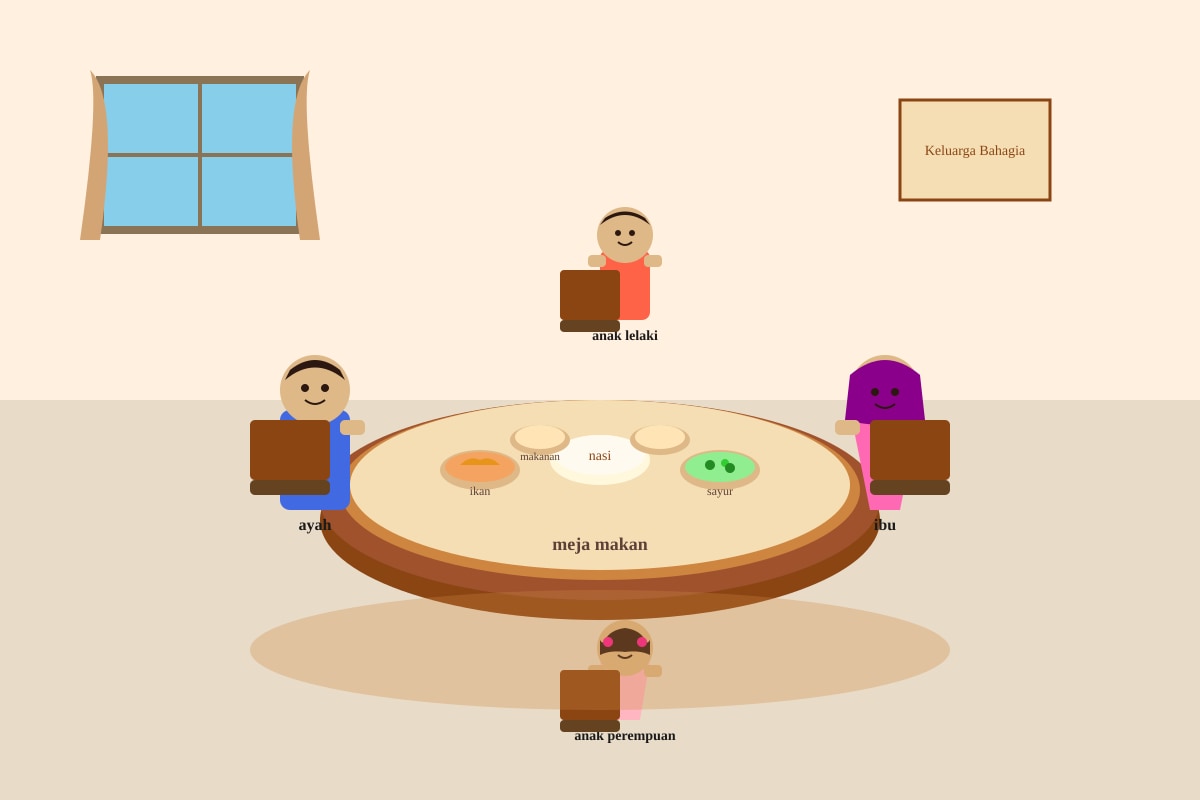
Question 10 (2 marks)
Answer: makan / makanan / keluarga / jamuan (accept appropriate vocabulary)
Expected visual features: Family eating together, various dishes, round table — indicates family meal/eating together.
Teaching note: "Makan" (to eat) or "makanan" (food) or "keluarga" (family) or "jamuan" (feast/occasion) all demonstrate vocabulary recognition. The scene emphasizes communal eating, central to Malay culture.
Marking guidance:
- 2 marks: Core vocabulary matching the activity shown
- 1 mark: Peripherally related word
- 0 marks: Unrelated word
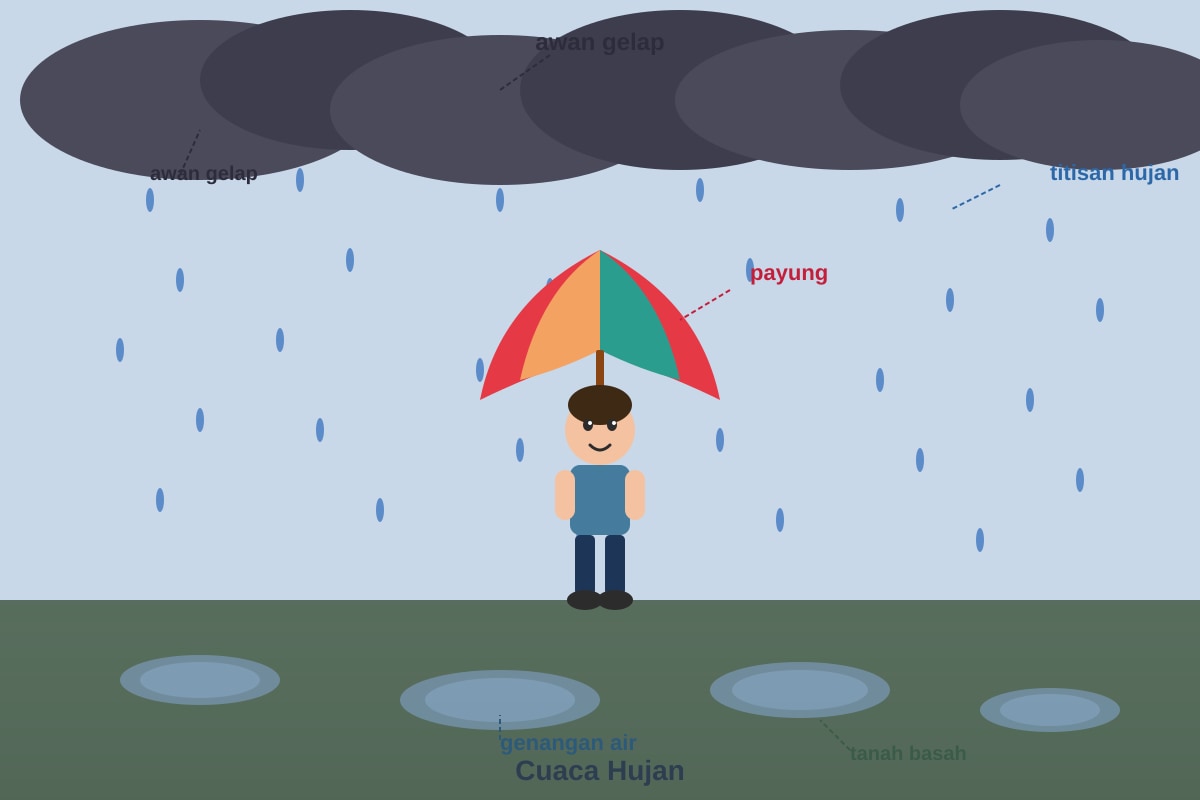
Question 11 (2 marks)
Answer: hujan
Expected visual features: Dark clouds, rain drops, umbrella, wet ground — clearly depicts rain.
Teaching note: "Hujan" is the essential weather vocabulary here. All visual elements point to this single concept. Students should recognize that multiple visual cues (clouds, drops, umbrella, puddles) reinforce one main idea.
Common mistake: Some might write "payung" (umbrella) — this is present but secondary to the main weather phenomenon. Accept but note as less precise.
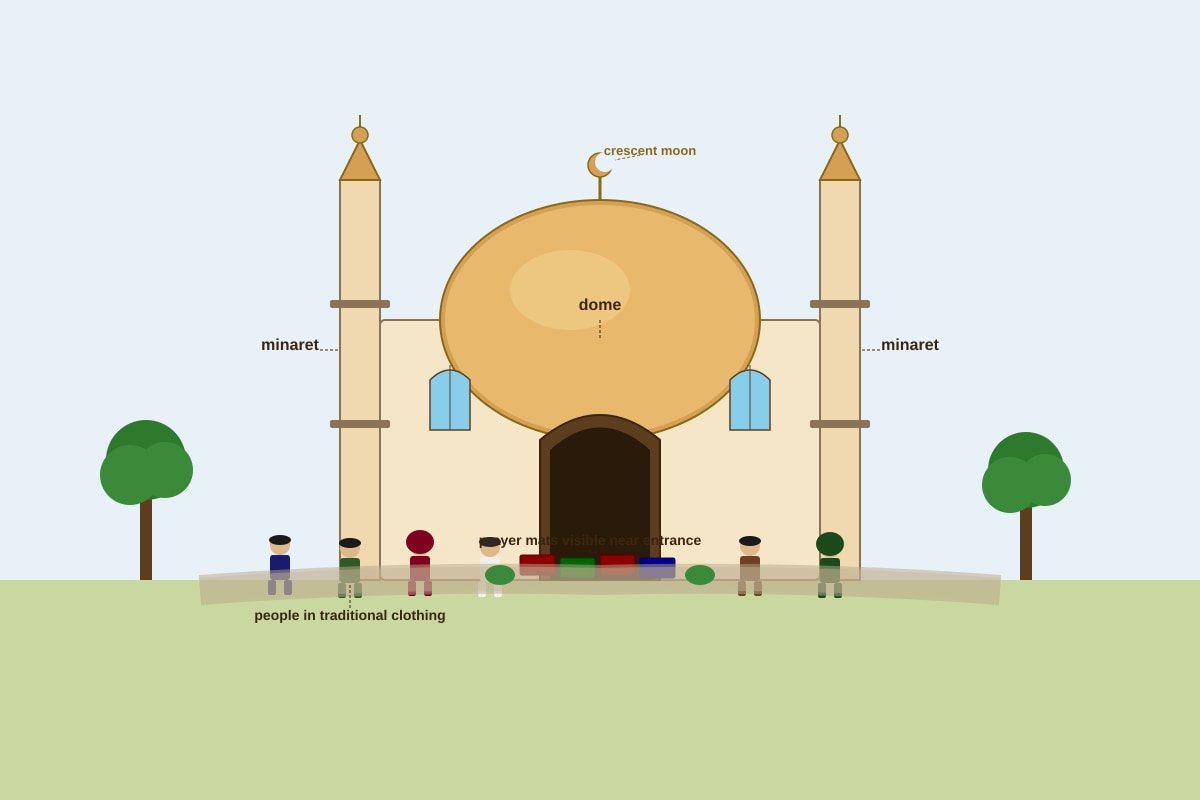
Question 12 (2 marks)
Answer: masjid
Expected visual features: Dome, minaret, people in traditional clothing, prayer mats — unmistakably a mosque.
Teaching note: "Masjid" is the correct term. This tests religious/cultural vocabulary alongside architectural recognition. The crescent moon and minaret are distinctive identifying features.
Cultural sensitivity: This is standard cultural knowledge for Singapore students of all backgrounds; recognition, not religious practice, is being tested.
Question 13 (2 marks)
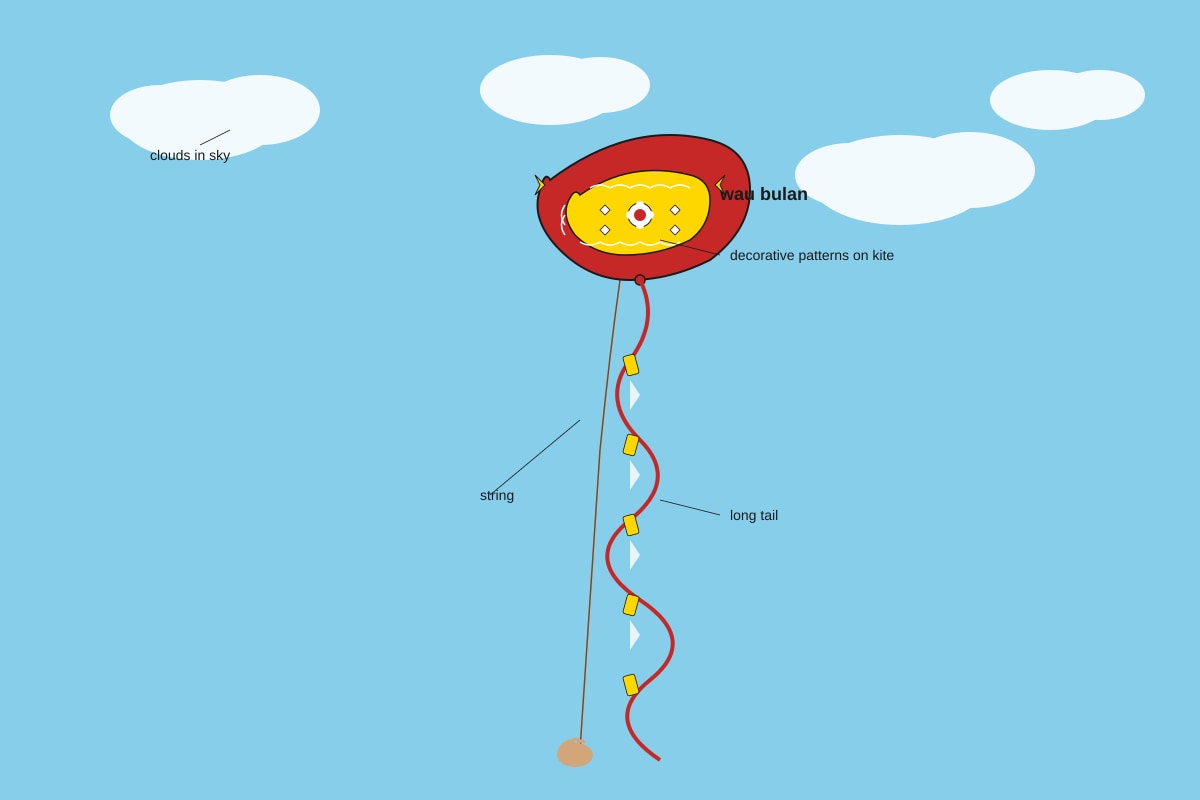
Answer: wau
Expected visual features: Ornate traditional Malay kite with characteristic shape, detailed patterns, flowing tail.
Teaching note: "Wau" specifically refers to the traditional Malay kite, with "wau bulan" (moon kite) being the most famous type. The intricate design and distinctive crescent/boat shape distinguish it from ordinary "layang-layang" (any kite).
Precision marking:
- 2 marks: "wau" or "wau bulan"
- 1 mark: "layang-layang" (generic kite — misses cultural specificity)
- 0 marks: other unrelated words
Question 14 (2 marks)
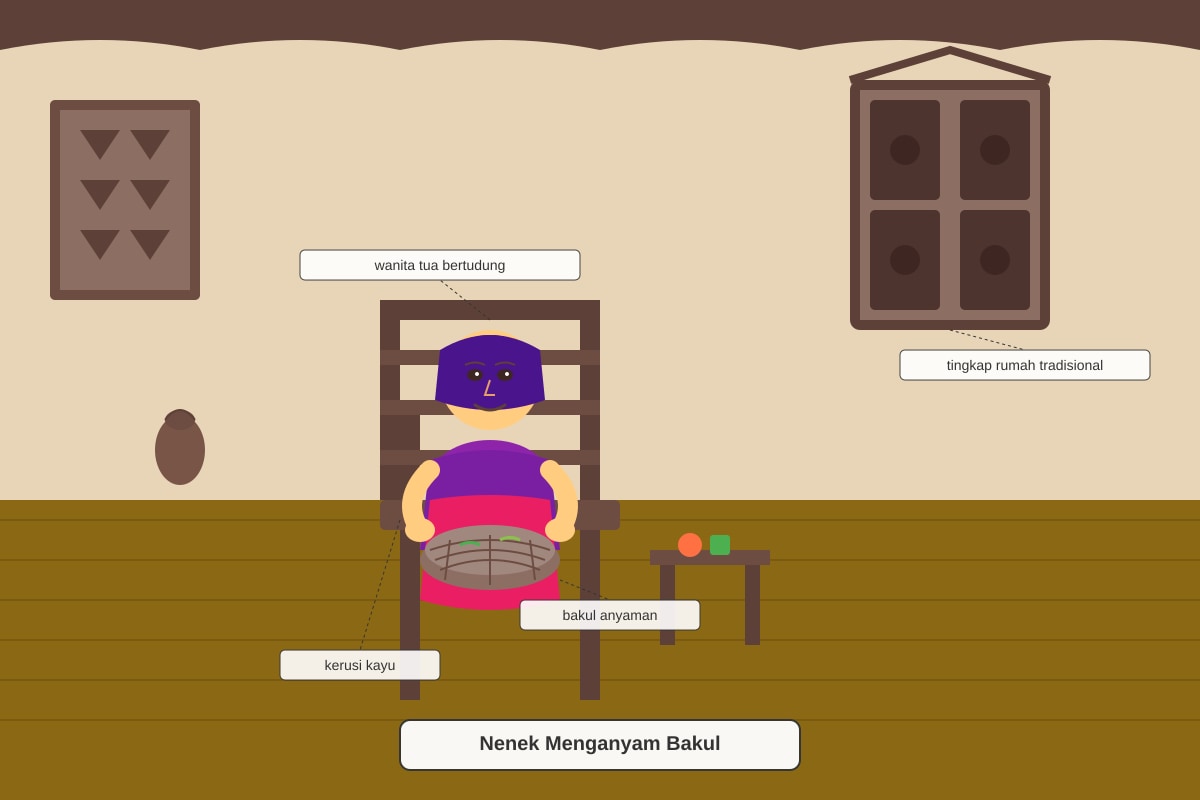
Answer: nenek / datuk / craft / any accurate descriptor
Expected visual features: Elderly woman, traditional craft activity, traditional house setting.
Teaching note: "Nenek" (grandmother) captures the person; craft vocabulary shows activity recognition. Either approach demonstrates comprehension. The traditional setting with carved window details emphasizes cultural heritage.
Marking flexibility: Accept any accurate vocabulary that shows understanding of the main subject.
Section C: Lengkapkan Ayat (Complete the Sentences)
8 marks
Question 15 (2 marks)
Answer: musim
Sentence: Semasa musim hujan, kami suka bermain di dalam rumah.
Explanation: "Musim" means season. "Musim hujan" is the rainy/monsoon season. The sentence describes a time period when rain is common. Other words don't fit: "berlari" (running) doesn't make sense as a time marker; "sekolah" (school), "pantai" (beach), "keluarga" (family), "bergembira" (happy), "buku" (book), and "kampung" (village) don't collocate with "hujan" to form a time expression.
Grammar note: "Semasa" (during) requires a time expression to follow.
Question 16 (2 marks)
Answer: pantai
Sentence: Kami pergi ke pantai untuk berkelah pada hari Ahad yang lalu.
Explanation: "Pantai" means beach. "Berkelah" means to picnic/have an outing — beaches are common picnic destinations. Other locations don't fit: "musim" is abstract time, not a place; "sekolah" is not for picnics; "keluarga" is a group, not a place; "bergembira" is an emotion; "buku" and "kampung" don't match "berkelah" as well as beach does.
Collocation: "Pergi ke pantai" (go to the beach) + "berkelah" (picnic) is a natural activity pairing.
Question 17 (2 marks)
Answer: kampung
Sentence: Sepupu-sepucu saya datang berkunjung ke kampung nenek saya.
Explanation: "Kampung" means village/rural hometown. "Nenek saya" (my grandmother) typically lives in the family hometown/village in traditional Malay family structures. "Kampung nenek" is a common expression for grandmother's village home. Other words don't fit grammatically or culturally.
Cultural context: Visiting grandparents in the kampung is a common experience, making this culturally resonant.
Question 18 (2 marks)
Answer: bergembira
Sentence: Murid-murid bergembira ketika hari sukan sekolah.
Explanation: "Bergembira" means happy/joyful. "Hari sukan" (sports day) is a happy occasion. This is the only emotion/feeling word in the box that describes student reactions. Verbs like "berlari" could grammatically fit but don't capture the emotional atmosphere; nouns like "sekolah" or "buku" don't work grammatically after "murid-murid" as predicates.
Grammar check: The sentence needs a predicate after the subject "murid-murid" — "bergembira" works as an adjective predicate.
Section D: Bina Ayat (Build Sentences)
4 marks
Question 19 (2 marks)
Answer: [Any grammatically correct sentence using "rajin"]
Example: Adik saya seorang murid yang rajin. Dia sentiasa menyiapkan kerja sekolahnya tepat pada waktunya.
Explanation: "Rajin" means diligent/hardworking. To show understanding, the student must:
- Use "rajin" correctly as an adjective describing a person
- Include context that demonstrates what "rajin" means (studying, doing homework, helping, practicing)
Marking descriptors:
- 2 marks: Complete sentence with correct grammar, "rajin" used appropriately as adjective describing diligence, context shows meaning
- 1 mark: Sentence uses "rajin" but grammar shaky or meaning not fully clear
- 0 marks: "Rajin" used incorrectly, or sentence incomplete/nonsensical
Common mistake: Using "rajin" as a verb ("Saya rajin buku") — it's an adjective, not a verb.
Question 20 (2 marks)
Answer: [Any grammatically correct sentence using "bersih"]
Example: Bilik tidur saya sentiasa bersih kerana saya mengemas setiap hari.
Explanation: "Bersih" means clean. The sentence should show:
- Correct adjectival use (describing a place, person, or thing as clean)
- Context that explains or shows what "clean" means
Marking descriptors:
- 2 marks: Correct grammar, "bersih" used appropriately, sentence complete with meaningful context
- 1 mark: Minor grammar issues or "bersih" meaning unclear from context
- 0 marks: Incorrect usage or incomplete sentence
Teaching note: "Bersih" often appears with "mengemas" (to tidy/clean) — students may naturally pair these, showing deeper vocabulary networks.
Paper Summary
| Section | Questions | Marks |
|---|---|---|
| A: Multiple Choice | 1-8 | 16 |
| B: Picture Words | 9-14 | 12 |
| C: Complete Sentences | 15-18 | 8 |
| D: Build Sentences | 19-20 | 4 |
| Total | 20 questions | 40 marks |
Estimated timing:
- Section A: 10 minutes (quick decisions, familiar format)
- Section B: 12 minutes (visual processing, vocabulary retrieval)
- Section C: 10 minutes (reading box, selecting, checking)
- Section D: 8 minutes (sentence construction requires more thought)
- Review: 5 minutes
Total: 45 minutes — appropriate for Primary 2 attention span and writing speed.
This practice paper is aligned with the Primary 2 Malay Language syllabus focusing on vocabulary expansion. It does not claim to replicate any specific official examination format, as formal examinations are not conducted at P2 level in Singapore.