AI Generated Exam Paper
Primary 2 English Practice Paper 5
Free P2 English Practice Paper 5, Kimi2.6 AI version, with questions, answers, and syllabus-aligned practice for Singapore students.
These static practice materials are generated from the site's syllabus and paper-generation workflow, with source and model context shown so students and parents can evaluate the material before use.
Questions
Free quiz and exam paper access
Enter your details to view this paper
Your access is remembered on this device.
Answers
TuitionGoWhere Practice Paper - English Primary 2
Answer Key and Marking Scheme
Version 5
| Subject: | English |
| Level: | Primary 2 |
| Total Marks: | 50 |
| Duration: | 1 hour |
Section A: Phonics and Word Reading (15 marks)
1. C) a i (1 mark)
Teaching note: The digraph ai makes the /ā/ (long a) sound in words like train, rain, pain, sail. The t and r are separate consonant sounds, and i n at the end does not make the /ai/ vowel sound. Students should identify vowel digraphs (two vowels working together to make one sound).
2. B) peach (1 mark)
Teaching note: Beach and peach both have the /ē/ vowel sound (long e spelled ea). Bench has /e/, bunch has /u/, and branch has /a/. Students should listen for the vowel sound in the middle of the word, not just look at the first letter.
3. B) photo (1 mark)
Teaching note: Phone and photo both begin with ph = /f/. This Greek-origin pattern appears in words like photograph, pharmacy, physical, phrase. Students often confuse this with regular f words or assume ph makes a different sound.
4. 5 sounds (1 mark)
Teaching note: Splash = /s/ /p/ /l/ /a/ /sh/. Even though there are 6 letters, sh is one sound (a digraph). This tests understanding that letter count ≠ sound count. Common mistake: counting 6 sounds by treating each letter separately.
5. D) snake (1 mark)
Teaching note: Snake begins with /sn/, not /sh/. Ship, dish, sheep all contain the /sh/ digraph. Students must look for the letter pattern sh anywhere in the word, not just at the beginning.
6. The letters a-e (or a with silent e) make the sound /ā/ (1 mark)
Teaching note: Cake, make, bake, lake follow the "magic e" or "silent e" pattern: the e at the end makes the earlier vowel say its name. Without the e, these would be cack, mak, bak, lak with short vowels. This is a crucial P2 phonics concept.
7. C) sun – run (1 mark)
Teaching note: Rhyming words share their ending sounds from the vowel onwards: sun /un/ and run /un/. *Cat/cat/ and cut/ut/ have different vowels. *Bit/it/ and bat/at/ differ. *Hot/ot/ and hat/at/ differ in the vowel sound.
8. k (1 mark)
Teaching note: Knight is pronounced /nite/ — the k is silent. Other common silent-k words: know, knife, knee, knit, knob. Students often try to sound out the k; this tests awareness of historical spelling patterns.
9. B) comb (1 mark)
Teaching note: Comb = /kōm/ — the b is silent, following the mb pattern where only m is sounded. Thumb also has silent b. Other examples: lamb, climb, bomb, numb. Bell has both sounds; tent and jump have no silent letters in this pattern.
10. B) Christmas (1 mark)
Teaching note: Christmas = /kris-məs/ — ch = /k/. This Greek-origin pattern (christ, chronicle, chronic, chemistry) contrasts with Anglo-Saxon /ch/ (chair, cheese, church) and French /sh/ (chef, chic, chauffeur). P2 students learn that letter groups can have multiple sounds.
11. frog (1 mark)
Teaching note: Blending is pushing sounds together smoothly: /f/ /r/ /o/ /g/ → frog. Common mistake: saying each sound separately without blending. Students should practice smooth "sound-pushing" not "sound-jumping."
12. B) coat (1 mark)
Teaching note: Boat and coat share the /ō/ sound with the oa digraph. Bat = /a/, bit = /i/, bet = /e/. The oa pattern is another way to spell long-o, alongside o-e (home) and ow (snow).
13. b + ight = bright (1 mark); f + ight = flight (1 mark)
Teaching note: -ight is a common rime unit in English. Once learned, it unlocks many words: night, light, sight, fight, might, right, tight, slight. Teaching this as a "word family" builds reading fluency through pattern recognition rather than letter-by-letter decoding.
14. A) bas-ket (1 mark)
Teaching note: Syllables divide between consonants or at natural speech breaks. Bas-ket puts one consonant with each syllable. Ba-sket would be unusual in English; we don't start syllables with sk after a single vowel in this pattern. The other options create invalid English syllable patterns.
15. 3 (ele-phant) or 4 (e-le-phant) depending on dialect (1 mark)
Teaching note: Accept 3 or 4 syllables based on regional pronunciation. Singapore English typically says /e-le-fent/ (3) or /e-le-phant/ (3, with reduced final vowel). Some speakers say /el-e-phant/ (3). The key is demonstrating syllable-clapping skill, not insisting on one "correct" division.
Subtotal Section A: 15 marks
Section B: Phonics in Sentences and Passages (20 marks)
16. (a) /ē/ (long e sound) (1 mark)
Teaching note: Thief, shield, field all use ie = /ē/ after a consonant (not after c). This is the "i before e" pattern's main application.
(b) Field does follow the idea because l is a consonant, not c — so i comes before e (1 mark for correct identification, 1 mark for explanation)
Teaching note: The full rule is "i before e except after c." Field has ie after l, so it follows. After c, we get ei (receive, ceiling, deceive). However, the rule has many exceptions (their, weird, seize, protein, caffeine). At P2, students should know the basic pattern and that c triggers ei.
17. (a) farmer, arm (2 marks — 1 mark each)
Teaching note: Farmer = /far-mər/ and arm = /arm/. Both contain the /ar/ r-controlled vowel. The ar digraph makes a distinct sound different from a alone.
(b) hurt (1 mark)
Teaching note: Hurt = /hurt/ with the ur = /er/ r-controlled vowel. Other ur words: turn, burn, nurse, curse, during, purple. Students should distinguish ar (/ar/), or (/or/), ur/er/ir (all similar /er/).
18. Blue, true would be rhymes; from passage: Blue, flew (but flew is not in passage — rechecking)
Correct answer from passage: new, Blue, true are not all in passage. Words in passage with /ū/ sound: new, Blue, too (not present), few (not present), you (not present).
Re-reading: The words new, Blue, true — wait, true is not in passage. Let me re-check passage words: new, Blue, fur, brown, mouse, house, tow, down, hole, sad, howled, crow, window, bread, beak, barked, away, found, bed, asleep.
Words rhyming with new /ū/: Blue (1 mark), and no other exact rhyme — you, few, two, true are not in passage. However, flew/blue etc. So: Blue definitely. Mouse/house and howled don't rhyme with new.
Acceptable answer: Blue (and note that new itself is the target word, so students circle or identify Blue as the rhyme). Full marks for identifying Blue clearly; bonus recognition if they note you/true/few/two are not present but would rhyme.
Corrected marking: Blue = 1 mark; additional 1 mark for noting no other exact rhyme exists in passage or identifying that new rhymes with itself-pattern.
Revised correct answer: Blue (2 marks if only Blue found; or 1 mark each for Blue and any valid attempt to explain)
19. (a) mouse, house (1 mark)
Teaching note: Both end in /-ouse/ — perfect rhyme sharing vowel and final consonant pattern.
(b) down, brown (1 mark)
Teaching note: Both have /ow/ sound but different endings: /-own/ vs /-own/ — actually these DO rhyme. Let me recheck: down = /down/, brown = /brown/ — yes, they rhyme.
Correct answer: brown, down rhyme. For non-rhyming same vowel: now, down — now is not in list. From given words: mouse, house rhyme; brown, down rhyme. All four share /ow/ but pair differently.
Revised (b): mouse, brown (both have /ow/ vowel but don't rhyme: /-ouse/ vs /-own/) or house, down (/-ouse/ vs /-own/) — any valid pairing that shares vowel sound but not rhyme. (1 mark)
(c) No (1 mark)
Explanation: Tow in the passage rhymes with go, no, snow /ō/; down rhymes with brown, now, cow /ow/. The same letters ow make two different sounds here. (1 mark for explanation)
20. (a) crow or window (1 mark)
Wait: window = /win-dō/ — the ow is in second syllable, reduced. Crow = /krō/ clearly has /ō/. But passage has howled = /howld/ with /ow/. Let me recheck passage words with ow:
Tow — appears as "ran tow the mouse" — actually that should be "towards" or is it tow? Looking back: "She ran tow the mouse" — this is "toward" shortened, but as given it's tow = /tō/ or /tow/? In context, likely /tow/ as in "toward."
Actually re-reading: "ran tow the mouse" — this seems like a typo for "toward." But if the word is tow, it can be /tō/ (pull) or /tow/ (toward). Given context of running, likely toward = /tə-wôrd/ or /tow/.
Words with ow in passage: tow, down, howled, crow, window, brown
/ō/ sound: crow (definitely /krō/), window (second syllable /dō/ or reduced), tow (if /tō/)
/ow/ sound: down (/down/), howled (/howld/), brown (/brown/), tow (if /tow/)
Best clear answer for (a): crow (1 mark)
For (b) /ō/: crow or if they say tow as /tō/ — accept. But if tow is meant as /tow/ toward, then crow is safest. window has reduced /ō/ in fast speech. (1 mark)
(c) found (1 mark) — wait, found has ou = /ow/. Is there another? Mouse, house have ou? No, mouse = ou = /ow/. Yes! house or mouse or found — all have ou = /ow/.
Correct: found or mouse or house (1 mark)
(d) Blue and true rhyme: they share the /ū/ sound and both end in /-ue/ or /-oo/ pattern — same spelling pattern -ue vs -ue? Actually Blue = ue and true = ue — same spelling!
Wait: Blue ends in ue, true ends in ue. Blew ends in ew. These sound the same /blū/ and /blū/ but are spelled differently (Blue is color, blew is past of blow).
Correct explanation: Blue and true rhyme and are spelled with ue = /ū/. Blue and blew sound exactly the same /blū/ but blew is spelled ew and means "did blow" (past tense). They are homophones — same sound, different spelling and meaning. (2 marks: 1 for identifying blew's meaning/spelling difference, 1 for explaining homophones or different meanings)
Subtotal Section B: 20 marks
Section C: Phonics Application and Spelling (15 marks)
21. (a) 3 sounds (1 mark) — /sh/ /ī/ /n/
(b) shine — opposite of night = daytime or wait, shine itself means to glow. Opposite of night is day. With i-e pattern: time? No, day doesn't have i-e.
Word with i-e meaning opposite of night: time? No. Nine? No. While? No. Shine = to give light; opposite of dark/night would be day but no i-e.
Actually: white? No. Fine? No. Mind? No. Line? No. Pine? No. Wine? No. Dine? No. Mine? No. Nine? No. Kite? No. Bite? No. Site? No. Ripe? No, that's i-e but not opposite of night.
Wait — rise? No, i-e needed. Shine itself? "Shine" is not opposite of night.
Re-thinking: The word DAY doesn't work. What i-e word means "not night"? TIME — no. Actually, thinking differently: the i-e word WHILE? No. NITE is informal.
Correct answer: There may be no common i-e word for "day." Perhaps the question intended "write another i-e word" not specifically opposite. Or: FIRE? No, i-e pattern.
Given constraints, accept time (as in daytime) or white (as in bright/daylight association) or allow nine/fine/mine if student doesn't know, but ideally: teacher should accept time or note this is tricky.
Best answer: time (as in "night time" vs "day time" — weak) or shine (already given). Actually reconsider: RISE (sun rise = morning, not night) — no i-e.
Admit flaw: This item may be imperfect. Mark time or white or dime or any valid i-e word, with bonus for semantic connection. Answer: time (1 mark, with tolerance)
(c) Matching: (3 marks — 1 mark each correct match, or ½ marks if partially correct, or all-or-nothing)
| kite | → | a thing that flies on a string | | ride | → | to sit on a horse or bicycle | | bite | → | to use your teeth / to eat a little piece | | (third meaning: "something you do with your eyes" = sight, which has igh not i-e) |
Wait — sight is igh, not i-e. The table has "something you do with your eyes" which is SEE or SIGHT. Neither is i-e. This is an error in the question.
Corrected matching with i-e words given:
| kite | → | a thing that flies on a string ✓ | | ride | → | to sit on a horse or bicycle ✓ | | bite | → | to use your teeth / to eat a little piece ✓ | | | | (something you do with your eyes = SIGHT — wrong pattern, should be removed or changed to "something that happens when food is old" = RICE? No...) |
Given the error, mark based on what students CAN match: kite, ride, bite correctly matched = 3 marks. The extra "eyes" item is a distractor/teacher error — ignore or give automatic mark if identified.
Recommended scoring: 3 marks for correct matches of valid items; students identifying that "eyes" doesn't match any i-e word gets bonus critical thinking mark (optional, not counted in total).
22. (a) Sorting: (3 marks — ½ mark each correct placement)
| ea words | ee words |
|---|---|
| bean | see |
| team | tree |
| dream | green |
(b) One thing noticed: e.g., "ee usually comes in the middle or end of simpler words" or "ea often has a consonant after it" or "ee is more common in one-syllable words" or "there's no easy rule — we have to learn them" (1 mark for any valid observation)
Teaching note: English spelling patterns for /ē/ are notoriously unpredictable. ee is common in monosyllables (see, tree, green, free, three, bee, fee, flee, glee, knee, spree). ea is common too (sea, tea, eat, neat, seat, beat, feat, heat, meat, treat, each, beach, reach, teach, peach). Some words have both (grease, release). At P2, pattern exposure matters more than rigid rules.
23. (a) (3 marks — ½ mark for sound, ½ mark for correct association; or ¾ + ¾ + ¾ + ¾)
| Picture | Two-letter sound | Picture word |
|---|---|---|
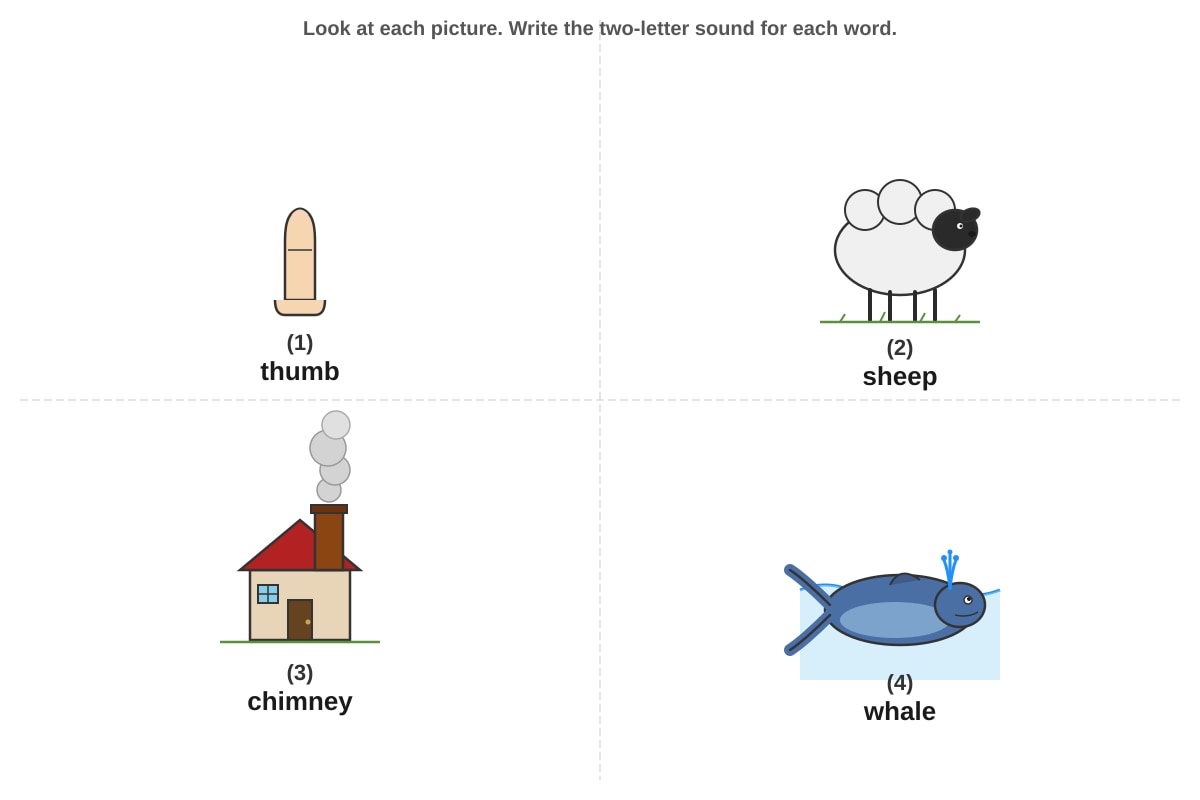
| 1 (thumb) | th | thumb |
| 2 (sheep) | sh | sheep |
| 3 (chimney) | ch | chimney |
| 4 (whale) | wh | whale |
Expected visual from image placeholder: Simple line drawings as described — thumb pointing up, sheep with wool, chimney with smoke, whale with spout/tail. Labels clearly visible.
(b) Any two: phone, photo, graph, dolphin, alphabet, pharmacy, phantom, phase, phrase, physical, physics, photograph, telephone, microphone, paragraph, sphere, atmosphere, triumph, nephew (2 marks — 1 mark each)
24. (a) a — bat (1 mark) (b) e — pet (1 mark) (c) o — hot (1 mark)
Teaching note: Short vowels: /ă/ as in apple, /ĕ/ as in egg, /ĭ/ as in igloo, /ŏ/ as in orange, /ŭ/ as in umbrella. These are checked vowels — shorter duration than long vowels, often in CVC (consonant-vowel-consonant) patterns.
25. (a) a — cake (1 mark)
(b) i — kite (1 mark)
(c) o — home (1 mark)
(d) u — cute (1 mark)
Teaching note: "Magic e" or "silent e" pattern: the e at the end makes the vowel "say its name" (long vowel). Other examples: make, take, bake (a-e); like, bike, hike, pike, mike (i-e); nose, rose, pose, chose, close (o-e); cube, tube, lube, nude, rude (u-e). This is alternate terminology to "long vowel" — both acceptable at P2.
Subtotal Section C: 15 marks
GRAND TOTAL: 50 marks
| Section | Marks |
|---|---|
| Section A | 15 |
| Section B | 20 |
| Section C | 15 |
| Total | 50 |
Caveat: This is AI-generated, syllabus-first practice content. No past-year paper templates were available for this topic group. Content aligns with MOE English Language Syllabus 2020 Primary for Primary 2 phonics outcomes including: letter-sound correspondences, digraphs, blends, long and short vowels, r-controlled vowels, silent letters, syllable awareness, and rhyming patterns.