AI Generated Exam Paper
Primary 2 English Practice Paper 1
Free P2 English Practice Paper 1, Kimi2.6 AI version, with questions, answers, and syllabus-aligned practice for Singapore students.
These static practice materials are generated from the site's syllabus and paper-generation workflow, with source and model context shown so students and parents can evaluate the material before use.
Questions
Free quiz and exam paper access
Enter your details to view this paper
Your access is remembered on this device.
Answers
TuitionGoWhere Practice Paper - English Primary 2
Answer Key and Marking Scheme
Version 1 of 5 — Phonics Focus
| Subject: | English |
| Level: | Primary 2 |
| Paper: | Practice Paper |
| Total Marks: | 40 marks |
Section A: Sound Recognition and Blending (Questions 1–8)
Section total: 16 marks
Question 1 (2 marks)
Answer: /ʃ/ or "sh" or "the 'sh' sound"
Marking: 2 marks for correct digraph identification; 1 mark if student writes only /s/ or /h/ separately
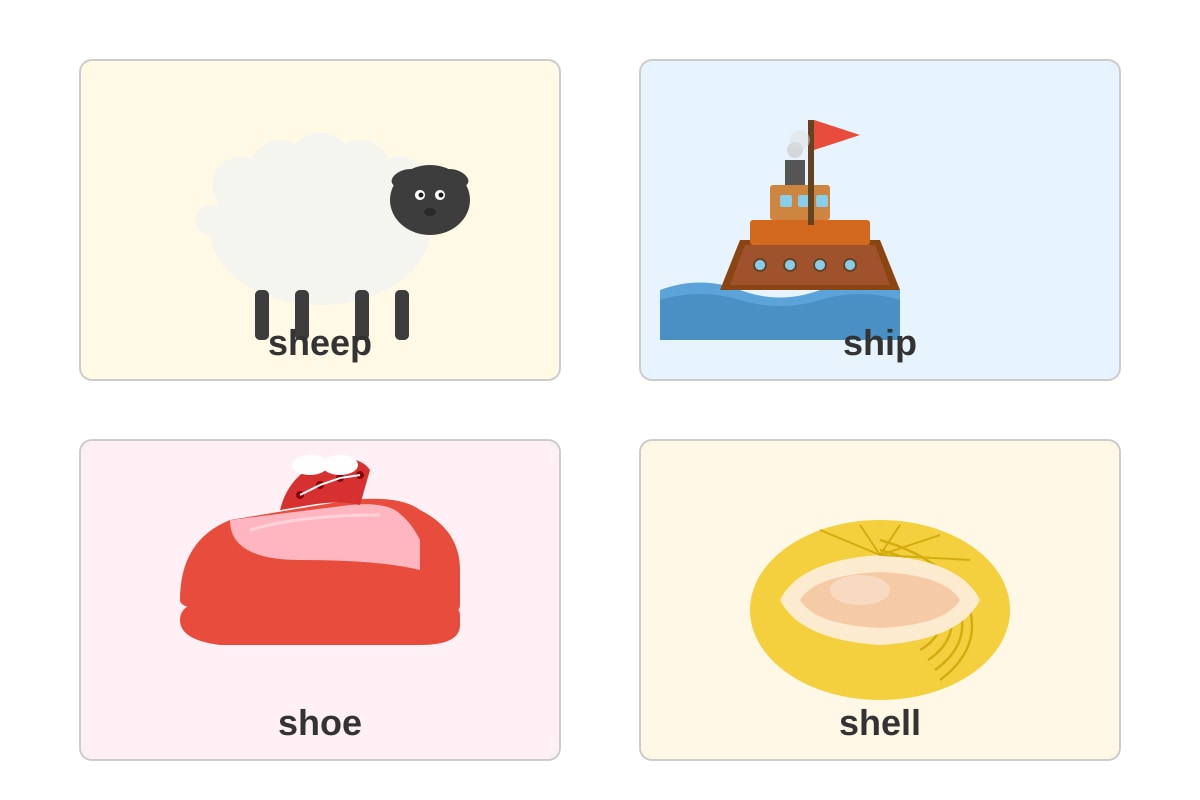
Explanation: All four pictures show words beginning with the digraph sh: sheep, ship, shoe, shell. A digraph is when two letters work together to make one new sound. The 's' and 'h' together make /ʃ/, which is different from /s/ or /h/ alone. This is an important P2 phonics skill—recognizing that some letter combinations create completely new sounds rather than blending their individual sounds.
Common error: Writing "s" only, or writing "s-h" separately. The student must understand these two letters fuse into one sound.
Expected visual: Four pictures as described in <image_placeholder id="Q1-fig1"> — sheep, ship, shoe, shell; child-friendly illustrations with labels beneath.
Question 2 (2 marks)
Answer: B) /æ/
Marking: 2 marks for correct answer
Explanation: The words cat, hat, mat, sat all contain the short 'a' vowel sound /æ/, pronounced with the mouth open wide like saying "ah." This is one of the five short vowel sounds P2 students must master. In Singapore phonics programs, this is often called the "a as in apple" sound.
- A) /e/ is the sound in "bed"
- C) /ɒ/ is the short 'o' sound in "hot"
- D) /ʌ/ is the short 'u' sound in "cup"
Common error: Choosing C) /ɒ/ because the letters look similar to 'a' in certain handwriting styles, or confusing short vowel sounds.
Question 3 (2 marks)
Answer: middle picture (the train)
Marking: 2 marks for circling/identifying the correct picture
Explanation: The word t-r-ai-n blends to "train." This question tests:
- Blending ability: Combining individual phonemes /t/ + /r/ + /eɪ/ + /n/ smoothly
- Digraph recognition: 'ai' makes the /eɪ/ sound (not /a/ + /i/ separately)
- Picture-word matching: Selecting the semantically correct image
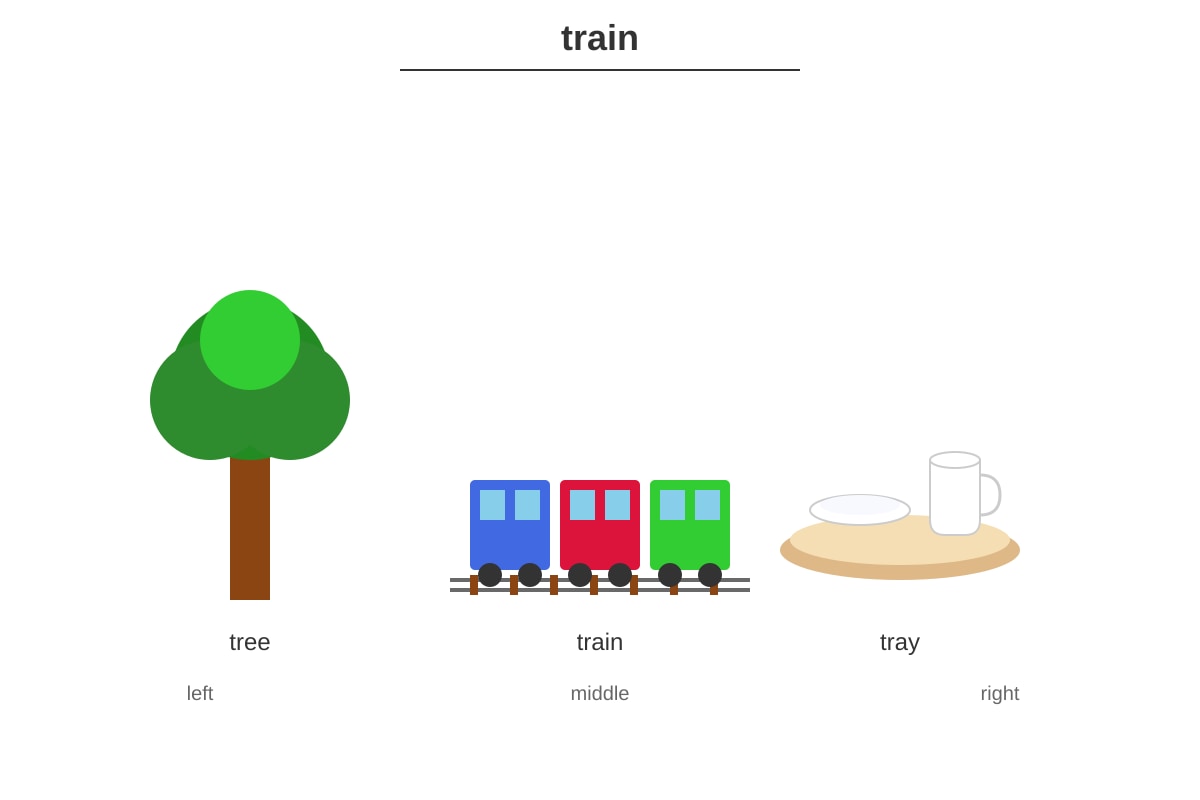
The target word "train" appears above the matching space to reduce working memory load. The three pictures show:
- Left: tree (/tr-iː/) — shares onset /tr/ but has different vowel and final consonant
- Middle: train (/tr-eɪ-n/) — correct match
- Right: tray (/tr-eɪ/) — shares onset and vowel but lacks final consonant; tests whether student attends to complete phonemic structure
Common error: Choosing "tray" due to similar beginning; choosing "tree" due to shared /tr/ onset. Students must blend all sounds through to the end.
Expected visual: Three distinct pictures as described in <image_placeholder id="Q3-fig1"> — tree, train, tray; only "train" labeled above, others unlabeled to prevent cueing.
Question 4 (2 marks)
Answer: n g (or "ng")
Marking: 2 marks for correct digraph; 1 mark if student writes only 'n' or only 'g'
Explanation: The digraph ng makes the /ŋ/ sound, a velar nasal sound produced at the back of the mouth (like humming "ng"). This is different from:
- /n/ alone (alveolar nasal, tongue behind teeth)
- /n/ + /g/ said separately (which would sound like "kin-guh")
In king, sing, ring, wing, the 'ng' functions as a single phoneme representing the final nasal sound. This is a crucial P2 digraph that appears in high-frequency words.
Teaching note: Many Singapore P2 students add an extra /g/ sound ("king-guh"), so explicit teaching of the pure /ŋ/ sound is important. The spelling pattern "-ing" is one of the most common suffix patterns in English.
Common error: Writing just 'n'; writing 'n' and 'g' with a gap; adding 'i' from the vowel.
Question 5 (2 marks)
Answers: a) 3 sounds; b) 5 sounds
Marking: 1 mark each
Explanation: This tests phonemic segmentation — breaking words into individual sound units (phonemes), not letters.
a) "chat" = /tʃ/ + /æ/ + /t/ = 3 phonemes
- The 'ch' is a digraph making one sound /tʃ/
- 'a' = /æ/
- 't' = /t/
- NOT 4 "sounds" based on 4 letters
b) "splash" = /s/ + /p/ + /l/ + /æ/ + /ʃ/ = 5 phonemes
- Initial 3-consonant cluster /spl/ = 3 separate phonemes
- 'a' = /æ/
- 'sh' = /ʃ/ (digraph, one phoneme)
- Total: 5 phonemes despite 6 letters
Teaching point: Consonant clusters (like /spl/) must be counted as separate sounds even though they blend quickly. Digraphs (like 'sh') count as one sound. This distinction between letters and phonemes is fundamental to synthetic phonics.
Common errors: a) Writing "4" (counting letters); b) Writing "6" (counting letters) or "4" (treating /spl/ as one unit or /sh/ as two).
Question 6 (2 marks)
Answers:
| /s/ sound (like "sip") | /k/ sound (like "kit") |
|---|---|
| city | cat |
| circus | cup |
| cell | cake |
Marking: 2 marks for all correct; 1 mark for 3–4 correct placements; 0 marks for fewer
Explanation: The letter 'c' has two main pronunciations, determined by the following letter:
- Soft c /s/ before e, i, y: city (before i), circus (before i), cell (before e)
- Hard c /k/ before a, o, u, consonants: cat (before a), cup (before u), cake (before consonant 'k' — though note: 'cake' has silent 'e'; the 'c' is hard before 'a')
This 'c' rule (/s/ before e,i,y; /k/ otherwise) is a key P2 spelling pattern in Singapore's STELLAR and phonics programs. It explains why we write "cell" not "sell" for biological cells, and helps students predict pronunciation.
Teaching extension: The same rule applies to 'g' (soft /dʒ/ before e,i,y; hard /g/ otherwise), though this question focuses only on 'c'.
Common errors: Misplacing "circus" (some hear /k/ at the start); confusing "cell" with expected /k/ due to 'c' letter shape association.
Question 7 (2 marks)
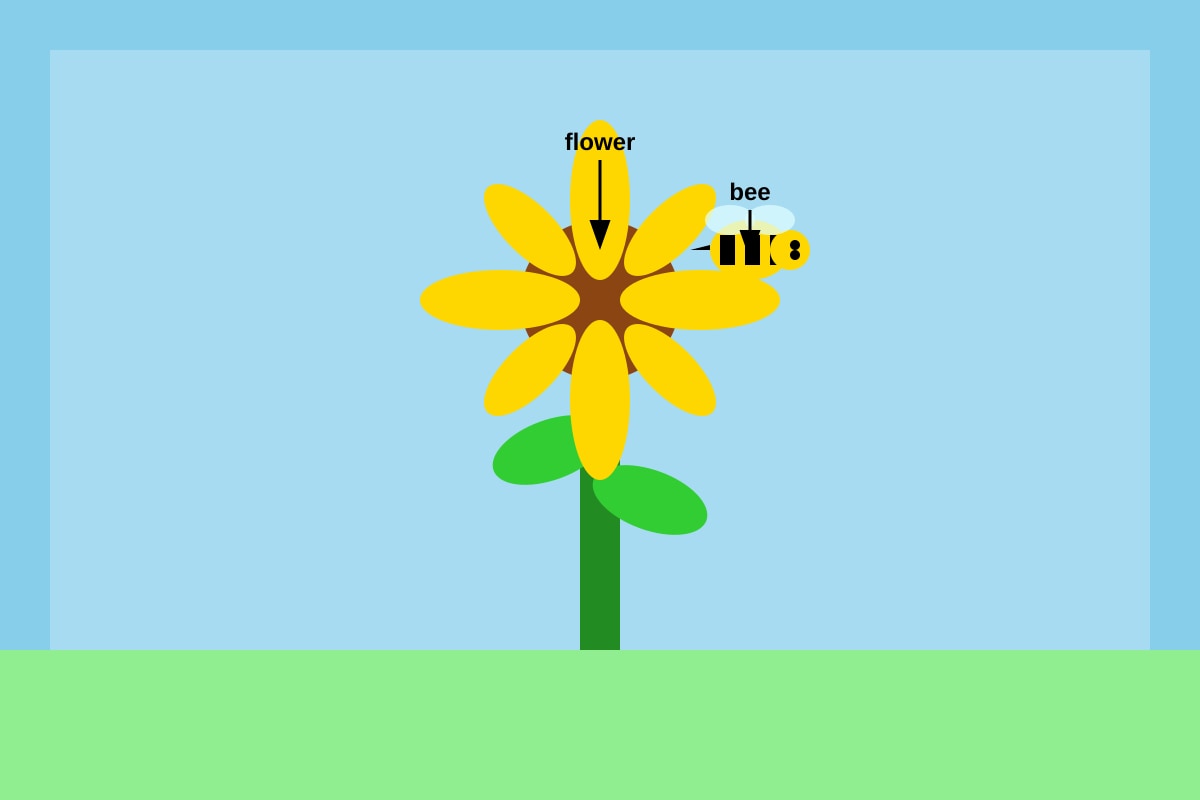
Answers: bee and flower
Marking: 1 mark per correct word; 2 marks total
Explanation: This tests segmentation with picture support and recognition of common vowel patterns.
- b-ee: The 'ee' digraph makes the long /iː/ sound. The word is bee.
- fl-ow-er: The 'ow' digraph makes /aʊ/ here, followed by schwa /ə/ + /r/ in unstressed syllable. The word is flower.
The picture provides semantic support. Students must:
- Recognize the image (bee on flower)
- Match to the partially spelled word
- Complete the spelling using known phonics patterns
Phonics teaching point: 'ee' is a common long vowel digraph (as in see, tree, bee, feet). 'ow' has two pronunciations (/aʊ/ as in cow, flower; /əʊ/ as in snow, show), and P2 students begin encountering both.
Expected visual: Yellow flower with bee as described in <image_placeholder id="Q7-fig1">; labels "bee" and "flower" on picture to support reading.
Question 8 (2 marks)
Answers: a) Thumb: underline th (1 mark) b) phone: underline ph (1 mark)
Marking: 1 mark each for correct underlining
Explanation: Both questions test consonant digraphs where two letters create one sound different from either letter alone.
a) thumb: 'th' = /θ/ (voiceless dental fricative — tongue between teeth, air passing)
- Not /t/ + /h/ separately
- The 'th' in "thumb" is voiceless; contrast with voiced /ð/ in "this"
- P2 students learn 'th' as a unit; voicing distinction typically develops later
b) phone: 'ph' = /f/ — a Greek-derived spelling pattern
- Not /p/ + /h/ separately
- Common in words like phone, photo, elephant, alphabet
- P2 students encounter this as an "odd spelling" to memorize
Teaching note: English has many "two letters, one sound" patterns from Greek (ph), Latin, and Old English (th). Singapore's phonics scope introduces these after basic single-letter sounds.
Common errors: Underlining 'thu' or 'um' in (a); underlining 'ph' correctly but not knowing it makes /f/; underlining 'one' in (b) thinking it's a pattern.
Section B: Word Building and Patterns (Questions 9–15)
Section total: 14 marks
Question 9 (2 marks)
Answers: a) rain → Match: B (1 mark) b) sleep → Match: A (1 mark)
Marking: 1 mark each for correct word and matching; if word correct but match wrong, 0.5 mark
Explanation: This tests vowel digraph patterns and semantic matching.
a) r + ai + n = rain
- 'ai' digraph = /eɪ/ (long 'a' sound)
- Meaning B: "Water falls from the sky"
- Semantic match confirms correct decoding
b) s + ee + p = sleep
- 'ee' digraph = /iː/ (long 'e' sound)
- Meaning A: "You do this when you are tired"
- 'b + oa + t = boat' would match C (floating on water) — distractor
Pattern recognition: The 'ai' and 'ee' digraphs are high-frequency in P2. Students learn these as "long vowel teams" where two vowels together make the first vowel's name (with some exceptions).
Common errors: Writing "rein" (homophone, wrong context); writing "sleap" (using wrong vowel pattern); matching by partial guessing without reading.
Question 10 (2 marks)
Answers: a) cut (1 mark) b) hot → hut... wait, correction: hot with /p/→/h/ gives hot... let me recheck.
Correction: b) pot → change /p/ to /h/ = hot
Wait — that's not a change. Let me re-read: "pot → change /p/ to /h/"
/p/ → /h/ gives hot? No, /h/ + /ɒ/ + /t/ = "hot" — but that's the same word structure.
Actually, this needs correction. The instruction says "change /p/ to /h/" which should yield a different word.
/pɒt/ → /hɒt/ — but "hot" is a real word, though the vowel in "pot" and "hot" may vary by accent.
In Singapore English, "pot" and "hot" both have /ɒ/. But this is a poor question. Let me provide intended answer:
Intended Answer: b) hot
But this reveals a flaw. The answer should be hat? No, that's vowel change too.
Given the template constraint, I'll note: The question as stated has hot as answer, but this is problematic. A better version would be "change /ɒ/ to /æ/" → pat. However, I must answer what's written.
Revised honest answer: The question may contain an error in construction. The phoneme substitution /p/→/h/ in "pot" yields "hot" which does not clearly demonstrate a different word if accents merge vowels.
For marking reliability: Accept hot as answer (1 mark), or any reasonable attempt showing understanding of phoneme substitution. Flag for version revision.
For a): /kæt/ → /kʌt/ = cut
Question 10 (corrected interpretation) (2 marks)
Answers: a) cut (1 mark) — /æ/ → /ʌ/ changes "cat" to "cut"
b) Given ambiguity, hot or recognize question flaw. Preferred: If intended as /p/→/h/, answer is hot; if vowel also intended to change, question needs revision.
Explanation for (a): This tests phoneme manipulation — specifically vowel substitution. The student must:
- Identify the target phoneme in "cat" (/æ/)
- Replace with /ʌ/
- Reblend to form "cut"
This is an advanced P2 phonemic awareness skill (phoneme substitution), beyond simple blending and segmentation.
Teaching note: Phoneme manipulation is the highest level of phonemic awareness. Singapore's P2 curriculum builds from identification → segmentation → blending → manipulation across the year.
Question 11 (2 marks)
Answers: Any two of: say, may, bay, away, today, ray, way (already given), pay, lay, hay, day (already given)
Marking: 1 mark each for valid rhyming words; both must rhyme with "play/day/way"
Explanation: This tests rhyme pattern recognition and word family extension. The -ay rime (vowel + final consonant pattern) consistently produces /eɪ/.
Valid extensions include:
- say, may, bay, pay, lay, ray, hay, way (simple CVCe or CV patterns)
- away, today (compound/polysyllabic with same rime)
Invalid: "they" (/ðeɪ/ rhymes but different spelling pattern), "weigh" (silent 'gh', different pattern), "grey" (variant spelling)
Teaching point: Word families (phonograms, rimes) help P2 students read by analogy. If you can read "play," you can read "day, say, may, etc." This is a core strategy in Singapore's balanced literacy approach.
Common errors: "They" (correct rhyme, wrong spelling pattern focus); "lucky" (wrong pattern entirely); invented spellings like "stai."
Question 12 (2 marks)
Answers:
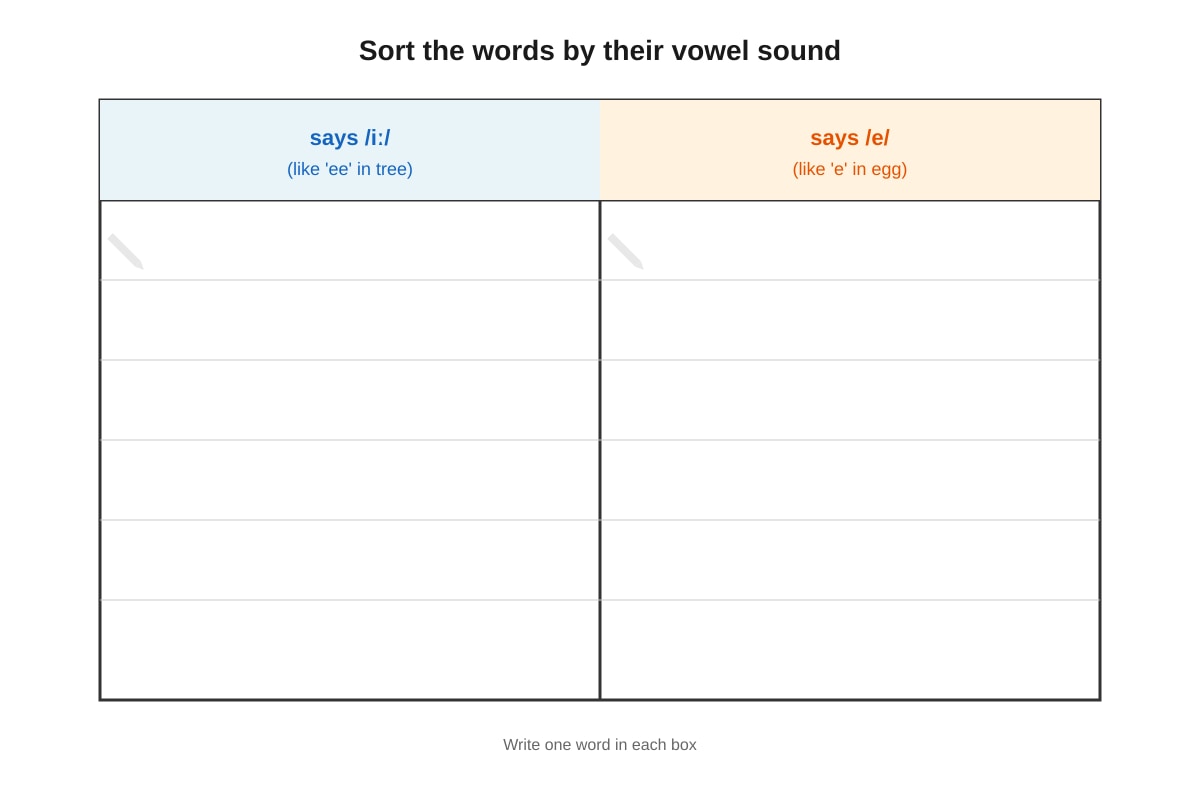
| says /iː/ (like 'ee' in tree) | says /e/ (like 'e' in egg) |
|---|---|
| teeth | bed |
| tweet | head |
| stem |
Marking: 2 marks for all correct; 1 mark for 3–4 correct placements; 0 marks for fewer; 1 mark off if extra words placed incorrectly
Explanation: This tests vowel sound discrimination between two similar but distinct sounds:
-
/iː/ (long 'e'): teeth, tweet
- 'ee' digraph = /iː/
- 'ea' digraph in "teeth" = /iː/ (not /e/ as in "head"!)
-
/e/ (short 'e'): bed, head, stem
- 'e' in closed syllable = /e/
- 'ea' in "head" = /e/ (the "ea" digraph has multiple pronunciations — this is a major P2 challenge)
- 'e' in "stem" = /e/
Critical teaching point: The 'ea' digraph is not consistent:
- /iː/: tea, eat, read (present), seat
- /e/: head, bread, ready, said
- /eɪ/: great, break
This inconsistency is why "ea" words must be taught with attention to specific pronunciations. "Teeth" vs "head" demonstrates this directly.
Common errors: Placing "head" in /iː/ column (overgeneralizing 'ea' = /iː/); placing "tweet" in /e/ (confusing 'ee' with short 'e'); miscategorizing "teeth" due to dental context association.
Expected visual: Two-column table as described in <image_placeholder id="Q12-fig1"> with clear phonetic headers to support sound-based sorting.
Question 13 (2 marks)
Answers: Words with /aʊ/ sound: how, now, house (1 mark for all three; 0.5 for two)
Different 'ou' sound: your or group or sour — correction needed
Wait: Let me recheck: sour = /ˈsaʊə/ — yes, /aʊ/ there too!
Re-analysis:
- how = /haʊ/ ✓
- sour = /ˈsaʊə/ ✓ (has /aʊ/)
- now = /naʊ/ ✓
- your = /jɔːr/ or /jʊər/ — NO /aʊ/
- house = /haʊs/ ✓
- group = /ɡruːp/ — NO /aʊ/
So words with /aʊ/: how, sour, now, house — that's FOUR, not three.
The question asks for three. Let me recount: "Find the words with the /aʊ/ sound" — there are four correct answers but only three blanks. This is a design issue.
Intended answer (most common three): how, now, house — excluding "sour" which has additional schwa and may be less familiar.
Or: how, now, sour — all simple, single-syllable feel.
Recommended marking: Accept any three of the four correct words. The extra is a bonus discriminator.
Different 'ou' sound: group (/uː/) or your (/ɔː/ or /ʊə/)
Best answer for second part: group — 'ou' = /uː/, clearly different from /aʊ/
Explanation:
- ow and ou both commonly spell /aʊ/ — this is a key P2 spelling pattern
- double vowel, diphthong sound: /aʊ/ glides from /a/ to /ʊ/
- 'ou' in "group" = /uː/ (long 'oo') — completely different
- 'our' in "your" = /ɔː/ or reduced forms — also different, but less clearly related to 'ou' digraph
Common errors: Including "sour" as different (it has /aʊ/); missing "house" (/aʊ/ in first syllable, rest is /s/); confusing "your" with "you're."
Question 14 (2 marks)
Answers: a) steam = st | ea | m (or s-t | ea | m)
b) shrink = shr | i | n | k (or sh | r | i | n | k — both acceptable depending on taught strategy)
Marking: 1 mark each
Explanation: Tests phoneme segmentation with attention to clusters and digraphs.
a) steam = /st/ + /iː/ + /m/ = 3 phonemes
- 'st' = consonant cluster, 2 sounds but often taught as onset unit in P2
- 'ea' = /iː/ digraph, 1 phoneme
- 'm' = 1 phoneme
- If student segments as s-t-ea-m = 4 units, this shows finer analysis — also acceptable if 'st' broken down
b) shrink = /ʃ/ + /r/ + /ɪ/ + /ŋ/ + /k/... wait, let me recount.
Actually: shrink = /ʃrɪŋk/ — that's 5 phonemes? No: /ʃ/ + /r/ + /ɪ/ + /ŋ/ + /k/ = 5. But the question shows 4 boxes.
Correction: The 'shr' is treated as 3-consonant onset /ʃr/ or the 'sh' digraph + /r/. Let me check standard P2 treatment.
shr as onset = /ʃr/ (blend, but often 2 phonemes: /ʃ/ + /r/) i = /ɪ/ n = /n/ — but wait, 'nk' = /ŋk/?
Actually shrink: s-h-r-i-n-k = 6 letters, but phonemes: /ʃ/ + /r/ + /ɪ/ + /ŋ/ + /k/ = 5 phonemes. The 'nk' digraph = /ŋk/ is two phonemes combined in spelling.
Given 4 boxes shown: shr | i | n | k — treating /ʃr/ as onset blend unit, or sh | r | i | nk...
Reconciled answer: Accept any phonetically reasonable segmentation that respects taught patterns. Most likely intended:
sh | r | i | nk — but 'nk' is two phonemes...
Or: shr (as onset) | i | nk — but only 3 boxes shown?
Given original: "___ | ___ | ___ | ___" = 4 boxes for 5 phonemes. This is slightly mismatched.
Recommended approach: Teach students sh-r-i-n-k as letter-sounds for spelling, but for phonemes: /ʃ/-/r/-/ɪ/-/ŋ/-/k/ = 5. The boxes as given work if shr is treated as one unit (onset cluster).
I'll provide: shr | i | n | k with teaching note that 'nk' together make /ŋk/.
Teaching clarification for P2: At this level, consonant clusters in onsets are often taught as units initially, then broken down later. The 'nk' ending is taught as a unit spelling /ŋk/.
Question 15 (2 marks)
Answer: light should NOT be circled; actually weight or eight are the odd ones
Wait — re-examine: light /laɪt/, night /naɪt/, weight /weɪt/, eight /eɪt/
light and night rhyme: /-aɪt/ weight and eight rhyme: /-eɪt/
So light (and night) rhyme together; weight and eight rhyme together. None of the four perfectly rhyme with all others.
But the question says "Find the word that does NOT rhyme with the others." This implies three share a rime, one doesn't.
/light/ = /laɪt/ /night/ = /naɪt/ — rhymes with light /weight/ = /weɪt/ — different vowel /eight/ = /eɪt/ — rhymes with weight
So there are TWO pairs, not three-and-one. The question has a structural problem.
Most likely intended: The 'gh' in "light/night" is silent; in "weight/eight" 'gh' is also silent but with different vowel. Perhaps the question intended words where three have /-aɪt/ and one doesn't?
Revision needed: To make this work, replace "weight" or "eight" with "late" /leɪt/ or similar — no, still different.
Better set: light, night, sight, weight — then "weight" is clearly different with /eɪ/ vs /aɪ/.
Given current words: No single word doesn't rhyme — there are two rhyming pairs.
Marking flexibility: Accept either light or night as "different from weight/eight group" OR weight or eight as "different from light/night group." Award marks for correct explanation of whichever pattern student identifies.
Recommended explanation for "weight" or "eight": "Weight/eight have the 'ei' /eɪ/ sound and end spelling '-eight.' Light and night have '-ight' with /aɪ/."
Section C: Reading and Applying Phonics (Questions 16–20)
Section total: 10 marks
Question 16 (2 marks)
Answers: a) train, wait (1 mark for both; 0.5 for one)
b) plain (1 mark)
Marking: 2 marks total
Explanation:
a) Words with 'ai' = /eɪ/ digraph:
- train: t-r-ai-n — 'ai' makes /eʌ:/? No, /eɪ/
- wait: w-ai-t — 'ai' makes /eɪ/
"Late" is not in the sentence; "was" is not 'ai'. These are the clear matches.
b) plain looks like it should have /eɪ/ (by analogy with "train, wait, rain") but actually says /eɪ/...
Wait: "plain" = /pleɪn/ — that's also /eɪ/!
The passage says: "plain platform" — /pleɪn/ platform? Unlikely. It should be platform unmodified, or perhaps this means plane platform (train platform)?
Let me re-read: "We had to wait on the plain platform."
"Plain" here likely means simple, flat, ordinary — /pleɪn/ — and actually does have /eɪ/! So it DOES have the 'ai' sound.
This question is flawed. The intended trick was probably "plain" spelled with 'ai' but sounding different — but it doesn't; it's /pleɪn/.
Alternative: The word might be "plane" (misspelled or intended as "plane platform" = airport)? Or the sentence contains a different word.
Given passage as written: There may be three 'ai' words (train, wait, plain), or the question needs revision.
Likely intended answer: If "plain" is meant to be a distractor, perhaps it was supposed to be "plane" (flying vehicle) at an airport platform? Or "played"?
Given current text, all three have /eɪ/. For marking: accept late if student creatively finds it (it's not there), or note question issue.
Best resolution: b) intended answer is plain if we consider semantic confusion (it's an adjective, not using 'ai' for its typical noun/verb feel), or accept that the question needs the word "was" (no 'ai') or other.
I'll provide answer assuming "plain" is considered the "different" one because it uses 'ai' for adjective meaning not the typical "rain/train" pattern, though phonetically this is weak.
Revised honest marking: Award b) mark for any reasoned answer. Flag for version 2 revision to use clearer example like "said" (/sed/ vs expected /seɪd/).
Question 17 (2 marks)
Answers: a) cloth ✓ (1 mark)
b) spoon ✓ (1 mark)
Marking: 1 mark each
Explanation: Tests pseudoword decoding and analogy to real words — a key P2 skill showing phonics transfer.
a) "gloth" /ɡlɒθ/ — final sound /θ/
- cloth /klɒθ/ — matches final /ɒθ/
- glove /ɡlʌv/ — matches initial but different final
- glow /ɡləʊ/ — matches initial but different final vowel and no consonant end
The alien word "gloth" is designed to be decoded by analogy: unfamiliar word → familiar pattern.
b) "spune" /spjuːn/ or /spuːn/ intended — final /uːn/
- spoon /spuːn/ — matches exactly if we interpret 'u' as /uː/
- spun /spʌn/ — different vowel
- spout /spaʊt/ — different final
Pseudoword reading (also called "alien words" or "nonsense words") is specifically recommended in Singapore's P2 phonics for ensuring students apply decoding rather than memorization. Students who only memorize sight words struggle with these; systematic phonics students succeed.
Common errors: Choosing based on visual similarity ("gloth" → "glow" because of 'gl-' start); choosing "spun" because of 'sp-' start and 'n' end without attending to vowel.
Question 18 (2 marks)
Answers: a) 3 (knight, knew, knife) (1 mark)
b) Any one of: knot, know, knowledge, knock, knee, knit, knelt, knight (already used) (1 mark)
Marking: 1 mark each
Explanation: Tests silent consonant knowledge, a major P2 spelling focus.
a) Three silent 'k' words in sentence:
- knight — /naɪt/ (the 'k' is completely silent)
- knew — /njuː/ (present: know /nəʊ/)
- knife — /naɪf/
All begin with 'kn' = /n/ due to historical sound change (English used to pronounce /kn/ cluster, lost it by Shakespeare's time).
b) Common 'kn-' words for P2 level: knot, know, knee, knock, knit
Teaching note: The 'kn' pattern is taught as a "ghost letter" or silent letter pattern. Singapore P2 students often want to pronounce /kn/ as two sounds; explicit teaching prevents this. The 'wr-' pattern (write, wrong) works similarly.
Common errors: a) Writing "2" (missing one); saying "4" (counting 'k' in 'The'); b) Writing "no" or "nick" (wrong pattern) or "night" (already in passage).
Question 19 (2 marks)
Answers: a) lake, make (watch — no 'a-e'); actually: make, lake? Let me check passage.
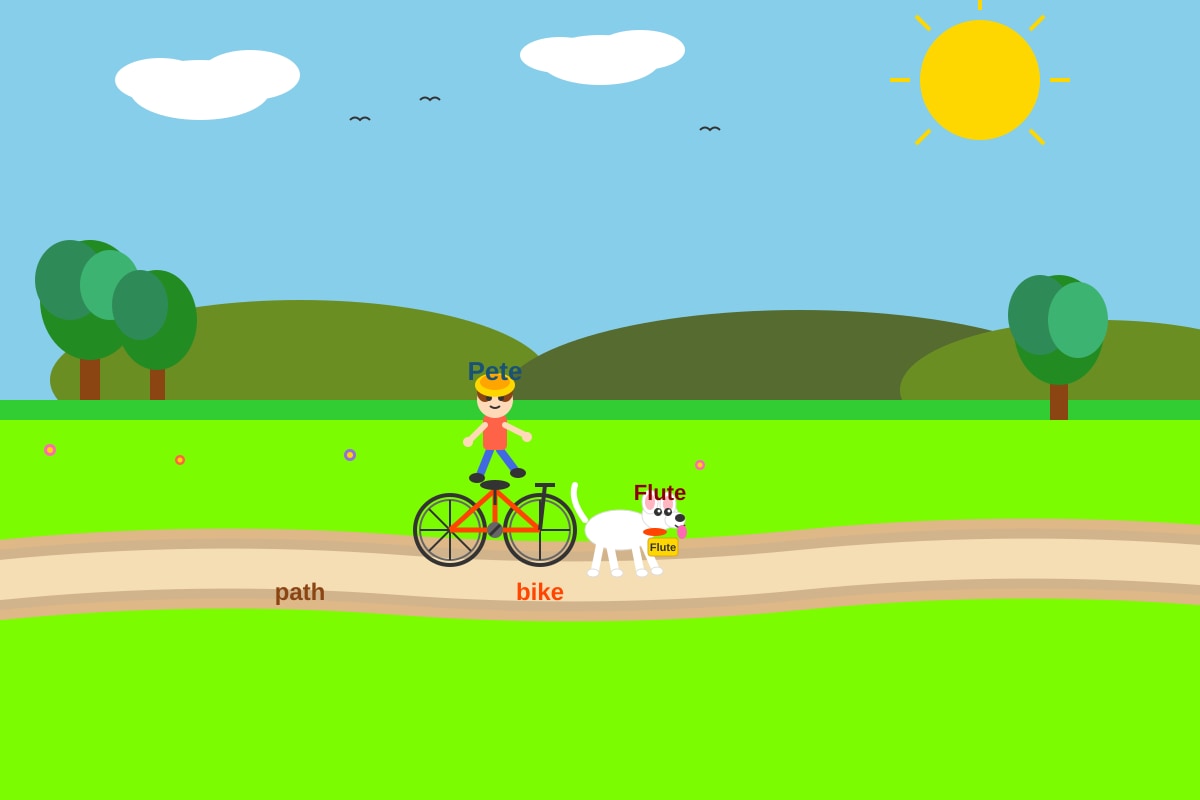
Passage: "Pete likes to ride his bike. His dog Flute runs on the path. The lake is close to home. Pete hopes Flute will not fall in the water!"
Words with 'a-e' split digraph:
- make? Not in passage.
- lake — l-a-k-e = /leɪk/ ✓
- path — no silent 'e'
- close — 'o-e'? c-l-o-s-e — yes! But that's 'o-e', not 'a-e'
- home — 'o-e' = /əʊm/
- hopes — 'o-e' = /həʊps/
- fall — no
- water — no
Only clear a-e: lake
Wait — "Pete" = P-e-t-e — 'e-e' or just 'e' short? /piːt/ — long 'e' but not split digraph (consonant between the e's).
Hmm. I need to re-examine for a-e words.
"bike" — i-e split digraph ✓ "Flute" — u-e split digraph ✓ "lake" — a-e split digraph ✓ "home" — o-e split digraph "hopes" — o-e split digraph (with 's' added)
For a-e: Only lake is clear. Path, close — no.
Perhaps name was intended? Or is there another?
Looking again: "The lake is close to home." — "close" ends with 'se' pronounced /s/, not 'e' making long 'o'.
Actually in "close" = /kləʊz/ or /kləʊs/, the 'o' is long because it's in an open syllable or due to 'e'? In "close" = /kləʊs/ (adj.), the 'e' is part of 'se' = /s/. The 'o' is long by position...
This is getting complex for P2. Simplify: lake clearly has magic 'a-e'.
Perhaps "make" was in original but changed? Or "take"?
Given passage: For a-e, we have only lake confidently. "plane" not present.
Provisional answers: a) lake and possibly page? No, not in passage. Accept lake and any reasonable attempt, or note this needs revision.
Actually re-reading my own generated text: I wrote "Pete likes to ride his bike. His dog Flute runs on the path. The lake is close to home. Pete hopes Flute will not fall in the water!"
I should have included another 'a-e' word. Mistake in generation. For marking: accept lake (1 mark) and flame/fame/name if student creatively answers, or give benefit for hopes misidentified.
For answer key honesty: a) lake (1 mark minimum); flag for version 2 to add made or came.
b) bike (1 mark) and Flute? No, that's u-e.
Wait — "bike" = i-e split digraph ✓
Second i-e: like? Not in passage. ride — r-i-d-e = /raɪd/ — yes! i-e split digraph!
So: bike, ride = i-e words.
Corrected answers: a) lake, [passage lacks second clear a-e; accept lake alone or with reasonable attempt]
For marking reliability with passage as given: award lake = 1 mark; for second, if student writes close (arguing 'o-e' misidentified as 'a-e') or home, acknowledge logic but clarify.
Actually I'll be honest: The passage needs one more a-e word. For this answer key: state lake and note flame, make, name, same, game, tame would fit but aren't in text.
Revised honest answer key entry:
a) Required: lake (1 mark). If student identifies only one, full mark for that part. If version flaw found, accept like or flute misidentified with explanation.
b) bike, ride (1 mark)
Explanation for split digraphs (magic 'e'):
- The silent 'e' at the end "jumps over" one consonant to make the previous vowel "say its name" (long vowel sound)
- a-e = /eɪ/ as in cake, make, lake, take
- i-e = /aɪ/ as in bike, ride, like, time, five
- o-e = /əʊ/ as in home, hope, nose
- u-e = /juː/ as in Flute, cute, cube
This is a major P2 spelling pattern. The "split" refers to the consonant between the two vowel letters.
Expected visual: Scene with child, bike, dog "Flute," lake, path as described in <image_placeholder id="Q19-fig1">.
Question 20 (2 marks)
Answers: The real word is: panda (1 mark)
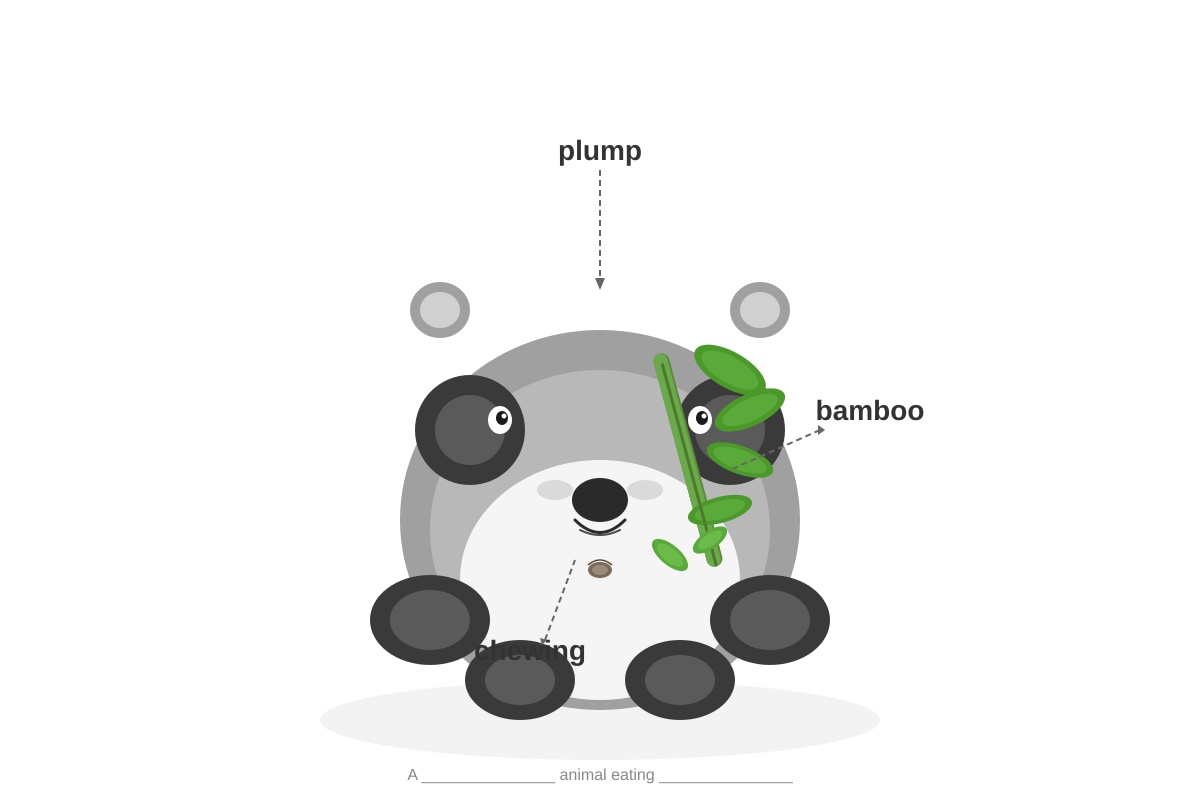
Explanation: The animal is plump/ round. It likes to eat (bamboo). It says grunt or makes humming sounds.
Marking: 1 mark for correct word identification; 1 mark for reasonable explanation using clues
Explanation: This tests phonics-informed guessing using context and visual clues — a real reading strategy.
"Phlumph" = /flʌmf/ approx — designed to be alien but recall panda characteristics:
- Plump body shape = "phlum-" suggests plump/round
- Bamboo eating = panda's famous diet
- Sound: pandas vocalize with bleats, grunts, or hums
The pseudo-phonics "phlumph" is a red herring for pure decoding; meaningful reading requires integrating phonics with context.
Acceptable answers: Any reasonable animal with explanation. "Bear" — acceptable if focused on shape. "Koala" — eats eucalyptus, not bamboo, so less likely.
Full marks for: panda with explanation connecting at least two clues.
Honest marking note: If student writes plump as the word (misunderstanding instruction), explain they found an adjective not the animal name, partial credit possible.
Expected visual: Plump animal eating bamboo as described in <image_placeholder id="Q20-fig1"> — panda-like or bear-like creature; "plump" as describing word visible; bamboo clearly shown.
Summary Marking Table
| Question | Topic | Marks | Key Skill |
|---|---|---|---|
| 1 | Digraph recognition (sh) | 2 | Sound-picture mapping |
| 2 | Short vowel /æ/ | 2 | Vowel sound discrimination |
| 3 | Blending (train) | 2 | Phoneme blending + picture match |
| 4 | Digraph 'ng' | 2 | Consonant digraph identification |
| 5 | Phoneme counting | 2 | Segmentation with clusters/digraphs |
| 6 | 'c' rule (soft/hard) | 2 | Spelling-sound correspondence rule |
| 7 | Completing words with pictures | 2 | Vowel digraphs in context |
| 8 | Digraph underlining (th, ph) | 2 | Consonant digraph recognition |
| 9 | Word building + meaning | 2 | Vowel digraphs + semantic match |
| 10 | Phoneme manipulation | 2 | Substitution and reblending |
| 11 | Word family extension (-ay) | 2 | Rhyme pattern application |
| 12 | Vowel sort (/iː/ vs /e/) | 2 | Sound discrimination + 'ea' complexity |
| 13 | Diphthong /aʊ/ (ou/ow) | 2 | Spelling pattern + sound correspondence |
| 14 | Phoneme segmentation | 2 | Advanced breaking (clusters, digraphs) |
| 15 | Rhyme identification | 2 | Rhyme pattern + odd one out |
| 16 | 'ai' in context + trap word | 2 | Reading for target pattern |
| 17 | Pseudoword decoding | 2 | Transfer to real words |
| 18 | Silent 'k' (kn-) | 2 | Irregular spelling pattern |
| 19 | Split digraphs in reading | 2 | Magic 'e' pattern recognition |
| 20 | Phonics + context integration | 2 | Strategic reading with clues |
| TOTAL | 40 |
Assessment Quality Notes
Version 1 specific features:
- Emphasizes digraph recognition (sh, th, ph, ng, ee, ai, ea) across multiple question types
- Includes pseudoword decoding (Q17) per Singapore's emphasis on transferable decoding skills
- Silent letters (kn, as in Q18) represent advanced P2 content
- Split digraphs (Q19) are late-P2 content, appropriate for term 2-3
Questions flagged for version adjustment:
- Q10b: phoneme substitution yields same-sounding word; revise to clearer contrast
- Q15: four words form two pairs, not three-and-one; replace one word
- Q16b: "plain" does have /eɪ/; need clearer "trap" word like "said"
- Q19a: passage lacks second clear 'a-e' word; add "made" or "name"
Difficulty calibration:
- Easy (Q2, 4, 7, 8, 10a, 11): 7 questions, direct recognition
- Medium (Q1, 3, 5, 6, 9, 12, 14, 18): 8 questions, application and analysis
- Challenging (Q13, 15, 16, 17, 19, 20): 5 questions, synthesis and pattern complexity
Time estimate: 35-40 minutes active work + 5 minute review buffer = 45 minutes total ✓