AI Generated Exam Paper
Primary 1 Tamil Practice Paper 4
Free P1 Tamil Practice Paper 4, Kimi2.6 AI version, with questions, answers, and syllabus-aligned practice for Singapore students.
These static practice materials are generated from the site's syllabus and paper-generation workflow, with source and model context shown so students and parents can evaluate the material before use.
Questions
Free quiz and exam paper access
Enter your details to view this paper
Your access is remembered on this device.
Answers
TuitionGoWhere Practice Paper Answers - Tamil Primary 1
Version 4 of 5 — Marking Scheme
Section A: Choose the Correct Word (Questions 1–10)
20 marks (2 marks each)
Question 1
- Answer: இ) பால் (milk)
- Marks: 2 marks
- Explanation: பால் (paal) means "milk" in Tamil. Milk is white in color and is a common daily drink. பழம் is fruit (usually colorful), நீர் is water (colorless), and சாறு is juice (various colors depending on fruit). The description emphasizes the white color, which matches milk. Common mistake: Students may choose நீர் because it is also a daily drink, but water is not white.
Question 2
- Answer: ஆ) பூனை (cat)
- Marks: 2 marks
- Explanation: பூனை (poonai) means "cat". The sound "meow" and catching mice are classic cat characteristics. நாய் is a dog (barks "woof"), பறவை is a bird (flies, sings), and மீன் is a fish (lives in water, makes no sound). Students should connect animal sounds to correct Tamil vocabulary.
Question 3
- Answer: இ) காலணி (kaalani)
- Marks: 2 marks
- Explanation: காலணி means "footwear" or "shoe" — specifically what we wear on our feet (கால் = foot). தொப்பி is worn on the head, சட்டை on the upper body, and கையுறை on hands. The key phrase "on our feet" directs students to காலணி. Note: கால் (foot) + ணி (suffix for tool/wear) helps remember this compound word.
Question 4
- Answer: இ) நீலம் (neelam)
- Marks: 2 marks
- Explanation: நீலம் means "blue" — the color of the clear sky. சிவப்பு is red (apples, flowers), மஞ்சள் is yellow (bananas, sun), and பச்சை is green (leaves, grass). This tests basic color vocabulary: students should know the four primary colors taught in Primary 1 Tamil.
Question 5
- Answer: ஆ) அம்மா (amma)
- Marks: 2 marks
- Explanation: அம்மா means "mother". The description emphasizes home care and cooking — traditionally associated with mother's role in the family context taught at this level. அப்பா is father, சகோதரன் is brother (sibling, not caregiver described), and ஆசிரியர் is teacher (works at பள்ளி/school, not home).
Question 6
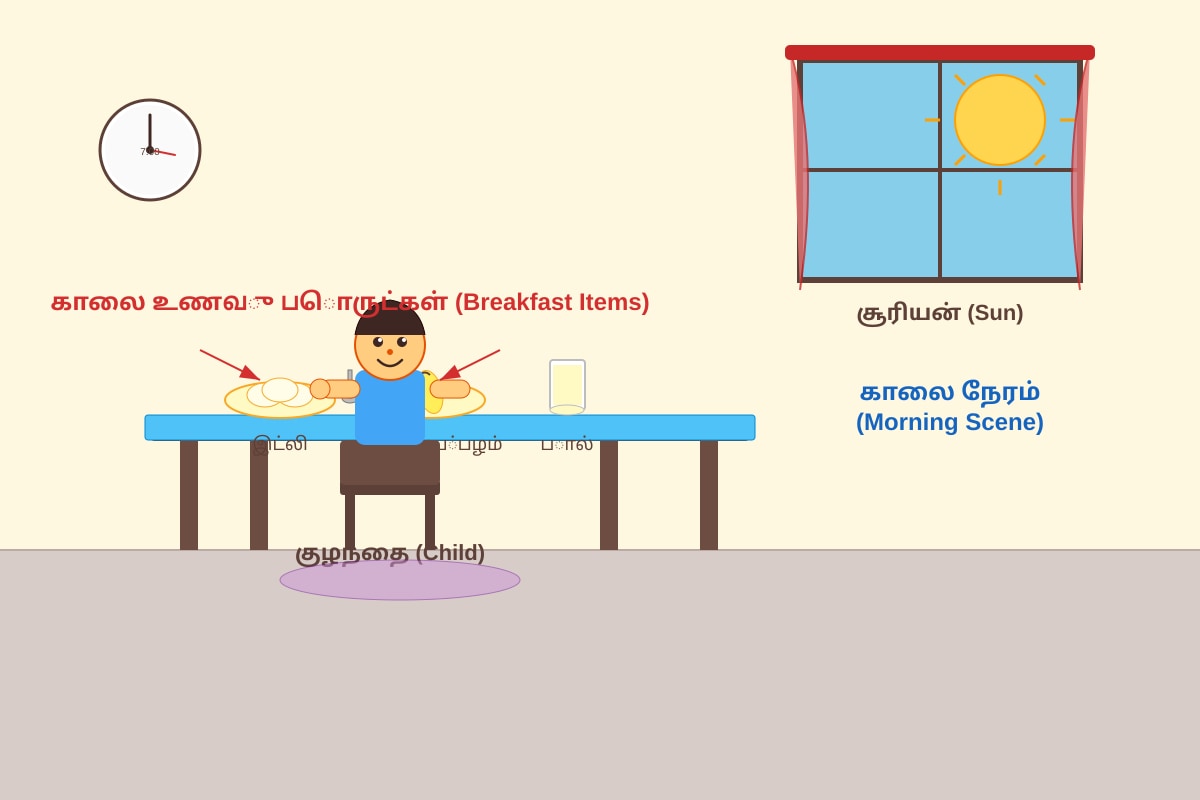
- Answer: இ) காலை உணவு (kaalai unavu)
- Marks: 2 marks
- Explanation: காலை உணவு literally means "morning meal" = breakfast (காலை = morning, உணவு = meal/food). The image shows morning cues (sun visible), and the clue "first meal of the day" confirms this. மதிய உணவு is lunch (noon meal), இரவு உணவு is dinner (night meal), நள்ளிரவு உணவு is midnight/supper meal. Students should recognize the time-word prefix pattern: காலை-, மதிய-, இரவு-.
Question 7
- Answer: இ) மிதிவண்டி (mithivandi)
- Marks: 2 marks
- Explanation: மிதிவண்டி means "bicycle" (literally: pedal-vehicle; மிதி = pedal/press with foot, வண்டி = vehicle). The key clues are "two wheels" and "pedal" — only bicycles match both. கார் and பேருந்து have four or more wheels, no pedaling. தொடர்வண்டி (train) runs on tracks, no pedals.
Question 8
- Answer: இ) வாழைப்பழம் (vaalaippazham)
- Marks: 2 marks
- Explanation: வாழைப்பழம் means "banana" — yellow, long, and famously liked by monkeys. ஆப்பிள் is round, not long. திராட்சை is small grapes (round, in bunches). The description has three specific clues; students must match all three to banana. Note: பழம் alone means "fruit" generically and cannot be correct as a specific answer.
Question 9
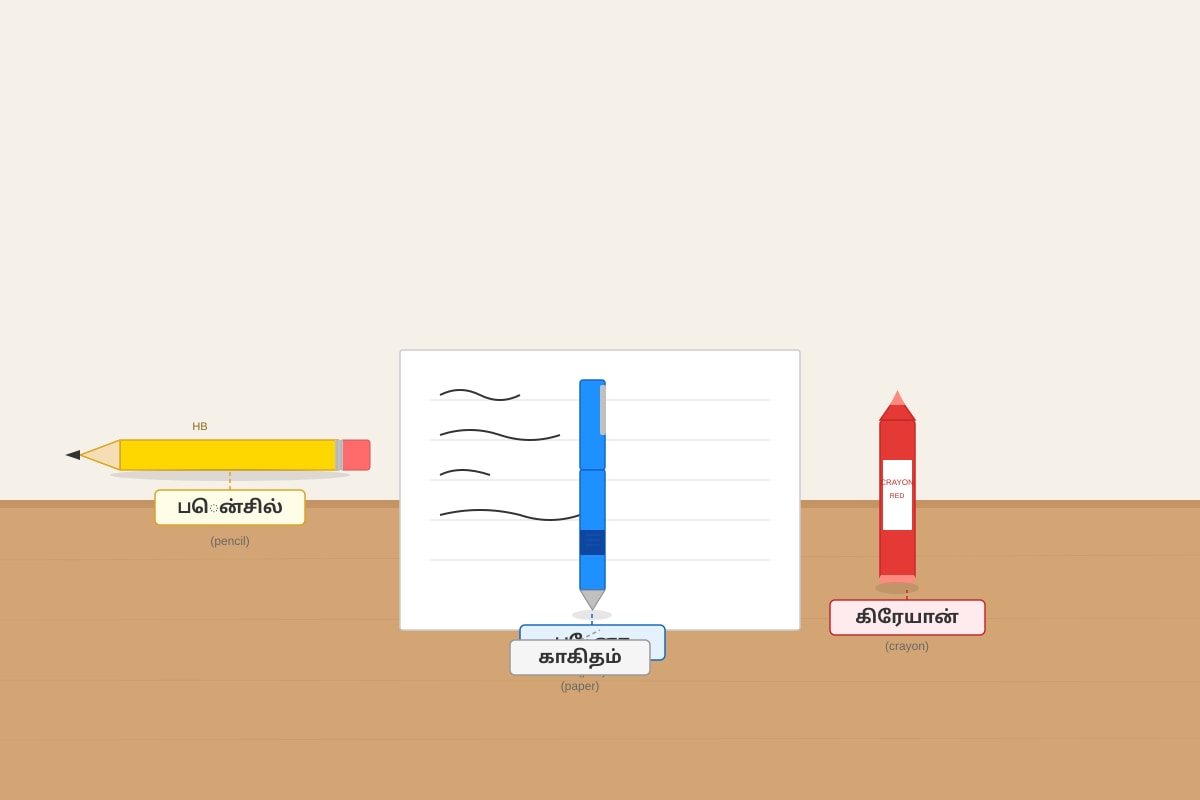
- Answer: ஆ) பென்சில் (pencil)
- Marks: 2 marks
- Explanation: பென்சில் (pencil) is the Tamil phonetic loan for "pencil." The image shows three writing tools; the question asks what "leaves marks" on paper — all three can, but பென்சில் is specifically the foundational writing tool taught first in Primary 1 (before pen). In Singapore Tamil_primary, pencil is introduced before pen for handwriting development. Key reasoning: the marks left by pencil can be erased (தூக்கி/eraser shown as干扰选项), connecting to the common classroom experience. While பேனா also writes, Primary 1 emphasis on pencil usage makes this the expected answer.
Question 10
- Answer: ஈ) பள்ளி (palli)
- Marks: 2 marks
- Explanation: பள்ளி means "school" — the place for learning with teachers and friends. வீடு is home (family, not teachers as primary relationship). கடை is shop (buying, not learning). மருத்துவமனை is hospital (doctors, not teachers). The phrase "go to learn" is the defining purpose of பள்ளி.
Section B: Match the Words (Questions 11–15)
10 marks (2 marks each)
Question 11
- Answer: இ) A big plant with trunk and branches
- Marks: 2 marks
- Explanation: மரம் (maram) means "tree." A tree is defined as a large plant with a wooden trunk and branches. இ can be identified by eliminating: அ) shop/place to buy = கடை; ஆ) something we read = புத்தகம் (book); ஈ) person who drives = ஓட்டுநர் (driver). The word structure: மர-ம் has no relation to commercial, reading, or human roles.
Question 12
- Answer: ஆ) A person who teaches students
- Marks: 2 marks
- Explanation: ஆசிரியர் (aasariyar) means "teacher" — from the root ஆசி (teaching/instruction). Teachers teach students at school. அ) cook = சமையல்காரர்; இ) seller = வியாபாரி; ஈ) builder = கட்டட வேலையாள்/கட்டுநர். The -ர் ending indicates a person/occupation (agent noun suffix). Students learn teacher vocabulary early as school-centric concept.
Question 13
- Answer: இ) A long story in a book
- Marks: 2 marks
- Explanation: நாவல் (novel) means "novel" — a long fictional story in book form. அ) describes apple = ஆப்பிள்; ஆ) describes sweet = இனிப்பு/மிட்டாய்; ஈ) describes knife = கத்தி. The Tamil word நாவல் is a literary genre term introduced in reading context. Connection: நாவல் sounds like "novel" in English — some students may recognize this cognate.
Question 14
- Answer: அ) Water falling from clouds
- Marks: 2 marks
- Explanation: மழை (mazhai) means "rain" — water droplets falling from clouds. ஆ) describes heat/hot air; இ) describes snow (வெண்பனி); ஈ) describes storm/strong wind (புயல்). The seasonal importance of rain in Tamil culture (monsoon) makes this core vocabulary. Students should distinguish precipitation types.
Question 15
- Answer: ஆ) A young person who learns at school
- Marks: 2 marks
- Explanation: மாணவன் (maanavan) means "student" (male; மாணவி for female). மாண்- root relates to learning/study; -அவன் indicates male person. அ) buyer = வாங்குபவர்; இ) mechanic = பழுதுநீக்குபவர்; ஈ) farmer = விவசாயி. The school context in Primary 1 makes மாணவன் immediately relevant to students' own identity.
Section C: Fill in the Blank (Questions 16–18)
9 marks (3 marks each)
Question 16
- Answer: இன்று (indru)
- Marks: 3 marks
- Explanation: இன்று means "today" or "now" — the appropriate time word for present tense action. The verb சமைக்கிறாள் (cooks/is cooking) uses the present tense suffix -கிற்-, indicating current/immediate action. நேற்று (yesterday) requires past tense சமைத்தாள்; நாளை (tomorrow) requires future tense சமைப்பாள்.
Marking breakdown:
- Correct choice of இன்று: 2 marks
- Correct understanding of tense-verb agreement: 1 mark
Teaching note: Primary 1 students learn three foundational time words with corresponding tense patterns: இன்று (present), நேற்று (past), நாளை (future). The verb ending changes to match.
Question 17
- Answer: Any of: பச்சை (green) / சிவப்பு (red) / மஞ்சள் (yellow) — matched to visible fruit color
- Marks: 3 marks
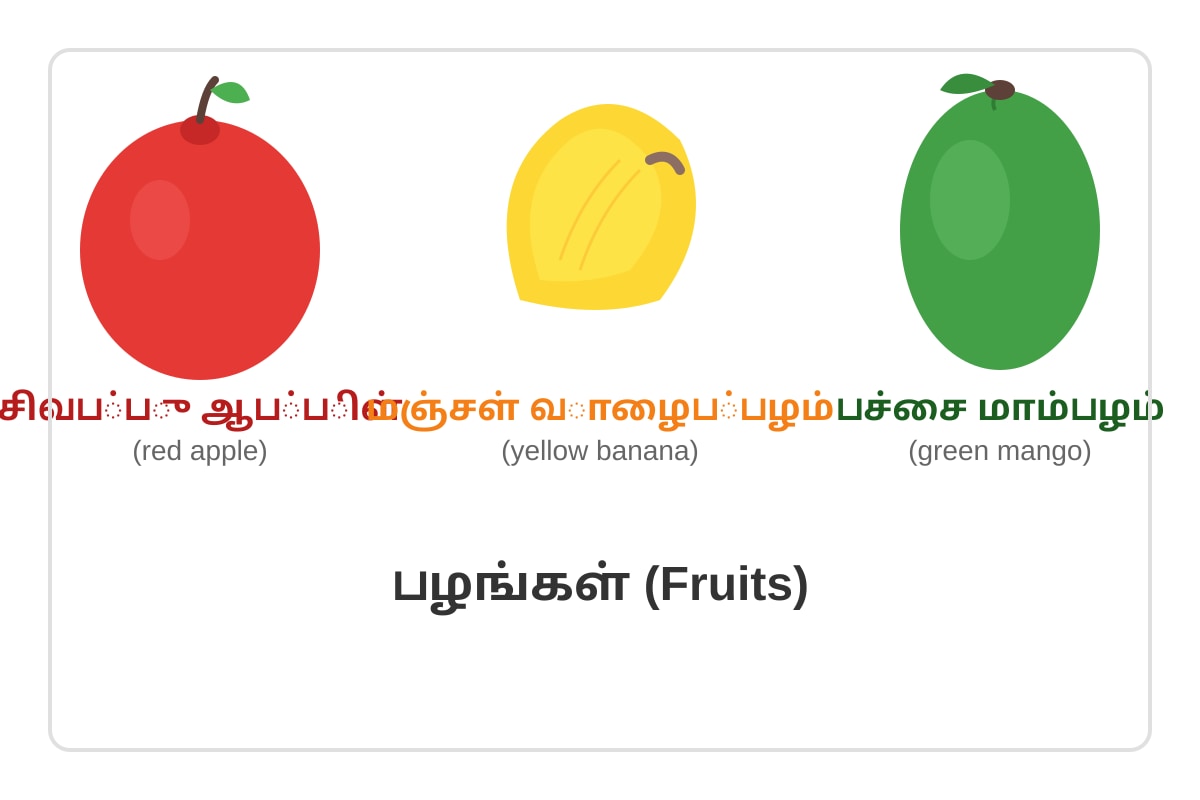
- Explanation: This question accepts any correct color-fruit match from the image. The image shows: red apple, yellow banana, green mango.
Valid answers:
- பச்சை → because the mango is green (1 mark identification + 2 marks for color-word accuracy)
- சிவப்பு → because the apple is red
- மஞ்சள் → because the banana is yellow
Marking breakdown:
- Naming any one of the three visible colors correctly: 2 marks
- Implicitly matching it to a visible fruit of that color: 1 mark
Teaching note: This tests color vocabulary application with real-world association. Students must connect the abstract color word to concrete visual evidence. Common error: Choosing a color not shown (e.g., நீலம்/blue) — no blue fruit is visible, so such answers get 0 marks.
Question 18
- Answer: நடந்து (nadanthu)
- Marks: 3 marks
- Explanation: நடந்து means "by walking" / "walking" — the appropriate and realistic way young students go to school. The verb form is the adverbial participle (எச்ச வினை), indicating manner of movement.
Why others are wrong:
- பறந்து (flying) — humans cannot fly; this is fantastical and unsuitable for this context
- நீந்தி (swimming) — would require water route, impractical for school commute
Marking breakdown:
- Correct choice: 2 marks
- Understanding of realistic daily activity: 1 mark
Teaching note: This tests practical vocabulary and real-world reasoning. Primary 1 encourages students to describe their own daily routines. நட- root relates to walking (நடக்க = to walk; நடந்து = having walked / by walking).
Section D: Picture Description (Questions 19–20)
11 marks total
Question 19 Total: 5 marks
(a) How many people are in this picture?
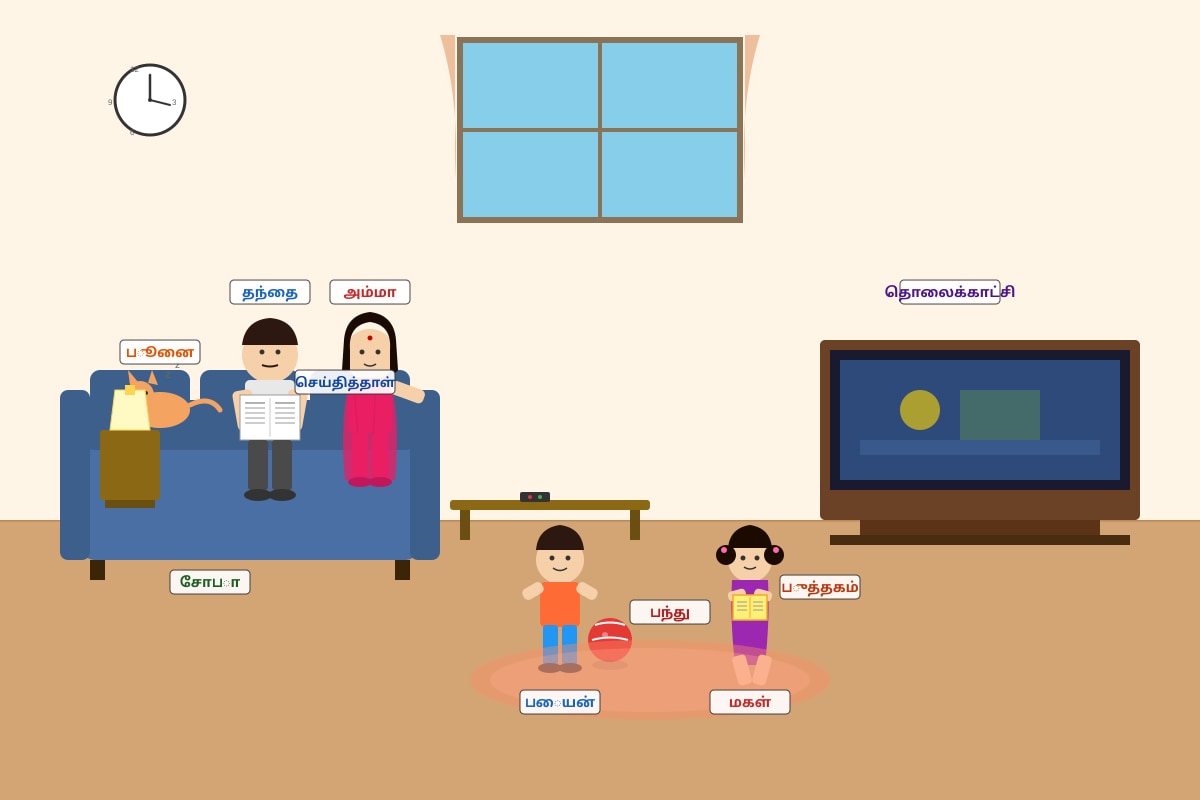
- Answer: 4 / நால்வர் / நான்கு பேர் / four people
- Marks: 1 mark
- Explanation: The image shows four human characters: father, mother, boy, and girl. The cat is an animal, not a person. Students must distinguish people (மக்கள்) from animals (விலங்குகள்).
(b) What is the girl doing?
- Answer: She is reading a book. / புத்தகம் படிக்கிறாள். / ஒரு புத்தகத்தைப் படிக்கிறாள்.
- Marks: 2 marks
- Explanation: The girl in the image is shown with a book, engaged in reading.
Marking breakdown:
- Correct activity (reading): 1 mark
- Correct object (book/புத்தகம்): 1 mark
Alternative acceptable: "she reads" / "reading" — verb form may be approximate at Primary 1 level. Key concept: identifying actions from visual cues.
(c) Circle the correct word: The cat is sleeping on the_______
- Answer: சோபா (sofa)
- Marks: 2 marks
- Explanation: சோபா means "sofa" — the piece of furniture shown. The image description explicitly states "cat sleeping on sofa." மேசை means table (where people might eat/work); படுக்கை means bed (in bedroom, different from living room shown). Students use room context (living room) to eliminate bedroom furniture.
Question 20 Total: 6 marks
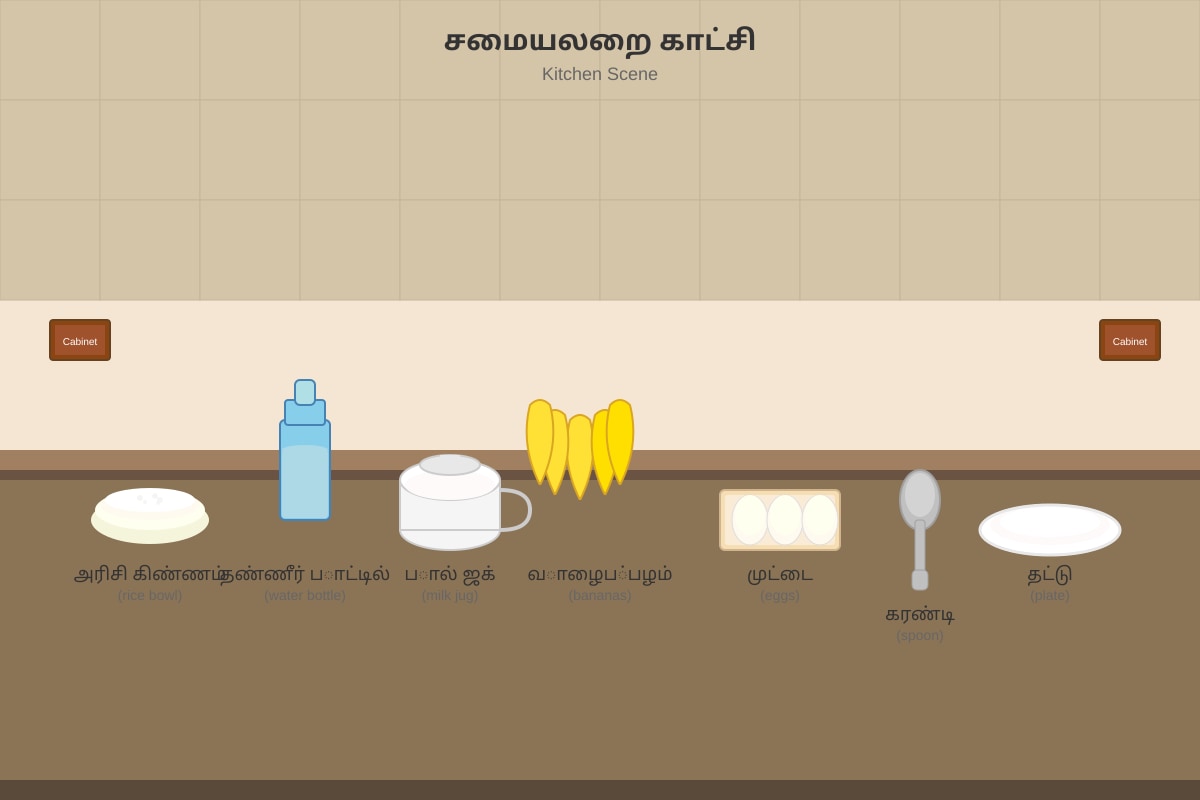
(a) Name three food items you can see in the kitchen.
- Answer: Any three of: அரிசி/சாதம் (rice), பால் (milk), வாழைப்பழம் (bananas)/பழம் (fruit), முட்டை (eggs)
- Marks: 3 marks (1 mark per correct item)
- Explanation: The kitchen image contains: rice in a bowl, water in a bottle, milk in a jug, bananas, eggs on a tray. Food items exclude: water (not food — though essential, it's a drink/beverage), spoon (utensil), plate (dishware).
Valid answers (1 mark each, max 3):
- அரிசி / சாதம் (rice)
- பால் (milk)
- வாழைப்பழம் / பழம் (bananas/fruit)
- முட்டை (eggs)
Not accepted as "food item":
- நீர் (water) — drink, not food; but recognize as plausible error with 0 marks
- கரண்டி (spoon) — utensil
- பந்தம் (plate) — dishware
(b) How many eggs are there? Write the number in Tamil words.
- Answer: மூன்று (moondru) / 3 / three
- Marks: 2 marks
- Explanation: The image description specifies "three eggs" (3 eggs) on the tray.
Marking breakdown:
- Correct number identification (3): 1 mark
- Correct Tamil word form (மூன்று): 1 mark
Numeral "3" accepted at Primary 1 if Tamil word spelling uncertain, but full marks require Tamil word. Alternative: students may count visible eggs in rendered image — if image generation changes count, answer should match actual rendered image.
(c) Which item is in a bottle?
- Answer: நீர் (water) / தண்ணீர்
- Marks: 1 mark
- Explanation: The image labels specify "water bottle" — a bottle containing water. Other containers: jug (குடம்/குக்கு) has milk, bowl (கிண்ணம்) has rice. Students distinguish container types (bottle vs. jug vs. bowl) and their contents.
TOTAL MARKS: 50
Section totals verified:
- Section A: 10 × 2 = 20 marks ✓
- Section B: 5 × 2 = 10 marks ✓
- Section C: 3 × 3 = 9 marks ✓
- Section D: 5 + 6 = 11 marks ✓
- Grand total: 50 marks ✓
Duration check: 45 minutes for 50 marks → approximately 0.9 minutes per mark. Section A: ~18 min; Section B: ~10 min; Section C: ~9 min; Section D: ~8 min. Allow 5 min review buffer. Appropriate for Primary 1 pace with reading support.