AI Generated Quiz
Primary 1 Mathematics Picture Graphs Quiz
Free P1 Maths Picture Graphs quiz, AI version, with questions, answers, and syllabus-aligned practice for Singapore students.
These static practice materials are generated from the site's syllabus and paper-generation workflow, with source and model context shown so students and parents can evaluate the material before use.
Questions
Free quiz and exam paper access
Enter your details to view this paper
Your access is remembered on this device.
Answers
Primary 1 Mathematics Quiz - Picture Graphs (Answer Key)
Total Marks: 20
Section A: Reading Picture Graphs (Questions 1 to 10)
Each question carries 1 mark.
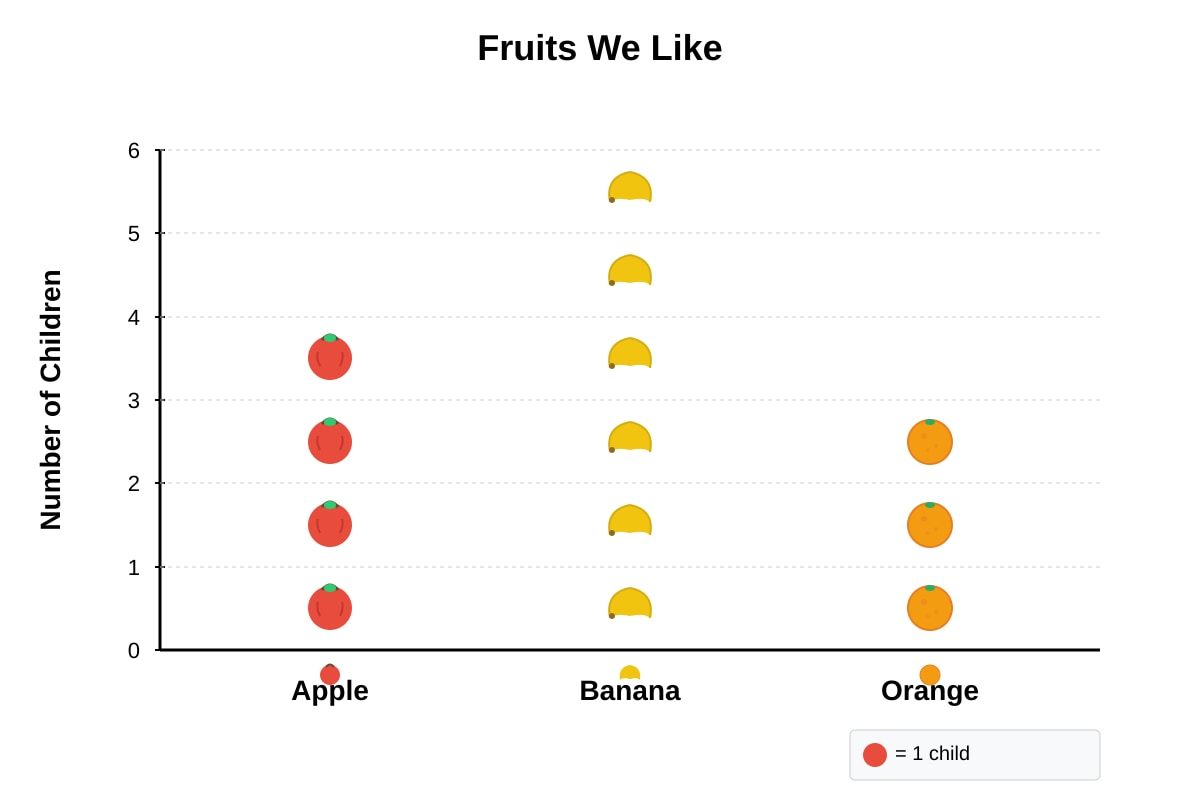
Questions 1 to 5 refer to the picture graph titled "Fruits We Like".
1. How many children like apples?
- Answer: 4
- Marks: 1
- Explanation: Look at the picture graph. The column for "Apple" has 4 apple symbols. Each symbol means 1 child. So, 4 children like apples.
- Common mistake: Counting the symbols incorrectly. Count each symbol one by one.
2. Which fruit do 6 children like?
- Answer: Banana
- Marks: 1
- Explanation: Look for the column that has 6 symbols. The column for "Banana" has 6 banana symbols. So, 6 children like bananas.
- Common mistake: Confusing the fruit names. Check the label under each column.
3. How many children like oranges?
- Answer: 3
- Marks: 1
- Explanation: Look at the column for "Orange". It has 3 orange symbols. So, 3 children like oranges.
- Common mistake: Counting the symbols incorrectly.
4. Which fruit has the most children who like it?
- Answer: Banana
- Marks: 1
- Explanation: Compare the number of symbols in each column. Apple has 4, Banana has 6, Orange has 3. Banana has the most symbols (6), so it is the fruit that the most children like.
- Common mistake: Choosing the fruit with the fewest symbols. "Most" means the greatest number.
5. How many more children like bananas than oranges?
- Answer: 3
- Marks: 1
- Explanation: Banana has 6 children, Orange has 3 children. To find "how many more", subtract: 6 - 3 = 3. So, 3 more children like bananas than oranges.
- Working: 6 - 3 = 3
- Common mistake: Adding instead of subtracting. "How many more" means find the difference.
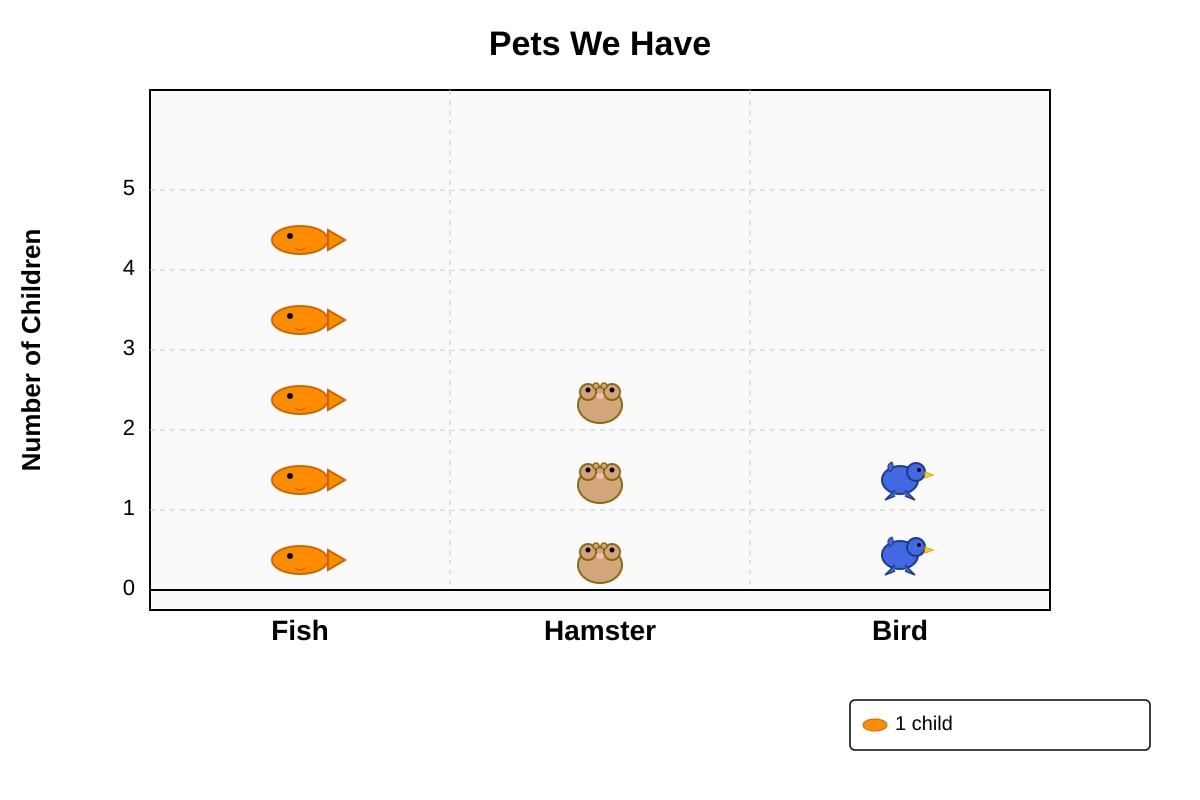
Questions 6 to 10 refer to the picture graph titled "Pets We Have".
6. How many children have a fish?
- Answer: 5
- Marks: 1
- Explanation: Look at the column for "Fish". It has 5 fish symbols. So, 5 children have a fish.
- Common mistake: Counting the symbols incorrectly.
7. Which pet do 3 children have?
- Answer: Hamster
- Marks: 1
- Explanation: Look for the column that has 3 symbols. The column for "Hamster" has 3 hamster symbols. So, 3 children have a hamster.
- Common mistake: Confusing the pet names.
8. How many children have a bird?
- Answer: 2
- Marks: 1
- Explanation: Look at the column for "Bird". It has 2 bird symbols. So, 2 children have a bird.
- Common mistake: Counting the symbols incorrectly.
9. Which pet has the fewest children who have it?
- Answer: Bird
- Marks: 1
- Explanation: Compare the number of symbols in each column. Fish has 5, Hamster has 3, Bird has 2. Bird has the fewest symbols (2), so it is the pet that the fewest children have.
- Common mistake: Choosing the pet with the most symbols. "Fewest" means the smallest number.
10. How many children have a fish or a hamster?
- Answer: 8
- Marks: 1
- Explanation: "Fish or a hamster" means we add the number of children who have a fish and the number who have a hamster. Fish has 5 children, Hamster has 3 children. 5 + 3 = 8.
- Working: 5 + 3 = 8
- Common mistake: Subtracting instead of adding. "Or" in this context means we combine the groups.
Section B: Completing Picture Graphs (Questions 11 to 15)
Each question carries 2 marks. 1 mark for drawing the correct number of symbols, 1 mark for drawing them neatly in the correct space.
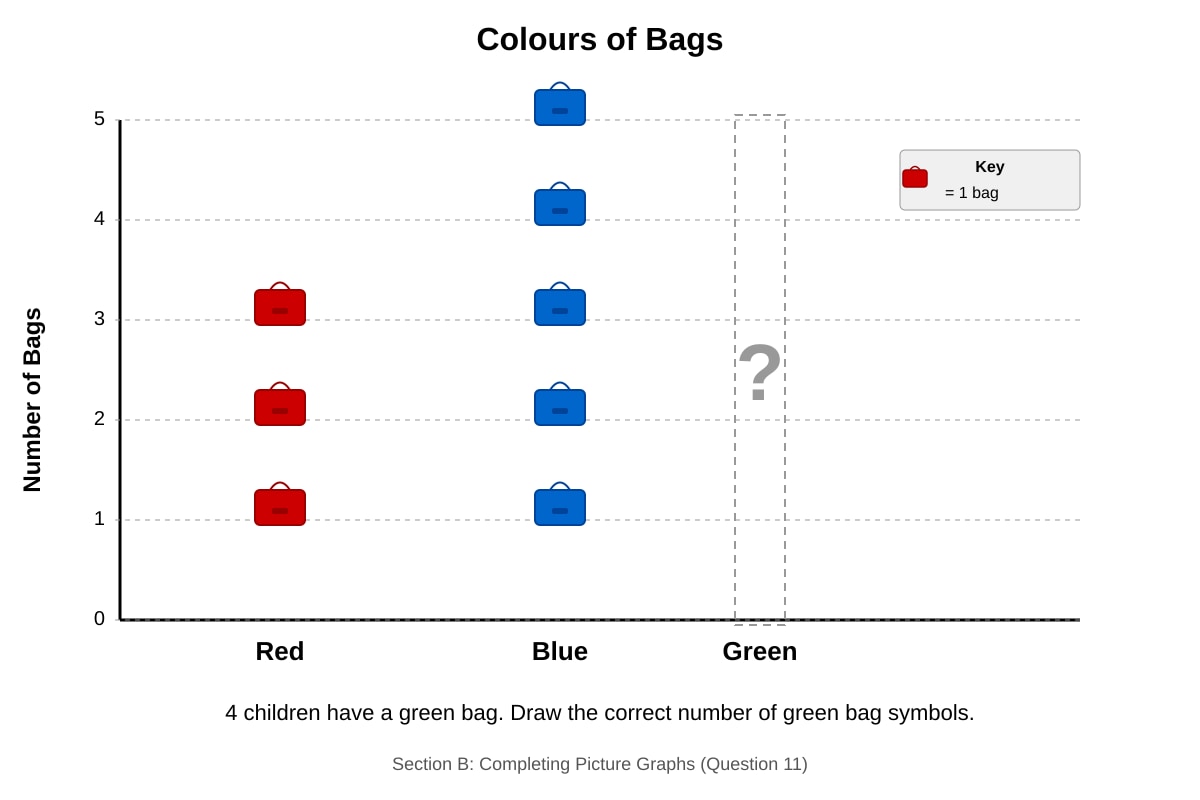
11. Draw the green bag symbols.
- Answer: Draw 4 green bag symbols in the space above "Green".
- Marks: 2 (1 mark for correct number, 1 mark for correct placement)
- Explanation: The question says 4 children have a green bag. Each symbol represents 1 bag. So, we need to draw 4 green bag symbols in the row for "Green".
- Common mistake: Drawing the wrong number of symbols. Read the question carefully.
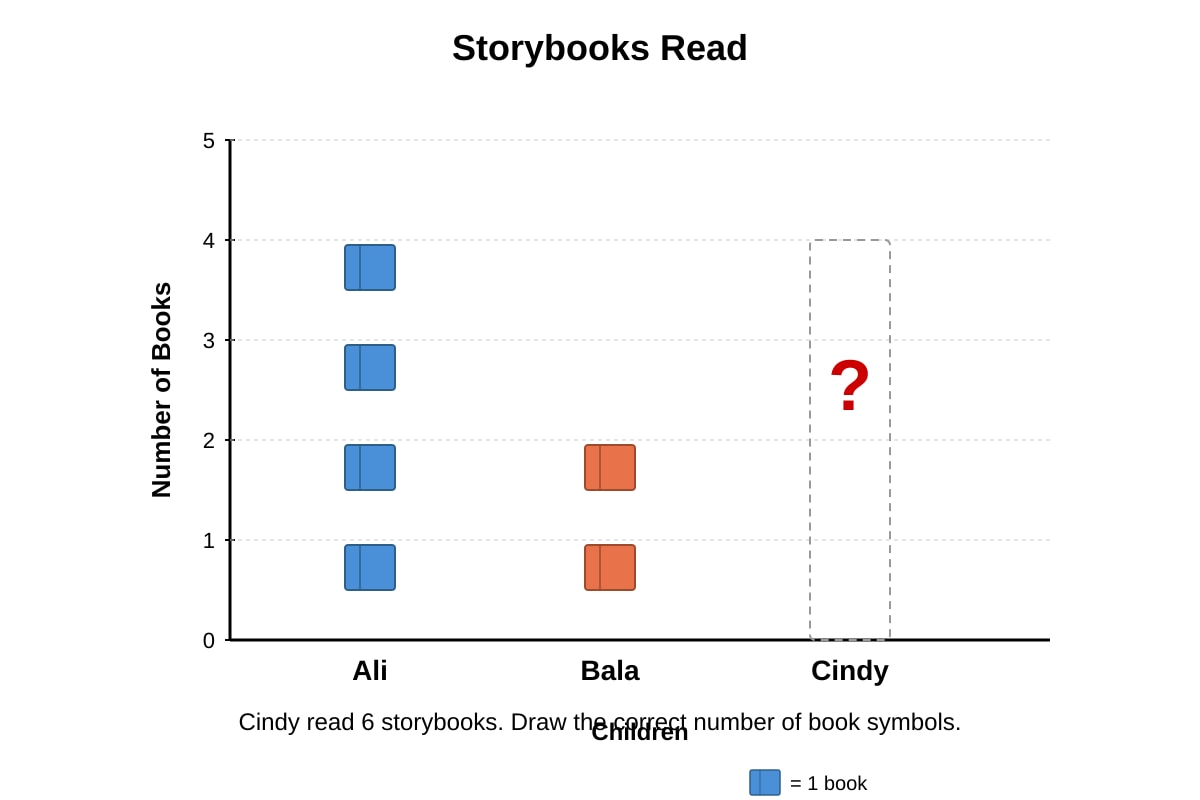
12. Draw the book symbols for Cindy.
- Answer: Draw 6 book symbols in the space above "Cindy".
- Marks: 2 (1 mark for correct number, 1 mark for correct placement)
- Explanation: The question says Cindy read 6 storybooks. Each symbol represents 1 book. So, we need to draw 6 book symbols in the row for "Cindy".
- Common mistake: Drawing the symbols in the wrong column. Check the label.
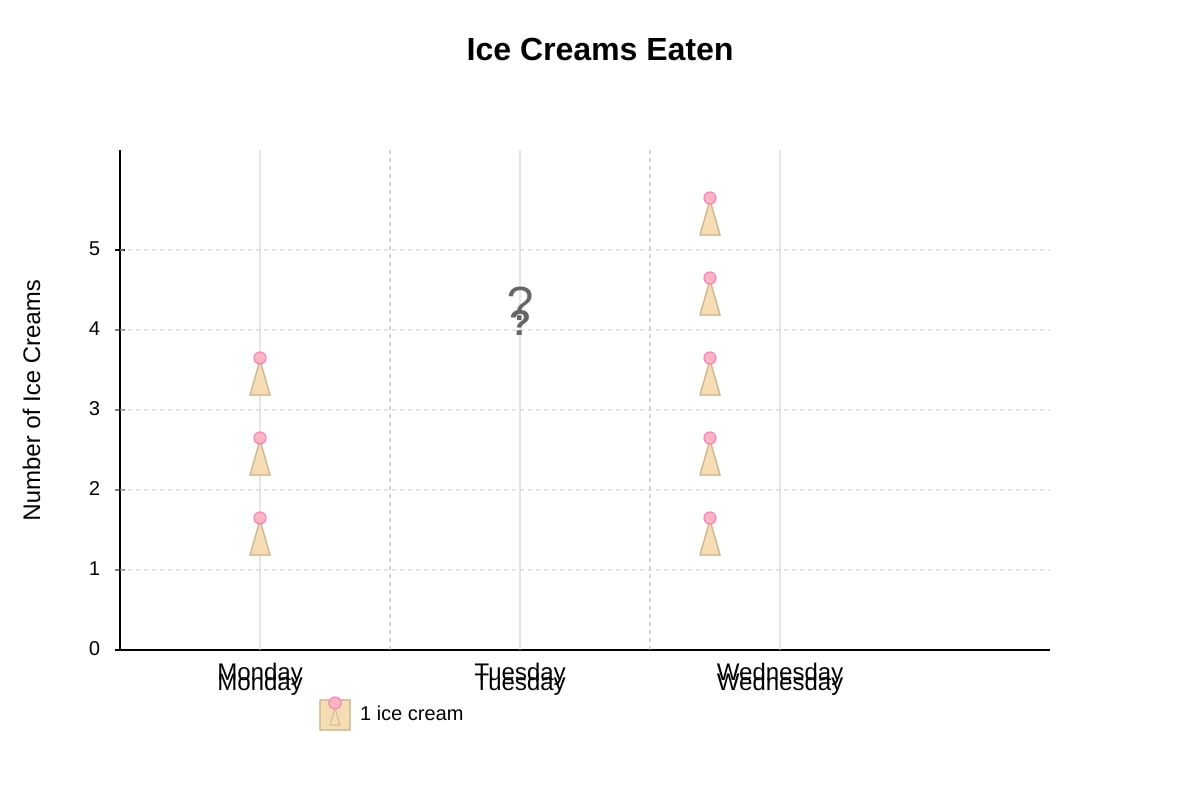
13. Draw the ice cream symbols for Tuesday.
- Answer: Draw 4 ice cream symbols in the space above "Tuesday".
- Marks: 2 (1 mark for correct number, 1 mark for correct placement)
- Explanation: The question says the children ate 4 ice creams on Tuesday. Each symbol represents 1 ice cream. So, we need to draw 4 ice cream symbols in the row for "Tuesday".
- Common mistake: Drawing the symbols in the wrong column.
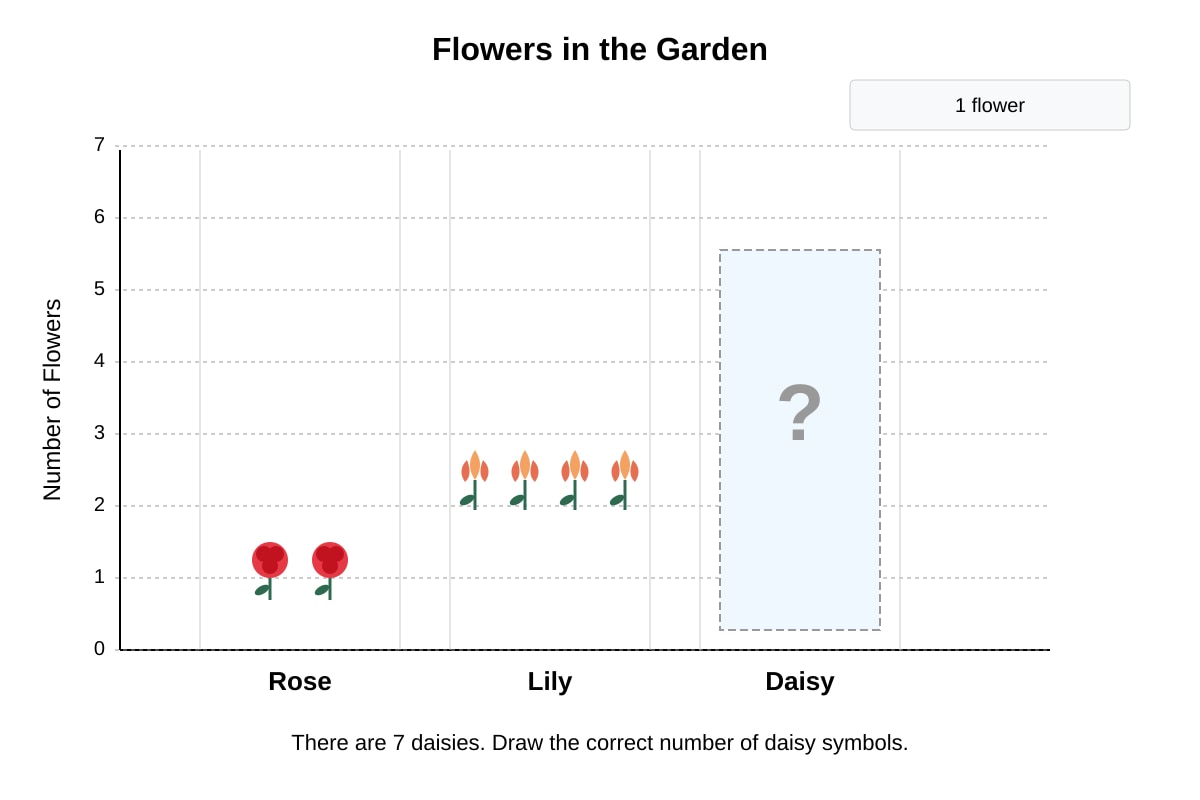
14. Draw the daisy symbols.
- Answer: Draw 7 daisy symbols in the space above "Daisy".
- Marks: 2 (1 mark for correct number, 1 mark for correct placement)
- Explanation: The question says there are 7 daisies. Each symbol represents 1 flower. So, we need to draw 7 daisy symbols in the row for "Daisy".
- Common mistake: Drawing the wrong number of symbols.
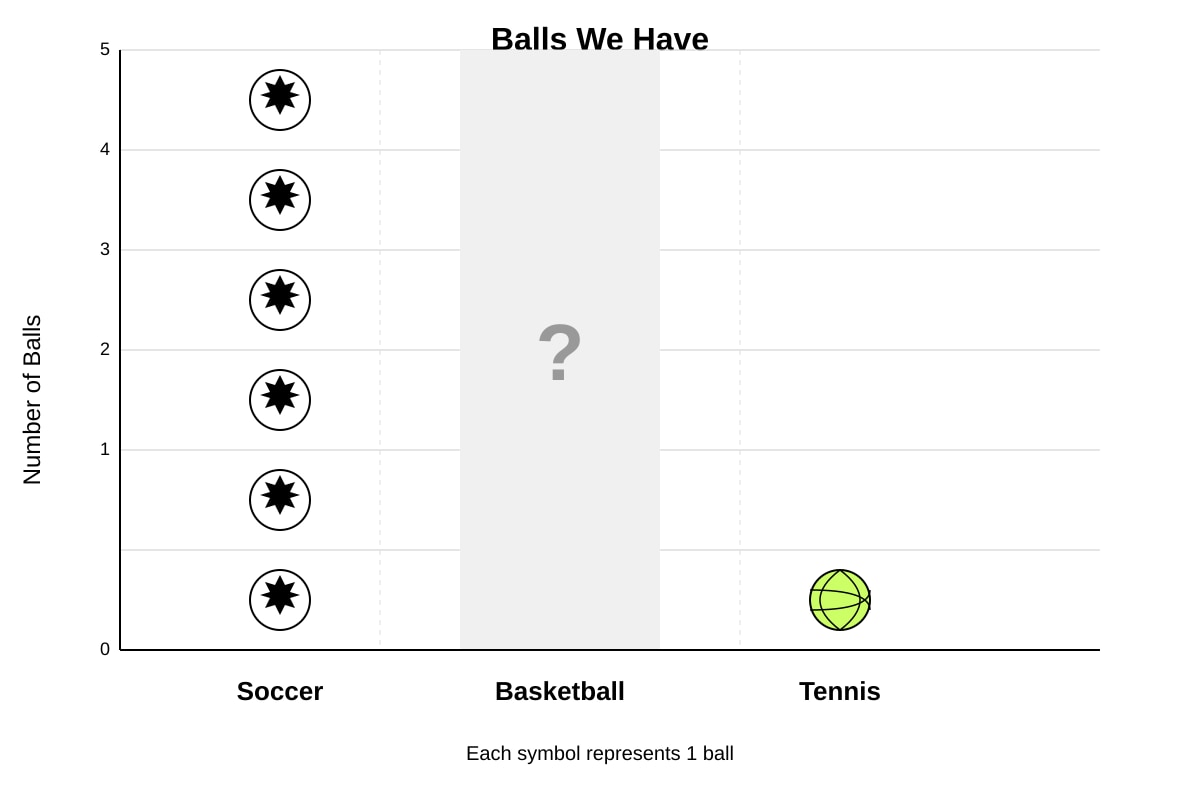
15. Draw the basketball symbols.
- Answer: Draw 3 basketball symbols in the space above "Basketball".
- Marks: 2 (1 mark for correct number, 1 mark for correct placement)
- Explanation: The question says the children have 3 basketballs. Each symbol represents 1 ball. So, we need to draw 3 basketball symbols in the row for "Basketball".
- Common mistake: Drawing the symbols in the wrong column.
Section C: Problem Solving with Picture Graphs (Questions 16 to 20)
Each question carries 2 marks. 1 mark for correct working, 1 mark for correct final answer.
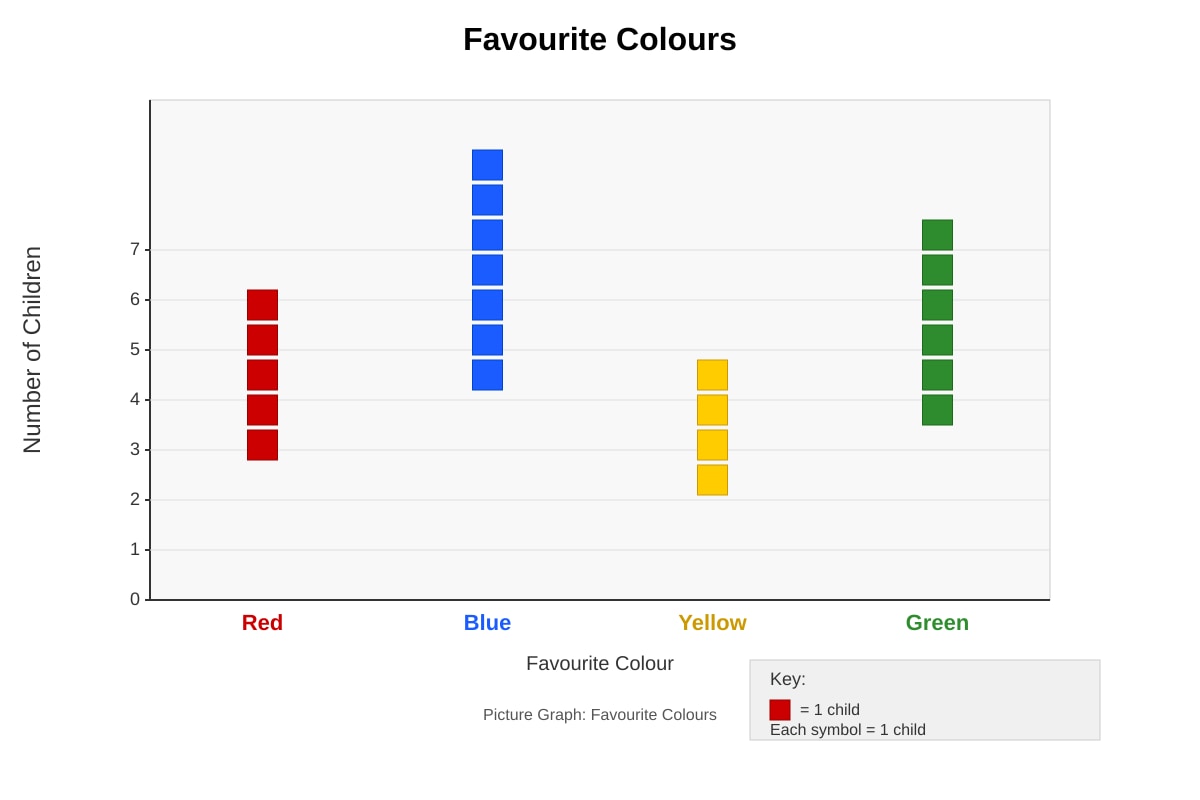
Questions 16 to 18 refer to the picture graph titled "Favourite Colours".
16. How many children chose red or yellow as their favourite colour?
- Answer: 9 children
- Marks: 2 (1 mark for working, 1 mark for correct answer)
- Explanation: "Red or yellow" means we add the number of children who chose red and the number who chose yellow. Red has 5 children, Yellow has 4 children. 5 + 4 = 9.
- Working: 5 + 4 = 9
- Common mistake: Adding all the colours instead of just red and yellow.
17. How many more children chose blue than green?
- Answer: 1 more child
- Marks: 2 (1 mark for working, 1 mark for correct answer)
- Explanation: "How many more... than" means we subtract the smaller number from the larger number. Blue has 7 children, Green has 6 children. 7 - 6 = 1.
- Working: 7 - 6 = 1
- Common mistake: Subtracting the wrong way (6 - 7). Always subtract the smaller number from the larger number.
18. How many children are there altogether?
- Answer: 22 children
- Marks: 2 (1 mark for working, 1 mark for correct answer)
- Explanation: "Altogether" means we add all the children. Red has 5, Blue has 7, Yellow has 4, Green has 6. 5 + 7 + 4 + 6 = 22.
- Working: 5 + 7 + 4 + 6 = 22
- Common mistake: Missing one of the colours. Make sure to add all four numbers.
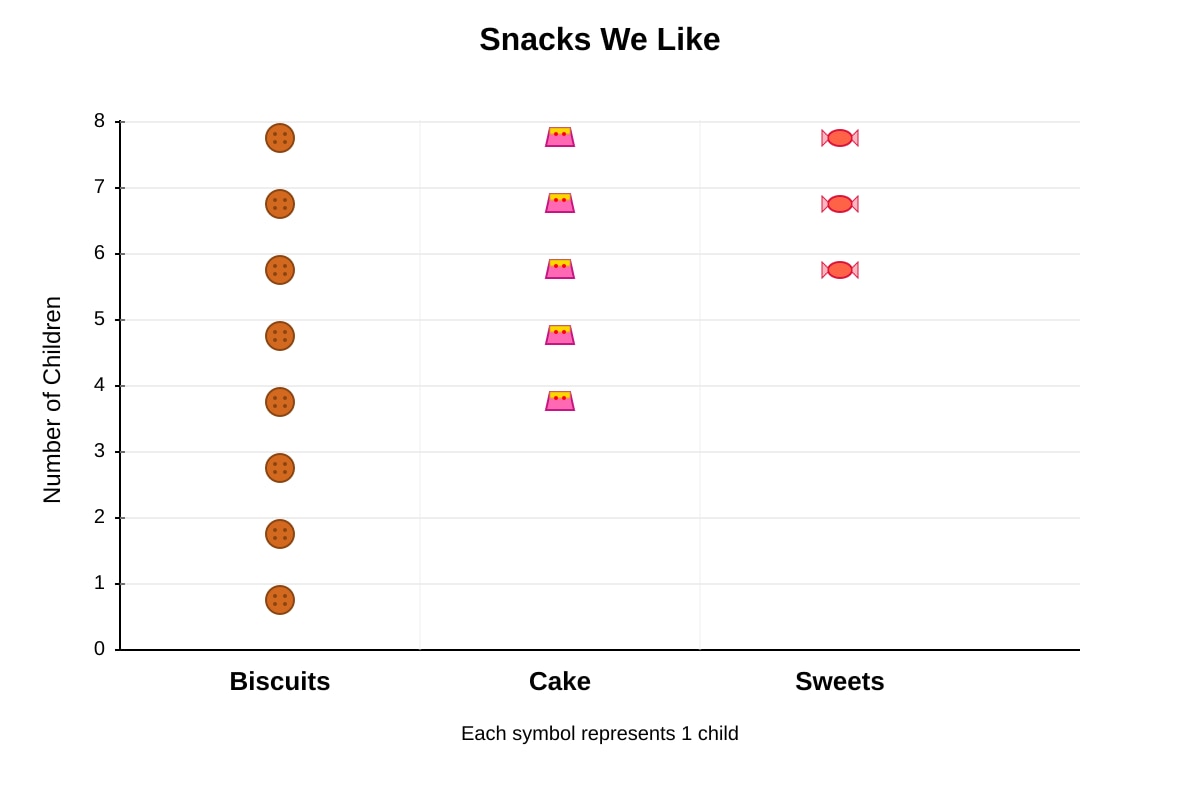
Questions 19 and 20 refer to the picture graph titled "Snacks We Like".
19. How many more children like biscuits than sweets?
- Answer: 5 more children
- Marks: 2 (1 mark for working, 1 mark for correct answer)
- Explanation: "How many more... than" means we subtract. Biscuits has 8 children, Sweets has 3 children. 8 - 3 = 5.
- Working: 8 - 3 = 5
- Common mistake: Adding instead of subtracting.
20. 4 more children said they like cake. How many children like cake now?
- Answer: 9 children
- Marks: 2 (1 mark for working, 1 mark for correct answer)
- Explanation: First, find how many children liked cake before. The graph shows 5 children liked cake. Then, 4 more children said they like cake. So, we add: 5 + 4 = 9.
- Working: 5 + 4 = 9
- Common mistake: Forgetting to look at the graph first to find the original number of children who liked cake.
End of Answer Key