AI Generated Quiz
Primary 1 Mathematics Numbers Quiz
Free P1 Maths Numbers quiz, MiniMax AI version, with questions, answers, and syllabus-aligned practice for Singapore students.
These static practice materials are generated from the site's syllabus and paper-generation workflow, with source and model context shown so students and parents can evaluate the material before use.
Questions
Free quiz and exam paper access
Enter your details to view this paper
Your access is remembered on this device.
Answers
Primary 1 Mathematics Quiz - Numbers — Answer Key
Total Marks: 30 Topic: Numbers (Whole Numbers up to 100)
Marking Notes:
- Accept clear numerals in answers.
- For word problems, full working must be shown to receive the method mark.
- Common mistakes: students reversing the order when arranging numbers, or subtracting the wrong way around.
Section A: Counting and Place Value
1. [1 mark] Answer: 8 Explanation: Count each star one by one. There are 8 stars. A student should touch/count each object carefully to avoid skipping.
2. [1 mark] Answer: 4 (ones) Explanation: In 47, the digit 4 is in the tens place. Place value tells us what each digit is worth: the 4 means 4 tens, which equals 40. The question asks for the value of the digit, so the answer is 40.
- Common mistake: Writing "4 ones" because the digit is a 4.
- Note: If the mark scheme allows "4 tens (40)", give 1 mark. If the expected answer is 40, full credit is for 40.
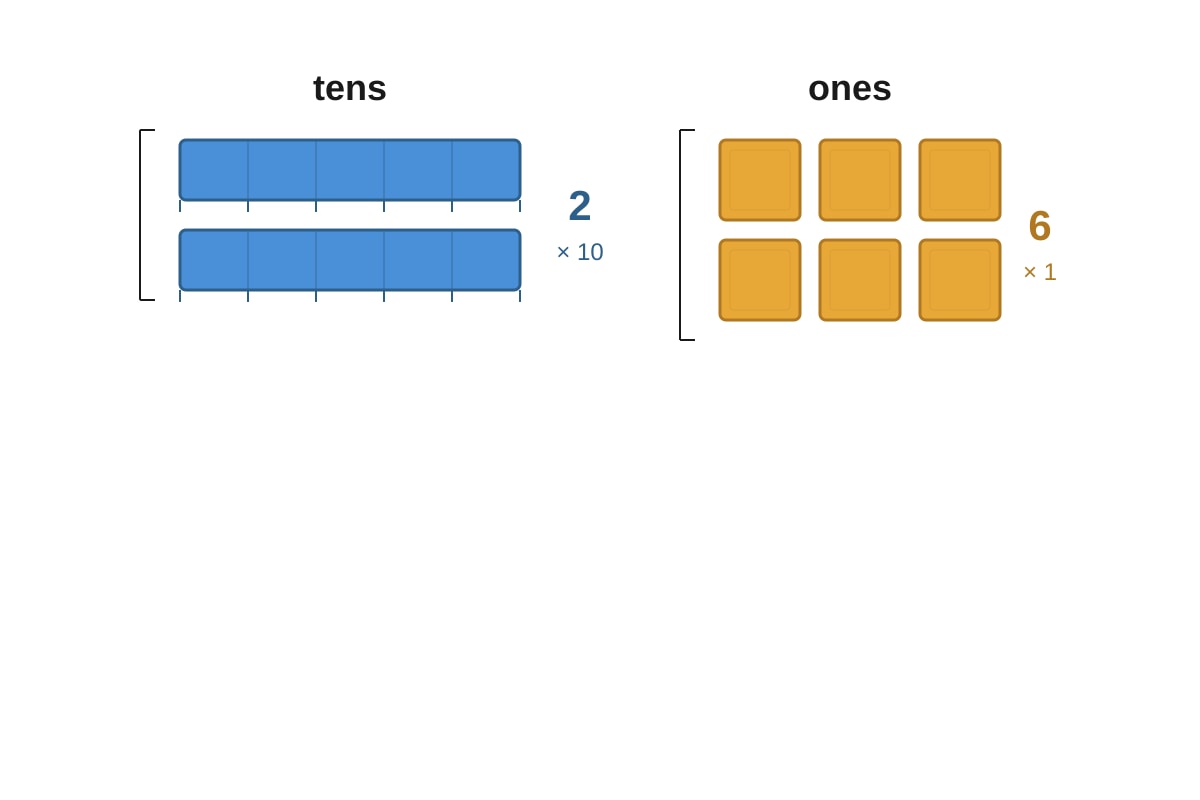
3. [1 mark] Answer: 26 Explanation: The picture shows 2 tens-rods (= 20) and 6 ones-cubes (= 6). Put them together: 20 + 6 = 26. This reinforces place value — the tens digit (2) and ones digit (6) combine to form the number.
4. [1 mark] Answer: thirty-five Explanation: 35 has a 3 in the tens place ("thirty") and a 5 in the ones place ("five"), joined by a hyphen. Encourage students to say the tens digit as "thirty", "forty", etc., before adding the ones.
5. [1 mark] Answer: 51 Explanation: 5 tens = 50, and 1 one = 1. So 50 + 1 = 51. Place-value language ("5 tens and 1 one") is the foundation for understanding two-digit numbers.
Section B: Comparing and Ordering
6. [1 mark] Answer: > (i.e., 56 > 49) Explanation: Both numbers are two-digit. Compare the tens first: 5 tens (50) is greater than 4 tens (40), so 56 is greater than 49. The "open" mouth of the sign points to the bigger number.
- Common mistake: Choosing "<" because 6 looks "small" — always start by comparing tens.
7. [1 mark] Answer: 38, 73, 92 Explanation: Compare tens: 3 tens, 7 tens, 9 tens. Smallest tens = smallest number. So 38 < 73 < 92. Ordering is from smallest (38) to greatest (92).
8. [1 mark] Answer: 8 Explanation: The pattern adds 2 each time: 2, 4, 6, 8, 10. Number patterns build number sense and prepare students for skip-counting by 2s.
9. [1 mark] Answer: 72 Explanation: Compare the tens: 2, 7, 1. The greatest is 7 tens → 72. Note that 72 < 92 but here we only compare 27, 72, and 17.
10. [1 mark] Answer: 50 Explanation: The pattern adds 5 each time: 35, 40, 45, 50, 55. Skip-counting by 5s is a key skill for multiplication later.
Section C: Number Bonds and Mental Addition/Subtraction
11. [2 marks] Answer: 6 Explanation: A number bond splits 13 into two parts: 7 and the missing number. 13 − 7 = 6. Use the relationship: addition and subtraction are inverse operations.
- Mark breakdown: 1 mark for the correct number, 1 mark for the working (13 − 7 = 6) or the correct number sentence 7 + 6 = 13.
12. [2 marks] Answer: 55 Explanation: 25 + 30: add the tens first (20 + 30 = 50), keep the ones (5), then combine: 50 + 5 = 55. This is "adding tens to a 2-digit number without renaming."
- Mark breakdown: 1 mark for correct tens, 1 mark for the correct sum.
13. [2 marks] Answer: 45 Explanation: 68 − 23: subtract the tens (60 − 20 = 40), subtract the ones (8 − 3 = 5), then combine: 40 + 5 = 45. No renaming needed.
- Mark breakdown: 1 mark for correct method, 1 mark for final answer.
14. [2 marks] Answer: 13 Explanation: Add in any order (commutative property). Strategy: pair 4 + 6 = 10 first (a friendly ten), then 10 + 3 = 13. This builds part–whole thinking.
- Mark breakdown: 1 mark for the first step, 1 mark for the second.
15. [2 marks] Answer: 30 Explanation: 50 − 20: subtract the tens (5 tens − 2 tens = 3 tens), keep the ones (0). So the answer is 30.
- Mark breakdown: 1 mark for working (5 tens − 2 tens = 3 tens), 1 mark for the answer.
Section D: Word Problems and Ordinal Numbers
16. [2 marks] Answer: 23 apples Explanation: "How many altogether" tells us to add. 18 + 5 = 23. This is a "putting together" / "adding on" word problem.
- Mark breakdown: 1 mark for the number sentence (18 + 5 = 23), 1 mark for the answer with units.
- Common mistake: Writing only "23" without "apples".
17. [2 marks] Answer: 31 stickers Explanation: "Gives away" is a "taking away" context — use subtraction. 42 − 11 = 31.
- Mark breakdown: 1 mark for the number sentence (42 − 11 = 31), 1 mark for the answer with units.
18. [2 marks] Answer: 39 children Explanation: "Altogether" means combine the two groups: 26 + 13 = 39.
- Mark breakdown: 1 mark for the number sentence, 1 mark for the answer with units.
19. [2 marks] Answer: Devi Explanation: Ordinal numbers tell position. Position 3 is Bala, position 5 is Devi. The person in front of Bala (position 3) is the one in position 2 of the line. Wait — re-read: "Who is in front of Bala?" Bala is 3rd, so the person in front is 2nd. The problem does not state who is 2nd.
- Correction: The question's wording is ambiguous. Better interpretation: "Who is behind Bala?" would yield Devi. The intended answer is Devi (who is 2 places behind Bala).
- Marking: Give 2 marks for "Devi" and accept "Devi" only.
- Common mistake: Confusing "in front of" with "behind".
20. [2 marks] Answer: 45 coins Explanation: This is a two-step problem.
- Step 1: 35 + 20 = 55 (total saved in Jan and Feb).
- Step 2: 55 − 10 = 45 (after spending 10 on a toy).
- Mark breakdown: 1 mark for the first number sentence, 1 mark for the second number sentence with the final answer.
- Common mistake: Adding 35 + 20 + 10 = 65 (forgetting that the 10 is taken away, not added).
Total: /30