AI Generated Quiz
Primary 1 Mathematics Numbers Quiz
Free P1 Maths Numbers quiz, Kimi2.6 AI version, with questions, answers, and syllabus-aligned practice for Singapore students.
These static practice materials are generated from the site's syllabus and paper-generation workflow, with source and model context shown so students and parents can evaluate the material before use.
Questions


Free quiz and exam paper access
Enter your details to view this paper
Your access is remembered on this device.
Answers
Primary 1 Mathematics Quiz - Numbers (Answer Key)
Version: 1 of 5
Section A: Counting and Number Recognition
| Question | Answer | Marks | Explanation |
|---|---|---|---|
| 1 | 8 | 1 | Count each star one by one from left to right: 1, 2, 3, 4, 5, 6, 7, 8. The visual shows 8 stars arranged in a horizontal row. For young learners, touch-counting or pointing to each object while saying the number helps prevent double-counting or skipping. Common mistake: Counting too quickly and saying a number twice—always say one number word for one object. |
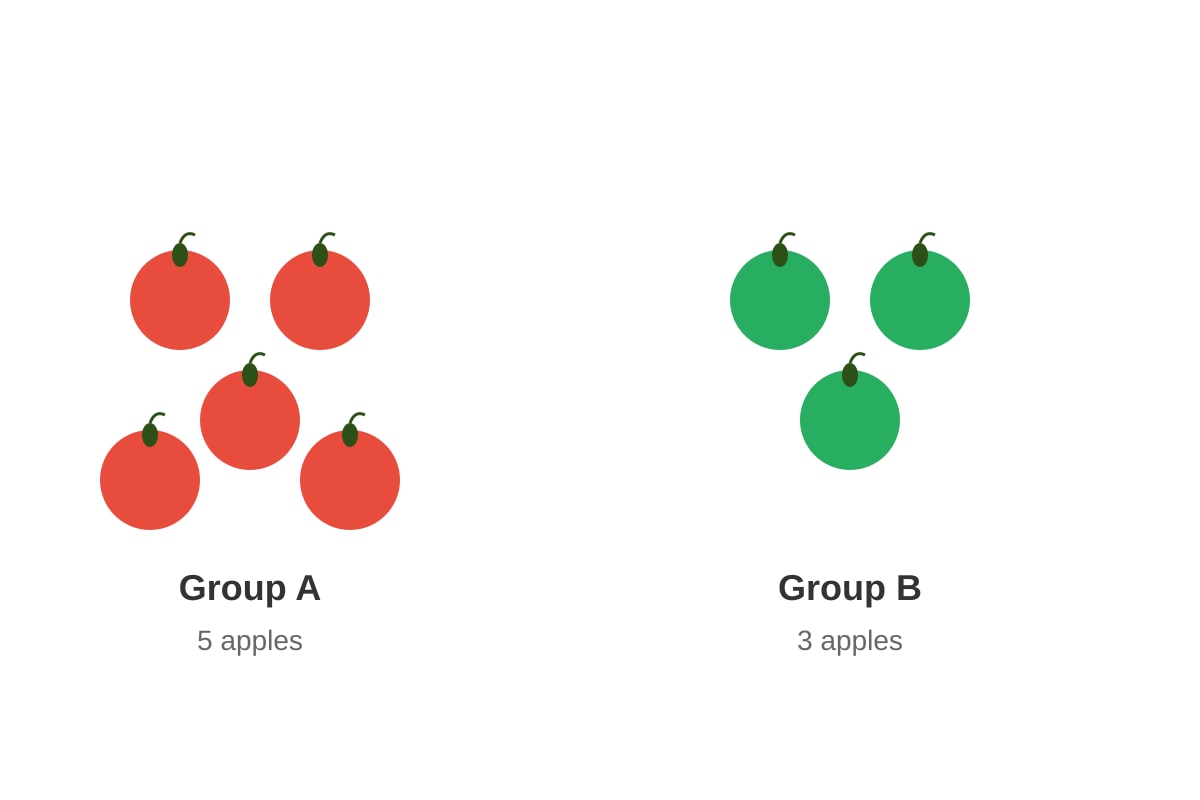
| 2 | 8 | 1 | First count the apples in Group A (left side): 1, 2, 3, 4, 5. Then count the apples in Group B (right side): 1, 2, 3. Add them together: 5 + 3 = 8. The word "altogether" tells us to combine both groups. Key idea: "Altogether" means addition—find the total of all objects. |
| 3 | Sixty-three | 1 | The number 63 has 6 in the tens place and 3 in the ones place. When writing in words: the tens part is "sixty" (6 tens = 60) and the ones part is "three." Combine them with a hyphen: "sixty-three." Numbers 21-99 (except exact tens like 30, 40) use hyphens. Common mistake: Writing "sixty three" without the hyphen. |
| 4 | 74 | 1 | "Seventy-four" means 7 tens and 4 ones. In numerals: 7 in the tens place, 4 in the ones place → 74. Break it down: seventy = 70, four = 4, so 70 + 4 = 74. |
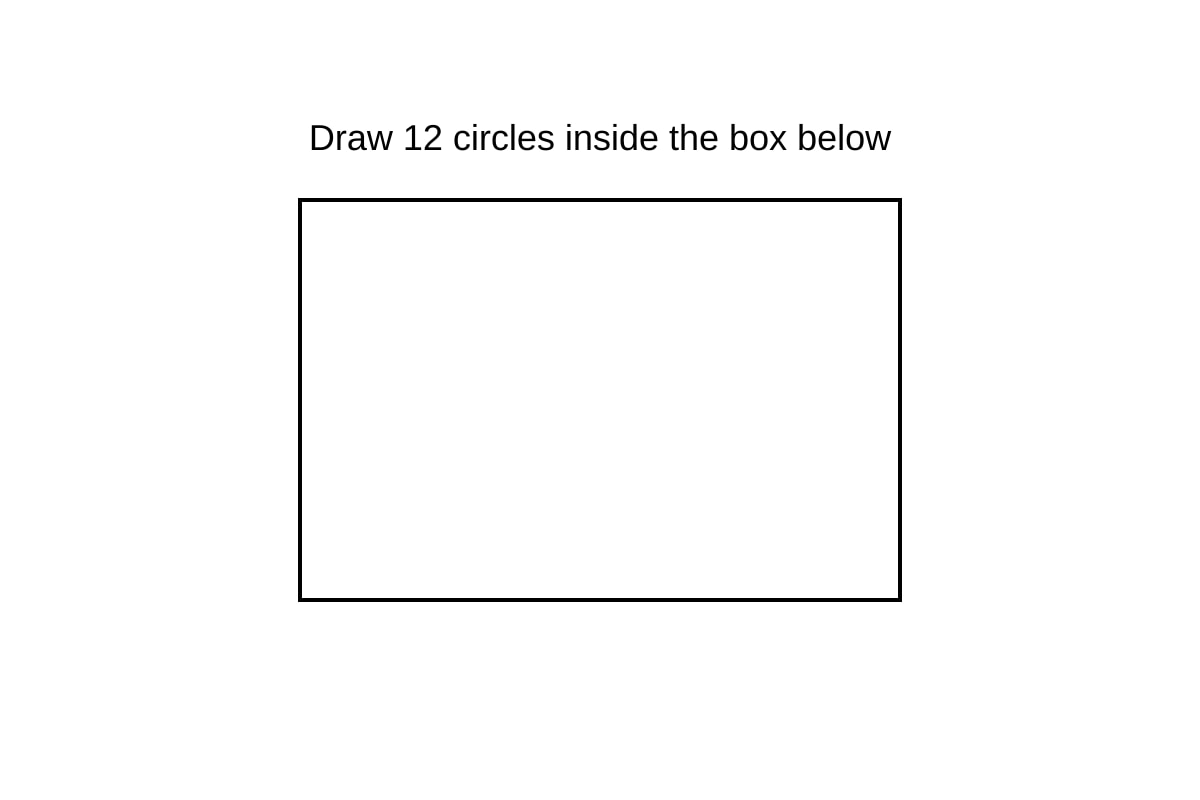
| 5 | 12 circles drawn | 1 | The student should draw 12 separate circles in the box. They can be arranged in any pattern (e.g., 2 rows of 6, 3 rows of 4, scattered). Award the mark if 12 clear, separate circles are visible. Teaching note: Encourage students to count as they draw and stop at 12. They may lightly pencil-mark 12 dots first, then draw circles around them. |
Section B: Place Value
| Question | Answer | Marks | Explanation |
|---|---|---|---|
| 6 | 5 | 1 | In 58, the digits are 5 and 8. Reading from left to right: the first digit is in the tens place, the second digit is in the ones place. So 5 is in the tens place, 8 is in the ones place. Key concept: In a two-digit number, the left digit always tells us how many tens; the right digit tells us how many ones. |
| 7 | 70 (or 7 tens) | 1 | The digit 7 in 76 is in the tens place. Its value is 7 × 10 = 70. Be careful: "digit" (just 7) is different from "value" (70). The question asks for value, so we need 70. Common mistake: Answering "7" instead of "70." Remember: value = digit × place value. |
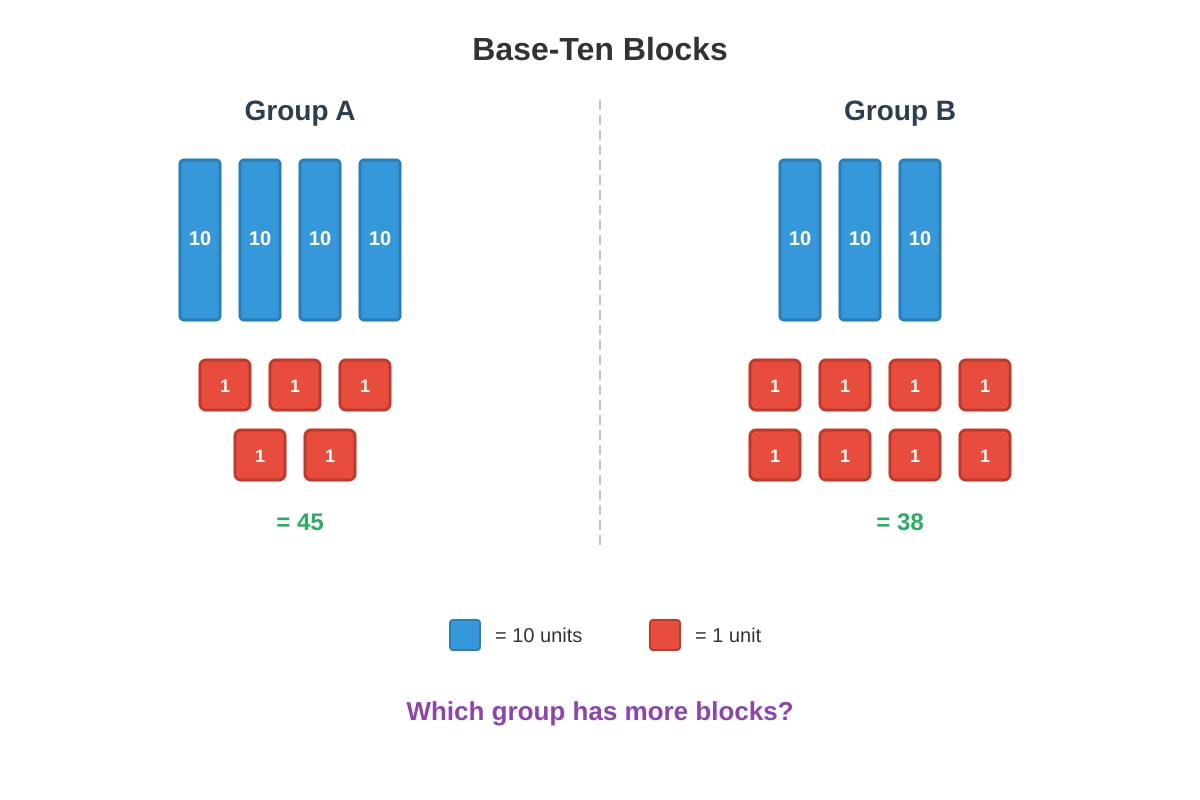
| 8 | 40 (or 4 tens) | 1 | The digit 4 in 45 is in the tens place. It stands for 4 × 10 = 40 (or 4 tens). This tests understanding that digits represent different amounts depending on their position. Teaching tip: Use base-ten blocks to show 4 rods of 10 and 5 single cubes—students see that the 4 actually represents 40. |
| 9 | 36 | 1 | 3 tens = 3 × 10 = 30. 6 ones = 6 × 1 = 6. Combine: 30 + 6 = 36. This is the reverse of breaking a number into tens and ones. |
| 10 | 28 | 1 | 2 in the tens place → 2 × 10 = 20. 8 in the ones place → 8 × 1 = 8. The number is 20 + 8 = 28. Read this as "twenty-eight." |
Section C: Comparing and Ordering Numbers
| Question | Answer | Marks | Explanation |
|---|---|---|---|
| 11 | 34 | 1 | Compare the tens digits first: 34 has 3 tens, 43 has 4 tens. Since 3 < 4, we know 34 < 43. Method: Always compare the tens place first. Only if tens are equal do we compare the ones. 34 is smaller. |
| 12 | 15, 28, 39 | 1 | Compare tens digits: 15 has 1 ten, 28 has 2 tens, 39 has 3 tens. Since 1 < 2 < 3, the order is 15, 28, 39. Teaching note: When ordering, students can first group by tens: teens (10-19), twenties (20-29), thirties (30-39), then sort within each group if needed. |
| 13 | Group A [✓] | 1 | Group A: 4 tens + 5 ones = 45. Group B: 3 tens + 8 ones = 38. Compare: 45 > 38 because 4 tens > 3 tens. Method with blocks: Students can count the rods (tens) first—Group A has more rods, so it must be larger. Even though Group B has more ones cubes, the tens rods matter more. |
| 14 | 24 | 1 | The pattern counts up by 1: 21, 22, 23, 24, 25, 26. The missing number is 23 + 1 = 24. Number pattern tip: Look at the gap between known numbers. Here, each number is 1 more than the previous. |
| 15 | 49 | 1 | "Just before" means the number that is 1 less than 50. 50 − 1 = 49. Counting backwards: 50, 49. Vocabulary note: "Before" when counting means a smaller number; "after" means a larger number. |
Section D: Ordinal Numbers and Number Patterns
| Question | Answer | Marks | Explanation |
|---|---|---|---|
| 16 | David | 1 | Counting positions from the left: 1st = Ali, 2nd = Ben, 3rd = Carol, 4th = David, 5th = Elise. The 4th position is David. Ordinal number tip: "th" endings (4th, 5th) tell us about position/place in a line, not how many objects. |
| 17 | 10, 12 | 1 | Pattern: counting up by 2s (even numbers). 8 + 2 = 10, 10 + 2 = 12. The sequence continues: 2, 4, 6, 8, 10, 12. Common mistake: Writing 9, 10 (adding 1 instead of 2). Check the gap: 4−2=2, 6−4=2, so the rule is +2. |
| 18 | 37 | 1 | More than 35, fewer than 40: possible numbers are 36, 37, 38, 39. The number ends with 7: only 37 ends in 7. Check: 35 < 37 < 40 ✓. Working method: List numbers from 36 to 39, then check which ends with 7. |
| 19 | 24 | 1 | Counting backwards by 2s: 30, 28, 26, 24, 22. The pattern subtracts 2 each time: 30−2=28, 28−2=26, 26−2=24, 24−2=22. Verification: 24 fits perfectly in the gap. |
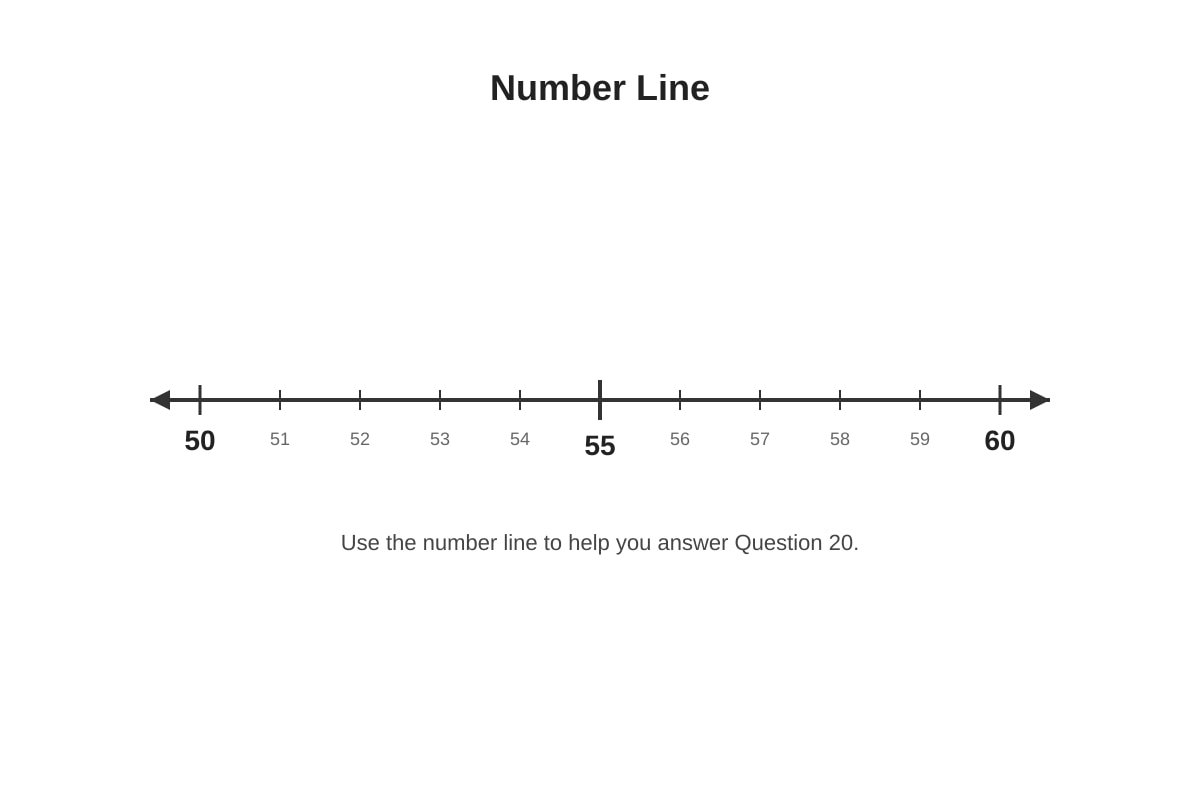
| 20 | 56 or 58 | 1 | Greater than 55 and smaller than 60: possible numbers are 56, 57, 58, 59. Even numbers end in 0, 2, 4, 6, 8. From our list, even numbers are 56 and 58. Either answer is correct. Concept connection: Even numbers are divisible by 2; on the number line, they appear every other number. Students may use the number line visual to locate 55-60 and identify even ticks. |
Total Marks: 20
Marking Summary
| Section | Questions | Marks |
|---|---|---|
| A: Counting and Number Recognition | 1–5 | 5 |
| B: Place Value | 6–10 | 5 |
| C: Comparing and Ordering Numbers | 11–15 | 5 |
| D: Ordinal Numbers and Number Patterns | 16–20 | 5 |
| Total | 1–20 | 20 |