AI Generated Quiz
Primary 1 Mathematics Multiplication Division Quiz
Free P1 Maths Multiplication Division quiz, AI version, with questions, answers, and syllabus-aligned practice for Singapore students.
These static practice materials are generated from the site's syllabus and paper-generation workflow, with source and model context shown so students and parents can evaluate the material before use.
Questions
Free quiz and exam paper access
Enter your details to view this paper
Your access is remembered on this device.
Answers
Answer Key: Primary 1 Mathematics Quiz - Multiplication Division
Total Marks: 20
Section A: Multiplication (Questions 1 – 10)
1. Draw 2 groups of 3 stars. How many stars are there altogether? Answer: 6 stars [1 mark] Explanation: 2 groups of 3 means 3 + 3 = 6. The student should draw two groups, each with 3 stars, and count all the stars to get 6. Marking note: Award 1 mark for correct answer. Accept any clear drawing showing 2 groups of 3.
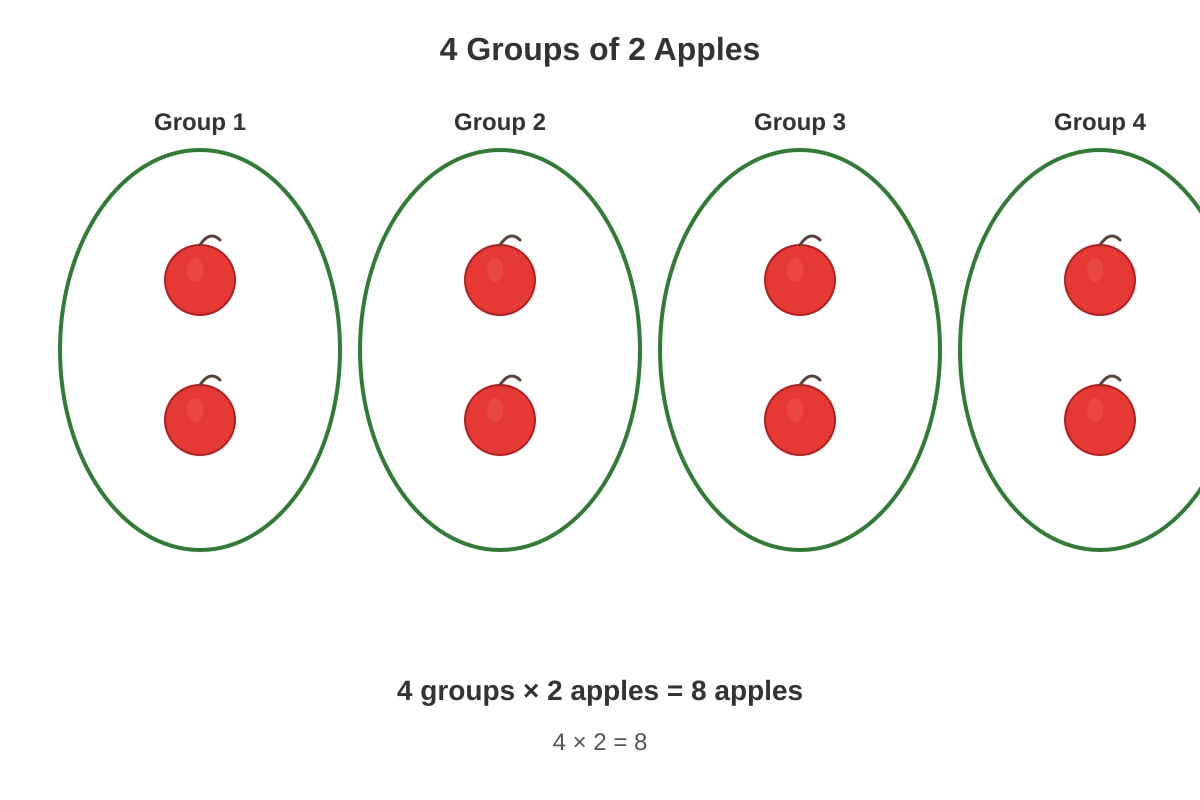
2. Write an addition sentence and a multiplication sentence for the picture. Addition: 2 + 2 + 2 + 2 = 8 [1 mark] Multiplication: 4 × 2 = 8 [1 mark] Explanation: There are 4 groups of 2 apples. Addition means adding the groups: 2 + 2 + 2 + 2 = 8. Multiplication means 4 groups of 2: 4 × 2 = 8. Marking note: Award 1 mark for each correct sentence. Accept 2 × 4 = 8 as equivalent.
3. There are 5 plates. Each plate has 4 biscuits. How many biscuits are there altogether? Answer: 20 biscuits [2 marks] Explanation: 5 plates × 4 biscuits per plate = 20 biscuits. This is repeated addition: 4 + 4 + 4 + 4 + 4 = 20. Marking note: Award 1 mark for correct method (e.g., showing 5 × 4 or repeated addition) and 1 mark for correct answer.
4. Fill in the blank: 3 × 5 = ________ Answer: 15 [1 mark] Explanation: 3 × 5 means 3 groups of 5, or 5 + 5 + 5 = 15. Marking note: Award 1 mark for correct answer.
5. What is 2 × 6? Answer: 12 [1 mark] Explanation: 2 × 6 means 2 groups of 6, or 6 + 6 = 12. Marking note: Award 1 mark for correct answer.
6. Draw 3 groups of 4 circles. Write the multiplication sentence. Multiplication sentence: 3 × 4 = 12 [2 marks] Explanation: 3 groups of 4 circles means 3 × 4 = 12. The student should draw three groups, each with 4 circles, and write the multiplication sentence. Marking note: Award 1 mark for correct drawing (3 groups of 4 circles) and 1 mark for correct multiplication sentence. Accept 4 × 3 = 12 as equivalent.
7. A box has 10 sweets. How many sweets are there in 2 boxes? Answer: 20 sweets [1 mark] Explanation: 2 boxes × 10 sweets per box = 20 sweets. This is 10 + 10 = 20. Marking note: Award 1 mark for correct answer.
8. 4 × 2 = ________ Answer: 8 [1 mark] Explanation: 4 × 2 means 4 groups of 2, or 2 + 2 + 2 + 2 = 8. Marking note: Award 1 mark for correct answer.
9. There are 3 bags. Each bag has 5 oranges. How many oranges are there in all? Answer: 15 oranges [2 marks] Explanation: 3 bags × 5 oranges per bag = 15 oranges. Repeated addition: 5 + 5 + 5 = 15. Marking note: Award 1 mark for correct method and 1 mark for correct answer.
10. Fill in the missing number: 2 × ________ = 8 Answer: 4 [1 mark] Explanation: 2 × ? = 8 means 2 groups of something equals 8. 2 × 4 = 8, so the missing number is 4. Marking note: Award 1 mark for correct answer.
Section B: Division (Questions 11 – 20)
11. Share 12 sweets equally among 4 children. How many sweets does each child get? Answer: 3 sweets [2 marks] Explanation: 12 sweets shared among 4 children means 12 ÷ 4 = 3. Each child gets 3 sweets. The student can draw 12 sweets and circle them into 4 groups of 3. Marking note: Award 1 mark for correct method (e.g., drawing or showing 12 ÷ 4) and 1 mark for correct answer.
12. 10 fish are put into 2 tanks. Each tank has the same number of fish. How many fish are in each tank? Answer: 5 fish [1 mark] Explanation: 10 fish shared equally into 2 tanks means 10 ÷ 2 = 5. Each tank has 5 fish. Marking note: Award 1 mark for correct answer.
13. 8 stickers are shared equally between 2 friends. How many stickers does each friend get? Answer: 4 stickers [1 mark] Explanation: 8 stickers shared between 2 friends means 8 ÷ 2 = 4. Each friend gets 4 stickers. Marking note: Award 1 mark for correct answer.
14. 15 marbles are put into groups of 5. How many groups are there? Answer: 3 groups [2 marks] Explanation: 15 marbles grouped into sets of 5 means 15 ÷ 5 = 3. There are 3 groups. The student can draw 15 marbles and circle groups of 5. Marking note: Award 1 mark for correct method and 1 mark for correct answer.
15. 6 ÷ 2 = ________ Answer: 3 [1 mark] Explanation: 6 divided into 2 equal groups means 6 ÷ 2 = 3. Each group has 3. Marking note: Award 1 mark for correct answer.
16. 9 apples are shared equally among 3 baskets. How many apples are in each basket? Answer: 3 apples [1 mark] Explanation: 9 apples shared among 3 baskets means 9 ÷ 3 = 3. Each basket has 3 apples. Marking note: Award 1 mark for correct answer.
17. 20 pencils are put into 4 boxes. Each box has the same number of pencils. How many pencils are in each box? Answer: 5 pencils [2 marks] Explanation: 20 pencils shared equally into 4 boxes means 20 ÷ 4 = 5. Each box has 5 pencils. Marking note: Award 1 mark for correct method and 1 mark for correct answer.
18. 14 ÷ 2 = ________ Answer: 7 [1 mark] Explanation: 14 divided into 2 equal groups means 14 ÷ 2 = 7. Each group has 7. Marking note: Award 1 mark for correct answer.
19. 8 children sit at 2 tables. Each table has the same number of children. How many children are at each table? Answer: 4 children [1 mark] Explanation: 8 children shared equally at 2 tables means 8 ÷ 2 = 4. Each table has 4 children. Marking note: Award 1 mark for correct answer.
20. 18 ÷ 3 = ________ Answer: 6 [1 mark] Explanation: 18 divided into 3 equal groups means 18 ÷ 3 = 6. Each group has 6. Marking note: Award 1 mark for correct answer.
Common Mistakes to Watch For:
- Confusing the order in multiplication (e.g., writing 4 × 2 as 2 × 4 is acceptable at P1, but ensure the student understands the meaning).
- In division, students may add instead of divide. Remind them that sharing means dividing into equal groups.
- For repeated addition, students may miscount. Encourage drawing or using counters.
- For missing number questions, students may guess. Teach them to think: "2 groups of what makes 8?"
Marking Summary:
- Questions 1, 2(a), 2(b), 4, 5, 7, 8, 10, 12, 13, 15, 16, 18, 19, 20: 1 mark each (15 marks)
- Questions 3, 6, 9, 11, 14, 17: 2 marks each (12 marks)
- Total: 27 marks, but quiz is scored out of 20. Scale proportionally or use the first 20 marks as the score.