AI Generated Quiz
Primary 1 Mathematics Money Quiz
Free P1 Maths Money quiz, Nemo3 AI version, with questions, answers, and syllabus-aligned practice for Singapore students.
These static practice materials are generated from the site's syllabus and paper-generation workflow, with source and model context shown so students and parents can evaluate the material before use.
Questions
Free quiz and exam paper access
Enter your details to view this paper
Your access is remembered on this device.
Answers
Primary 1 Mathematics Quiz - Money (Answer Key)
Total Marks: 30
Section A: Multiple Choice Questions (10 marks)
1. Which of the following coins has the smallest value? [1]
Answer: (4) 5-cent coin
Explanation: Singapore coins in circulation for Primary 1 are 5¢, 10¢, 20¢, 50¢, and $1. The 5-cent coin has the smallest value.
Common mistake: Some students may think the 10-cent coin is smaller because it is physically smaller than the 5-cent coin. Remind students that value is not determined by physical size.
2. How many 10-cent coins make $1? [1]
Answer: (2) 10
Explanation: $1 = 100¢. Each 10-cent coin is worth 10¢.
100¢ ÷ 10¢ = 10 coins.
Teaching note: This reinforces the conversion between dollars and cents (100¢ = $1) and skip counting by 10s.
3. Look at the coins below. What is the total amount? [1]
Answer: (3) 85¢
Explanation: Add the values of all coins shown:
50¢ + 20¢ + 10¢ + 5¢ = 85¢
Step-by-step:
50 + 20 = 70
70 + 10 = 80
80 + 5 = 85
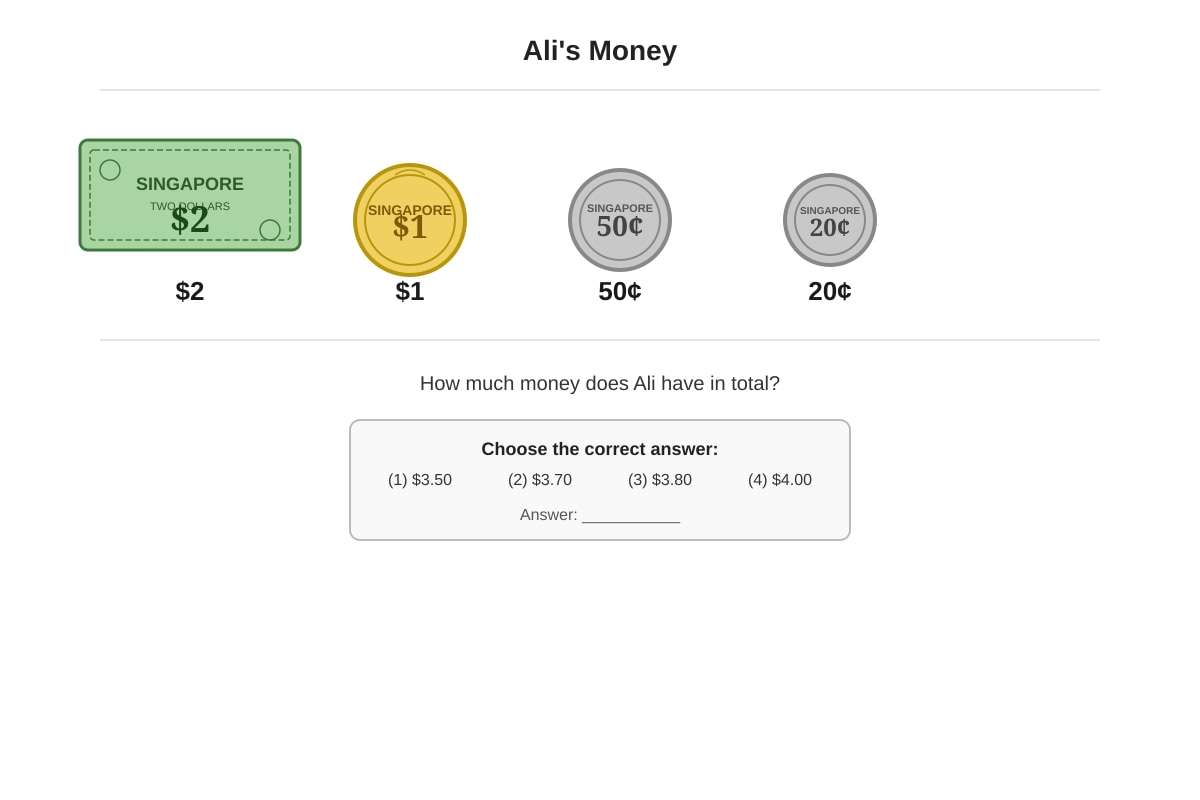
4. Ali has the following notes and coins. How much money does he have? [1]
Answer: (2) $3.70
Explanation: Add the values:
1 + 50¢ + 20¢ = 3.70
Step-by-step:
1 = 3 + 70¢ = $3.70
5. Which set of coins shows 65¢? [1]
Answer: (1) 50¢, 10¢, 5¢
Explanation: Check each option:
(1) 50 + 10 + 5 = 65¢ ✓
(2) 50 + 20 = 70¢ ✗
(3) 20 + 20 + 20 + 5 = 65¢ but uses 4 coins (not fewest) ✗
(4) 50 + 10 + 10 = 70¢ ✗
Teaching note: Option (1) uses the fewest coins (3 coins) to make 65¢, which is the standard way to represent an amount.
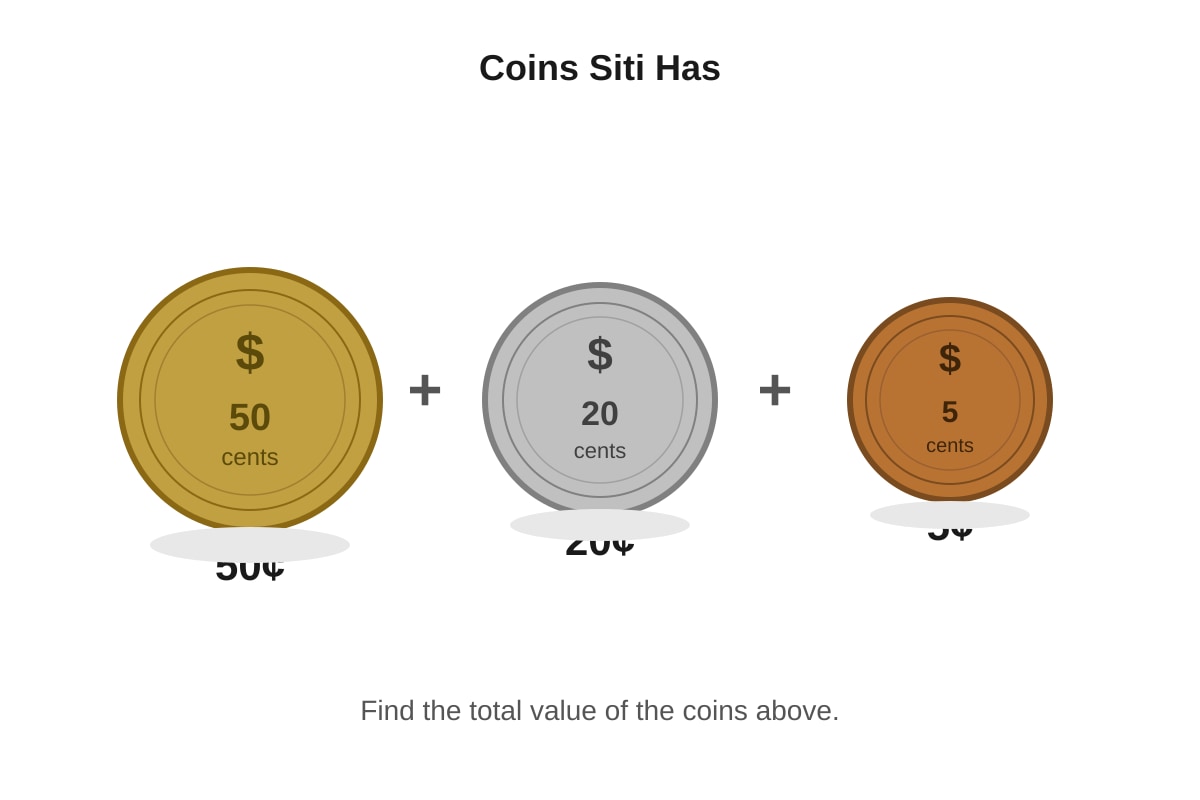
6. Siti wants to buy a pencil that costs 80¢. She has the coins shown below. How much more money does she need? [1]
Answer: (1) 5¢
Explanation: Siti has: 50¢ + 20¢ + 5¢ = 75¢
Pencil costs: 80¢
Amount needed: 80¢ - 75¢ = 5¢
7. John has $2. He buys an eraser for 60¢. How much change does he get? [1]
Answer: (3) $1.40
Explanation: 1.40
Alternative method:
0.60 = $1.40
8. Which of the following is the same as $1.50? [1]
Answer: (1) 150¢
Explanation: 1.50 = 100¢ + 50¢ = 150¢
Common mistake: Students may choose (3) 105¢ by incorrectly placing the decimal. Emphasise that $1.50 means 1 dollar and 50 cents, not 1 dollar and 5 cents.
9. Mary has three 20-cent coins and two 10-cent coins. How much money does she have? [1]
Answer: (3) 80¢
Explanation:
3 × 20¢ = 60¢
2 × 10¢ = 20¢
Total = 60¢ + 20¢ = 80¢
10. The price of a toy car is $4.50. Which of the following shows the correct amount using notes and coins? [1]
Answer: (2) One 1 coins, and one 50-cent coin
Explanation: Check each option:
(1) 2 + 50¢ = 2 notes, not standard)
(2) 1 + 4.50 ✓
(3) 1 + 1 + 50¢ = 1 coins)
(4) 1 + 50¢ + 50¢ = $4.00 ✗
Note: Options (1), (2), and (3) all make 2 notes and $1 coins are commonly used.
Section B: Short Answer Questions (10 marks)
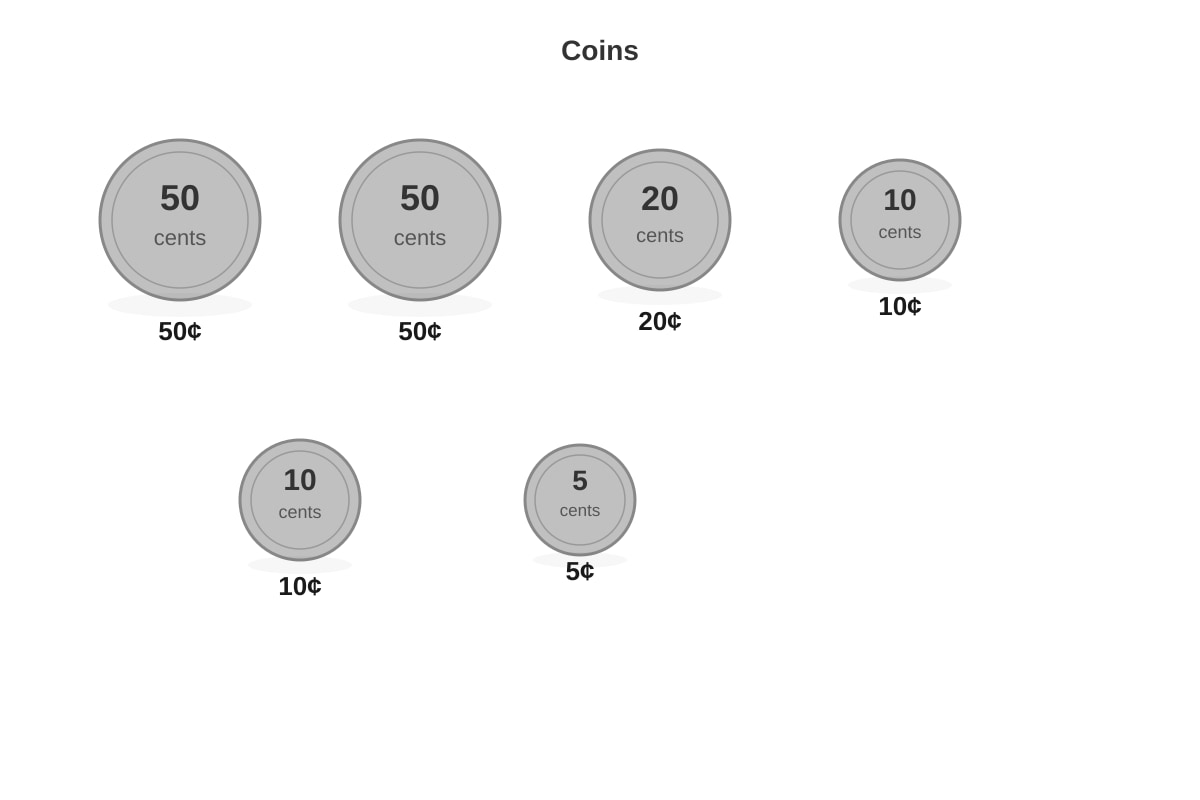
11. Count the money shown below and write the total amount. [2]
Answer: $1.45 or 145¢
Marking:
- Correct total: 1 mark
- Correct unit ($ or ¢): 1 mark
Working:
50¢ + 50¢ = 100¢ = 1 + 40¢ + 5¢ = $1.45
12. Fill in the blanks with the correct amount. [2]
(a) 3.50 = 350¢ [1]
Explanation:
(a) 1 dollar = 100 cents (basic conversion)
(b) 3.50 = 300¢ + 50¢ = 350¢
Common mistake: For (b), students may write 35¢ or 305¢. Remind them that $3.50 = 3 dollars and 50 cents = 300¢ + 50¢.
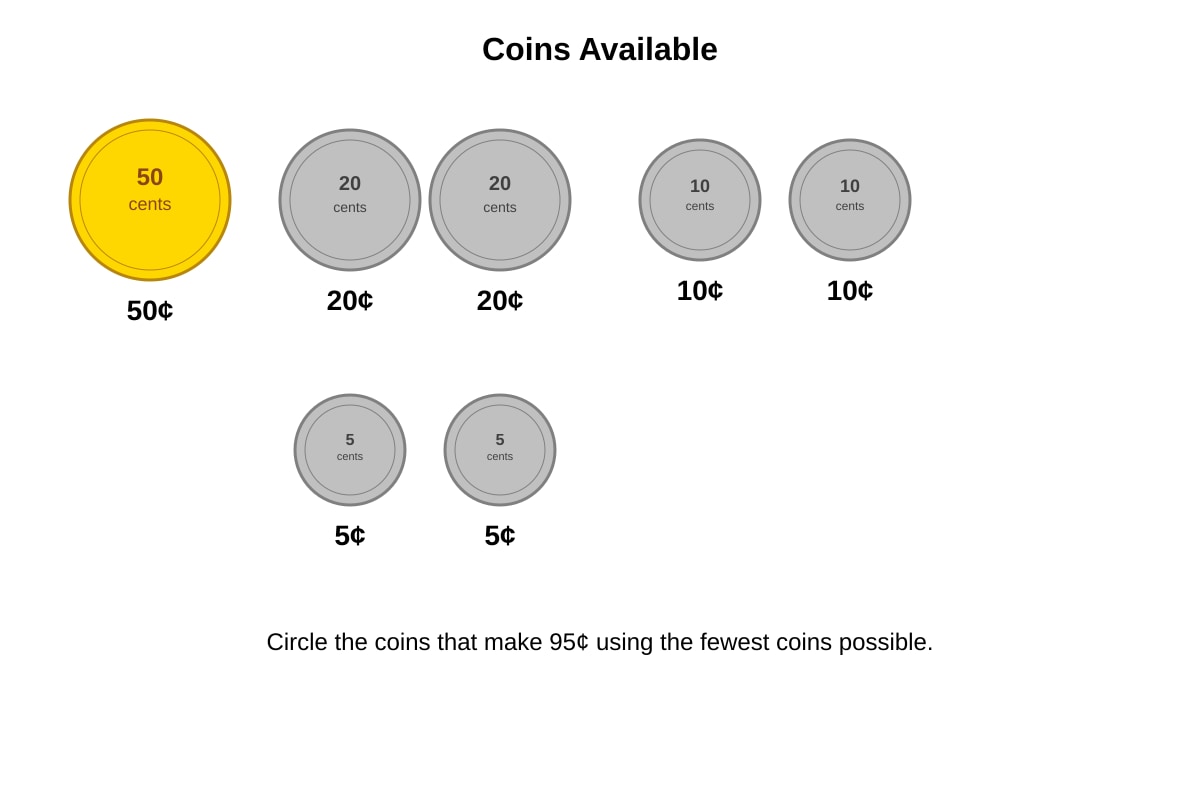
13. Circle the coins that make 95¢. Use the fewest number of coins possible. [2]
Answer: Circle the 50¢ coin, two 20¢ coins, and one 5¢ coin. (4 coins total)
Marking:
- Correct coins circled: 1 mark
- Fewest coins used (4 coins): 1 mark
Working:
Start with the largest coin: 50¢
Remaining: 95¢ - 50¢ = 45¢
Next largest: 20¢ (use two) → 45¢ - 40¢ = 5¢
Last: 5¢
Total coins: 1 + 2 + 1 = 4 coins
Alternative using more coins (not fewest): 50¢ + 20¢ + 10¢ + 10¢ + 5¢ = 5 coins
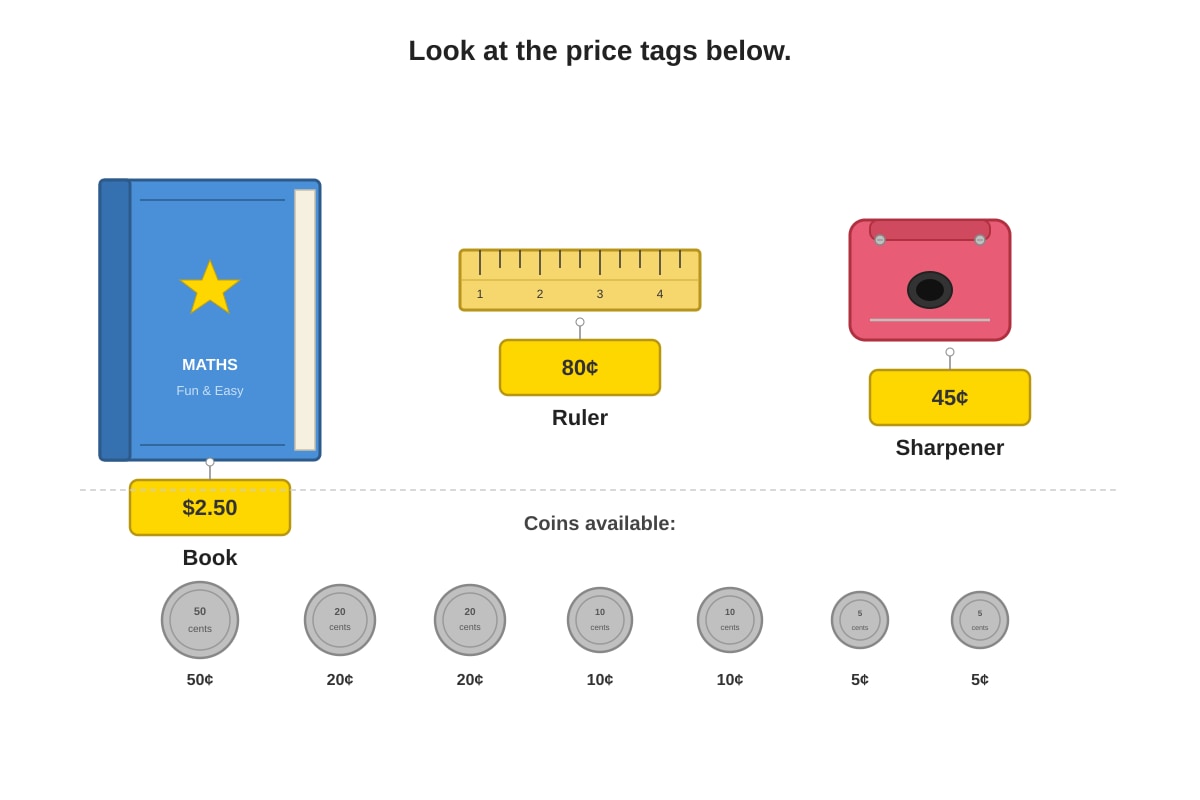
14. Look at the price tags below. [2]
(a) Which item costs the most? Book [1]
(b) How much more does the book cost than the ruler? $1.70 [1]
Working for (b):
Book = 1.70
Alternative: 0.80 = $1.70
15. Ahmad has 1.20 and a bun for 80¢. How much money does he have left? [2]
**Answer: 3)
Marking:
- Correct total spent: 1 mark
- Correct change: 1 mark
Working:
Drink = 0.80
Total spent = 0.80 = 5.00 - 3.00
Section C: Word Problems (10 marks)
16. Lily has two 5. Does she have enough money? If yes, how much will she have left? If no, how much more does she need? [2]
Answer: Yes, she has enough. She will have $0.50 (50¢) left.
Marking:
- Correct total money Lily has: 1 mark
- Correct comparison and final answer: 1 mark
Working:
Two 4.00
Three 50-cent coins = 3 × 50¢ = 150¢ = 4.00 + 5.50
Storybook = 5.50 - 0.50 left
17. A packet of stickers costs 65¢. Tom buys 2 packets. He gives the cashier $2. How much change does he get? [2]
Answer: 70¢
Marking:
- Correct total cost: 1 mark
- Correct change: 1 mark
Working:
Cost of 1 packet = 65¢
Cost of 2 packets = 65¢ × 2 = 130¢ = 2.00 = 200¢
Change = 200¢ - 130¢ = 70¢
18. Mrs Tan has 2.50. How much money does she have left? [2]
Answer: $5.70
Marking:
- Correct cost of apples: 1 mark
- Correct total spent and change: 1 mark
Working:
3 apples = 3 × 60¢ = 180¢ = 2.50
Total spent = 2.50 = 10.00 - 5.70
19. Peter has four 20-cent coins and three 10-cent coins. Jane has two 50-cent coins. Who has more money? How much more? [2]
Answer: Peter has more money. He has 10¢ more than Jane.
Marking:
- Correct amount for each person: 1 mark
- Correct comparison and difference: 1 mark
Working:
Peter: 4 × 20¢ = 80¢; 3 × 10¢ = 30¢; Total = 110¢ = 1.00
Peter has more.
Difference = 110¢ - 100¢ = 10¢
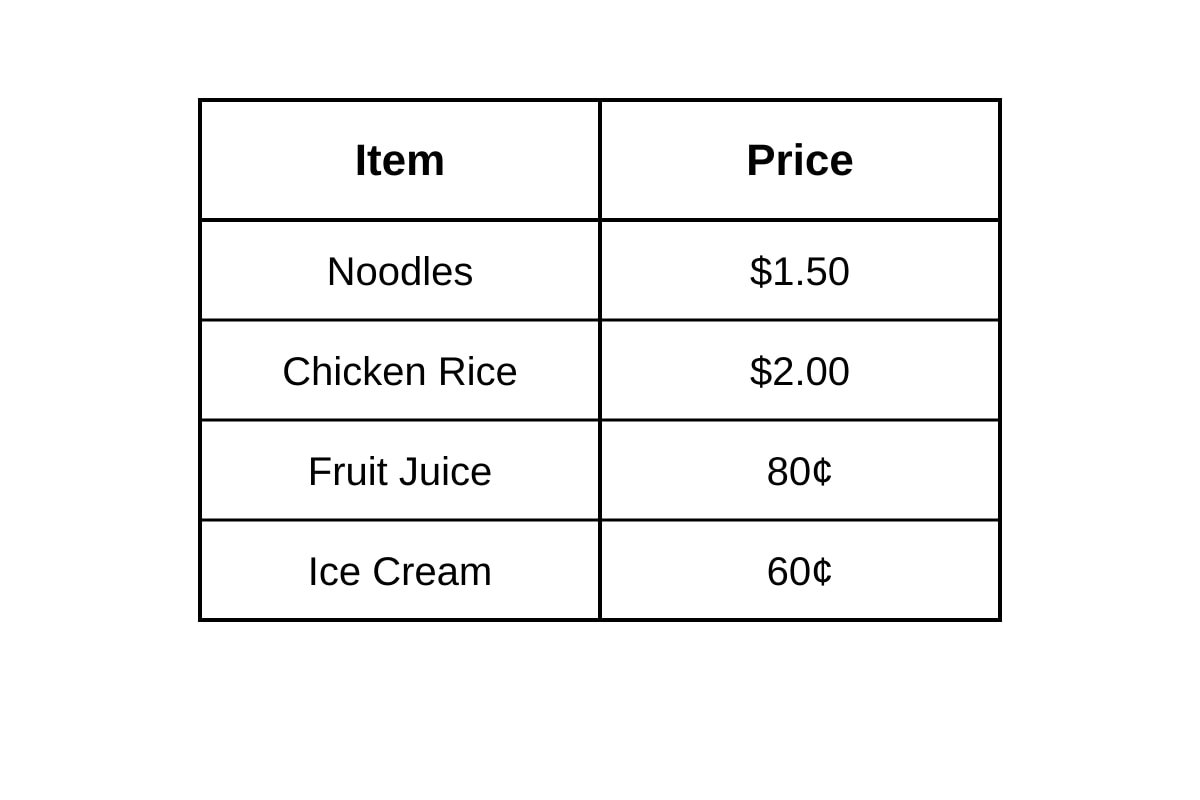
20. The canteen sells the following items: [2]
Answer: $0.70 (or 70¢)
Marking:
- Correct total cost: 1 mark
- Correct change: 1 mark
Working:
Noodles = 0.60
Total spent = 0.60 = 3.00
Money left = 2.10 = $0.90
Wait, let me recalculate:
2.10 = $0.90 (90¢)
Correction: Answer should be $0.90 (90¢)
Working (corrected):
Noodles = 0.60
Total = 0.60 = 3.00 - 0.90
Final Answer: $0.90 (or 90¢)
End of Answer Key
Note to Teachers/Parents:
This quiz covers the Primary 1 Money syllabus including:
- Recognising coins and notes
- Counting money in cents up to 100
- Converting between dollars and cents
- Adding and subtracting money
- Solving word problems involving money
- Making change
Encourage students to use play money or draw coins to visualise the problems if needed.